

False albacore tuna have a reputation problem, Are False Albacore Good to Eat? false albacore can be good to eat, but only when they are killed, bled, and iced immediately. Handle them like tuna, remove the dark bloodline, and cook them fresh; otherwise they get oily, soft, and strongly fishy.
Scroll through any fishing forum and you’ll find the same lines repeated: “Trash fish.” “Cat food.” “Cook it on a plank and eat the plank.”
But here’s what those threads don’t tell you: the same fish that gets mocked in New England is sold in Mediterranean fish markets. It’s served as sashimi in Hawaii. It’s canned in olive oil in Italy and Spain.
The difference isn’t the fish. It’s the handling.
If you’ve ever wondered whether false tuna are actually good to eat, this guide gives you the straight answer. No hype. No old wives’ tales. Just what happens when you treat an albie like the tuna it almost is.
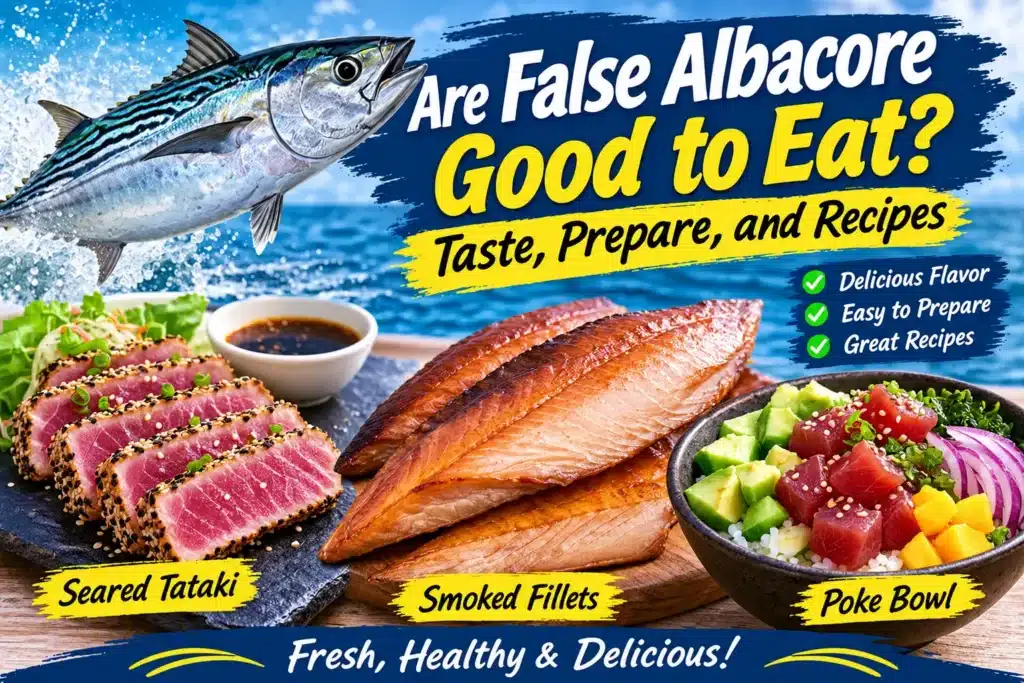
What Is a False Albacore?
False albacore (Euthynnus alletteratus) are not real albacore. They’re not even in the same genus. Real albacore (Thunnus alalunga) is a true tuna with long pectoral fins and white meat. False albacore are more closely related to mackerels.
They go by many names:
- Little tunny (the official IGFA name)
- Albie (Northeast slang)
- Bonita (Southern U.S.)
- Fat Albert
- Kawakawa (Hawaii)
False albies are built like tiny torpedoes. Wavy stripes on the back. Spots below the pectoral fin. No teeth to speak of. They’re found in the Atlantic, Gulf of Mexico, Caribbean, and Mediterranean.
They’re prized for one thing above all: speed. A false tuna can hit 40 miles per hour and strip line off a reel like a bonefish on caffeine.
That speed is exactly why most anglers release them. The fight is the point. The meat is an afterthought.
But should it be?
Can You Eat False Albacore?
Yes. Absolutely, The idea that false albacore are inedible is a cultural preference, not a biological fact. Millions of people around the world of false albacore eating regularly.
Here’s the catch: false albacore spoil fast. Very fast.
Their meat is packed with oil and blood. When a fish dies and isn’t bled immediately, that blood breaks down inside the muscle. The result is a strong, metallic, “fishy” taste that most American palates find offensive.
But when a Little tunny is killed quickly, bled thoroughly, and iced immediately? The meat turns pink, firm, and mild. On The Water’s test found it “looked every bit as delicious as sushi-grade tuna”.
The takeaway: false albacore isn’t a bad-eating fish. It’s a poorly-handled fish that gets judged on its worst preparation.
Albacore vs False Albacore: What’s the Difference?
This trips up a lot of people.
| Feature | True Albacore | False Albacore |
|---|---|---|
| Scientific name | Thunnus alalunga | Euthynnus alletteratus |
| Family relation | True tuna | Closer to mackerel |
| Pectoral fins | Very long | Short |
| Meat color | White to light pink | Dark red to brown |
| Fat content | Moderate | High |
| Common use | Canned “white tuna” | Bait, sport fishing, regional food |
| Taste | Mild, clean | Strong, gamey if mishandled |
True albacore is the stuff in your tuna salad. False albacore is the fish that smoked your drag and left you breathless on the beach.
They share a name. They don’t share a dinner plate.
Atlantic Bonito vs False Albacore: Same Family, Different Fork
This is the comparison that matters most for anglers in the Northeast and Mid-Atlantic.
Atlantic bonito (Sarda sarda) and false tuna look similar from a distance. Both have stripes. Both fight hard. Both show up in the fall.
But they eat very differently.
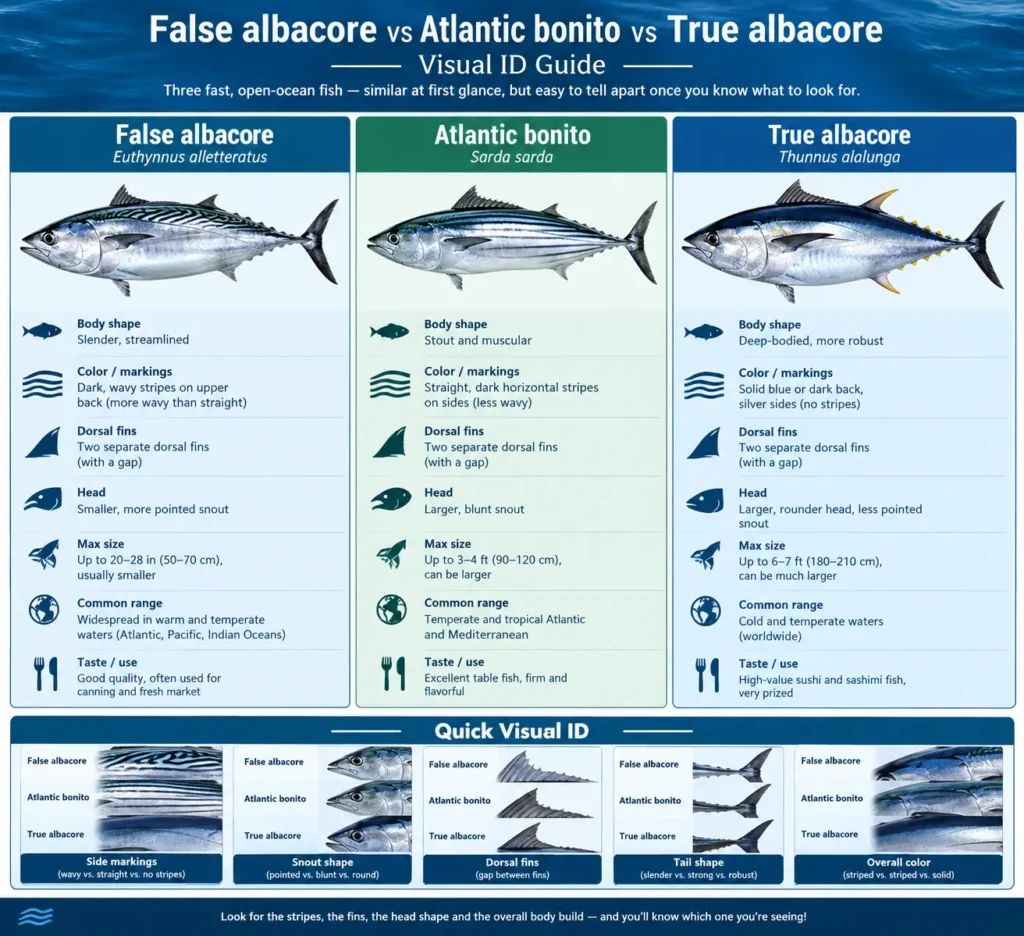
Bonito are generally considered better eating. The meat is lighter, the bloodline is thinner, and the flavor is closer to skipjack or yellowfin.
False albacore are more polarizing. Some people love them. Some won’t touch them. But almost everyone agrees: if you’re going to eat one, you have to handle it right.
Are False Albacore Good to Eat? The Honest Answer
Here’s the truth in plain language:
They’re good if you do three things right. Miss any one of them, and you’ll understand why people call them trash.
1. Kill and bleed immediately.
A false albacore that flops on the deck for five minutes is already losing quality. The stress builds acid in the muscle. The blood starts breaking down. You need to spike the brain and cut the gills within seconds of landing it.
2. Ice it fast.
Not “put it in the cooler eventually.” Not “wait until you get back to the dock.” Immediately. A saltwater ice slurry is ideal. Plain ice works if that’s what you have. The goal is to drop the core temperature as fast as possible to stop the oils from turning rancid.
3. Trim every trace of dark meat.
The bloodline runs along the spine. It’s dark red, sometimes brown, and it tastes like exactly what it is: congealed blood and oil. Cut it out. All of it. What’s left is pink, firm, and surprisingly mild.
Do those three things, and false albie tastes like a leaner, slightly stronger version of skipjack tuna. It’s not bluefin. It’s not yellowfin. But it’s good.
Skip them, and you’ll be the next person on a forum writing “worst fish I’ve ever tasted.”
False Albacore Taste: What to Actually Expect
Let’s be specific.
Raw (sashimi): Clean, sweet, no off-putting flavor. Outdoor Life’s testers were “all shocked” at how good it was, comparing it to skipjack and blackfin tuna.
Seared (tataki style): The outside chars, the inside stays rare. The flavor intensifies but stays pleasant. This is the Japanese preparation for katsuo, a close relative.
Grilled: Marinade is your friend. Soy, ginger, garlic, and oil help balance the richness. Cook it hot and fast. Leave the middle pink. Overcooking turns it rubbery and fishy.
Smoked: This is the gateway preparation. Smoking masks the oiliness and concentrates the flavor into something savory and rich. Even people who dislike grilled albie often love it smoked.
Canned: Boil the fillets in salted water with bay leaf and rosemary. Pack in olive oil. This is how Italy and Spain handle little tunny.
The taste is not “fishy” in the way a mackerel is fishy. It’s rich. It’s oily. It’s tuna-adjacent. If you like bluefish or Spanish mackerel, you’ll probably like false albies.
If you only eat tilapia and cod? Maybe not.
The Scombroid Risk: Why Icing Isn’t Optional
This is the part nobody talks about.
False albacore are in the Scombridae family. That means their flesh is high in histidine, an amino acid. When the fish isn’t iced quickly, bacteria convert histidine into histamine. Histamine doesn’t cook off. It doesn’t freeze off. It’s heat-stable.
Eating a poorly-handled false tuna fish can cause scombroid poisoning. Symptoms hit within minutes to hours:
- Flushing
- Headache
- Dizziness
- Nausea
- Heart palpitations
It’s rarely fatal, but it’s miserable.
The fix is simple: ice the fish immediately. Keep it cold. If the meat smells sharp, metallic, or ammonia-like, throw it out. Don’t taste-test it. Don’t cook it “to be safe.” Histamine doesn’t care about your grill.
This isn’t meant to scare you off false tuna. It’s meant to explain why the bleeding-and-icing advice isn’t just about taste. It’s about eating yellowfin tuna safely.
False Albacore Nutrition: Better Than Its Reputation
One persistent myth is that false albacore have “limited nutritional value”.
That’s wrong.
Little tunny are high in protein and rich in omega-3 fatty acids. Their oil content, which makes them tricky to cook, is the same oil that makes them nutritious. They’re a lean protein source with a fatty acid profile similar to other scombrids.
Mercury levels are a legitimate consideration for any predatory fish, but false albacore are small and short-lived compared to bluefin or swordfish. They don’t accumulate mercury the way apex predators do.
If you’re worried about contaminants, follow the same guidelines you would for any tuna: moderate consumption, especially for pregnant women and children.
But don’t skip false tuna because you think it’s nutritionally empty. It’s not.
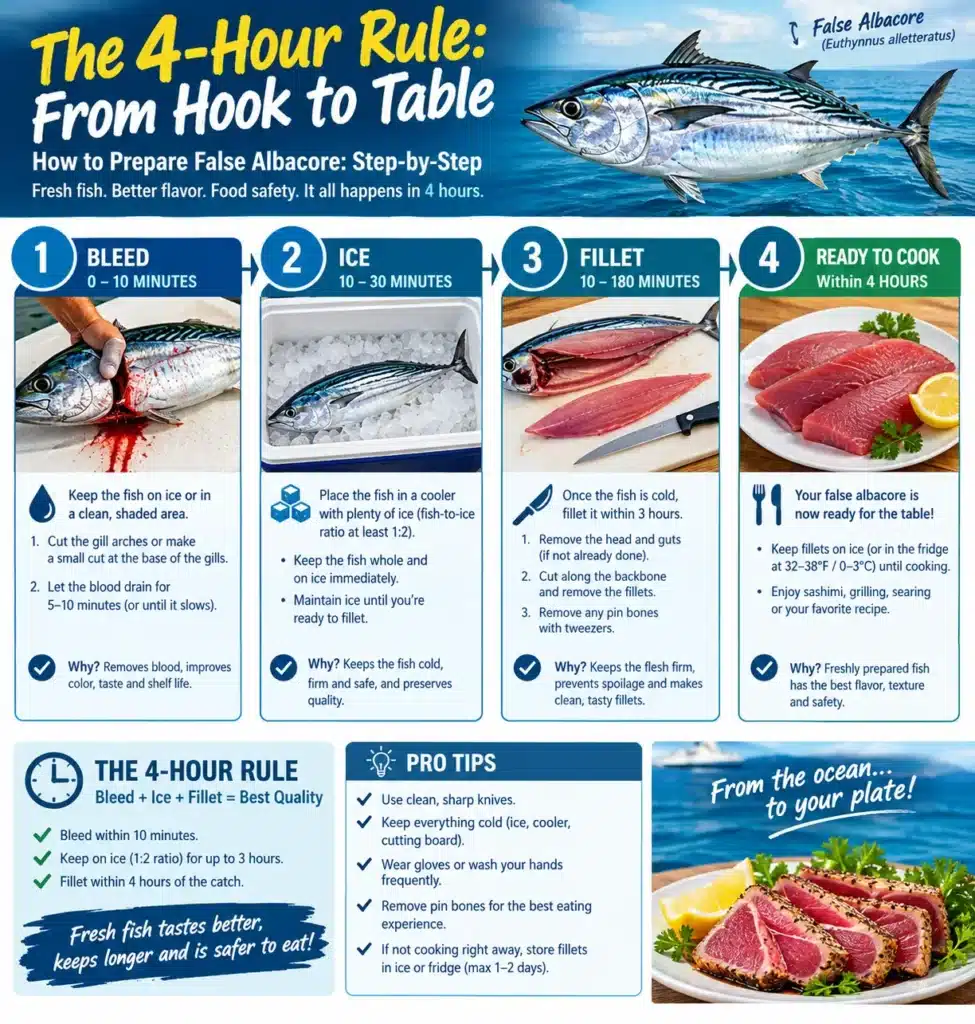
How to Prepare False Albacore: Step-by-Step
Here’s the protocol that separates “delicious false albacore tuna recipes” from “disgusting.”
Step 1: Dispatch Immediately
Use a fish bat or brain spike. One firm blow to the head. The goal is instant death, not stunning.
Step 2: Bleed Thoroughly
Cut the gill arches on both sides. Make a shallow cut at the base of the tail. Place the fish head-down in a bucket of saltwater. Let it bleed for 5–10 minutes.
Step 3: Ice Immediately
Transfer to an ice slurry. Saltwater and ice is ideal. The salt drops the freezing point and chills the fish faster. If you don’t have salt, use plain ice. Don’t let the fish sit in fresh water—it’ll dilute the flavor.
Step 4: Fillet Into Four Loins
False albies are shaped like mini tunas. Cut two fillets off each side, then separate the top loin from the bottom loin. You’ll end up with four clean pieces per fish.
Step 5: Trim the Bloodline
Lay each loin flat. You’ll see a dark red or brown strip running down the center. Cut it out. Cut out any gray or brown patches. What’s left should be uniform pink.
Step 6: Skin and Portion
Remove the skin. Cut into sashimi slices, grilling steaks, or cubes for poke.
3 False Albacore Recipes That Actually Work
False Albacore Tuna Recipe 1: Simple Grilled Albie with Soy-Ginger Marinade
Ingredients:
- 1 lb Little tunny loins, bloodline removed
- 1/4 cup soy sauce
- 1/4 cup rice vinegar
- 1 tbsp grated fresh ginger
- 2 cloves garlic, minced
- 1 tbsp sesame oil
Instructions:
- Whisk marinade ingredients. Add fish. Marinate 1 hour in the fridge.
- Heat grill to high.
- Grill 2–3 minutes per side. Leave the center pink.
- Rest 2 minutes. Slice against the grain.
Recipe 2: Smoked False Albacore
Ingredients:
- 2 lbs false albacore fillets, skin on
- 1 quart water
- 1/2 cup kosher salt
- 1/4 cup brown sugar
- 2 bay leaves
Instructions:
- Dissolve salt and sugar in water. Add bay leaves. Brine fish 2–4 hours in the fridge.
- Remove from brine. Pat dry. Let sit 1 hour to form a pellicle (tacky surface).
- Smoke at 180–200°F for 2–3 hours until firm and mahogany-colored.
- Cool. Flake into fish salad or eat straight.
Recipe 3: False Albacore Poke
Ingredients:
- 1 lb false albacore, cubed, bloodline removed
- 3 tbsp soy sauce
- 1 tbsp sesame oil
- 1 tsp rice vinegar
- 1 tsp sriracha
- 2 scallions, sliced
- 1 tsp toasted sesame seeds
Instructions:
- Combine soy, sesame oil, vinegar, and sriracha.
- Toss with cubed fish. Marinate 15 minutes.
- Serve over rice with scallions and sesame seeds.
When NOT to Eat False Albacore
Not every albie is a candidate for the table.
Skip it if:
- The fish sat on deck for more than 10 minutes without bleeding
- It wasn’t iced within 30 minutes
- The meat smells sharp, metallic, or ammoniated
- The meat is brown or gray throughout, not just along the bloodline
- You caught it in warm tropical water during a known ciguatera zone
If any of those apply, release the fish (if it’s alive) or use it for bait. Sharks and marlin love albie strips.
FAQs
Q: Are false albacore good to eat?
Yes, if bled, iced, and trimmed properly. The meat is pink, firm, and mild—similar to skipjack tuna. Poor handling makes it strong and fishy.
Q: What does false albacore taste like?
Properly handled false albies taste clean and slightly sweet when raw, with a richer, oilier flavor when cooked. It’s often compared to skipjack or blackfin tuna.
Q: Are little tunny good to eat?
Little tunny (false tuna) are good eating when handled correctly. They’re sold in Mediterranean markets, served as sashimi in Hawaii, and canned in Italy and Spain.
Q: Are false albacore good eating compared to bonito?
False albacore vs bonito Taste: Atlantic bonito have lighter, milder meat and a thinner bloodline, making them easier to prepare. The little tunny are stronger-tasting but still good if bled and trimmed properly.
Q: Can you eat false albacore raw?
Yes, if the fish was brain-spiked, bled, and iced immediately. The raw meat is clean and sweet. If handling was delayed, cook it instead.
Q: Why do people say false albacore are inedible?
Because poorly handled false tuna tastes terrible. The oils and blood break down fast, creating a strong, gamey flavor. Most people who call them inedible have never tried a properly handled one.
Q: Is false albacore safe to eat?
Yes, with proper handling. Ice immediately to prevent scombroid poisoning. Avoid eating large fish from tropical waters where ciguatera is a concern.
Q: What’s the best way to cook false albacore?
Smoking is the most forgiving method. Grilling with a marinade works well if you don’t overcook it. Sashimi and poke are excellent if the fish was handled perfectly.
Q: Does false albacore have mercury?
False albacore are smaller and shorter-lived than large tunas, so mercury accumulation is lower. Follow general seafood guidelines for frequency of consumption.
Q: Can you can false albacore?
Yes. Boil fillets in salted water with herbs, then pack in olive oil. This is a traditional Mediterranean preparation.
Conclusion
False albacore don’t deserve their bad reputation. They earn it only when they’re mishandled. Bleed one fast. Ice it right away. Trim every bit of dark bloodline. Do that, and eating false albacore becomes a completely different experience. The meat turns pink and firm. The false albie taste is clean, rich, and surprisingly close to skipjack tuna. It’s not bluefin. It’s not yellowfin. But it’s good. Smoke it, grill it hot and fast, or slice it raw if the fish was handled perfectly. Miss those steps, and you’ll taste why people call them trash.
Nail them, and you’ll understand why Mediterranean fishermen sell them, Hawaiian anglers eat them, and smart captains keep one for the table. So next time an albie hits the deck, don’t release it on autopilot. Bleed it, ice it, and decide for yourself. Give it a fair shot. The fish may surprise you.ounterparts and has a milder flavor which some people find appealing. While there is no definitive reply to whether false Albacore tastes good or not, they can certainly be eaten if you’re looking for something different from your average piece of fish.
You might also love:
- Can You Eat Bonita Fish? (Catch, Clean & Cook) Giant Bonito
- Does Tuna Fish Have Scales And Fins (Reveal The Truth!)
- How Long Is Tuna Fishing Season! (Complete Guide & Dates)
- 23+ Vital Things Every Snook Angler Should Know (Snook Fishing Tips)
- Tuna Fishing Tackle Recommendation & Techniques (Explained)
- How Much To Tip Fishing Charter Crew? (Here’s What To Do!)