
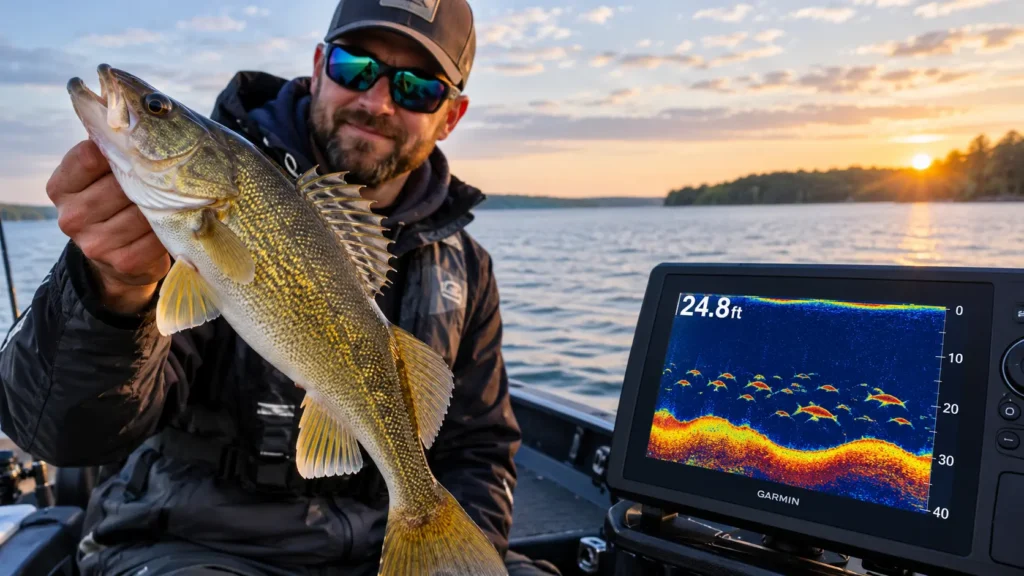
How deep do walleye go in the summer? Most walleye hold in 15–30 feet during summer, but the right depth depends on water temperature, oxygen, lake clarity, and baitfish. In hot weather, they often slide deeper or suspend near the thermocline; in stained or cooler lakes, they may stay much shallower.
This guide gives you a practical depth range, a temperature-based chart, and simple ways to find summer walleye on points, humps, weedlines, and drop-offs.
How Deep Do Walleye Go in the Summer?
Start your search at 15–30 feet on a typical inland lake. That range catches many early- and mid-summer walleye, especially around the first major break, deep weed edges, rock transitions, and the sides of main-lake points.
Do not treat these depth as a rule. Walleye follow comfort, food, and oxygen—not a number on a depth finder. Some fish stay in 6–12 feet all summer in shallow, stained lakes; others suspend 20–40 feet down over 50–80-foot basins in large, clear lakes.
Typical Summer Walleye Depths in Feet
| Summer period | Common depth range | Best places to check first |
|---|---|---|
| Early summer | 10–20 feet | First breaks, shallow-to-mid weedlines, points near spawning bays |
| Midsummer | 15–30 feet | Deep weed edges, rock humps, main-lake points, thermocline intersections |
| Late summer | 20–40 feet, sometimes deeper | Deep humps, basin edges, channel bends, offshore structure |
| Hot, clear lakes | 25–50+ feet | Deep rock, thermocline edges, suspended baitfish schools |
| Shallow, stained lakes | 6–15 feet | Weed flats, shallow rock, wind-blown shorelines |
These ranges are starting points, not guarantees. Research on summer walleye movement shows fish commonly move deeper as summer progresses, often tracking the deepening thermocline while staying in water near their preferred temperature range.
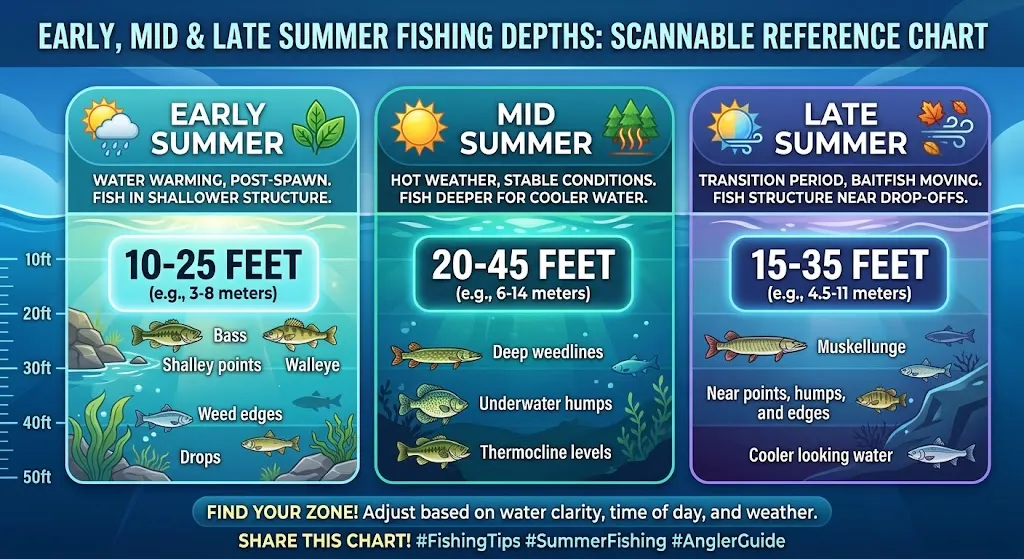
Why Walleye Move Into Deeper Water
Walleye move deeper in summer mainly to find cooler, more comfortable water. They are a cool-water species, and studies place their preferred summer temperature around 64–73°F (18–23°C).
Depth also matters because summer lakes stratify. Warm water sits near the surface, while colder water settles below. The transition zone is called the thermocline. Walleye often hold just above or along this layer because deeper water can become low in oxygen.
Food pulls them there too. Perch, shad, smelt, ciscoes, and other baitfish gather around temperature changes and structural edges. When baitfish move, walleye usually follow.
Walleye Trolling Depth Chart by Water Temperature
| Surface water temperature | Where to start | Depth to target | Presentation idea |
|---|---|---|---|
| Below 65°F | Shallow-to-mid lake areas | 8–18 feet | Crankbaits, jig-and-minnow, slow harness |
| 65–72°F | Main-lake structure | 12–25 feet | Bottom bouncer and crawler harness, crankbaits |
| 72–78°F | Deep weedlines and breaks | 18–30 feet | Deep-diving cranks, live-bait rigs, jigging |
| 78–85°F | Thermocline and deeper structure | 25–40+ feet | Leadcore, downriggers, vertical jigs, deep cranks |
| Above 85°F | Coolest oxygenated water | 30–60+ feet in deep lakes | Trolling suspended baits; fish dawn, dusk, and night |
The key is to find the depth where cool water and enough oxygen overlap. In many lakes, that zone sits near the thermocline; in shallow lakes, wind, current, and stained water can keep fish active much shallower.
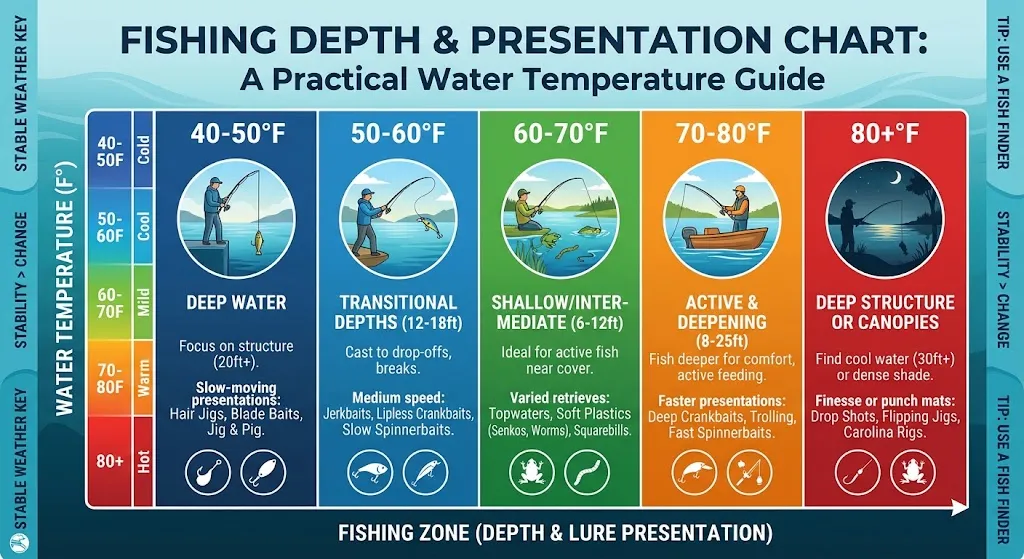
What Depth Do Walleye Prefer in Early, Mid, and Late Summer?
Your game plan must evolve as summer progresses.
Early summer walleye locations
Early walleye fishing often remain closer to the areas they used after spawning. Check 10–20 feet along the first drop, emerging weedlines, gravel-to-rock transitions, and points near shallow bays.
If the lake is stained or windy, do not ignore 6–12 feet. Walleye can feed shallow in low light, especially where waves break up the light and push baitfish toward shore.
Midsummer walleye locations
By midsummer, many walleye settle into 15–30 feet. Look for the deepest green weed edge, a rock hump with a sharp break, or a long point that drops into the main basin.
This is also when the thermocline becomes important. Mark fish suspended over deep water, then check whether they sit near a temperature change. A school 22 feet down over 45 feet of water can be more catchable than fish glued to bottom in 30 feet.
How to find late summer walleye?
To find late summer walleye, expand your search outward and deeper. Productive areas include 20–40 feet, especially deep humps, saddles between islands, river-channel edges, and the last break before a flat drops into the basin.
Late summer fish often relate to structure even when they suspend. A school may hover 18–25 feet down over a 40-foot reef or basin edge. Find the structure first, then adjust your bait depth to the fish.
How Water Temperature Affects Summer Walleye Depth
Water temperature controls where walleye can live comfortably. Their optimal summer range is roughly 18–24°C, or about 64–75°F, though individual lakes and fish vary.
When the surface reaches the high 70s or 80s, walleye often move to the coolest water that still has usable oxygen. That may mean:
- Fishing deeper during bright, calm conditions.
- Moving shallower after wind, rain, or cloud cover.
- Holding along a thermocline instead of going all the way to bottom.
- Feeding more actively at dawn, dusk, and after dark.
Oxygen matters as much as temperature. Below a thermocline, oxygen can fall quickly. Fish may avoid water that is cool enough but lacks enough dissolved oxygen, so the best depth is often just above the thermocline, not below it.
Where Do Walleye Hide in Lakes During Summer?
Fish rarely roam open mud flats aimlessly. They use underwater topography like highways and shelter.
Underwater Humps, Points, and Drop-Offs
Walleye use underwater humps, main-lake points, and drop-offs because these places combine cover, current, and access to deep water. A hump surrounded by deeper water gives fish a compact feeding area without forcing them to travel far.
Start on the upwind or current-facing side of a hump or point. Baitfish often collect there, and walleye can ambush them as they move across the structure. If you mark fish on one side, work that exact side and depth before moving.mdc.mo
Deep Weed Lines and Submerged Structures
Deep weedlines can produce all summer, particularly in lakes with healthy cabbage, coontail, or milfoil. The outside edge of the weeds gives walleye shade, ambush cover, and nearby access to open-water baitfish.
Other high-percentage spots include:
- Rock-to-mud transitions.
- Submerged roadbeds, old shorelines, and timber.
- Channel swings and sharp bends.
- Saddles between islands or humps.
- The lip where a flat breaks into deeper water.
Do Walleye Stay Near the Bottom or Suspend in Summer?
Walleye do both. Bottom-oriented fish often hold tight to rock, weed edges, or the base of a drop-off. Suspended fish commonly relate to baitfish, temperature changes, or offshore structure.
A good rule: if you mark fish near bottom, fish jigs, live-bait rigs, or bottom bouncers. If you mark them off bottom, troll crankbaits, use leadcore, or run a planer-board spread at the depth where you see fish.
Do not assume every fish on your screen is catchable at the same depth. Change lure depth in 3–5-foot increments until you find the productive band.
How Deep Do Walleye Go During the Day vs. at Night?
During bright daylight, walleye often move deeper, tighter to cover, or into stained water. At night, they commonly rise or move shallow to feed. Research and field patterns consistently show walleye using deeper water or cover by day and moving shallower after dark.
- Day: Fish 18–35 feet around humps, deep weeds, and drop-offs.
- Dusk: Check 10–20 feet along points and weedlines.
- Night: Try 5–15 feet on shallow rock, sand flats, and wind-blown shorelines.
In very clear lakes, night and low-light periods can be the best time to catch active walleye. In stained water, daytime fishing can remain productive because less light reaches the fish.
What Is the Best Depth to Catch Walleye in Hot Weather?
In hot weather, begin at 20–35 feet and adjust from there. On deep, clear lakes, walleye may suspend in 30–70 feet of water, especially near the thermocline. On shallow lakes, 8–18 feet can still produce if wind, weeds, or stained water create comfortable conditions.
The best depth is the one with three things:
- Cool-enough water.
- Enough dissolved oxygen.
- Nearby forage or a travel route to it.
If you catch one walleye, stay in that depth zone and repeat the same type of structure. Walleyes in summer often school by depth and habitat, so one fish can reveal a productive pattern. mdc.mo
Best Baits and Lures for Catching Deep Summer Walleye
Match your bait to the depth and mood of the fish.
- Crawler harness and bottom bouncer: Excellent for 15–30 feet along breaks, weedlines, and mud-to-rock transitions.
- Jig and minnow or leech: Best for vertical Boatfishing over marked fish, especially around humps and channel edges.
- Deep-diving crankbait: Productive for trolling 12–25 feet over points, flats, and suspended fish.
- Leadcore or downrigger: Useful when walleye hold 25–50+ feet down or suspend above the thermocline.
- Jigging spoon, jig spinners or blade bait: Strong choice for aggressive fish stacked on deep structure.
- Live-bait rig: A slow, natural presentation for neutral fish near bottom.
Slow down when the water is very warm. A slower presentation gives neutral fish more time to see and strike at the bait.
How to Find Summer Walleye With a Fish Finder
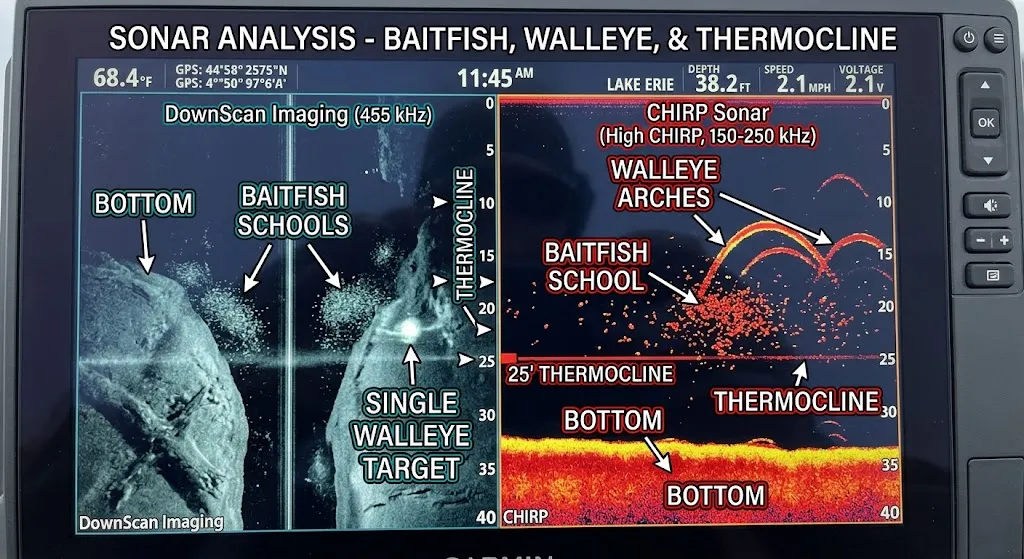
Use your fish finder to answer three questions: How deep is the water? Where is the thermocline? Where are the fish sitting?
- Idle over likely structure. Scan points, humps, weedlines, and drop-offs before fishing.
- Find the thermocline. Many units show it as a faint horizontal line; a temperature probe can confirm it.
- Mark bait and predators. Baitfish often appear as clouds or balls; walleye may show as tighter arches near them.
- Note the exact depth. If fish mark at 24 feet, set your presentation to run 20–26 feet.
- Repeat the pattern. Once you catch fish, look for similar depth, bottom composition, and structure nearby.
A lake map helps you find likely spots before you launch. Then use sonar to confirm whether the spot has bait, a hard-bottom transition, or a sharp break.
Frequently Asked Questions About Summer Walleye Depth
Do Walleye Go 30 to 40 Feet Deep in Summer?
Yes. Walleye commonly use 30–40 feet in midsummer and late summer, particularly in reservoirs or deep lakes. In large systems such as Lake Erie, anglers often target suspended fish in much deeper water, sometimes 60–80 feet, depending on the thermocline and baitfish.
Can You Catch Walleye in Shallow Water During Summer?
Yes. Walleye can stay in 5–15 feet throughout summer in shallow, stained, windy, or cooler lakes. They also move shallow at night and during low-light periods to feed.
What Is the Best Time of Day to Catch Summer Walleye?
Dawn, dusk, and night are usually best during hot summer weather. Bright midday sun often pushes walleye deeper or into heavier cover, while low light lets them feed more comfortably in shallower water.
How Deep Is Too Deep for Midsummer Walleyes?
There is no universal “too deep,” but fish below the thermocline can be hard to catch if oxygen is low. If you mark fish very deep but cannot get bites, look for a similar structure closer to the thermocline or try suspended fish above it.
Conclusion
So, how deep do walleye go in the summer? A smart starting range is 15–30 feet, but the best answer is always tied to water temperature, oxygen, baitfish, and lake type. Early summer fish often use 10–20 feet, midsummer fish commonly settle around 15–30 feet, and late summer walleye may relate to structure in 20–40 feet or suspend over much deeper basins.
Use a depth finder to locate the thermocline, then fish the structure that intersects it: deep weedlines, rock humps, points, channel edges, and drop-offs. If the surface water is hot, fish earlier or later in the day and adjust your bait to the exact depth where you mark fish. When you find one active walleye, stay with that depth and structure pattern—summer walleye often school together, and one good contact can turn into a fast limit.
You might also like:
- 5 Reasons Why Is Bass Fishing So Popular Sport (Explained)
- What Fish Can You Catch With Squid! – Cut Bait (Must-Read)
- Is Northern Pike Good To Eat? 13 Answers You (Should-Know)
- Choosing The Best Reel For Walleye Fishing – Walleye Experts Hacks!
- How Long Do Smallmouth Bass Live? Quick Answer (Should-Know)
- When Do Walleye Spawn in lakes? Best Time, Water Temps & Locations