
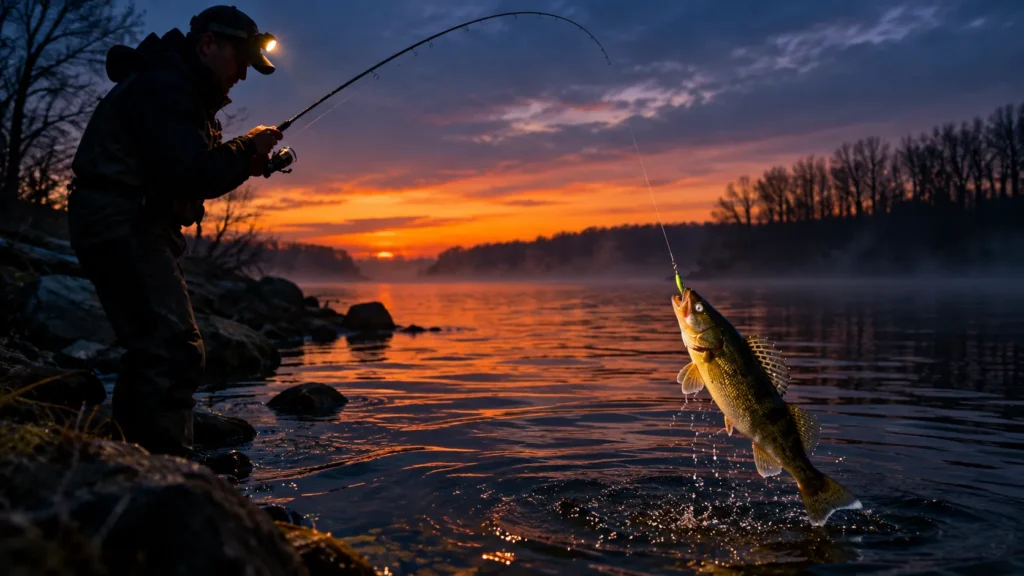
Walleye usually spawn in spring after ice-out, when water reaches 42–50°F. Learn spawning months by state, where walleye spawn, and how to fish the pre-spawn and post-spawn bite.
Walleye generally spawn in early spring after ice-out, most often from late March through early May. The exact timing depends on latitude, water temperature, and whether the fish live in a river, lake, or reservoir.
For most anglers, the practical answer is simple: watch the water temperature, not the calendar. Walleye spawning peaks when water reaches 42–50°F, though the run can begin once water approaches the upper 30s in some systems
When Do Walleye Spawn?
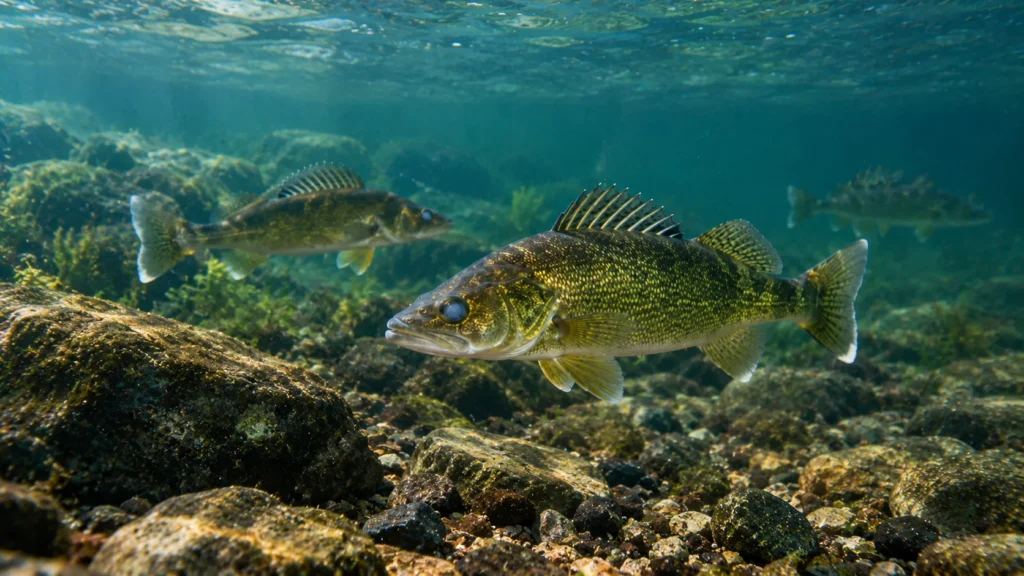
Walleye spawn once a year in spring, usually shortly after ice leaves their lake or river. In southern waters, the walleye spawning season can begin in late February or March; in northern lakes and Canadian waters, it often runs from mid-April into May.
Male walleye reach spawning areas first, sometimes while water is only a few degrees above freezing. Larger females arrive later, move onto gravel, rubble, or rocky shoals, and release eggs at night or during low-light periods.
A useful rule: when your lake hits the low 40s, start checking known spawning flats, spawning behavior, rocky points, creek mouths, and river current seams. When it reaches the mid-40s, the spawn is often close to peak.
State-by-State Spawning Calendar
How does timing of walleye spawning vary? Walleye spawn earlier in the South and later in the North. Use this calendar as a starting point, then confirm local regulations because many states protect spawning walleye with closed seasons or special rules.
| State / region | Typical walleye spawning months | Notes |
|---|---|---|
| Georgia, Alabama, Carolinas | Late February–early April | Headwaters, rocky reservoir shallows, and inflowing creeks warm first. |
| Missouri, Kansas, Oklahoma | March–mid-April | Southern populations start in early March; northern waters lag. mdc.mo |
| Ohio, Indiana, Illinois | Late March–mid-April | Lake Erie tributaries such as the Maumee peak late March through mid-April. |
| Iowa, Nebraska, South Dakota | Late March–late April | River walleye often spawn earlier than northern natural lakes. |
| Pennsylvania, New Jersey, Maryland | Late March–late April | Inland spawning commonly begins near 45°F and peaks at 45–50°F. |
| Minnesota, Wisconsin, Michigan | Mid-April–mid-May | Wisconsin’s run generally occurs mid-April through early May. |
| North Dakota, Montana, Wyoming | Late April–May | Cold winters and ice-out delay spawning. |
| Northern Ontario, Manitoba, Saskatchewan | May–early June | Season openers are often timed around the spawn. northernontario |
What Water Temperature Triggers Walleye Spawning?
The most reliable walleye spawn temperature is 42–50°F. Wisconsin and Minnesota fisheries agencies both identify this range as the peak spawning window, while some fish begin staging or spawning slightly earlier in rivers and southern reservoirs.
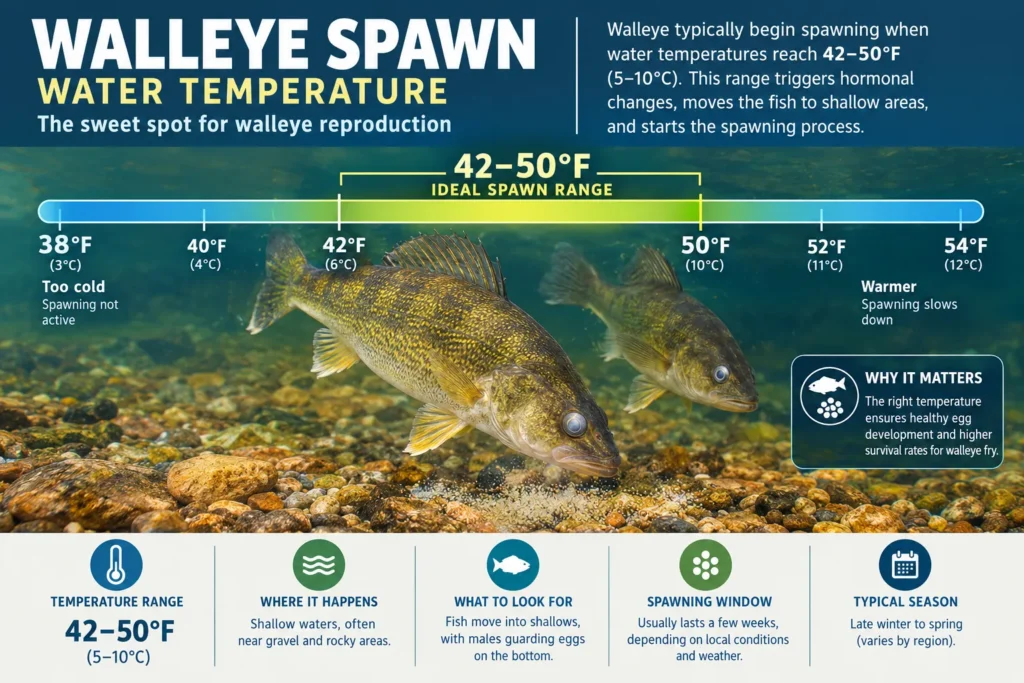
Water temperature for walleyes spawning varies by water type:
- Rivers: Current, warmer inflows, and open water can start the run around 38–42°F.
- Natural lakes: Walleye often spawn after ice-out, with peak activity from 42–50°F.
- Reservoirs: Creek arms, dam tailwaters, and wind-blown rocky banks warm first and can hold the earliest fish.
- Southern waters: Fish may spawn closer to 43–54°F, depending on the body of water.
Do not rely on surface temperature alone. A handheld thermometer read at spawning depth, especially near rocky structure, gives you a better picture of what the fish are experiencing.
What Month Do Walleye Spawn in Different States?
Most walleyes spawning in March, April, or May. The month changes with geography: southern reservoirs can finish by early April, while far-northern lakes may still be spawning in late May.
For a quick planning window:
- February–March: Deep South and early river systems.
- March–April: Midwestern rivers, Ohio reservoirs, and mid-latitude lakes.
- April–May: Upper Midwest, Great Lakes region, and northern natural lakes.
- May–early June: Far-north lakes and Canadian Shield waters.
The best approach is to track three signals: ice-out, water temperature, and local fishing reports. Those three together predict the run far better than a fixed date.
Where Do Walleye Spawn in Lakes, Rivers, and Reservoirs?
Walleye spawning locations share three features: hard bottom, moving or oxygenated water, and shallow access to deeper water. They are broadcast spawners, so eggs settle into gravel cracks and rock crevices rather than being guarded in a nest.
– Lakes
In lakes, look for windswept rocky points, gravel bars, island shoals, reef tops, and shorelines with clean rock. Wind-driven wave action keeps silt off the eggs and adds oxygen, which is why windward shorelines can be especially productive.
– Rivers
River walleye often spawn below dams, near current seams, around riffles, and at creek mouths. They use hard-bottom areas where flow removes fine sediment and keeps eggs clean.
– Reservoirs
In reservoirs, target the backs of creek arms, riprap near dams, rocky causeway openings, submerged roadbeds, and wind-blown banks. These areas combine shallow rock, current, and quick access to deeper staging water.
What Depth Do Walleye Spawn In?
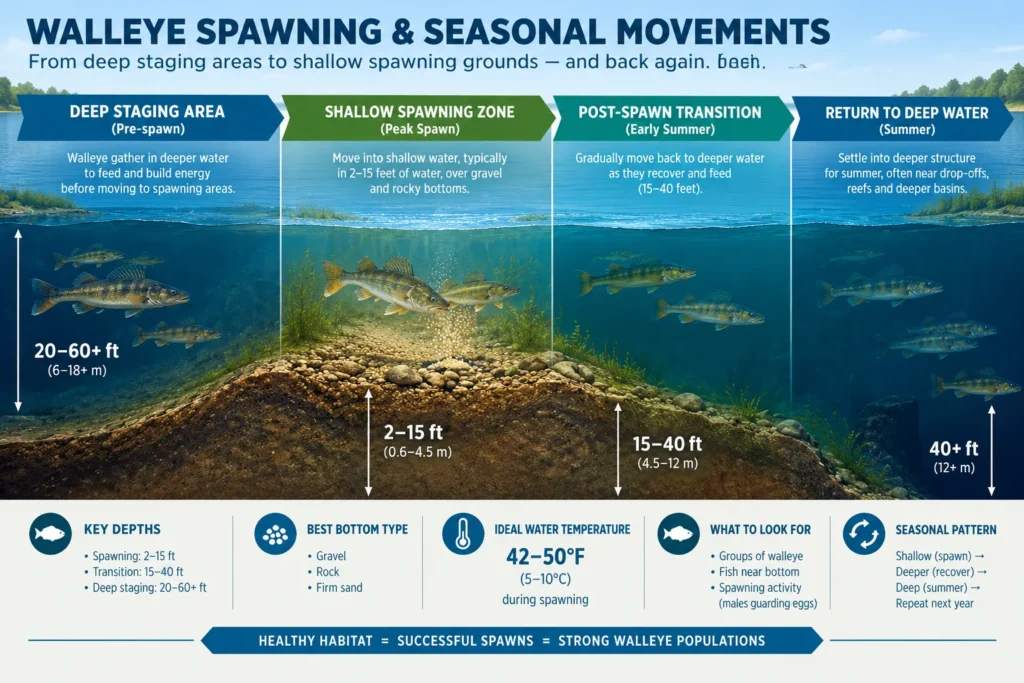
Walleye commonly spawn in 1–6 feet of water, although fish may stage deeper nearby before moving shallow. In clear lakes, they may spawn slightly deeper; in stained rivers, they can be surprisingly shallow, sometimes in less than two feet.
A simple depth pattern:
- Pre-spawn: Fish hold on nearby breaks, channel edges, or deeper water adjacent to spawning rock.
- Spawn: Males move shallow first; females slide in during darkness or low light.
- Post-spawn: Fish retreat to nearby drops, weed edges, and deeper structure to recover and feed.
Do Walleye Spawn at Night or During the Day?
Walleye mostly spawn at night, especially around dusk, after dark, and before dawn. They may still be active during cloudy days, wind, or stained-water conditions, but darkness is the prime spawning period.programs.
Males often stay on the spawning area longer and are easier to catch during the day. Females tend to move in briefly, release eggs, then pull back to deeper water.
How Long Does the Walleye Spawn Last?
The walleye spawn usually lasts about two to three weeks, with the heaviest activity lasting roughly 7–10 days. Weather can stretch or compress that window; a cold snap can pause the run, while steady warming can concentrate it.programs.
Eggs hatch in about 12–18 days, depending on water temperature. Adults do not guard the eggs or fry, so successful spawning depends heavily on clean gravel, oxygen, and stable water conditions.
How to Identify Pre-Spawn, Spawn, and Post-Spawn Walleye
Pre-spawn
Pre-spawn walleye stage near spawning grounds but have not committed to shallow rock yet. Look for them on drop-offs, channel swings, points, and the deep edge of flats in early season.
Best tactics: slow jig-and-minnow presentations, blade baits, and suspending jerkbaits worked along transitions.
Spawn
During the spawn, males dominate shallow rock, rubble, and current seams. Females make short visits to deposit eggs, often after dark.
Best tactics: fish slowly. A jig tipped with minnow or plastic, worked with short hops and long pauses, matches the cold-water mood.
Post-spawn
Post-spawn walleyes leave the shallows to recover, then begin feeding aggressively. Big females often relate to rocky points, boulder bars, weed edges, and breaks near spawning areas.
Best tactics: crankbaits, jerkbaits, jig-and-plastic combinations, and slow-trolled crankbaits along 8–12-foot breaks.
Can You Catch Walleye During the Spawning Season?
Sometimes—but check the rules first. Many states and provinces close walleye season, restrict night fishing, limit gear, or protect specific spawning areas during the walleye spawning season.
If fishing post spawn walleye is legal, target pre-spawn and post-spawn fish rather than actively spawning fish. Pre-spawn walleye are concentrated and aggressive; post-spawn walleye feed hard as they recover.
How to Catch Spawning Walleye
When regulations allow it:
- Fish jigs tipped with minnows or soft plastics along rocky spawning flats.
- Use blade baits or spoons vertically on deeper reef edges.
- Cast suspending jerkbaits to shallow rock during low light.
- Work current seams and eddies in rivers with a slow, controlled jig presentation.
Handle any fish carefully, release oversized females quickly, and avoid repeatedly fishing a visible spawning concentration.
Walleye Spawning FAQs
Do walleye spawn more than once a year?
No. Walleye spawn once each spring. A female may release eggs over several nights during the spawning window, but she does not spawn again until the following year.
How to catch post spawn walleye?
Start at the nearest deep-water structure outside the spawning area. Fish rocky points, boulder bars, weed edges, and breaks in 8–15 feet with jerkbait, crankbaits, or jigs. Early morning, evening, wind, and cloud cover improve the bite.
Do walleye return to the same spawning grounds?
Yes. Walleye commonly return to the same spawning areas year after year, especially where clean rock, gravel, current, and oxygenated water are consistent.
When is the best time to fish for walleye after spawning?
The best post-spawn window is usually one to three weeks after the peak spawn, once water reaches the low-to-mid 50s. Fish move from spawning rock to nearby breaks and begin feeding heavily.
Do walleye spawn in shallow water?
Yes. Walleye often spawn in 1–6 feet of water over gravel, rubble, rock, or coarse substrate. In rivers, they can be even shallower around current seams and riffles.
What month is best for walleye fishing?
For many anglers, May is the best overall month. In northern waters, walleye are often still concentrated near spawning areas, while post-spawn fish begin feeding aggressively.
How to locate walleye?
Use a lake map or sonar to find spawning rock, then follow the nearest deep-water access. Check wind-blown shorelines, creek mouths, points, reefs, channel edges, and current seams. Fish transition zones rather than random open water.
What time do walleyes bite the most?
Walleye bite best during low light: dawn, dusk, night, and overcast or windy conditions. Spring fish can also feed during the day when water is stained or choppy.
Best time to catch walleye in spring?
The best springtime window is usually pre-spawn through early post-spawn. Pre-spawn fish stage near spawning grounds; post-spawn fish feed hard after recovering. Both periods can produce better numbers and bigger fish than the actual timing of walleye spawning.
Conclusion
When do walleyes spawning? They spawn in spring, usually from late March through May, after ice-out and when water temperature reaches the key 42–50°F range. Southern rivers and reservoirs start first, while northern lakes and Canadian waters can continue into late spring.
The best anglers do not chase a date. They follow ice-out, track water temperature, and search for clean rock, gravel, current, and wind-blown shorelines near deeper water. Those clues reveal where walleye will stage, spawn, and recover.
Whether you are planning an early spring walleye trip or waiting for the post-spawn feeding window, understanding when do walleye spawn helps you fish the right water at the right time. Check local regulations, respect spawning fish, and use the temperature and location clues above to make your next spring outing more productive.
Recommended posts
- What Size Husky Jerk for Walleye? (Best Sizes, Tips & More)
- How Deep Do Walleye Go in the Summer? 9 Things (Should-Know)