
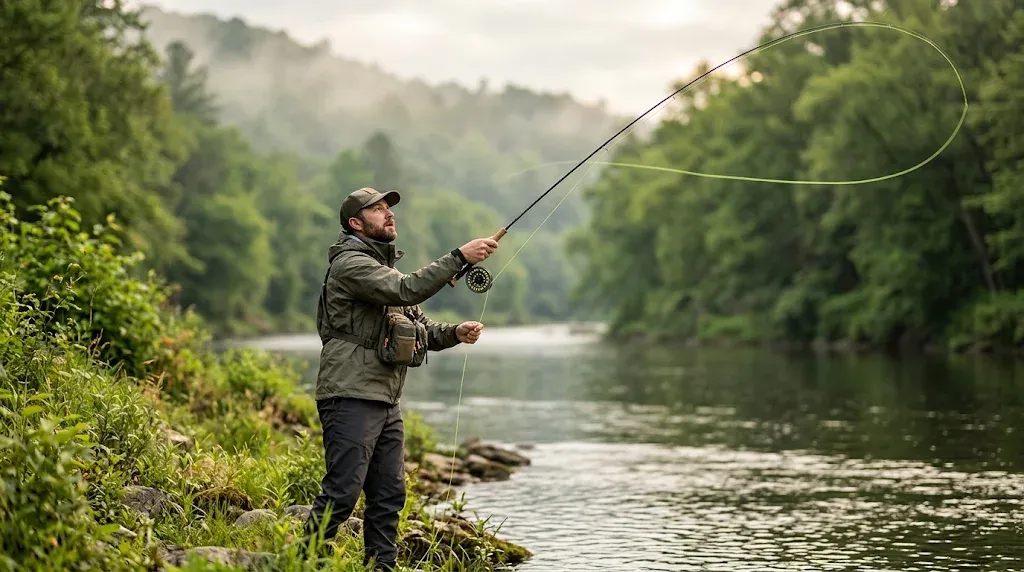
False casting means moving your line backward and forward above the water without letting the fly land. To learn how to false cast a fly rod, use smooth strokes, clear stops, and a pause that lets each loop nearly straighten before you reverse direction.
The goal is control, not a long series of swings. You use this skill to adjust distance, change direction, or remove water from a floating pattern before making your presentation.
This guide breaks the movement into simple steps, from your first grip to your final delivery. You will learn what to watch, what to feel, and how to spot common problems. Short practice sessions give you a clear way to test each change. Start with a manageable amount of line, choose an open space, and work on repeatable loops before chasing extra distance today.
What Is False Casting in Fly Fishing?
A false cast is an aerial casting movement that does not end with a presentation. Instead, you reverse direction and continue holding the line in the air.
Unlike casting a weighted lure, this method uses the mass of the line to carry the leader and fly. Think of it as a temporary adjustment between picking up and putting down—not the main event.
If you searched for “false cast fly fishing” or “fly fishing false cast,” both phrases describe this same skill.
Why Is False Casting Important When Fly Fishing?
It lets you change direction, check distance, and help dry a wet pattern before presenting it. That makes it useful when a feeding trout moves or your next target sits farther away.
But extra movement has a cost: visible line flash and repeated surface disturbance can spook fish. Learning control matters more than learning to keep the fly in the air indefinitely.
Give every repetition a purpose. If nothing needs to change, make the presentation.
What Equipment Do You Need to Practice False Casting?
For a beginner, a basic fly setup and a clear practice area are enough to begin. Use this suggested checklist:
- A balanced outfit with a securely fitted reel
- A floating line matched to the outfit’s recommended rating
- A tapered leader with a small yarn marker instead of a hook
- Eye protection, a hat, and room behind and beside you
- A visible ground marker that will not snag your equipment
Choose a familiar setup rather than buying specialized gear. A 9wt outfit used for saltwater work does not need to be your starting point for ordinary trout fishing.
Check the equipment maker’s matching guidance. Learn what the line’s taper means later; first, build a motion you can repeat.
How to False Cast a Fly Rod Step by Step
Before adding repeated aerial strokes, learn to pick the line up and lay it down cleanly; FFI recommends mastering that foundation first.
For this practice session, start with a manageable amount extended straight ahead. FFI’s lesson uses about 30 feet, but treat that as a teaching setup—not a distance you must achieve immediately.
Start With the Correct Grip and Stance
Try a relaxed thumb-on-top grip. Stand with your feet comfortably apart and one foot slightly behind the other.
Keep your shoulders loose. Hold firmly enough to guide the movement without squeezing hard throughout the stroke.
Begin with the rod tip low and pointing toward the straightened line, as FFI describes. Look behind you before lifting.
Make Your First Backcast
Lift smoothly, then accelerate into a clear backward stop; avoid starting with a sudden yank.
For early practice, turn slightly so you can watch the loop travel behind you. Use the phrase “back cast” as a direction cue, not an instruction to throw your whole arm backward.
Keep the movement comfortable and controlled. If you lose balance, shorten the exercise.
Pause and Let the Fly Line Straighten
Wait while the loop unrolls behind you, then begin the next stroke as it approaches straightening and before it falls.howtoflyfish.orvis
Do not rely on a fixed count. Watch what the line actually does.
A useful practice cue is: move, stop, watch, return. Say it slowly while learning, then let the visible loop set your rhythm.
Make a Smooth Forward Cast
Accelerate toward a clear front stop and allow the loop to unfold. To continue the exercise, reverse again before the line drops; to finish, make your presentation instead.
Avoid forcing extra distance during this first session. Aim for a clean turnover in front of you.
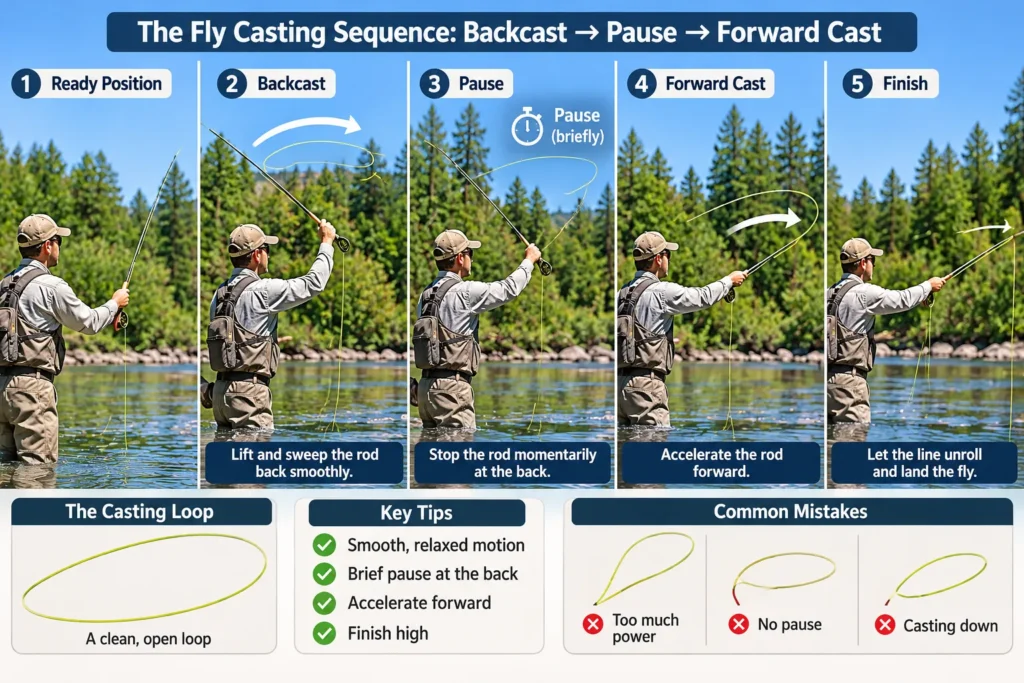
Suggested step-by-step illustration
Use four panels with a side-on view:
- Lift: Line straight ahead, low starting position.
- Backward stroke: Hand moves smoothly into a clear stop.
- Pause: Rear loop nearly unrolled.
- Return: Front loop forms, followed by either another pause or delivery.
Use different colors for the line and leader, and show motion arrows beside the hand. Caption it: “Move smoothly, stop clearly, and let the loop unroll.”
How to Control the Fly Line During False Casting
Your non-casting hand helps manage the loose section below the handle. Tony’s lesson introduces this hand as part of maintaining control during repeated strokes.
Try this progression:
- Keep the working distance unchanged.
- Make two controlled aerial cycles.
- Deliver toward your marker.
- Retrieve the loose section and reset.
Add distance only after the sequence feels steady. You need enough line to reach the presentation—not the largest amount you can keep moving.
If you encounter the label “upline” in a discussion, check what the writer means before treating it as a standard instruction.
How to Make Tight Loops When False Casting
Use loop shape as feedback, not as a contest. Start with the visible stops and consistent rhythm emphasized in Tony’s lesson.
For a manageable fly cast, try these adjustments one at a time:
- Use steady acceleration instead of an abrupt punch.
- Keep the hand’s movement controlled rather than sweeping through a huge arc.
- Watch whether the upper and lower legs cross.
- Reduce distance whenever you lose control.
Film a short side view and compare successful attempts with unsuccessful ones. Look at the rod tip, your hand, and the loop—not just where the yarn lands.
Do not assume that more effort automatically produces useful line speed. Your first goal is a repeatable shape.
Common False Casting Mistakes and How to Fix Them
Use this table as a practice checklist, not a complete diagnosis. Change one variable, make a few attempts, and check whether the result improves.
| What you notice | First adjustment to test |
|---|---|
| A sharp crack behind you | Reduce force and watch whether you reverse before the leader finishes extending. |
| Line falls onto the ground | Shorten the distance and check both the stop and the pause. |
| Loop legs cross | Remove the sudden punch and return to a smaller, controlled movement. |
| Front loop spreads widely | Reduce the sweeping motion and check your stopping point. |
| Casts wander sideways | Compare the direction of your backward and forward movements. |
| Repetitions keep multiplying | Decide what must change before making another stroke. |
A crack is a reason to stop and inspect your leader before fishing. For persistent problems, a qualified casting instructor can observe details that a checklist cannot.
Casting too much is a separate issue from casting poorly: a technically neat sequence can still delay the presentation. Orvis specifically cautions against overusing the movement.
How Many Times Should You False Cast Before Delivering the Fly?
There is no universal number of false casts that suits every setup and condition. Use the fewest that accomplish a clear task.stripersonline
Try these as practice decisions rather than fixed rules:
- Zero: Your direction and distance are already set.
- One false cast: Make a small adjustment, then present.
- Two false casts: Check whether the second movement truly improves control.
- Three false casts: Pause afterward and identify why each was needed.
If you count “2 false casts” during a drill, define your counting method first. For this guide, count one full backward-and-forward aerial cycle as one repetition.
Multiple false casts are not a score to beat. Build toward fewer false movements when fishing, while allowing useful repetition during practice.
When Should You Use False Casting While Fly Fishing?
Use it to adjust direction or distance, check placement, or remove water from a dry fly. Each is a specific reason to continue before delivering.
Use extra care during sight fishing in shallow water. Murray’s recommends keeping necessary aerial movements away from the fish rather than passing directly overhead.
Match the Movement to Conditions
Before casting, ask:
- Is there clear space behind me? If not, consider another method, such as a roll cast, rather than forcing this exercise.
- Am I ready to present? If yes, stop adjusting.
- Does the pattern need to float or sink? Decide the presentation before making repeated movements.
- Am I beside a stream or on a lake? Check surrounding obstacles and available room rather than assuming the same motion fits both.
A stream bank, a boat, and an open flat create different space limits. Long casts should be a response to the situation, not the default goal.
Tips and Drills to Improve Your False Casting Technique
Use these suggested drills in short sessions. They give both a new angler and an intermediate caster a way to focus on one skill at a time.
Drill: Watch the Rear Loop
Practice with a yarn marker in a clear area. Turn enough to observe the rear loop without twisting into an awkward position.
Make five attempts at a comfortable distance. Note which pause produces the cleanest return.
Drill: Hold a Fixed Distance
Keep the working length unchanged for several attempts. Do not feed extra material through your fingers.
Aim for matching loops rather than reaching farther. This separates timing practice from distance practice.
Drill: Deliver After One Cycle
Pick up, make one aerial cycle, and deliver. Reset fully before trying again.
The goal is to get the fly—or yarn marker—down with purpose. Practice a cast to get a useful presentation, not to fill time.
Drill: Aim, Then Review
Place a marker at an easy distance. Make five deliveries and record how many land within a broad, realistic area around it.
Repeat on later fishing trips or practice days. Many anglers can benefit from tracking consistency instead of judging progress by their longest attempt.
Frequently Asked Questions about False Cast Fly Fishing
Can I practice without a hook?
Yes—use a small yarn marker for the drills in this guide. Check that your practice area stays clear, and stop whenever someone enters it. You can rehearse a fly cast without exposing nearby people to a fishing hook.
Why does my line slap the water?
Begin by checking whether the loop falls before you reverse direction. Orvis emphasizes restarting before the airborne line drops. Shorten the exercise and review a side-on recording. If timing changes do not help, ask an instructor to check the complete movement.
Should I use a fixed clock position?
Clock positions can provide a starting reference; FFI uses them in its introductory lesson. They are not a substitute for watching the loop. Treat the clock as a teaching aid, then judge your result by control and clean turnover.
Does false casting help every presentation?
No. Orvis describes it as useful but often overused. For example, if your direction and distance are ready, more aerial movement may simply delay the start of your drift.
Will better casting help me catch more fish?
Better control is a useful goal, but this guide makes no catch-rate promise. Judge your progress by safer movement, more accurate placement, and fewer unnecessary repetitions. Keep the practice focused on decisions you can measure.
How can you change direction or extend the line while false casting?
Change direction by rotating your body and redirecting the rod tip toward the new target. Extend line by feeding slack from your line hand during the pause, then make a smooth, controlled stroke to carry the added line.
Fly Fishing False Cast Conclusion
Learning how to false cast a fly rod starts with a simple goal: control the movement before adding distance. Pick one skill for each session, whether that means a cleaner stop, a better pause, or a more accurate casting flies. Keep your practice area clear, use a yarn marker, and watch what happens behind you as carefully as what happens ahead.
You do not need a perfect-looking sequence to make useful progress. You need a repeatable motion and a clear reason for every adjustment. When something goes wrong, shorten the exercise, change one thing, and try again. That approach gives you feedback you can use instead of another round of guesswork.
Take these drills to your next practice session. Record a few attempts, choose one improvement, and finish with controlled presentations. Build confidence through small gains, then carry that calm, deliberate rhythm onto the water when the next fishing opportunity arrives.