
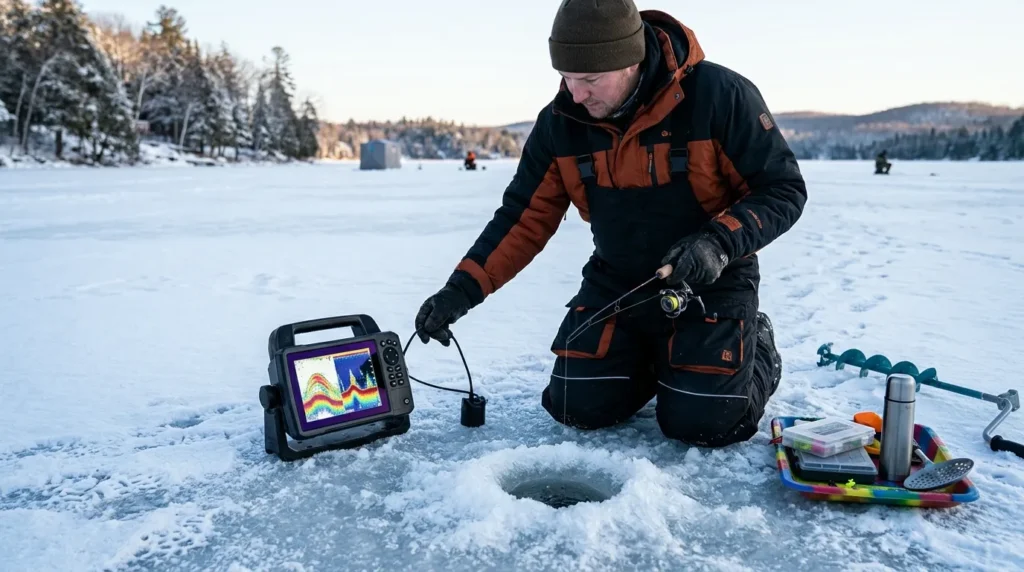
The best ice fishing fish finder is the one that shows your jig, nearby fish, and bottom contour clearly without slowing you down. For most anglers, the Garmin Striker 4 Portable Bundle is the best ice fishing fish finder for the money; anglers who want the most detailed view should choose a Garmin LiveScope ice bundle.
A good ice fishing sonar does more than locate fish. It helps you read depth, follow a school, watch a fish rise to your bait, and decide whether to keep drilling or move on. The right choice depends on your budget, the water you fish, and whether you want a simple ice fishing flasher or a full GPS-and-mapping system.
Top Rated Ice Fishing Fish Finders of 2026
Which ice fishing fish finder is best for the money? These are seven strong options for different budgets and fishing styles. Check the current price, included transducer, and battery type before ordering.
1. Garmin Striker 4 Portable Bundle — Best Budget Pick
A compact portable fish finder with CHIRP sonar, a flasher-style view, GPS waypoints, and a sealed rechargeable battery. It is an excellent first fish finder for ice, kayak fishing, and small-boat fishing.
Best for: Beginners, budget buyers, and anglers who want one unit for ice and open water.
Buy it: Garmin Striker 4 Portable Bundle on Amazon
2. Garmin LiveScope Plus Ice Bundle — Best Overall
This is the premium choice if you want live sonar and forward-facing sonar. It shows fish and structure around the hole, not just directly beneath your transducer, so you can locate schools without drilling extra holes.
Best for: Serious ice anglers chasing crappies, perch, lake trout, and walleyes.
Buy it: Garmin LiveScope Plus Ice Bundle on Amazon
3. Humminbird ICE Helix 7 CHIRP GPS G4 — Best All-Season Unit
The Humminbird Helix 7 combines dual-spectrum CHIRP sonar, GPS mapping, a flasher view, and a portable ice shuttle. It also works well for kayak fishing and boat fishing during open-water season.
Best for: Anglers who want one fish finder for ice, kayak, and boat use.
Buy it: Humminbird ICE Helix 7 CHIRP GPS G4 on Amazon
4. Vexilar FL-8SE Genz Pack — Best Traditional Flasher
The Vexilar FL-8SE is a proven ice fishing flasher with a simple circular display, rugged build, and fast response. It remains one of the best choices for anglers who want an easy-to-read unit without extra menus.
Best for: Beginners and anyone who values simple, dependable sonar.
Buy it: Vexilar FL-8SE Genz Pack on Amazon
5. MarCum LX-7L — Best Digital Ice Sonar
The MarCum LX-7L offers strong interference rejection, excellent target separation, zoom controls, and a color LCD display. It is a great choice for crowded lakes where nearby flashers can create screen noise.
Best for: Anglers who fish busy lakes and want detailed sonar readings.
Buy it: MarCum LX-7L on Amazon
6. Lowrance Elite FS Explorer Pack — Best for Mapping
This Lowrance package combines CHIRP, down-view, side-view, and live-view sonar with C-Map Contour+ mapping. It is powerful enough for ice fishing but equally useful for serious kayak or boat fishing.wired2fish
Best for: Anglers who want detailed maps, structure scanning, and live sonar.
Buy it: Lowrance Elite FS Explorer Pack on Amazon
7. HawkEye FishTrax 1C-K Paddlesport Fishfinder — Best for Kayaks and Small Boats
The HawkEye FishTrax 1C-K is a compact, self-contained fish finder built for kayaks, canoes, paddleboards, and small boats. It uses dual-frequency sonar at 200/83 kHz, reads depths from 1.5 to 240 feet, and includes a 15-foot transducer cable, mounting track, bracket, and carrying case.
Best for: Kayak anglers, canoe anglers, shore anglers, and anyone who wants a simple portable fish finder without an external battery.
Buy it: HawkEye FishTrax 1C-K Paddlesport Fishfinder on Amazon
Quick Jump
ToggleWhat Is the Best Ice Fishing Fish Finder?
The best ice fishing fish finder is the Garmin Striker 4 Portable Bundle for most anglers. It gives you CHIRP sonar, a flasher-style display, GPS waypoints, and a portable battery setup at a lower price than premium live-sonar systems.
If money is not the main concern, the Garmin LiveScope Plus Ice Bundle is the strongest choice. Its live sonar lets you watch fish move around your lure in near real time, which is especially useful for suspended crappies, perch, and walleyes.
For a traditional hardwater setup, choose a Vexilar flasher. For mapping, GPS, and year-round use, choose a Humminbird Helix or Lowrance Elite system.
How Does an Ice Fishing Fish Finder Work?
An ice fishing fish finder sends a sonar signal through the water from a transducer placed below the ice. The signal bounces off the bottom, baitfish, structure, and your lure, then returns to the unit as readable information on the screen.
The display shows:
- Water depth
- Bottom hardness and contour
- Fish position in the water column
- Your jig or bait
- Weeds, rocks, drop-offs, and other structure
- Fish movement as they approach or reject your presentation
A traditional ice fishing flasher uses a circular dial. A digital fish finder uses an LCD display, often with zoom, split-screen views, GPS, and mapping. Both types use sonar; the difference is how the information appears and how much control you have.
Best Types of Fish Finders for Ice Fishing
Traditional Ice Fishing Flashers
A flasher is the classic ice fishing sonar. Its circular display shows depth like a clock face, with your lure and fish appearing as colored marks around the dial.
Flashers are popular because they respond quickly and are easy to read while jigging. The Vexilar FL-8SE is a proven example, with a three-color LED display, self-leveling Ice-Ducer, and reliable cold-weather performance.outdoorlife
Best use: Panfish, perch, walleye, and anglers who want a simple unit.
Digital Sonar Fish Finders
Digital units use an LCD screen and offer more detail than a basic flasher. Many include CHIRP sonar, zoom, split-screen views, GPS waypoints, and lake maps.
The Humminbird Helix 7 G4, for example, provides dual-spectrum CHIRP sonar, GPS, LakeMaster and Navionics compatibility, and a portable ice shuttle. The MarCum LX-7L focuses on precise target separation and interference rejection.
Best use: Anglers who want more detail, mapping, and flexibility.
Live Sonar and Forward-Facing Sonar
Live sonar, also called forward-facing sonar, shows fish and structure around your transducer rather than only below it. Garmin’s LiveScope system can rotate 360 degrees and reveal fish direction, school size, and how fish respond to your lure.
This technology is powerful, but it costs more and adds weight. It is best for anglers who spend many days on the ice and need to find roaming schools quickly.
Best use: Mobile anglers, trophy hunters, and anglers targeting suspended fish.
Key Features to Look for in an Ice Fishing Fish Finder
Choosing the right fish finder for ice fishing depends on your fishing style, target species, budget, and the depth of the lakes you fish. Unlike traditional open-water fish finders, ice fishing models need to work through a small hole in the ice, provide reliable sonar readings in cold temperatures, and help you track fish directly beneath your fishing spot.
The best unit should offer clear sonar images, accurate depth readings, adjustable sensitivity, and a transducer designed for ice fishing. Some models also include GPS mapping, flasher displays, and CHIRP sonar to help you identify fish and distinguish them from underwater structure.
Before buying, compare these features rather than choosing based on screen size alone.
| Feature | Why it matters |
|---|---|
| Transducer type | The transducer determines sonar clarity, beam width, and how well you see your jig. |
| CHIRP sonar | CHIRP sends a range of frequencies, helping separate fish, bait, and bottom detail. |
| Target separation | Better separation helps you distinguish your jig from a fish only inches away. |
| Display size | A 5-inch or 7-inch screen is easier to read than a very small display. |
| Battery type | Lithium batteries usually offer better cold-weather performance and longer runtime. |
| GPS and mapping | Useful for marking productive spots, depth contours, and access points. |
| Interference rejection | Important on busy lakes with several anglers using sonar nearby. |
| Portability | A padded shuttle, carry case, and manageable cable make hole-hopping easier. |
A quality transducer matters as much as the display. A poor transducer can make even an expensive screen hard to interpret.
Flasher vs. Digital Fish Finder: Which Is Better for Ice Fishing?
A flasher is better if you want simplicity, fast feedback, and a durable unit for vertical jigging. A digital fish finder is better if you want GPS, mapping, zoom, CHIRP sonar, and more detailed bottom readings.
| Feature | Ice fishing flasher | Digital fish finder |
|---|---|---|
| Display | Circular dial | LCD screen |
| Learning curve | Low | Moderate to high |
| Jig tracking | Excellent | Excellent |
| Mapping and GPS | Usually none | Often included |
| Target separation | Good to very good | Often excellent |
| Best for | Beginners and traditional anglers | Tech-minded and multi-season anglers |
If you fish shallow weed flats for bluegills, a flasher may be all you need. If you chase walleyes on large lakes, mark offshore structure, or use the same unit for kayak fishing, a digital fish finder is usually the better investment.
Best Ice Fishing Fish Finder for Different Fishing Situations
Best Budget Ice Fishing Fish Finder
The Garmin Striker 4 Portable Bundle is the best budget ice fishing fish finder. It includes a compact display, CHIRP sonar, GPS waypoints, a flasher-style view, and a portable battery setup.
Budget buyers should also consider the Deeper PRO+ 2. It is a castable wireless sonar option with built-in GPS and a phone-based display, though it is not as fast or intuitive as a dedicated ice flasher.
Best Fish Finder for Beginners
The Vexilar FL-8SE Genz Pack is one of the easiest ice fishing sonar units to learn. Its circular display makes it simple to see depth, bottom, your lure, and approaching fish without navigating complex menus.outdoorlife
Beginners should avoid starting with the most expensive live-sonar system. Learn to read bottom hardness, fish position, and jig movement first; upgrade later if you need more capability.
Best Fish Finder for Deep-Water Ice Fishing
For deep water, prioritize a sensitive transducer, strong target separation, and a clear display. The Humminbird ICE Helix 7 CHIRP GPS G4 is a strong all-around choice, while the MarCum LX-7L is excellent for anglers who need precise readings in deeper water.
For deep-water anglers who also want to search wide areas, Garmin LiveScope provides a major advantage because it can show fish away from the hole rather than directly beneath it.outdoorlife
How to Choose the Right Ice Fishing Transducer
The transducer is the part that sends and receives sonar signals. Choosing the right one improves clarity, reduces false readings, and helps you track your jig.
Consider these points:
- Ice transducer: Designed to hang below the ice and stay stable in the hole.
- Self-leveling transducer: Helps maintain a clean signal on uneven ice or when moving between holes.
- Dual-frequency transducer: Lets you choose between a wider search beam and a narrower, more detailed beam.
- CHIRP transducer: Provides stronger target separation and better detail.
- Cable length: Make sure the cable reaches comfortably from your shuttle to the hole.
The Humminbird Helix 7 G4 uses dual-spectrum CHIRP sonar and can separate targets by about three-quarters of an inch. The MarCum LX-7L offers half-inch target separation, which helps when fish hold tight to bottom or suspend in a tight school.
Battery Life, Portability, and Cold-Weather Performance
Cold weather affects every part of an ice fishing setup. Batteries lose capacity in extreme cold, screens can become harder to read, and cables can stiffen.
Choose a unit with:
- A lithium battery if your budget allows
- A padded shuttle or carry case
- A screen cover or protective case
- Simple controls you can use with gloves
- A transducer arm that stays stable in the hole
- Enough battery capacity for a full day on the ice
The Garmin LiveScope ice package includes a 16.5Ah lithium-ion battery, while the Humminbird Helix 7 ice package includes a 12-volt 15Ah lithium battery. Lithium batteries generally perform better in cold weather than older sealed lead-acid batteries, though they still need sensible winter storage and charging habits.outdoorlife
Tips for Using a Fish Finder to Catch More Fish Through the Ice
A fish finder helps most when you use it to make decisions, not simply to confirm that fish are below you.
- Start by scanning the bottom contour before drilling multiple holes.
- Look for transitions: weed edges, drop-offs, rock piles, basins, and points.
- Drop your transducer before drilling to check depth and locate fish.
- Watch how your jig appears on screen, then keep it in the strike zone.
- Raise or lower your bait until fish react; do not keep jigging blindly.
- Mark productive holes with GPS waypoints so you can return later.
- Move when you see fish but cannot get bites; a small move can make a big difference.
- Use zoom to focus on the bottom few feet when fish hug structure.
- Turn down sensitivity or use interference rejection when other anglers are nearby.
For panfish, watch whether the fish rises aggressively or simply follows your bait. For walleyes, pay attention to bottom transitions and fish holding just off structure. For lake trout, scan deeper basins and look for fish suspended above the bottom.
Frequently Asked Questions About Ice Fishing Fish Finders
Are fish finders worth it for ice fishing?
Yes. A fish finder helps you find depth changes, structure, bait, and fish faster. It also shows whether fish are reacting to your jig, which saves time and helps you learn a lake more quickly.
Can you use a regular fish finder for ice fishing?
Yes, but you need an ice-compatible transducer and a portable power source. Many portable fish finders can work through the ice with the correct ice transducer, though a dedicated ice fishing unit is usually easier to carry and operate.
What is better for ice fishing, a flasher or sonar?
A flasher is better for simple, real-time jig tracking. A digital sonar unit is better if you want GPS, mapping, zoom, CHIRP sonar, and more detailed readings. Many modern units, including the Garmin Striker 4 and Humminbird Helix, offer both flasher-style and traditional sonar views.
Do ice fishing fish finders work in shallow water?
Yes. Shallow water can actually be easier to read because the bottom and your lure are close to the transducer. Use a narrower beam or reduce sensitivity if the display becomes cluttered in very shallow water.
Can a fish finder replace an underwater camera?
No. Sonar is better for locating fish and reading the water column, while an underwater fishing camera is better for identifying species, checking weed cover, and seeing exactly how fish react. Many serious ice anglers carry both.
Do I need live sonar for ice fishing?
No. Live sonar is helpful, but it is not necessary for most anglers. A quality flasher or CHIRP sonar unit will catch plenty of fish. Live sonar becomes more valuable when you fish large lakes, chase roaming schools, or want to locate fish without drilling extra holes.
Conclusion
The best ice fishing fish finder is the one that matches your water, target species, and fishing style. For most anglers, the Garmin Striker 4 Portable Bundle delivers the best mix of value, portability, CHIRP sonar, and flasher-style performance. If you want the most advanced fish-finding technology, choose a Garmin LiveScope ice bundle. If you prefer simple, proven hardwater sonar, a Vexilar flasher remains hard to beat.
Before buying, check the transducer, battery type, screen size, and whether the unit can also serve your kayak or boat. A good ice fishing fish finder does not just locate fish; it helps you understand depth, structure, bait movement, and fish behavior. Choose the right system, learn to read its display, and you will spend less time drilling holes and more time catching fish.
You might also like: