
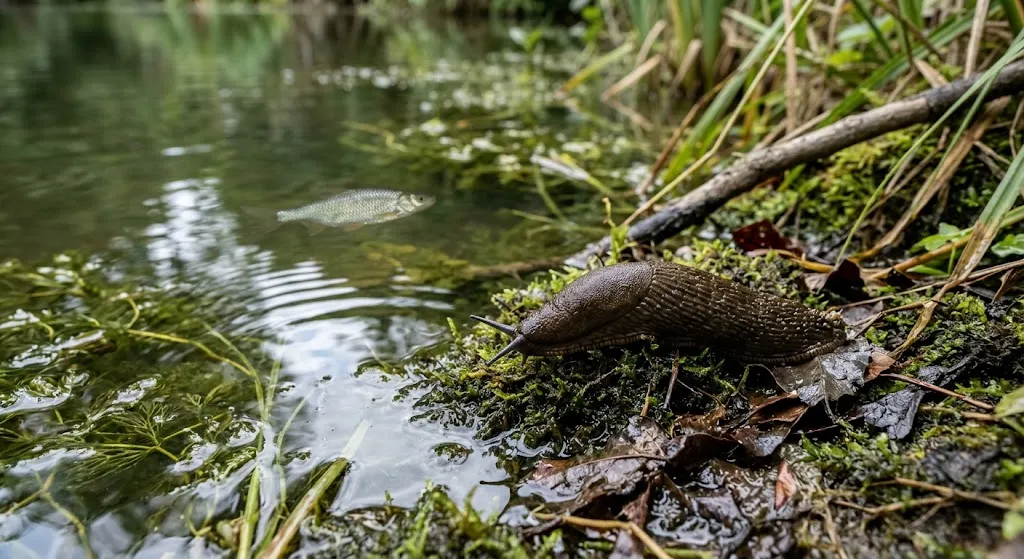
Do fish eat slugs? Some fish eat slugs, but that does not make slugs a safe food for pet fish. Published research documents fish eating certain marine species, while reports about freshwater fish eating land slugs often come from keepers rather than controlled studies.
If you are asking, “Do fish eat slugs?” the useful answer depends on which fish, which slug, and where the encounter happens. A fish taking an unexpected bite outdoors tells us little about whether you should offer the same animal at home. Even a successful feeding does not prove long-term safety.
Do Fish Eat Slugs?
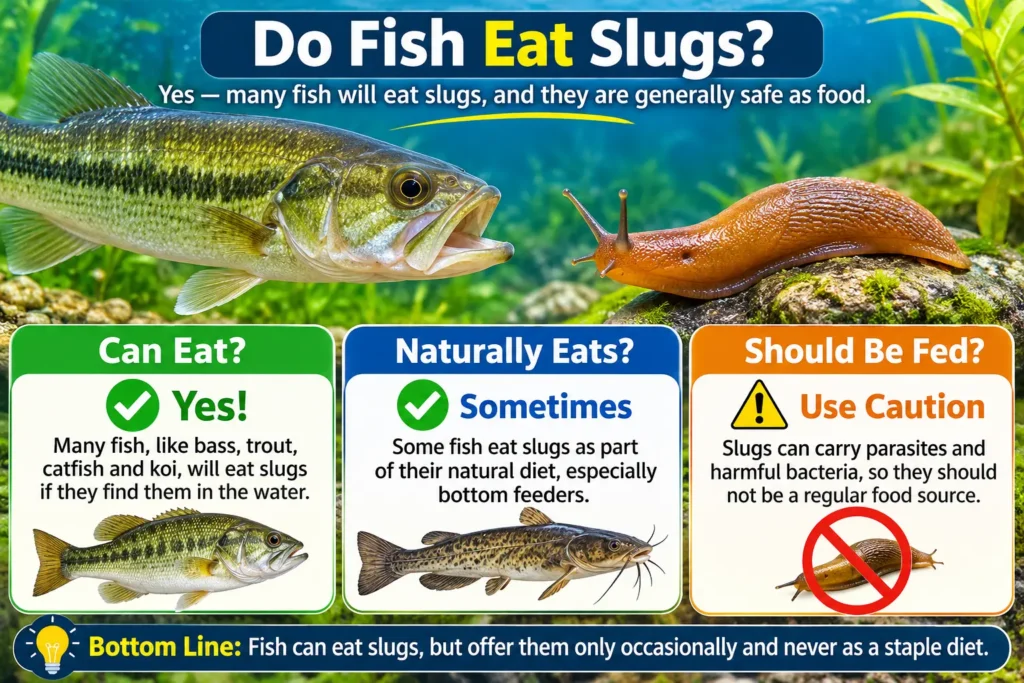
Many pond fish actively consume small slugs, especially larger omnivorous and carnivorous species that hunt small invertebrates. Pond fish such as koi and goldfish may nibble on small slugs, while certain wild freshwater fish may include them in their natural diet.
Still, not every slug offers safe food because some carry parasites, harmful chemicals, or environmental contaminants.
Understanding which fish eat slugs, whether slugs provide nutritional benefits, and what risks they pose can help you make better feeding decisions. Explore the difference between fish that naturally eat slugs and those that should avoid them. Let’s dive in and find out whether slugs belong on your fish’s menu!
Eating is not a safety test
Research on Alderia offers a useful warning against broad claims: small fish rejected chemically defended slugs in one study, while earlier experiments recorded consumption by much larger predators under different conditions.
“Fish sometimes eat slugs” is defensible. “Slugs are safe fish food” goes well beyond that evidence.
Which Types of Fish Eat Slugs?
The clearest answer comes from separating documented examples from assumptions.
| Fish or group | What the evidence supports | What it does not establish |
|---|---|---|
| Certain sculpins and surfperch | A researcher reported consumption of several marine slug species during feeding trials. | That all members of these groups accept all slugs |
| Arowana | One keeper reported a single successful feeding. | Routine safety, nutritional suitability, or long-term outcomes |
| Small fish tested with Alderia | Fish attacked but rejected live slugs in a controlled study. | That every marine slug has the same defense |
| Familiar snail hunters | Their ability to eat snails concerns different prey. | Confirmed land-slug consumption |
What about familiar pet fish?
Do not turn a list of fish that eat snails into a list of proven slug eaters. A loach, puffer, or cichlid may have feeding adaptations relevant to shelled prey, but that does not answer questions about an unfamiliar, chemically defended animal.
The FishProfiles discussion names oscars, a barb, a pleco, and corydoras among the original poster’s livestock; those names are not reports that each fish ate a slug. The sources reviewed here also do not establish trout or betta fish as reliable, safe choices for land-slug feeding.
Why Do Some Fish Eat Slugs?
A slug can resemble an available food source, especially to an opportunistic predator. Experiments show that fish may investigate or attack before rejecting the animal, so an initial strike does not necessarily mean the fish will swallow it.
Prey defenses can change the outcome. Researchers found compounds that made slug flesh unpalatable, demonstrating that a soft body alone does not make an animal suitable prey.
Texture is only one factor
A slimy surface, sticky mucus, and body size may affect handling, but avoid claiming that ordinary land-slug slime always blocks gills or causes poisoning. The evidence reviewed here does not support those universal claims.
The more useful questions concern identification, exposure history, and whether the food has an established place in that fish’s feeding routine.
Do Freshwater Fish Eat Land Slugs?
Freshwater fish can consume terrestrial slugs, as the arowana account illustrates, but the available evidence is too limited to build a dependable species-by-species feeding guide.
A garden visitor is also different from familiar aquatic prey. Neither an appetite for a worm nor an ability to crush a snail shell proves that a fish can safely consume a land slug.
Land and marine species differ
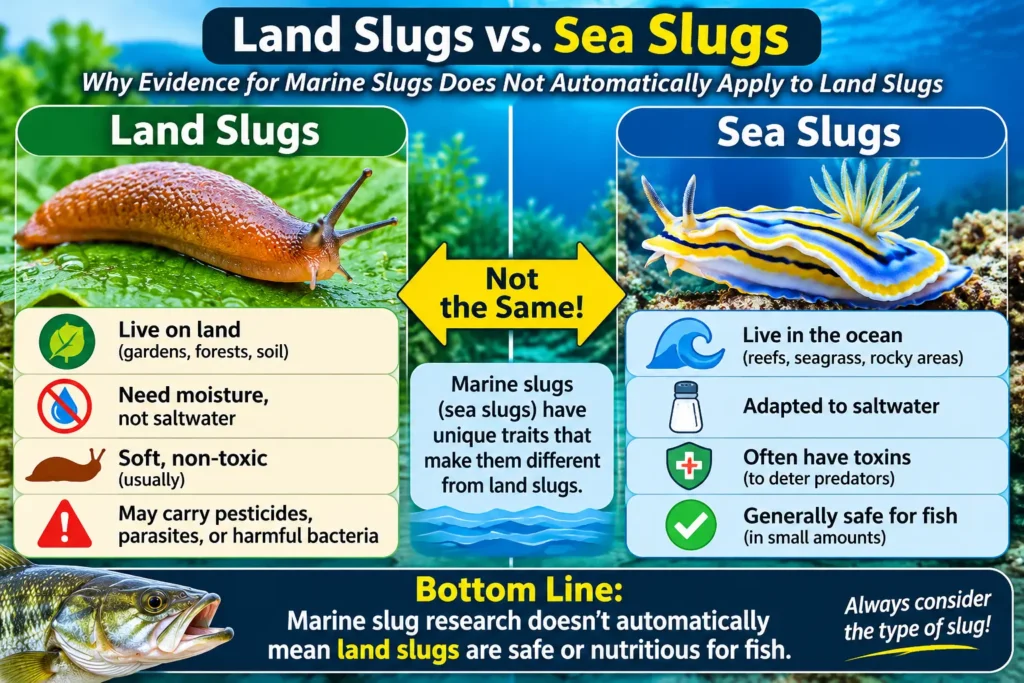
Do not use evidence about sea slugs as a direct feeding recommendation for freshwater pets. Marine species vary widely: some are eaten, while others contain defensive chemicals that discourage fish.
For example, research describes a marine slug obtaining a defensive toxin through its association with an alga-based food chain. That is a species-specific finding, not proof that every land slug has the same chemistry. academic.oup
Are Slugs Good for Fishing?
Can you use slugs as fish bait? Slugs can be good for fishing in the right conditions, but they are not a universal replacement for worms or artificial lures. Their soft body and natural scent may attract fish, especially in murky water or after rain, yet results vary by species, location, and presentation.
When trying fishing with slugs, start with a small piece threaded onto a suitable hook and fish it slowly near cover, drop-offs, or likely feeding areas. Keep the bait moving gently rather than letting it sit motionless for long periods.
Use slugs for fishing bait only where local rules permit them. Avoid collecting them from lawns, gardens, or paths treated with pesticides, and wash your hands after handling them. If you choose slugs as fishing bait, treat them as one option to test—not a guaranteed trout or panfish solution—and compare results with approved bait or lures.
Can Fish Eat Slugs That Fall Into the Water?
A fish may swallow an accidentally submerged slug, but a single encounter does not establish either certain harm or certain safety. The hobby report of an arowana eating one supports possibility, not a predictable outcome.
If you spot an uneaten slug, remove it rather than leave it as an experiment. Veterinary guidance identifies decaying organic material and poor sanitation as conditions that can contribute to fish-health problems.
After accidental exposure
Use this cautious checklist:
- Remove the remaining animal and visible debris.
- Note when the exposure happened and whether nearby chemicals were used.
- Check water quality and watch for changes in breathing, balance, activity, or appetite.
- Contact a fish veterinarian if the fish appears unwell or chemical exposure is plausible.
- Avoid automatic medication without a diagnosis; veterinary guidance discourages preventive drug use without testing.
You do not need to drain the entire setup simply because one slug entered it. Base corrective action on the exposure, water results, and professional advice rather than a blanket cleaning rule.
Are Slugs Safe for Fish to Eat?
Wild-caught garden slugs are not a sensible routine feeding choice. An animal’s willingness to swallow one does not verify its chemical history, nutritional suitability, or disease status.
A slug collected near pesticide use creates an avoidable uncertainty. Calling the collection area “organic” does not provide a tested residue result or confirm that the animal stayed within that area.
Washing is not verification
Rinsing thoroughly may remove visible dirt, but it does not establish that an animal is free of internal organisms or absorbed chemicals. This article does not recommend washing, freezing, or cooking as a validated method for turning unknown slugs into safe fish food.
A pet store label alone is not enough either. Choose products sold specifically for the species you keep, with clear feeding instructions and a known supply chain.
Can Slugs Harm Fish or Carry Parasites?
Slugs can act as hosts for parasites, but a claim that a particular parasite will infect fish requires evidence about that organism’s life cycle. The reviewed hobby discussion raises parasite concerns; it does not provide veterinary confirmation of transmission in the reported feeding event.
Fish do suffer from parasitic diseases, yet those infections involve specific hosts and routes of exposure. Avoid assuming that a parasite associated with a bird, frog, turtle, or mammal will necessarily infect fish.
Are slugs poisonous?
“Poisonous” is too broad a label for every slug. Some marine species have chemical defenses that make them distasteful or harmful to would-be consumers, while other species are readily eaten.
Likewise, do not assume all slug-control products contain copper or share the same toxicity. Keep product packaging if exposure is suspected, and seek advice based on the actual ingredient rather than the product’s general purpose.
Do Pond Fish Eat Slugs?
An outdoor fish may encounter slugs, but the sources reviewed here do not justify presenting goldfish or koi as dependable slug-control animals.
Evidence about pond snails answers a different question. The Closer Pets article discusses snail predators and management, not confirmed land-slug feeding across those same fish species.
Keep control methods separate
Do not add tropical fish to an outdoor water feature merely because someone calls them a snail eater. Closer Pets itself notes that temperature needs can make such choices unsuitable.
If the actual problem is a snail population, start with identification and husbandry rather than adding another animal. A filter or vacuum may help collect debris, but neither proves that the remaining invertebrate population needs treatment.
Should You Feed Slugs to Aquarium Fish?
No—do not deliberately offer wild slugs as aquarium food. The evidence does not establish a reliable benefit that outweighs the uncertainty.
If you are asking, “Can I feed slugs to my fish?” choose a known, species-appropriate food instead. A complete prepared diet provides a more controlled starting point than an unidentified outdoor animal.
Avoid improvised treatments
If a slug has already been fed, do not assume that salt, medication, or a pea will solve a problem. Veterinary guidance favors environmental assessment and targeted treatment over medication without diagnosis. merckvetmanual
The same principle applies in a community tank: do not introduce live outdoor animals simply to see which resident will eat them.
What Other Insects and Small Animals Do Fish Eat?
Appropriate foods depend on the species, its size, and how its natural diet consists of different prey and other materials. One feeding plan will not suit every fish.
Possible options to discuss with a knowledgeable supplier include:
- Cultured daphnia and brine shrimp
- Commercially prepared insect-based foods
- Frozen foods labeled for the fish you keep
- Appropriately sized cultured feeders
A commercial betta guide identifies mosquito larvae and small crustaceans among commonly offered foods, but its broader health claims should not replace veterinary advice.
Match the food to the fish
Choose portions appropriate to the fish’s mouth and remove uneaten food. Do not assume a bottom-dwelling fish will suck up every leftover animal.
For grazers, look for species-specific feeding guidance rather than replacing necessary plant material with animal prey. There is no single food that suits every fish.
Slugs Versus Common Snails
A slug usually lacks the obvious external protection people associate with snail shells. That visual difference does not make it safer or easier for every fish to digest.
These names also describe different animals and care needs, not interchangeable foods:
- Bladder snails and ramshorn snails
- Mystery snails and a nerite
- Assassin snails
- Unidentified slug-like hitchhikers
Do not introduce an animal as pest control until you know what it is and what it requires. Vegetation can conceal hitchhikers, so inspect each new plant and follow an appropriate quarantine process before adding it.
FAQs
Can small slugs be safely fed to large fish?
Size alone cannot establish safety. A large fish may swallow an animal while still encountering unsuitable chemicals or other hazards; the single arowana report does not resolve those uncertainties.
Does a fish spitting out a slug mean it is toxic?
No. Rejection alone cannot identify the cause, although researchers have shown that defensive compounds can make particular marine species unpalatable. pmc.ncbi.nlm.nih
Do stomach contents prove a fish regularly eats slugs?
A verified identification would document consumption. Establishing how often the fish eats that prey would require broader sampling, not one specimen or photograph.
Can I collect slugs from an untreated yard?
An untreated yard does not provide a verified feeding history or laboratory screening. This article recommends established commercial or cultured foods instead.
Should I flush an unwanted slug?
Do not use a household drain as a wildlife-disposal method. Remove the animal with a suitable tool and follow local guidance for its identification and disposal.
Will a fish control slugs around the water?
Do not buy a fish for that purpose based on these sources. Evidence of occasional feeding is not evidence of effective population control.
Is it bad to leave a dead snail in a fish tank?
Yes. Remove it promptly because decomposition can raise ammonia and reduce water quality, especially in smaller tanks. Test ammonia and nitrite afterward and watch fish for stress.
What is a slug fish?
“Slug fish” is not a standard fish species. People may mean a fish that eats slugs, a slug-like aquatic animal, or a sea slug; clarify the exact animal before assuming it is a fish.
Do slugs eat snails?
Some do. A few slug species are carnivorous and may eat snails, other slugs, worms, and carrion, while most slugs mainly eat decaying plant material or living plants.
Can you use slugs for fishing?
Are slugs good fishing bait? Yes—where local rules allow it, slugs as bait can work as an experimental freshwater option. Check bait regulations first, avoid pesticide-exposed areas, and use a small hook; effectiveness varies by water and species. flyfishfinesse
How do I collect slugs for fishing?
For slug in fishing, search cool, damp spots such as under leaf litter or moist vegetation. Use gloves, avoid chemically treated areas, keep them in a ventilated container, and never release them into another waterway.entomology.mgcafe.uky+1
Do trout like to eat slugs?
Trout may take a slug, but success is not guaranteed. Use slugs as bait only where permitted, present them naturally near likely feeding spots, and compare results with worms or approved artificial lures.
Do catfish eat slugs?
Some catfish species may eat slugs, according to angling reports, but direct scientific evidence is limited. Channel catfish and bullheads eat varied foods, including mollusks; however, that does not establish wild slugs as safe or suitable food for captive fish.
Conclusion
Do fish eat slugs? Some do, but the strongest answer separates documented feeding from assumptions. Research confirms that certain fish consume marine species, while freshwater feeding claims often rest on isolated keeper reports.
That leaves a practical rule for fish owners: do not turn an uncertain outdoor animal into a regular meal. A fish swallowing something once does not prove that the food is clean, suitable, or safe over time. Choose established foods that match the species you keep, and treat accidental exposure as a reason to observe and assess, not to panic.
If a slug enters the water, remove what remains, check conditions, and seek qualified advice when the fish looks unwell. Avoid copying treatment recipes from casual discussions. The useful question is not simply whether your fish will eat a slug. It is whether offering that slug provides a clear benefit worth the uncertainty for your fish.
YOU MIGHT ALSO LIKE:
- Is Chicken Liver Good Catfish Bait? (Does It Worth It!)
- What Size Fluorocarbon Leader For Bass Fishing? (Full Guide)
- Best Frog Lures For Bass Fishing (Incl. AFFORDABLE Models!)
- How To Fish In A River With A Strong Current? (Explained)
- Why Trout Fish Is Expensive? Trout Vs Salmon (Taste & Price)
- Do Carp Eat Worms? The Truth About Worm Bait! (Explained)