

Does sardines have fins and scales? Yes, sardines possess both distinct fins and delicate scales that cover their entire bodies. If you just popped open a tin of fish for lunch and noticed a shimmering, silver sheen on the skin, you might wonder how these tiny ocean swimmers are built.
In this guide, we take a close look at sardine physical traits. You’ll learn what their scales look like up close, the types of fins they use to navigate ocean currents, how canning changes their texture, and why these traits matter for kosher guidelines.
Does Sardines Have Scales?
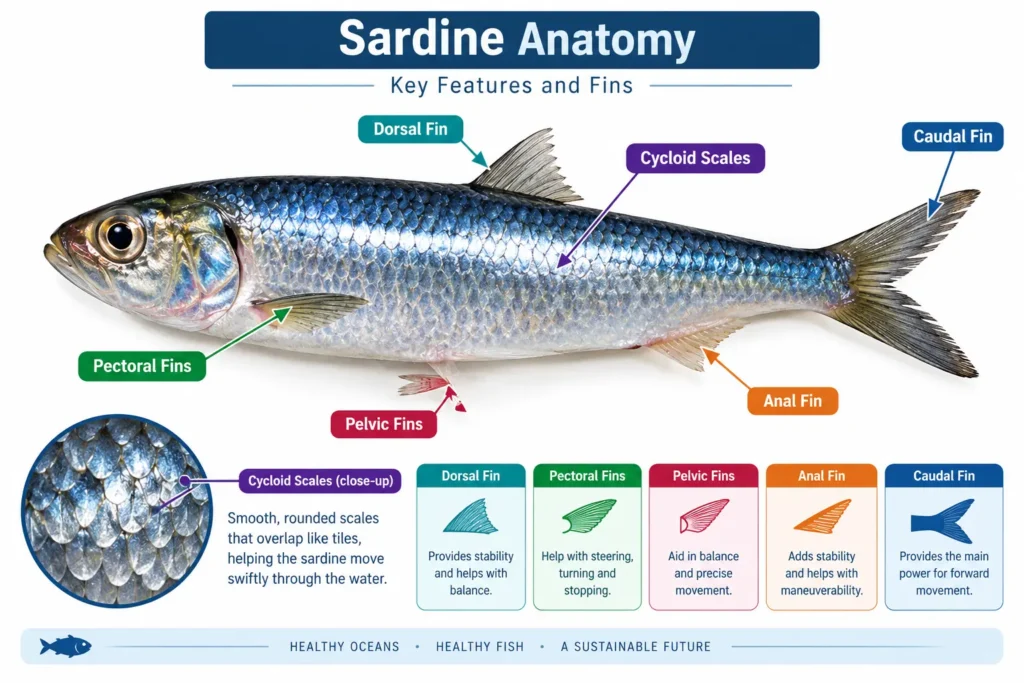
Do sardines have scales and fins? Absolutely. Sardines belong to the Clupeidae family—the same biological group as herrings—and like most bony marine species, they come equipped with a lightweight coat of armor.
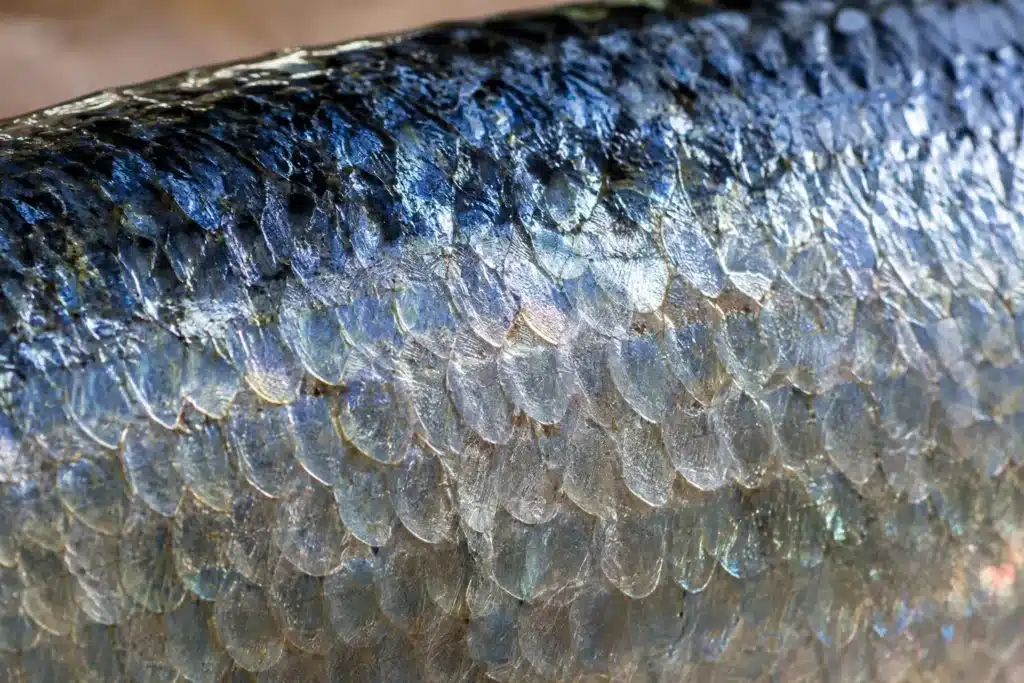
Their scales are round, paper-thin, and overlap like shingles on a roof. That distinctive metallic sparkle you see on fresh fish comes from stacked layers of reflective guanine crystals inside their skin cells. This built-in mirror effect confuses predators below by reflecting light from the water’s surface.
Scientists classify sardine scale type as cycloid. Unlike the prickly, serrated scales found on game fish like bass or perch, cycloid scales feature completely smooth, rounded edges. They are also loosely anchored into the skin pocket. Because of this, sardines lose a large chunk of their scales naturally whenever they brush against each other in tight schools or rub up against commercial fishing nets.
What Types of Fins Do Sardines Have?
To make sense of sardine anatomy, it helps to look at how these fast-moving fish maneuver through the water. Sardines belong to the ray-finned class (Actinopterygii). Their fins consist of thin, flexible webs of skin held together by bony struts called fin rays.
A typical sardine uses five main fin structures to stay agile:
- Dorsal Fin: Placed smack in the center of the spine to keep the fish stable during quick swerves.
- Pectoral Fins: Sitting right behind the gill covers on either side, working like tiny oars for steering and braking.
- Pelvic Fins: Positioned lower down on the belly to control rising and diving depths.
- Anal Fin: Located near the tail on the underside, acting like a keel on a boat to prevent rolling.
- Caudal Fin: The deeply notched tail fin that generates quick bursts of forward speed.
Are Sardines Considered Clean Fish to Eat?
Sardines are widely regarded as one of the cleanest, safest choices in the seafood aisle. When cooks and nutritionists talk about “clean fish,” they usually mean seafood with minimal exposure to heavy metals like mercury, microplastics, and industrial runoff.
Because sardines sit near the bottom of the marine food chain, their daily diet consists almost entirely of microscopic phytoplankton and zooplankton. They do not eat smaller fish, nor do they live long enough to absorb toxic compounds. Unlike massive apex hunters like swordfish, shark, or bigeye tuna, sardines simply do not accumulate heavy toxins in their muscular tissue.
Most commercial sardines are wild-caught straight from open ocean waters. They aren’t raised in crowded commercial fish pens that rely on synthetic feeds or heavy doses of antibiotics. Nutritionally, that makes them a pristine protein source packed with marine omega-3s, essential calcium, and high levels of vitamin B12.
From a traditional perspective, sardines also hit every marker for biblical dietary purity. Ancient standards (like Jewish kashrut) define clean aquatic species by two clear anatomical rules: they must have true fins and removable scales. Sardines check both boxes easily.
Do Canned Sardines Still Have Scales and Fins?
When you buy tinned fish, dealing with prep work can be confusing. It’s completely normal to wonder about canned sardines scales and fins because canned seafood manufacturers almost never peel, scale, or trim these tiny fish before packing them into oils or sauces.
The good news? You can eat the entire fish—skin, fins, scales, and bones—without any prep at all.
During factory processing, packed tins go into industrial pressure cookers called retorts. The combination of high heat and steam turns stiff bones soft and renders delicate scales virtually invisible. By the time you peel back the aluminum lid, the scales and fins are tender, easily digestible, and completely safe to eat straight from the can, over warm toast, or tossed into pasta.
Are Sardines Considered Kosher Because They Have Fins and Scales?
Under Jewish dietary laws (kashrut), aquatic animals are split into two categories: kosher and non-kosher. To be considered kosher, a fish must possess both fins and true scales that can be removed without tearing the skin.
Because all sardine species develop both rayed fins and removable cycloid scales, they are 100% kosher. Unlike shellfish, eels, or bottom scavengers, wild-caught sardines meet every physical standard required by kosher certification boards around the world.
Does Sardines Have Fins and Scales – FAQs
Do anchovies have fins and scales?
Yes. Anchovies are small, bony ocean fish that carry both distinct fins and delicate, silvery scales across their bodies.
Does mackerel have fins and scales?
Yes. Mackerel are fast-swimming, ray-finned fish covered in tiny, ultra-smooth scales that help reduce water drag.
Does sardines have scales and fins?
Yes. Sardines feature thin, flexible cycloid scales and a complete set of rayed fins.
Do sardines have fins and scales?
Yes, they do. Their fins help them navigate in massive schools, while their reflective scales provide vital ocean camouflage.
Are sardines bottom feeders?
No. Sardines are open-water (pelagic) fish. They swim near the surface and mid-depth columns of the ocean, filtering plankton out of the water.
Does sardines have scales?
Yes, sardines are covered in thin, shiny scales that give them their signature mirror-like exterior.
Do sardines have fins and scales?
Yes, possessing both traits is a primary biological requirement for all members of the herring (Clupeidae) family.
Are sardine scales hard to digest?
Not at all. Sardine scales are paper-thin, and the high-heat pressure cooking used during canning softens them until they melt away during chewing.
Do you need to clean scales off fresh sardines?
If you’re cooking whole fresh fish, a quick wipe down with a butter knife or paper towel gently lifts off any remaining loose scales, though many cooks leave them on when grilling whole.
Why are sardine scales so shiny?
Sardine scales hold microscopic guanine crystals that bounce light back into the surrounding ocean, making the fish hard for predators to spot from below.
Final Thoughts on Sardine Anatomy and Nutrition
Clearing up how fish are built makes cooking and eating them much easier. Now that you know these small swimmers carry both fins and scales, you can add them to your meal rotation without second-guessing what’s on your plate. Choosing to eat sardines on a weekly basis is a simple way to fill your plate with wholesome, wild seafood. As a standout example of an oily fish, sardines pack incredible nutritional value into a tiny, budget-friendly package.
Beyond protecting your cardiovascular health with essential fats, the health benefits of these tiny powerhouses include mineral density and high-quality protein. Whether you keep a stash of tins in your pantry or pick up fresh catches at the seafood counter, paying attention to overall freshness guarantees brilliant flavor every time. Next time you pull back the tab on a tin, you can dig in with confidence knowing those tender scales and tiny fins are nourishing, safe, and delicious.
You might also love
- Can You Eat Bonita Fish? (Catch, Clean & Cook) Giant Bonito
- Trolling Fishing: Ultimate Guide To Trolling (19 Facts You Should Know)
- Is Marlin Good To Eat? -13 Quick Answers You (Should Know!)
- When Is The Best Time To Fish For Sharks From Shore! (Solved)
- 10 Reasons To Go For Columbia River Sturgeon Fishing Trip
- Does Tuna Fish Have Scales And Fins (Reveal The Truth!)
- What Fish Are Not Bottom Feeders? (4 Fish To Never Eat)