
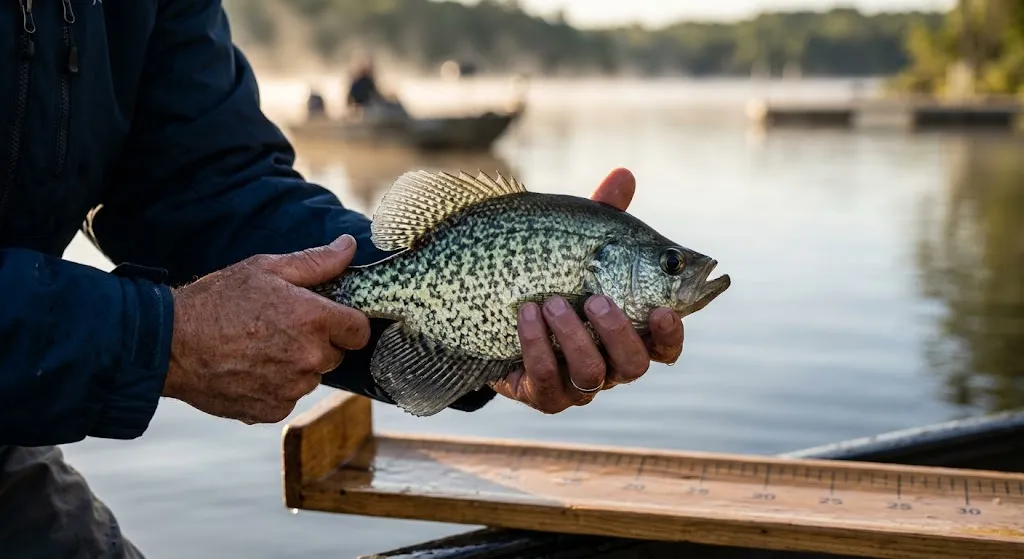
How big does a crappie have to be to keep? A crappie does not have to reach one universal length before you can keep it. The legal size depends on the state—and sometimes the exact lake—so the safest answer is: check the crappie size limit for the public waters you plan to fish before you go.
Many anglers use 10 inches as a practical keeper benchmark, and some states use it as a statewide minimum. Texas, for example, sets a 10-inch minimum length and a 25-fish daily bag for white crappie, black crappie, hybrids, and subspecies; Oklahoma has no statewide minimum length for crappie, although several lakes and public fishing areas have special rules.
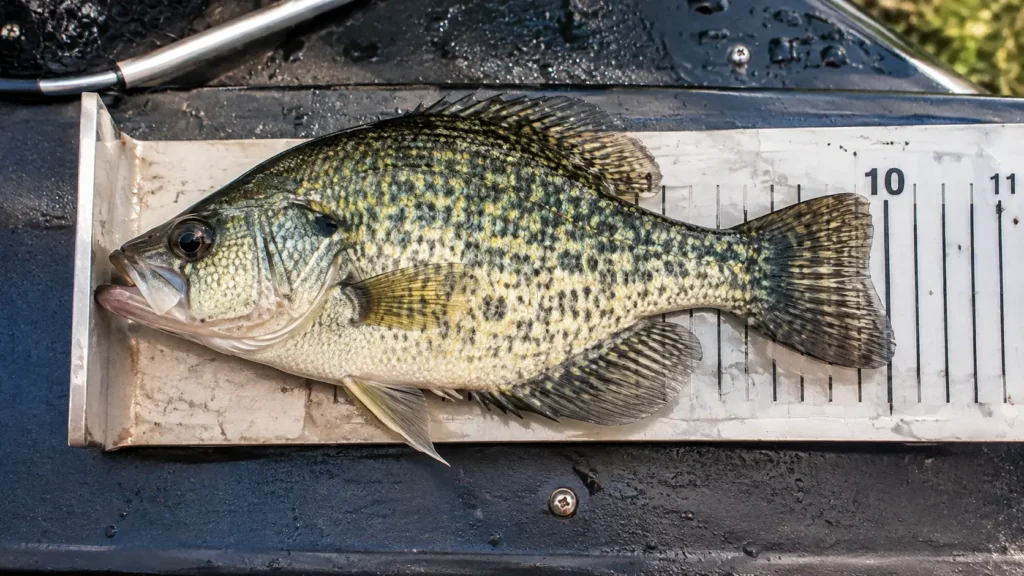
How Big Does a Crappie Have to Be to Keep?
The short answer is: a crappie must meet the minimum length limit for the water you are fishing. If that water has no minimum crappie length, a legally caught crappie may be kept at any size, subject to the daily creel limit.
For example:
- Texas: Keep crappie only if they measure at least 10 inches. The crappie daily bag limit statewide is 25 in any combination.
- Oklahoma: There is no statewide minimum size limit; the statewide daily limit is 37 combined white and/or black crappie. Special waters can differ.
- Tennessee: The statewide minimum is 10 inches, with a 15-fish daily creel limit for all crappie species combined.
- Mississippi: The statewide daily creel limit is 30 combined black and white crappie, but many important reservoirs have their own minimum length and creel rules.
A 10-inch crappie is often called a “keeper” by anglers because it provides a better fillet and usually has had time to reproduce. But “keeper crappie size” is not always the same as the legal limit. On a lake with no minimum length, an 8-inch crappie may be legal; on a lake with a 12-inch minimum, it must go back.
Are There Minimum Size Limits for Crappie in Every State?
No. Not every state sets a statewide minimum length for crappie. Some states manage crappie mainly through a daily bag limit, while others use a minimum length limit, a slot limit, or water-specific rules.
This matters because a “crappie size limit” can change from one reservoir to the next, even within the same state. A statewide rule is only the starting point; the regulations section for the individual lake, river, or fish management area controls when it has a special rule. Texas Parks and Wildlife specifically notes that statewide rules apply except where exceptions are listed for certain waterbodies.
Crappie Size & Creel Limits by State: (length limit)
The crappie length limit by state table below shows examples of how much crappie rules can vary. Treat it as a quick reference, not a substitute for the current official fishing regulations.
| State | Statewide minimum crappie length | Statewide daily limit | Important exception or note |
|---|---|---|---|
| Texas | 10 inches | 25 | Special rules may apply on certain waterbodies. |
| Oklahoma | None statewide | 37 combined | Some public fishing areas and lakes have special size or bag limits. |
| Tennessee | 10 inches | 15 combined | Region 1 has a 30-fish, no-minimum exception unless a specific water says otherwise. |
| Kentucky | None statewide | 20 combined | Many individual lakes have 9- or 10-inch minimums; possession limit is 40. |
| Florida | None statewide | 25 | Some Fish Management Areas require black crappie under 10 inches to be released immediately. |
| Ohio | None statewide | 20 | Pymatuning Lake has a 9-inch minimum and 20-fish daily limit; other waters have special rules. |
| Louisiana | None in most state waters | 50; 100 possession | Lower Atchafalaya-area waters have an 8-inch minimum and 25-fish daily limit; Eagle Lake has an 11-inch minimum. |
| Mississippi | 30-fish statewide creel; no universal statewide minimum listed in the rule table | 30 combined | Sardis, Grenada, Enid, and Arkabutla require crappie over 12 inches, with a 10-fish daily creel limit. |
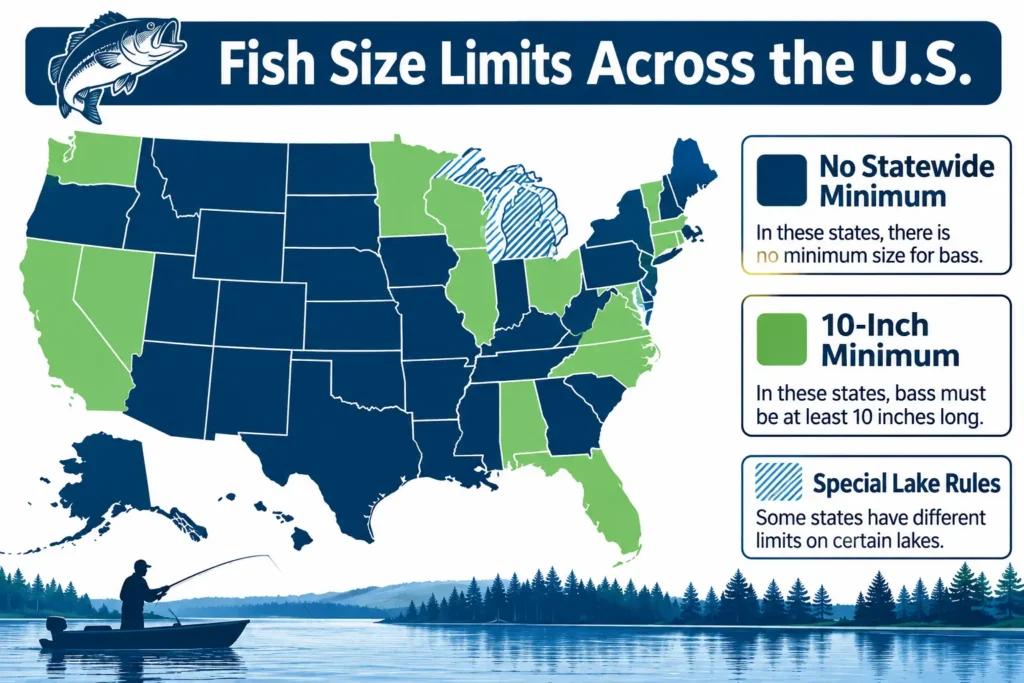
Why the same state can have different rules
Fishery managers adjust rules by reservoir because crappie populations, spawning success, fishing pressure, and habitat differ. On Mississippi’s Arkabutla, Sardis, Enid, and Grenada reservoirs, crappie must be over 12 inches and anglers may keep 10 per day; boats with three or more anglers have a 25-fish aggregate daily limit.mdwfp+3
Pickwick Lake and the Tennessee-Tombigbee Waterway in Mississippi use a 9-inch minimum with a 30-fish daily creel limit, according to the state regulation table. That is a major difference from the 12-inch rule on nearby flood-control reservoirs.
What Is the Daily Bag Limit for Crappie?
A daily bag limit—also called a daily creel limit—is the maximum number of crappie one angler may keep in a single day. A possession limit is the maximum number you may have in your possession, often after more than one day of fishing.
Examples:
- Texas: 25 crappie per day.
- Oklahoma: 37 combined white and/or black crappie per day statewide.
- Kentucky: 20 per day and 40 in possession statewide, with exceptions.
- Florida: 25 crappie per day statewide.
- Louisiana: 50 per day and 100 in possession in most state waters, with major exceptions.
Do not assume that everyone in the boat can combine limits. In many states, each licensed angler is responsible for their own daily bag and possession limit. Florida explicitly states that each angler is responsible for their own bag limit.
How to Measure a Crappie Correctly: What Anglers Need to Know
Most states measure crappie by total length: lay the fish flat, pinch the tail together if required, and measure from the tip of the snout to the farthest tip of the tail. Use a flat measuring board rather than a soft tape, because a curved fish can measure longer than it really is.
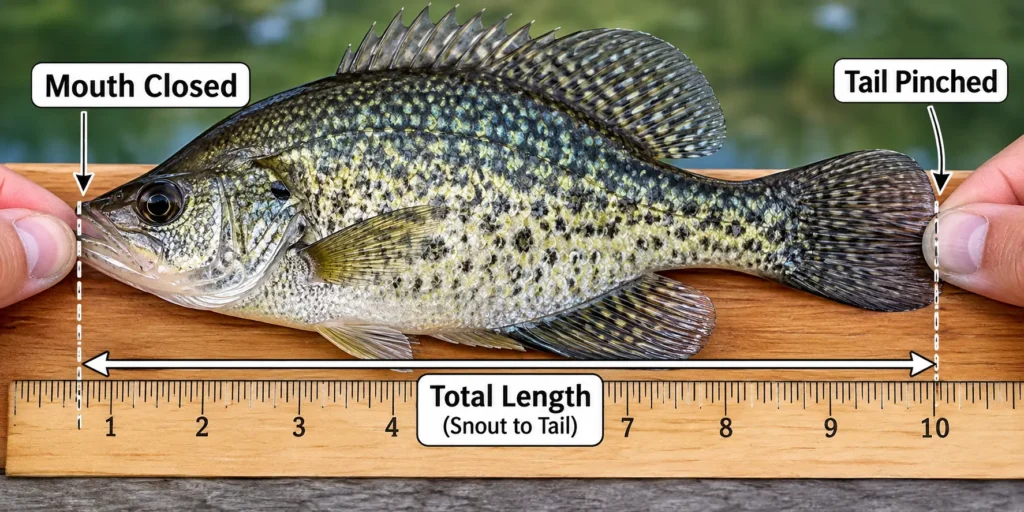
Follow this routine:
- Wet the measuring board.
- Place the crappie on its side with its mouth closed.
- Squeeze the tail lobes together if your state’s rule requires it.
- Measure from the front of the mouth to the tip of the tail.
- If the fish is even slightly under the legal limit, release it immediately.
When a fish is close to the line, do not guess. An angler who keeps a crappie under the minimum length limit can face a citation, even if the fish looked legal on the water.
What Is Considered a Keeper Crappie?
A keeper crappie is any crappie that meets the legal minimum length and daily bag rules for that water. In everyday fishing talk, many anglers call a 10-inch crappie a keeper because it is large enough for a solid fillet.
Here is a practical size guide:
| Crappie length | What it usually means |
|---|---|
| Under 8 inches | Often called a “short fish”; legal only where no minimum length applies. |
| 8–9 inches | A usable eater in some waters, but small where a 10-inch minimum applies. |
| 10 inches | A common legal minimum and a widely accepted keeper size. |
| 11–12 inches | A good keeper and a better fillet; some reservoirs require 11 or 12 inches. |
| 13 inches or more | A quality crappie in most fisheries. |
| 14 inches or more | A genuinely nice crappie for many public waters. |
A 14-inch crappie is not automatically protected or illegal to keep; it is simply a desirable size. Some regulations use a 14-inch threshold for other species, such as striped bass and hybrids in Mississippi, which have a 15-inch minimum—not crappie.
Does the Minimum Size Limit Differ for Black and White Crappie?
Usually, no. Most rules treat black and white crappie together and apply the same length limit, daily limit, and possession limit to both species and their hybrids.
Texas, for instance, lists “white, black, their hybrids & subspecies” under one crappie regulation: 10 inches minimum and 25 per day. Mississippi likewise regulates “crappie (combined black and white)” in its statewide creel table and applies lake-specific rules to both species and hybrids.
The exception is not the species—it is the location. A lake may have a special rule for black crappie, white crappie, or both. Florida’s Northeast Fish Management Area, for example, requires black crappie under 10 inches to be released immediately.
Can You Keep Crappie That Are Smaller Than the Legal Limit?
No. If the water has a minimum length limit, keeping a smaller crappie is unlawful. Release it immediately and handle it carefully.
To improve survival:
- Use long-nose pliers to remove the hook quickly.
- Keep the fish in the water while unhooking when possible.
- Avoid squeezing the belly or touching the gills.
- Release the fish gently rather than tossing it back.
- Do not put short fish on a stringer “just in case.”
A crappie caught below the minimum size must be returned to the water. On lakes with special rules, fish that are under the limit may also need to stay intact until you finish fishing for the day; Florida applies that rule to black crappie and panfish where minimum-length or slot-size limits apply.
Why Do Fishing Regulations Set Minimum Crappie Sizes?
Minimum crappie sizes protect young fish long enough for many of them to spawn at least once. That helps maintain a strong future population, especially on heavily fished reservoirs.
Agencies may also use:
- Minimum length limits to prevent harvest of small fish.
- Slot limits to protect a middle size range while allowing harvest of smaller or larger fish.
- Daily creel limits to spread the catch among more anglers.
- Boat limits to cap the total harvest from a group.
- Water-specific rules to fit local crappie populations.
Mississippi’s flood-control reservoir rules show how targeted management works: the 12-inch minimum and 10-fish daily creel limit are stricter than the statewide 30-fish creel limit because those reservoirs receive heavy crappie fishing pressure.
How to Check Local Crappie Fishing Regulations Before You Go
Check the official wildlife agency for the state where you will fish—not a forum post, old blog article, or memory from last season. Rules can change annually or mid-season.
Use this quick checklist:
- Search the state wildlife agency’s freshwater fishing regulations.
- Open the statewide crappie table.
- Search for the exact lake, river, reservoir, or fish management area.
- Confirm the minimum length, daily creel, and possession limit.
- Check border-water rules if the lake crosses a state line.
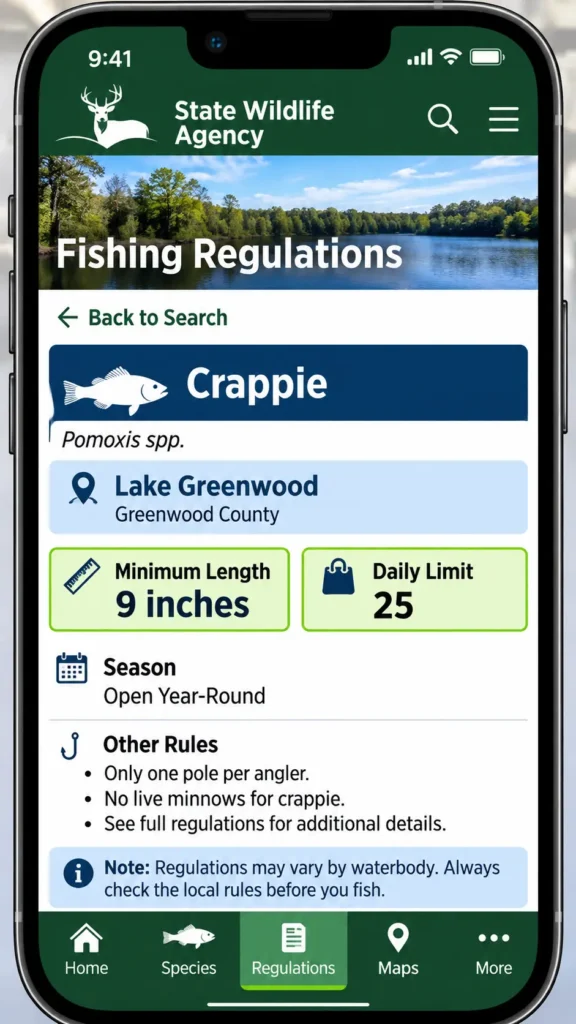
- Save a screenshot or offline copy of the regulations section before launching.
For example, Kentucky Reservoir has a reciprocal agreement with Kentucky, but anglers must follow the regulations of the state in which they are fishing. On the Tennessee portion, crappie have a 10-inch minimum and 20-fish daily limit. That kind of border-water detail is easy to miss and can turn a legal limit into a violation.tn
Creel and Possession FAQs to Anglers
What size crappie is a keeper?
A keeper is any crappie that meets the legal minimum length for that water. Ten inches is a common keeper size, but some lakes allow smaller fish and others require 11 or 12 inches.
Is a 10-inch crappie big enough to keep?
Often, yes. Ten inches is the statewide minimum in Texas and Tennessee, and it is a common target size for anglers.
Is there a minimum size limit on crappie in Oklahoma?
Not statewide. Oklahoma lists no minimum size limit for white and/or black crappie, with a 37-fish combined daily limit, but special waters can have different rules.
What is the crappie limit in Texas?
Texas has a 10-inch minimum length and a 25-fish daily bag limit for white crappie, black crappie, hybrids, and subspecies. Special waterbody exceptions may apply.
Can I keep a 9-inch crappie?
Only if the water has no minimum length limit or specifically allows 9-inch crappie. For example, Mississippi’s Pickwick/Tennessee-Tombigbee rule lists a 9-inch minimum, while Oklahoma has no statewide minimum.
Do black crappie and white crappie have separate limits?
Usually not. Most states regulate them together, although a particular lake may have a special rule for one species.
What happens if I keep an undersized crappie?
You may be cited or fined. Release any crappie that does not meet the minimum length immediately.
Does the daily limit include fish I release?
No. A daily creel limit applies to fish you keep, not fish you catch and release.
What is the maximum size limit for bass in Alabama?
Alabama generally has no statewide maximum size limit for black bass; statewide rules focus on a 10-fish daily creel limit and a 15-inch minimum for largemouth and smallmouth bass. Some waters use slot limits or a cap on fish over 22 inches, so check the rules for your specific lake.
How old is a 10-inch crappie?
A 10-inch crappie is usually about 3 to 4 years old in productive southern waters, though it may take 5 to 6 years in slower-growing fisheries. Growth depends heavily on food availability, water temperature, habitat, and genetics.
Why soak crappie in salt water?
People soak crappie in salt water to draw out remaining blood, reduce a “fishy” taste, firm the delicate fillets, and help them retain moisture during frying. It can also make the meat look whiter and cleaner.
Conclusion
So, how big does a crappie have to be to keep? It depends on where you fish. There is no single nationwide Keeper Size for Crappies. A 10-inch fish is a useful benchmark and is the legal minimum in states such as Texas and Tennessee, but Oklahoma has no statewide minimum, while several Mississippi reservoirs require crappie over 12 inches.tpwd.texas+3
Before you keep a single fish, check the current fishing regulations for the exact public waters you plan to fish. Confirm the minimum length limit, daily creel limit, and possession limit, then measure each crappie carefully. If a fish is close to the legal limit, release it. That simple habit protects the fishery, keeps you compliant, and leaves more quality crappie for the next angler.
Recommended posts
- How Big Do Bluegill Have to Be to Keep! (Must-Know Rules!)