
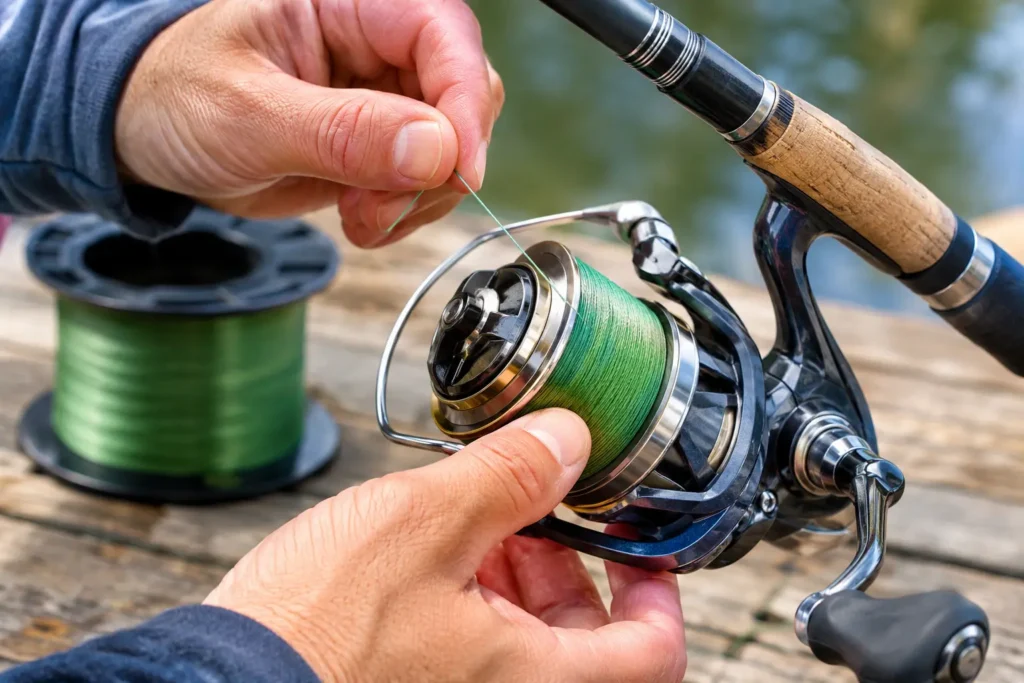
How much braid to put on a reel? Fill the spool until the braid sits about 1/16 to 1/8 inch below the spool lip. Most anglers need 100–150 yards of usable braid for freshwater and 150–300 yards for saltwater, with mono backing underneath when the spool is deeper than the braid requires. The exact amount depends on reel capacity, braid diameter, casting distance, and the fish you target.
A full spool casts farther and reduces friction on the rod guides. An overfilled spool throws loose loops, wind knots, and tangles. The goal is a nearly full spool—not a spool packed past its edge.
Quick Jump
ToggleHow Much Braid Should You Put on a Fishing Reel?
For most spinning reels, put on enough braid to leave a small visible gap below the spool lip. A practical target is 1–3 mm, or roughly 1/16 to 1/8 inch, below the rim.
The right amount depends on four things:
-
Reel capacity: Check the numbers printed on the spool or in the manual.
-
Braid diameter: Thinner braid takes less space, so a reel holds more yards of it.
-
Casting distance: Long casts and running fish require more reserve line.
-
Target fish: Bottom fish, boat fish, and fast saltwater species may demand more line.
For everyday bass, walleye, trout, and panfish fishing, 100–150 yards of braid is usually plenty. For surf, pier, inshore, or offshore fishing, plan for 200–300 yards or more.
How to Calculate the Right Amount of Braided Line
Start with the reel’s rated capacity. A spool label may read something like “10 lb braid / 150 yd” or “0.13 mm / 140 m.” That is your best starting point because reel models vary even when they share the same size number.
Use this simple method:
-
Decide how much braid you want as your working line.
-
Add a safety margin for break-offs, retying, and fish runs.
-
Use mono backing to fill the remaining space.
-
Stop winding when the braid reaches just below the lip.
A useful rule: keep 50–100 yards as your main working braid, then add enough reserve for the water you fish. If you fish from a boat near structure, 100 yards may be enough. If you fish open beaches, deep water, or fast-moving fish, carry 150–300 yards.
Quick Formula for Backing
You do not need an exact mathematical answer to fish well. But line capacity changes with diameter: a line with twice the diameter occupies about four times the spool volume.
A practical approach:
-
Put your desired amount of braid on first.
-
Fill the rest with cheaper mono backing.
-
Reverse-wind it onto another spool if needed, so the backing ends up underneath.
-
Finish with braid on top at the correct fill level.
How Much Braid Fits on Different Reel Sizes?
Reel capacity changes by brand, spool depth, and line diameter. The table below gives practical starting ranges rather than universal rules.
| Reel size | Common braid strength | Useful braid amount | Best use |
|---|---|---|---|
| 1000–2000 | 4–10 lb braid | 100–150 yards | Trout, panfish, ultralight lures |
| 2500–3000 | 10–20 lb braid | 120–180 yards | Bass, walleye, light inshore |
| 4000–5000 | 15–30 lb braid | 150–250 yards | Pike, stripers, redfish, snook |
| 6000+ | 30–50 lb braid | 250–400+ yards | Surf, heavy inshore, boat fishing |
For example, a 3000-size spinning reel often works well with 150 yards of 15–20 lb braid plus backing. A 4000-size reel may suit 200 yards of 20 to 30lb braid for larger freshwater fish or light saltwater work.
How to Choose the Right Braided Line Strength
Choose braid strength for the cover, lure weight, rod, and fish—not just the reel size.
-
4–10 lb braid: Finesse fishing, clear water, small lures, trout and panfish.
-
10–20 lb braid: All-around bass, walleye, and general spinning-reel fishing.
-
20–30 lb braid: Heavy cover, larger baits, pike, redfish, and light saltwater.
-
30–50 lb braid: Surf fishing, big inshore species, and boat fishing around structure.
A 20 lb braid is a strong all-around choice for many freshwater anglers, while 30 lb braid suits anglers fishing thick vegetation, current, or larger saltwater fish. Braid is much thinner than mono at the same breaking strength, so it takes up less room on the spool.
Should You Fill Your Reel With Braid or Use Backing?
Use mono backing when your reel holds more line than you need. Backing fills the deep part of the spool, saves money, and helps braid grip the arbor.
Use braid only when:
-
Your reel is braid-ready and has a rubber or textured arbor.
-
You need maximum line capacity for long runs.
-
You are fishing deep water or open surf.
Use backing when:
-
Your spool is deep.
-
You only need 100–150 yards of working braid.
-
You want to avoid wasting expensive line.
-
Braid slips on a bare spool.
Tie the mono to the spool with an arbor knot, join the braid with a strong knot such as a double uni or Albright, and trim the tags close. This creates a smooth transition through the rod guides.
How Much Braid Do You Need for Freshwater Fishing?
Most freshwater anglers do not need a completely full spool of premium braid. 100–150 yards covers the majority of bass, walleye, pike, and trout situations.
Use these starting points:
-
Trout and panfish: 100 yards of 4–8 lb braid.
-
Bass and walleye: 120–150 yards of 10 to 20lb braid.
-
Pike and musky: 150–200 yards of 30–50 lb braid.
-
Heavy cover: 150 yards of 20–30 lb braid, with a fluorocarbon leader if needed.
If you cast a light lure all day, do not overload the spool. Too much line increases loose wraps and wind knots, especially on spinning tackle.
How Much Braid Do You Need for Saltwater Fishing?
Saltwater fish often make longer runs, so keep more line on the reel. A good baseline is 150–200 yards for inshore fishing and 250–300 yards or more for surf, pier, and offshore applications.
Common saltwater setups:
-
Inshore redfish, snook, and seatrout: 150–200 yards of 15–30 lb braid.
-
Pier and jetty fishing: 200–300 yards of 20–40 lb braid.
-
Surf fishing: 250–300+ yards of 30–50 lb braid.
-
Bottom fish from a boat: Enough braid to reach the bottom with reserve for current and fish runs.
Saltwater also corrodes line faster. Inspect the first 20–30 yards often, cut back worn line, and respool when the braid looks faded, fuzzy, or weakened.
How Full Should You Spool a Fishing Reel With Braid?
Fill the spool until the braid is just below the lip. For many spinning reels, leave about 1/8 inch of space; some anglers go as close as 1/16 inch for maximum casting distance.
Do not fill the line above the lip. Overfilling causes the braid to spring off in loose coils, wrap around the spool, and create tangles during a cast. If you see line jumping off when you open the bail, remove a few wraps and test again.
Fill-Level Test
-
Make several normal casts.
-
Watch for loose loops or line coming off in bunches.
-
If that happens, remove line until casts settle down.
-
If casts feel short or line rubs the spool edge, add a little more braid.
Common Mistakes When Putting Braid on a Reel
Avoid these errors before you tie on a lure:
-
Overfilling the spool. Leave a small gap below the lip.
-
Putting braid directly on a slippery spool. Use mono backing, electrical tape, or a braid-ready arbor.
-
Spooling with no tension. Loose braid digs into itself under pressure.
-
Using the wrong line capacity. Two 3000-size reels can hold different amounts of the same braid.
-
Ignoring diameter. Pound test alone does not tell you how much line fits.
-
Skipping the leader. Braid is visible and can be hard on rod guides and fish mouths; add fluorocarbon or mono where needed.
-
Winding too much braid for short-range fishing. Save money by using backing underneath.
How to Spool Braided Line on a Reel Step by Step
-
Check the reel capacity. Read the spool label or manual for the recommended lb/yd rating.
-
Attach mono backing. Tie it to the spool with an arbor knot and wind on enough to create a firm base.
-
Join the braid. Use a double uni or Albright knot, then trim the tag ends close.
-
Run line through the rod guides. Keep the rod tip low and make sure line would flows smoothly.
-
Maintain tension. Have a partner hold the filler spool with light pressure, or run the braid through a folded towel while you reel.
-
Fill to just below the lip. Stop at about 1/16 to 1/8 inch below the edge.
-
Test-cast. Adjust the amount if you see loose coils or poor casting distance.
-
Tie on your lure or leader. Use a improved clinch, Palomar, or leader knot suited to your setup.
Wear a glove or towel when handling braid. It can cut skin under pressure.
FAQs
How much braid to put on a spinning reel?
Put on enough braid to leave about 1/16 to 1/8 inch below the spool lip. For most freshwater spinning reels, 100–150 yards of braid over mono backing is enough.
How much braided line to put on a spinning reel?
Use 120–180 yards on a 2500–3000 reel for general fishing. Use 150–250 yards on a 4000–5000 reel for larger freshwater fish or light saltwater species.
How much fishing line to put on a spinning reel?
Fill the spool nearly full, but never past the lip. If you use braid, add mono backing underneath so the spool reaches the correct height without wasting expensive braid.
Can I put braid directly on a reel?
Sometimes. If the spool is braid-ready, you can. On a bare metal spool, braid may slip under pressure, so use mono backing or electrical tape for grip.
How much mono backing should I use under braid?
Use enough mono to fill the spool after you add your desired braid. Many anglers fill roughly two-thirds to three-quarters of the spool with backing, then add braid on top.
Is 150 yards of braid enough?
For most freshwater fishing, yes. It is also enough for many inshore situations. Surf, deep water, and fast-running fish may require 200 to 300 yards or more.
Should I fill the spool completely with braid?
Fill it nearly full, but leave a small gap below the lip. A completely overfilled spool can spill line during casts and cause tangles.
How much 20 lb braid fits on a 3000 reel?
It varies by reel model and braid brand, but many 3000-size reels can hold roughly 150–250 yards of 15–20 lb braid. Always check the exact capacity printed on your spool.
Does braid casting distance depend on spool fill?
Yes. A properly filled spool reduces friction and improves casting distance. Too little line forces the braid to rub the spool edge; too much line creates loose coils.
How often should I respool braid?
Respool when the braid looks faded, frayed, or fuzzy. Many anglers replace the top portion every season, or sooner after fishing around rocks, sand, oysters, or heavy cover.
Conclusion
Knowing how much braid to put on reel comes down to one simple rule: fill the spool almost full, but leave a small gap below the lip. For most freshwater anglers, 100–150 yards of braid over mono backing is enough. Saltwater anglers, surf fishermen, and boat anglers should carry 200–300 yards or more for long runs and deep water.
Check your reel’s printed capacity, match the braid diameter to your tackle, and use backing when the spool is deeper than you need. Avoid overfilling, keep steady tension while winding, and test-cast before your first fishing trip. When your spool is filled correctly, your casts travel farther, your lure works better, and you have enough line to catch fish when it matters.
You might also love: