
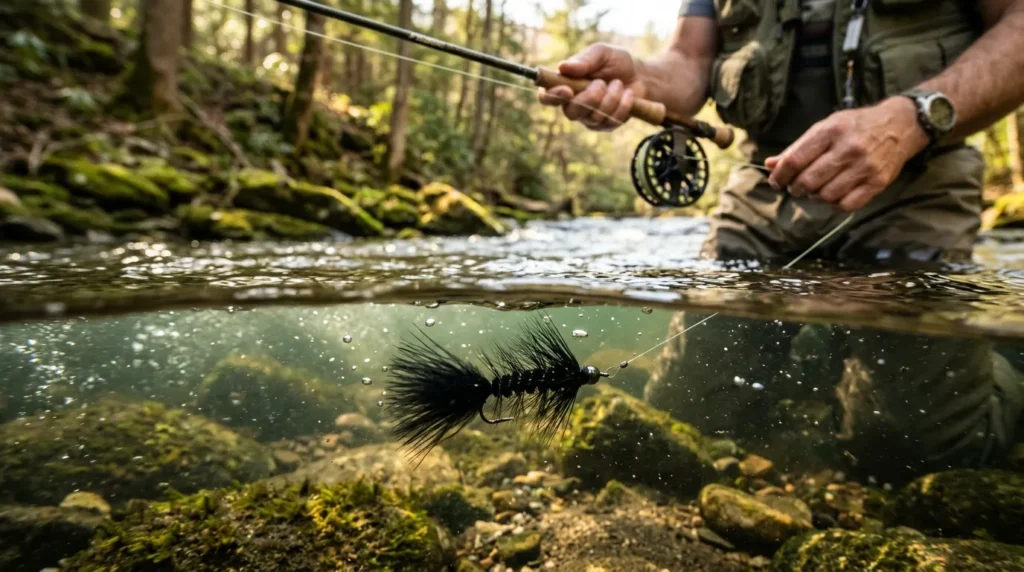
Learning how to fish a Woolly Bugger fly can help you catch trout, bass, and other predatory fish in rivers, streams, and lakes. But what makes this classic fly so effective? Its marabou tail, chenille body, and flowing hackle create lifelike movement that triggers aggressive strikes.
To fish a Woolly Bugger, cast across or upstream, let the fly sink to your target depth, and retrieve it with short, steady strips. You can also swing it through current or use a dead drift to imitate natural prey. Fly-fishing expert Tom Rosenbauer of Orvis emphasizes matching your presentation to water conditions and fish behavior.
From choosing the right Woolly Bugger size and color to mastering retrieves, depth control, and seasonal techniques, the right approach can make a big difference. Whether you’re targeting hungry trout in moving water or bass around lake structures, these practical tips will help you fish this versatile streamer with confidence. Let’s get started!
Woolly Buggers Don’t Count: Trout Fishing Adventures in the Driftless Area – Learn How Experienced Anglers Catch More Trout!
What Is a Woolly Bugger and Why Does It Catch Fish?
A Woolly Bugger is a subsurface fly pattern built around a hook, marabou tail, chenille body, and palmered hackle. The marabou tail pulses with every strip, current seam, and rod-tip movement, while the hackle fibers create a buggy silhouette that trout can easily recognize as food.files.
The fly does not imitate one exact insect. Instead, it suggests several food forms at once: a swimming leech, a small sculpin or minnow, a crayfish, a stonefly nymph, or a damselfly nymph. That flexibility is why it remains a staple in most fly boxes.files.
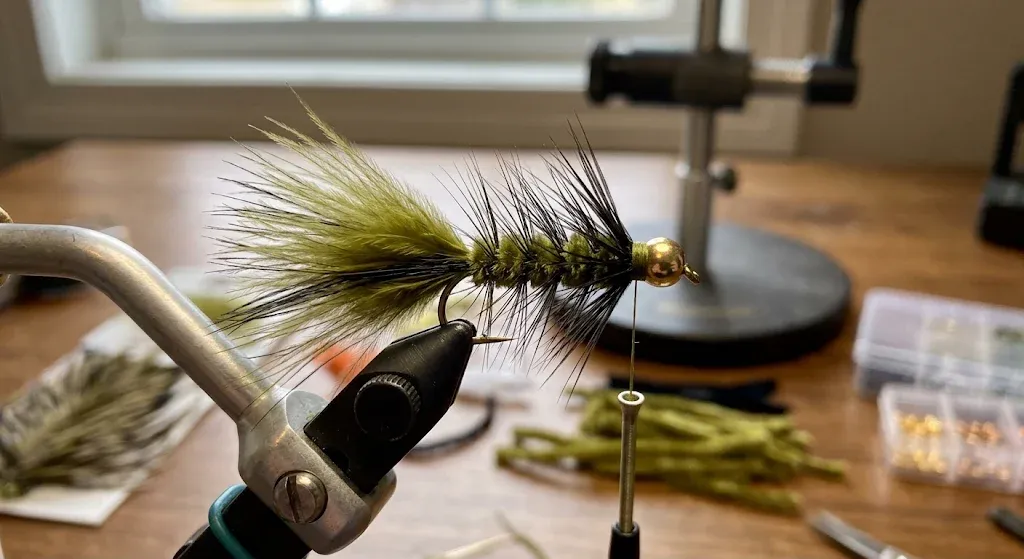
Trout and bass respond to movement as much as exact imitation. When the fly swims, pauses, rises, or darts near cover, it can trigger a chase response—especially from rainbow trout, brown trout, smallmouth bass, and largemouth bass.
What Fishing Gear Do You Need for a Woolly Bugger?
For most trout fishing, start with a 9-foot, 5-weight or 6-weight fly rod. A 5-weight handles smaller streams and average trout well, while a 6-weight gives you more control in wind, deeper water, and when casting larger streamers.
Use a weight-forward floating line for versatility. Add a sinking-tip or intermediate line when trout hold below the surface in lakes, deep pools, or fast runs.
A 7.5- to 9-foot tapered leader works well for many river presentations. For streamer fishing, many anglers shorten the leader to 5 or 6 feet so the fly turns over more easily; use 3X to 5X tippet depending on fly size, water clarity, and fish size.
Bring these basics:
- A fly box with olive, black, brown, and white Buggers
- Bead-head and unweighted versions
- Split shot or a sink-tip line for deeper water
- Nippers, forceps, and a small net
- Polarized sunglasses for spotting structure and fish
How to Choose the Right Woolly Bugger Size and Color
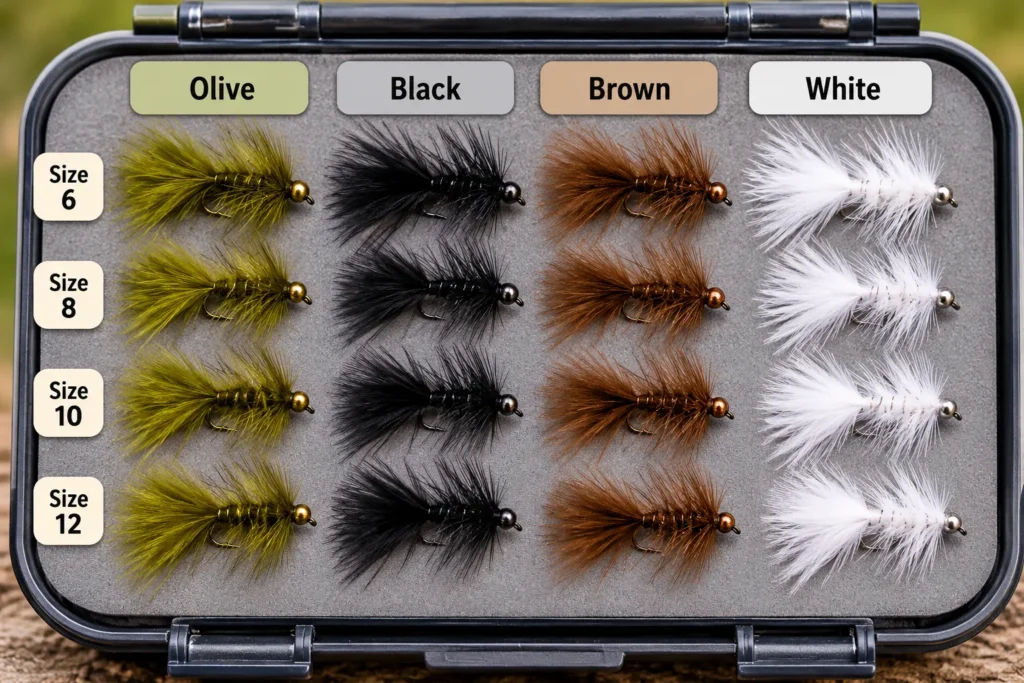
The best Woolly Bugger size for trout is usually size 8 or 10. Size 6 works well for larger trout, bass, and faster or deeper water, while size 12 can be effective in clear, slow, or heavily pressured streams.
| Situation | Recommended size | Best color |
|---|---|---|
| Small stream, clear water | 10–12 | Olive or brown |
| Average trout river | 8–10 | Olive, brown, or black |
| Deep pool or stained water | 6–8 | Black or dark olive |
| Bass fishing | 4–8 | Black, white, olive, or baitfish colors |
| Lake or pond | 8–10 | Olive, black, brown, or white |
Olive is the best first choice because it reads as a natural leech, damsel nymph, or small baitfish. Black creates a strong silhouette in stained water or low light, brown works well around woody cover and rocky bottoms, and white can imitate a baitfish in clearer water.
Match the color scheme to conditions rather than trying to match a single insect. In clear water, choose smaller and more natural tones. In murky water, choose black, larger profiles, or a slightly flashy pattern that trout can see.
How to Fish a Woolly Bugger: Step-by-Step Instructions
We’ll share practical advice inspired by respected fly-fishing authorities such as Orvis and expert angler Tom Rosenbauer. Ready to put this versatile streamer to work? Let’s get started!
1. Tie on the fly
Use an improved clinch knot, loop knot, or non-slip loop knot to attach the Bugger to your tippet. A loop knot can give the fly a little extra freedom to move, while a clinch knot is simple and dependable for beginners.
2. Make an accurate cast
Pick a precise target before casting: the seam beside a boulder, the edge of a weed bed, the tail of a pool, or the shadow line beneath an undercut bank. Cast slightly upstream or across current so the fly has time to sink before it reaches the fish.
3. Let it sink
Count down before retrieving. Start with a two-second sink, then add time until you begin ticking bottom or contacting fish. A bead head, lead-free wire wraps, split shot, or sinking-tip line can help the fly reach deeper water.
4. Retrieve naturally
Begin with short strips, then pause. The pause matters because the marabou tail and hackle fibers continue to move after the fly stops, which often convinces a following trout to commit.
5. Detect the take
Keep the line tight enough to feel the fly. A trout may bump the fly, follow it, nip at the tail, or crush it during the pause. Set the hook only when you feel weight or see the line move decisively.
The Best Woolly Bugger Retrieve
The best Woolly Bugger retrieve is usually a strip-and-pause retrieve: make one or two short strips, pause for one to three seconds, then repeat. This creates movement without making the fly race away from a trout.
Try these retrieves in the same run before changing flies:
- Slow and steady retrieve: Use a continuous hand-twist retrieve in cold water or when trout are sluggish.
- Strip-and-pause retrieve: Strip 4 to 12 inches, pause, then strip again; this is a dependable default.
- Dead drift: Let the fly tumble naturally downstream like a large nymph, especially with a bead-head version.
- Swing: Cast across and slightly downstream, then let the current pull the fly across the seam.
- Short strips and twitches: Add small rod-tip twigs to imitate a wounded baitfish, crayfish, or leech.
Do not assume fast stripping is always best. A fly that swims naturally and stays available to the fish often produces more takes than one ripped quickly through the water.
How to Fish a Woolly Bugger in Rivers and Streams
In a river, target trout where they can feed without fighting strong current. Look for seams, riffle edges, pool tails, current breaks behind boulders, submerged logs, and undercut banks.
Cast upstream or across current, mend the line if needed, and let the fly sink into the trout’s feeding lane. A dead drift works well when trout are keyed on nymphs or leeches; a swing or strip retrieve works better when fish are willing to chase.
For a basic river approach:
- Cast across and slightly upstream.
- Let the Bugger sink for two to four seconds.
- Make a small upstream mend to reduce drag.
- Let the fly swing through the seam.
- Strip it back with short pulls and pauses.
- Repeat at a slightly different depth or angle.
Work every likely holding spot methodically. Start close to your position, lengthen each cast by a foot or two, then move downstream and repeat the sequence. flylordsmag
How to Fish a Woolly Bugger in Lakes and Ponds
In a lake, target weed edges, drop-offs, submerged timber, rocky points, and wind-blown banks. Trout often patrol these areas because they provide food, cover, and access to deeper water.
Use a floating line for shallow weed beds and shorelines. Switch to an intermediate or sinking-tip line when fish hold deeper along a drop-off or near the bottom.
A productive lake retrieve is strip-strip-pause: make two short strips, pause for a few seconds, then repeat. The stop-and-go action lets the marabou tail flare and makes the fly look like a baitfish or leech that has momentarily stopped.
In cold water, slow down. Let the fly sink longer and use a slow hand-twist retrieve. In warmer water, try faster strips, direction changes, and longer pauses until you find what triggers a strike.
When Is the Best Time to Fish a Woolly Bugger?
Early morning and late evening are often productive because trout move farther from cover to feed in lower light. Cloudy days can also improve streamer fishing because fish feel more secure leaving holding water.
Season matters too. In spring and fall, trout may chase a Bugger actively as they feed before or after spawning periods. During hot summer afternoons, fish deeper, cooler water and slow the retrieve. In winter, use a smaller fly, heavier weight, and a much slower presentation.
Water temperature affects fish behavior. Cold water calls for slower retrieves and deeper presentations, while warmer water often supports more aggressive chasing and faster strips.
Common Woolly Bugger Fishing Mistakes to Avoid
- Retrieving too quickly: Give the fly time to sink and pause where trout can see it.
- Fishing at the wrong depth: Change weight, cast angle, or line type before changing the entire fly pattern.
- Using an oversized fly: In clear or pressured water, a size 10 or 12 can outfish a size 6.
- Ignoring pauses: Many trout take the fly as it stops or begins to fall.
- Overlooking structure: Fish the edges of weeds, rocks, logs, drop-offs, and current seams—not just open water.
- Setting too early: A bump may be a short strike; wait for a firm pull or visible line movement before setting the hook.
Expert Tips for Catching More Fish With a Woolly Bugger
Change one variable at a time. If you receive follows but no takes, slow the retrieve or add a pause. If trout ignore the fly completely, change depth first, then color, then size.
A bead-head Bugger is an excellent starting point for beginners because the bead helps the fly sink and gives it a subtle jigging action. A jig hook with a slotted tungsten bead can also help the fly ride hook-point-up and reduce snags near the bottom.
Keep a simple selection in your fly boxes: olive size 8 and 10, black size 8 and 10, brown size 8, and a white or baitfish-colored Bugger for lakes. Add a few bead-head versions and a few unweighted flies so you can adjust depth without changing your entire setup.
For a new fly or unfamiliar water, start with an olive Bugger. It is one of the most effective patterns for trout because it suggests several natural food forms without looking overly specific.
Woolly Bugger fly fishing tips & FAQs
What is the best Woolly Bugger color for trout?
Olive is the best starting color for trout. Use black in stained water or low light, brown around rocky or woody cover, and white when trout are feeding on small baitfish.
What size Woolly Bugger should I use for trout?
Use size 8 or 10 for most trout fly fishing wooly buggers. Choose size 6 for bigger water or larger fish, and size 12 for clear, slow, or highly pressured streams.
Should I use a bead-head Woolly Bugger?
Yes. A bead-head Woolly Bugger is useful when trout hold deeper in pools, lakes, or fast current. An unweighted version works better in shallow riffles, clear water, or when you want a slower, more natural presentation.
How do you fish a Woolly Bugger in a lake?
Cast along weed edges, drop-offs, points, and submerged structure. Let it sink, then use short strips with pauses; adjust the retrieve until you find the speed trout prefer.
Can you dead-drift a Woolly Bugger?
Yes. A bead-head or lightly weighted Bugger can be dead-drifted like a large nymph, especially in rivers. Add an indicator or fish it tight-line style, then let it swing at the end of the drift.
Do Woolly Buggers work for bass?
Yes. Woolly Buggers work well for largemouth bass, smallmouth bass, sunfish, and even pike. Use larger sizes, darker colors, and a more aggressive strip-and-pause retrieve around cover.
What is the difference between a Woolly Bugger and a nymph?
A Woolly Bugger is usually larger and has a marabou tail, chenille body, and palmered hackle. A nymph is generally smaller and more imitative of an aquatic insect stage, although a Bugger can be dead-drifted like a nymph.files.
How do you choose where to fish a Woolly Bugger in a river?
Target seams, riffle edges, pool tails, boulders, logs, and undercut banks. Cast upstream or across, let the fly sink, then dead-drift, swing, or strip it through the current. mdc.mo
What should you change when fish aren’t striking a Woolly Bugger?
Change one thing at a time: depth, retrieve speed, color, or fly size. Try slower strips, longer pauses, a bead-head version, or a smaller olive or black Bugger.
How do you fish a Woolly Bugger in small streams or still water?
In small streams, cast across or upstream and strip, swing, or dead-drift it. In still water, target weed edges and drop-offs, then use short strips with pauses.
What id the best fly fishing kits for beginners?
The best beginner fly fishing kits include a 9-foot, 5-weight rod, matching reel, floating line, leader, backing, and a few flies. Strong options include the Echo Lift Kit, Orvis Clearwater, Redington Crosswater, and budget-friendly Maxcatch or Wild Water combos. pick one instead of tying flies your self.
Conclusion
Learning how to fish a Woolly Bugger comes down to controlling depth, movement, and presentation. Start with an olive size 8 or 10, cast across likely trout-holding water, let the fly sink, and use a strip-and-pause retrieve. If that fails, dead-drift it, swing it through a seam, or jig it slowly near the bottom.
The Woolly Bugger earns its place in every fly box because it can imitate a leech, baitfish, crayfish, or large nymph without requiring a perfect match. Change one variable at a time—depth, retrieve speed, color, or size—and you will quickly learn what the fish want that day. Whether you are fishing a small stream, a large river, or a wind-blown lake, this versatile streamer gives beginners and experienced anglers a dependable way to catch fish.
Recommended posts
- Best Wooly Bugger Size for Trout Fishing (Explained)