
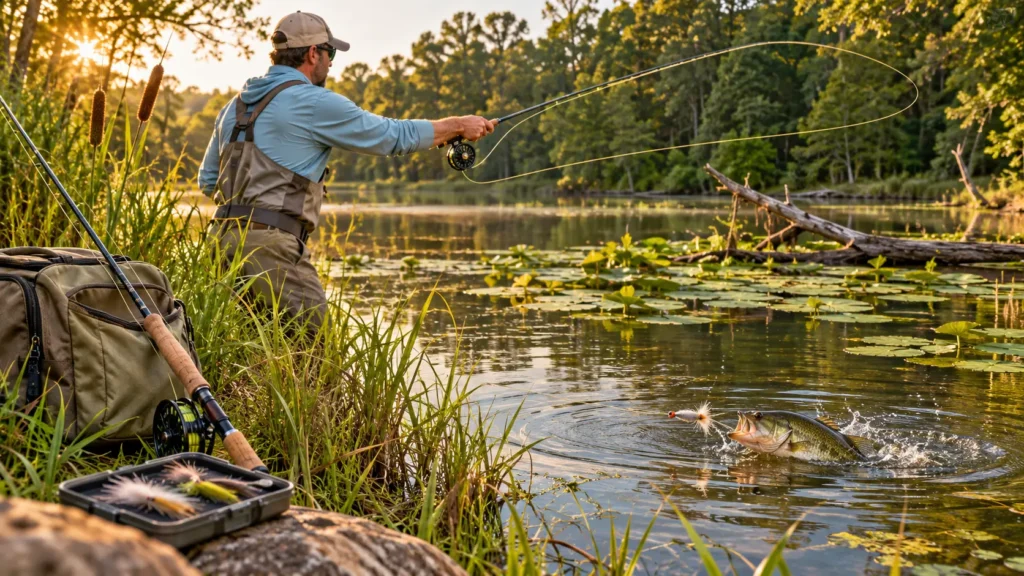
For most anglers, a 7-weight fly rod is the best all-around answer to what weight fly rod for bass fishing. It has enough power to cast poppers, streamers, and bass bugs, while still remaining comfortable for smaller flies and shorter casts.
If you mostly target largemouth bass with big topwater flies, choose an 8-weight; if you mainly fly fish for smallmouth bass with smaller streamers, a 6-weight can be the better fit.
Recommended Bass Fly Rod: Check out this versatile 7-weight fly rod setup on Amazon
Quick Answer: Best Fly Rod Weight for Bass
| Your fishing situation | Best rod weight | Why it works |
|---|---|---|
| Small ponds, creeks, and smaller bass | 5-weight | Light, fun, and accurate with small flies |
| Smallmouth bass in rivers | 6-weight | Handles smaller streamers and dry flies well |
| Mixed bass fishing, most anglers | 7-weight | Best balance of casting power and versatility |
| Largemouth bass, big poppers, wind | 8-weight | Turns over bulky flies and handles wind better |
| Heavy cover, large streamers, big lakes | 8-weight | Provides enough backbone to move big flies |
A 7 weight is the safest first choice if you want one rod for bass, bluegill, crappie, and occasional trout. Orvis lists bass among the species suited to 6- to 8-weight rods and identifies a 7-weight as useful for bass, carp, salmon, and large trout.
Quick Jump
ToggleWhat Weight Fly Rod Is Best for Bass Fishing?
The best weight fly rod for bass depends more on your fly size, wind, and water type than on the size of the fish. A small bass can crush a large deer-hair popper, while a large smallmouth may take a slim woolly bugger that casts easily on a 6-weight.
For a first bass fly rod, choose a 9-foot, 7-weight, fast-action or medium-fast rod. It gives you enough rod weight to cast a popper, streamer, or bass bug without feeling like you are carrying a broomstick. It also remains useful for trout, panfish, and other freshwater species.
When a lighter rod makes sense
Choose a 5-weight or 6-weight when you fish small water, make short casts, and use smaller flies. A 5-weight rod is enjoyable for bluegill, crappie, small bass, and light streamer fishing, but it can struggle with large, wind-resistant bass flies.
When a heavier rod makes sense
Choose an 8-weight when you fish large lakes, cast big streamers, fish from a boat, or battle wind. The extra line weight helps load the rod faster and turn over bulky bass bugs. Orvis notes that an 8-weight is especially useful for hair bugs, big poppers, and large, hairy streamers.
Understanding Fly Rod Weights for Bass
A fly rod “weight” does not mean how much the rod weighs on a scale. It refers to the line weight the rod is designed to cast. A 7wt rod is meant to cast 7-weight fly line; an 8wt rod uses 8-weight line.
The line carries the energy that turns over the fly. Heavier line can move bigger, more air-resistant flies, while lighter line offers a softer presentation and better feel with small flies.
Fly rod weight chart for bass
| Rod weight | Best flies | Best water | Best use |
|---|---|---|---|
| 5wt | Small woolly buggers, small poppers, nymphs | Ponds, creeks, small rivers | Small bass, bluegill, crappie |
| 6wt | Medium streamers, smaller poppers, crayfish patterns | Rivers, ponds, light wind | Smallmouth bass and mixed freshwater fishing |
| 7wt | Poppers, streamers, bass bugs, larger streamers | Lakes, rivers, ponds | Best all-around bass rod |
| 8wt | Big deer-hair bugs, large streamers, heavy flies | Lakes, windy banks, boats | Largemouth bass and tough casting conditions |
| 9wt | Very large flies, sinking lines, strong wind | Big water, boat fishing | Specialty bass and light saltwater use |
The number matters because it determines whether your rod can cast the fly effectively. A rod that is too light will feel unstable when you try to cast a large bass bug, while a rod that is too heavy can make small flies feel clumsy and less enjoyable.
Is a 5-Weight Fly Rod Good for Bass?
Yes, a 5-weight fly rod can catch bass, especially in small ponds, creeks, and protected river water. It works best with small streamers, nymphs, small poppers, and flies sized for panfish.
A 5 wt is a good choice if you already own a trout setup and want to try bass fishing without buying new gear. It is also a fun light rod for small bass and bluegill. However, it is not the best choice for casting big deer-hair bass bugs, large poppers, or oversized streamers.
Limitations of a 5-weight rod
- It may struggle to turn over a large bass bug.
- Wind can make accurate casting difficult.
- Big streamers can feel heavy and awkward.
- It may not provide enough backbone for thick vegetation.
- It works better for smallmouth bass than largemouth bass.
If you already have a 5-weight rod, use it with smaller flies before buying a new setup. If you are choosing your first fly rod specifically for bass, a 7wt is usually the smarter purchase.
Can You Catch Bass With a 6-Weight Fly Rod?
Yes. A 6-weight fly rod is an excellent choice for smallmouth bass, especially in rivers and medium-sized streams. It handles smaller streamers, crayfish patterns, poppers, and dry flies well.
A 6 weight is also a good option for anglers who want one rod for trout and bass. Orvis describes a 6-weight as suitable for larger trout, bass, and smaller steelhead, and its bass guidance specifically recommends a 6- or 7-weight for smallmouth when the flies are smaller.
Best uses for a 6-weight
- Fly fish for smallmouth bass in rivers.
- Cast medium woolly buggers and crayfish patterns.
- Fish smaller poppers on calm water.
- Make accurate casts around rocks, current seams, and woody cover.
- Use one rod for trout, bass, and panfish.
A 6-weight rod becomes less ideal when you need to cast large, wind-resistant flies. For largemouth bass in open water, a 7wt or 8wt will usually make casting easier.
Why a 7-Weight Fly Rod Is Ideal for Bass
A 7-weight fly rod is the best compromise for most bass anglers. It has enough power to cast poppers, streamers, and bass bugs, but it is not so heavy that it becomes tiring or awkward with smaller flies.
A 9-foot 7wt is especially useful because it gives you line control for mending, better reach over cover, and enough power to handle wind. FlyRods recommends a 7-weight as the overall best bass rod, particularly for anglers who want one setup for different bass waters.
What a 7-weight handles well
- Medium and large streamers
- Poppers and foam bugs
- Deer-hair bass bugs
- Woolly buggers
- Crayfish patterns
- Windy conditions better than a 5wt or 6wt
- Bass, bluegill, crappie, and many trout situations
A 7-weight is also a strong choice if you are new to fly fishing for bass. It gives you room to grow without forcing you to buy a separate rod for every species.
When Should You Use an 8-Weight Fly Rod for Bass?
Use an 8-weight fly rod when your flies are big, your casts are long, or the wind is strong. It is the better choice for largemouth bass in lakes, ponds with heavy vegetation, and open water where you need distance.
Orvis identifies the 8-weight as likely the best all-around rod for both largemouth and smallmouth bass because the heavier line helps drive bigger flies. An 8wt is also useful if you plan to fish for light saltwater species later, since many 8-weight rods are designed for both freshwater and inshore fishing.
Best times to choose an 8wt
- Casting large deer-hair poppers or mouse patterns
- Fishing big articulated streamers
- Casting into wind
- Fishing from a boat on a large lake
- Targeting largemouth bass around heavy cover
- Using sinking fly line or sink-tip lines
- Preparing for light saltwater fishing
An 8 weight rod is not overkill for bass. It is simply the right tool when fly size and wind demand more casting power.
Best Fly Rod Length for Bass Fishing
For most anglers, a 9-foot fly rod is the best length for bass. It provides better line control, easier mending, and more reach when casting over weeds, rocks, or brush.
| Rod length | Best use | Trade-off |
|---|---|---|
| 8-foot | Small creeks and tight cover | Less line control and reach |
| 8.5-foot | Small rivers and ponds | Good balance, slightly less versatile |
| 9-foot | Lakes, rivers, ponds, boats | Best all-around choice |
| 9-foot 6-inch | Big rivers and open water | More reach, but heavier to carry |
A 9ft rod is the most practical choice if you are choosing your first fly rod for bass. It gives you enough length to pick up line, mend around current, and keep your fly away from snags.
Choosing the Right Fly Line and Leader for Bass
Start with a weight-forward floating fly line that matches your rod. For example, use a 7-weight line with a 7-weight rod. A weight-forward taper helps turn over larger bass flies, especially poppers and hair bugs.
Fly line choices
| Line type | Best use | Example |
|---|---|---|
| Floating weight-forward | Poppers, bass bugs, shallow water | WF7F for a 7wt rod |
| Intermediate | Streamers just below the surface | Useful in clear, shallow lakes |
| Sink-tip | Streamers near weed edges and drop-offs | Good for deeper bass water |
| Full sinking line | Deep water and slow presentations | Best for experienced anglers |
For most bass fishing, begin with a floating weight-forward line. It is easier to cast, easier to repair, and works well with topwater flies.
Leader and tippet
Use a 7.5- to 9-foot tapered leader in the 8- to 12-pound range for most bass. Add 8- to 12-pound tippet when fishing around weeds, wood, or rocks.
For smaller flies and clear water, use lighter tippet. For big streamers and heavy cover, use stronger tippet. Bass are not usually line-shy, so it is better to have enough strength to pull a fish away from cover.
Best Bass Flies for Different Fly Rod Weights
The size and weight of the fly should guide your rod choice. A large popper catches air and needs more line speed than a small woolly bugger.
| Fly type | Best rod weight | Best conditions |
|---|---|---|
| Small woolly bugger | 5wt or 6wt | Ponds, creeks, calm water |
| Crayfish pattern | 6wt or 7wt | Rivers, rocky banks, shallow water |
| Small popper | 6wt or 7wt | Calm mornings and evenings |
| Large popper | 7wt or 8wt | Lakes, wind, open water |
| Deer-hair bass bug | 7wt or 8wt | Largemouth bass, weed edges |
| Large streamer | 7wt or 8wt | Lakes, rivers, wind |
| Mouse pattern | 8wt | Night fishing, heavy cover |
Poppers and surface flies create exciting topwater strikes. Streamers imitate baitfish or leeches and work well when bass are not looking up. A woolly bugger is one of the easiest first flies for a new bass angler because it casts easily and catches many freshwater species.
How to Choose the Right Bass Fly Rod for Your Fishing Style
Choosing Your First Fly Rod Weight can feel confusing when you start fly fishing. Should you pick a 3-weight, 5-weight, or 8-weight rod? Your choice affects casting distance, fly presentation, and the size of fish you can handle. So, which weight makes the best starting point?
Largemouth bass
Largemouth bass often live around weeds, docks, brush, lily pads, and other cover. They commonly take larger flies, so a 7-weight or 8-weight rod is usually the better choice. Orvis notes that largemouth often require bigger, more air-resistant flies than smallmouth.
For fishing for largemouth in ponds or small lakes, a 7wt is usually enough. For big lakes, wind, or bulky bass bugs, choose an 8wt.
Smallmouth bass
Smallmouth bass often live in rivers and rocky areas. They commonly take smaller, slimmer flies, which makes a 6-weight or 7-weight rod a great fit.
If you mainly fly fish for smallmouth bass, choose a 6wt for smaller streams and a 7wt for larger rivers or windier conditions. A 7-weight also works well if you want one rod for both smallmouth and largemouth.
Beginner recommendation
If you are new to fly fishing, buy a 9-foot, 7-weight, medium-fast or fast-action fly rod outfit. Match it with a 7-weight weight-forward floating line, a durable reel, and a 7.5- to 9-foot tapered leader.
This setup will work for bass, bluegill, crappie, and many trout situations. It also gives you enough power to cast a popper or streamer without making every cast feel difficult.
Experienced angler recommendation
If you already fly fish and own a 5-weight or 6-weight, add a 7wt for bigger bass flies. If you regularly fish big lakes, wind, or heavy cover, add an 8wt.
A fast action rod can help punch larger flies into wind, but beginners often cast better with a medium-fast action because it loads more easily at shorter distances.
Common Mistakes When Choosing a Bass Fly Rod
- Buying only for fish size instead of fly size.
- Choosing a 5-weight for big lake largemouth bass.
- Using a rod that is too heavy for small streamers.
- Matching the wrong line weight to the rod.
- Buying a very fast action rod before learning casting timing.
- Ignoring wind when choosing between a 7wt and 8wt.
- Using a trout leader that is too light for heavy cover.
- Choosing a short rod when you need line control around weeds.
A good fly shop can help you test different rod weights before you buy. Cast the actual flies you plan to use, not just a small yarn fly in the shop.
Choosing Your First Fly Rod FAQs
What weight fly rod for bass fishing should a beginner buy?
A beginner should buy a 9-foot, 7-weight fly rod with a matching weight-forward floating line. It is versatile enough for poppers, streamers, bass bugs, bluegill, and many trout situations.
What is the best weight fly rod for bass?
For most anglers, a 7-weight is the best all-around weight fly rod for bass. Choose an 8-weight if you mostly fish largemouth bass with large poppers, bulky streamers, wind, or heavy cover.
Is a 5-weight fly rod enough for bass?
A 5-weight can catch bass, but it is best for small bass, smaller flies, and calm water. It may not have enough backbone to cast large bass bugs or handle wind well. flyrods
Is a 6-weight fly rod good for bass?
Yes. A 6-weight is excellent for smallmouth bass, smaller streamers, and river fishing. It is less ideal for large poppers and big deer-hair bass bugs.
Should I choose a 7wt or 8wt for largemouth bass?
Choose a 7wt for general largemouth bass fishing and medium-sized flies. Choose an 8wt for large bass bugs, big streamers, wind, long casts, or heavy cover.
What length fly rod is best for bass?
A 9-foot rod is best for most bass fishing. It improves line control, reach, and mending compared with shorter rods.
Can I use a bass fly rod for trout?
Yes. A 5-weight, 6-weight, or 7-weight can all work for trout. A 5-weight is best for smaller trout and dry flies, while a 6wt or 7wt handles bigger streamers and wind better. orvis
Do I need an expensive reel for bass?
No. Bass rarely make long runs, so the reel mainly stores line. Choose a reel that balances your rod and holds the correct line weight; Orvis notes that an expensive drag system is not necessary for most bass fishing.
What fly line should I use for bass?
Start with a weight-forward floating fly line matched to your rod weight. Use sinking or sink-tip lines when you need to get streamers deeper.
Can one fly rod work for bass and saltwater?
An 8-weight can work for bass and lighter saltwater fishing, such as bonefish or redfish. For larger saltwater species, anglers usually move to 9- or 10-weight rods.
What color can bass not see?
Bass do not see one color as completely invisible. Research suggests largemouth bass struggle to distinguish chartreuse/yellow from white and green from blue; blue can also resemble black under some conditions. Bass do see red and green, so color matters less than contrast, size, and movement.
What weight spinner for bass fish?
For most bass fishing, use a 3/8-ounce or 1/2-ounce spinnerbait. Choose 3/8 ounce for shallow water and precise casts; choose 1/2 ounce for deeper water, wind, or longer casts. Use 3/4 to 1 ounce for deep water or slow-rolling presentations.
Is 6WT too heavy for trout?
No, a 6wt is not too heavy for trout, especially for larger rivers, wind, streamers, and bigger trout. It is less delicate than a 5-weight for tiny dry flies and small streams, but it remains a versatile crossover rod for trout and bass.
Conclusion
What weight fly rod for bass fish, is the best? For most anglers, a 9-foot, 7-weight fly rod is the best all-around choice. It can cast poppers, streamers, bass bugs, and smaller flies without feeling overly heavy. It also works well for smallmouth bass, largemouth bass, bluegill, crappie, and many trout situations.
Choose a 6-weight if you mainly fly fish for smallmouth bass in rivers and use smaller flies. Choose an 8-weight if you regularly cast large poppers, bulky streamers, or fish windy lakes and heavy cover. The right rod weight depends on the size of fly you cast, the wind you face, and whether you fish from shore or a boat.
If you are choosing your first fly rod, start with a 7-weight outfit. Match it with a weight-forward floating fly line, a balanced reel, and a strong tapered leader. That setup will give you enough backbone to handle bass while remaining enjoyable for everyday freshwater fishing.
Recommended posts
- Best Bass Fishing Rods For Beginners to Transform Your Game