
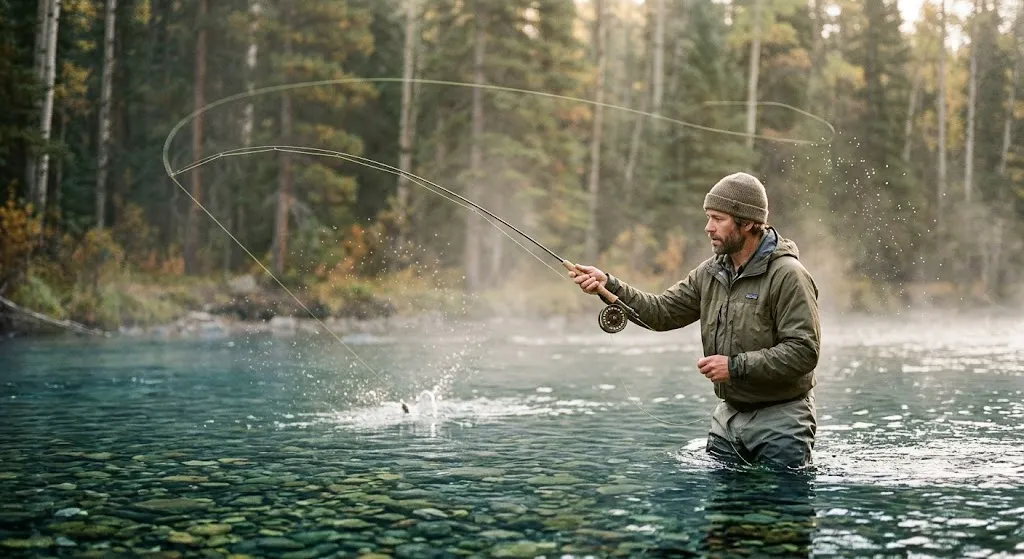
Choosing the best fly rod weight for trout can make the difference between a frustrating day on the water and a successful fishing trip. For most trout anglers, a 5-weight fly rod offers the best all-around performance.
It handles dry flies, nymphs, and small streamers while providing enough casting power for rivers, lakes, and moderate wind. A 3-weight suits small streams and delicate presentations, while a 4-weight offers an excellent balance of finesse and versatility.
Find Your Perfect Match Rod Size: Explore the Best Fly Rods for Trout Fishing Today!
Quick Answer: 3-, 4-, 5-, or 6-Weight?
| Rod weight | Best trout use | Fly types | Water type | Best for |
|---|---|---|---|---|
| 3-weight | Tiny dries, short casts, wild trout | Size 14–22 dries, small nymphs | Small streams, spring creeks | Experienced anglers who value finesse |
| 4-weight | Dry flies and light nymphing | Size 10–20 dries, small nymphs | Creeks to medium rivers | Dry-fly anglers and technical water |
| 5-weight | The best all-around trout rod | Dries, nymphs, small streamers | Most trout water | Beginners and one-rod anglers |
| 6-weight | Wind, distance, bigger flies | Weighted nymphs, streamers, large dries | Large rivers, lakes, windy banks | Anglers chasing bigger trout |
A 9-foot, 5-weight rod paired with a matching floating fly line is the most common recommendation for a first trout outfit because it covers dry flies, nymphs, and light streamers without forcing you to specialize too soon.
Make Every Cast Count! Compare Our Favorite Trout Fly Rods Before You Buy!
What Is the Best Fly Rod Weight for Trout Fishing?
What size fly rod for trout? For most anglers, the best fly rod weight for trout is a 5-weight. A 5wt handles the common trout fly patterns—Parachute Adams, Pheasant Tail nymphs, Woolly Buggers, Elk Hair Caddis—and works on small streams, tailwaters, spring creeks, and many lakes.
If you buy a new rod, make it a 9-foot, 5-weight, medium-fast action rod with a weight-forward floating line. That setup gives a new angler the widest range of options while still remaining enjoyable on 10-inch trout.
Use these simple rules:
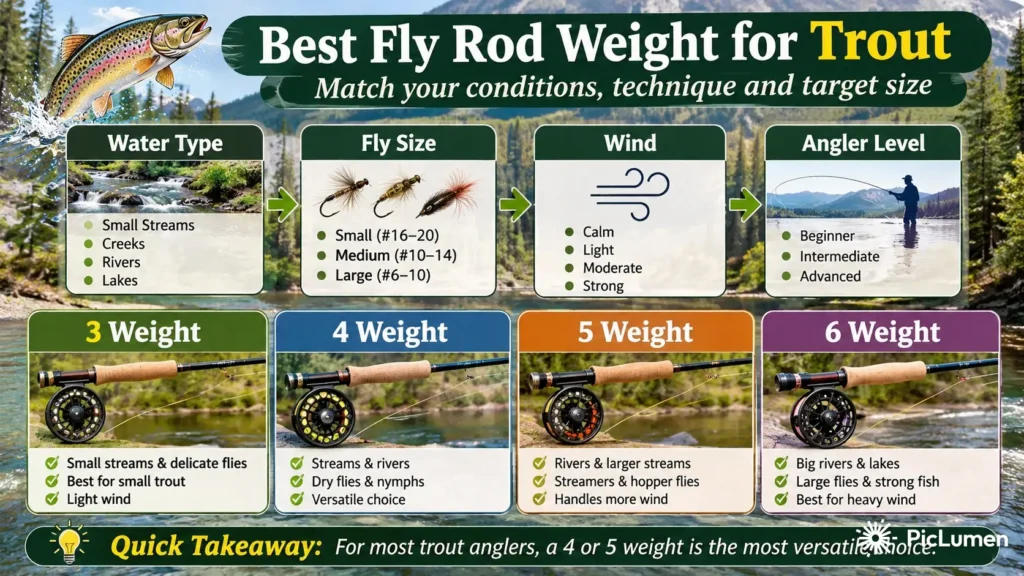
- 3-weight: Small creeks, brook trout, tiny dry flies, short casts.
- 4-weight: Delicate dry-fly fishing, small to medium rivers, lighter nymph rigs.
- 5-weight: The best all-around choice for trout fishing.
- 6-weight: Heavy nymphs, streamer fishing, wind, larger trout, and bigger water.
Understanding Fly Rod Weights and What the Numbers Mean
A fly rod “weight” does not mean how many ounces the rod weighs. It describes the fly line weight the rod was designed to cast. A 5-weight rod is built around a 5-weight line; a 6wt needs a 6-weight line.
Under the AFFTA standard, fly line weight is measured by the mass of the first 30 feet of line, excluding the level tip. A 5-weight line targets about 140 grains, while a 4-weight targets about 120 grains and a 6-weight about 160 grains.
– Lighter rods versus heavier rods
Lighter rods—such as a 3 weight or 4 weight—use less line mass. That makes them pleasant for small dries, short casts, and protecting light tippet. Heavier rods, such as a 5 weight or 6 weight, carry more line mass, so they turn over larger flies, punch through wind, and handle weighted rigs more easily.
– How rod weight affects casting
Rod weight affects how the rod loads during the cast. A properly matched fly line bends the rod and stores energy; when you stop the cast, that energy releases and carries the fly to the target. If the line is too light for the rod, the rod feels dead. If the line is too heavy, the rod can overload and feel clumsy.
Practical takeaway: Match the line to the rod rating first. Then choose the rod weight based on the flies, wind, and water you fish most often.
Best Fly Rod Weight for Different Trout Fishing Conditions
– Small streams and creeks
A 3-weight or 4-weight is ideal for overgrown creeks, mountain streams, and wild brook trout water. Shorter rods—often 7 feet 6 inches to 8 feet 6 inches—help you avoid branches while making accurate short casts.
– Medium-sized rivers
A 4-weight or 5-weight fits medium rivers best. You can fish dry flies during a hatch, run a dry-dropper rig, or nymph a riffle without feeling undergunned. Many experienced trout anglers prefer an 8-foot 6-inch or 9-foot 4-weight for dry-fly work.
– Large rivers and lakes
A 5-weight or 6-weight performs better where casts get longer and flies get bigger. On lakes, a 6wt also helps with streamers, wind, and weighted nymphs.
– Windy conditions and open water
Wind is one of the biggest reasons to move up in rod weight. A 6 weight gives you more line speed and mass to drive a streamer or weighted nymph into a breeze. A 4-weight can still work in light wind, but it becomes tiring when you repeatedly cast larger, wind-resistant patterns.
Is a 3-Weight Fly Rod Good for Trout?
Yes. A 3-weight fly rod is excellent for trout in the right setting—especially small streams with wild brook trout, cutthroat trout, or small brown trout. It shines with small dries, tiny nymphs, and short, accurate presentations.
Best applications
- Headwater creeks and brushy streams
- Wild brook trout and small native trout
- Size 16–22 dry flies
- Short casts under overhanging trees
- Anglers who enjoy a light, sensitive trout rod
Advantages
A 3wt protects fine tippet, makes small flies land softly, and turns modest trout into a lot of fun. It is also lighter to carry on long fishing trips into remote water.
Limitations
A 3-weight struggles with large streamers, heavy split shot, long casts, and steady wind. It is a specialty rod, not the best single rod for every trout fishing scenario.
Is a 4-Weight Fly Rod Better Than a 5-Weight for Trout?
A 4-weight is better for delicate dry-fly fishing; a 5-weight is better as an all-around trout rod. Neither is universally “better.” The right choice depends on your local water and the flies you throw.
| Factor | 4-weight fly rod | 5-weight fly rod |
|---|---|---|
| Dry flies | Excellent with small dries | Very good, slightly more power |
| Nymphs | Light nymphs and dry-dropper rigs | Weighted nymphs and indicator rigs |
| Casting distance | Good at short to medium range | Better at longer range |
| Wind | Manageable in light wind | More dependable in breeze |
| Small streamers | Small streamers only | Handles small to medium streamers |
| Beginner friendly | Good for dry-fly-focused anglers | Best overall beginner choice |
A 4 weight gives you softer presentations and more enjoyment with small trout. A 5-weight rod gives you more range across fly types and conditions, which matters if you want one rod for trout fishing.
Which should a beginner choose?
Choose a 5-weight if you are new to fly fishing and do not yet know whether you will prefer dry flies, nymphs, or streamers. Choose a 4-weight if you already know you will spend most of your time casting small dries on clear, slower water.
Why a 5-Weight Fly Rod Is the Best All-Around Choice for Trout
A 5-weight fly rod earns its reputation because it sits in the middle of the trout range. It is light enough for dry flies but strong enough for nymph fishing and smaller streamer patterns.
What a 5wt can do
- Cast dry flies accurately at typical trout distances
- Fish a dry-dropper or indicator nymph rig
- Throw Woolly Buggers, leeches, and other small streamers
- Handle trout from roughly 8 inches to the low-20-inch range
- Work on creeks, rivers, tailwaters, and many stillwaters
Best setup for a first trout rod
For a beginner fly fishing kit, start with:
- Rod: 9-foot, 5-weight, medium-fast action
- Reel: A simple disc-drag reel sized for a 5/6 line
- Line: Weight-forward floating 5-weight line
- Leader: 9-foot tapered leader, usually 4X to 5X
- Flies: A few dries, nymphs, and one or two streamers
This is the best beginner fly fishing combo because it teaches casting, mending, drift reading, and fly presentation without locking you into one technique.
When Should You Use a 6-Weight Fly Rod for Trout?
Use a 6-weight fly rod for trout when you need more power than a 5wt provides. It is not “too heavy” for trout; it is simply a tool for bigger flies, tougher conditions, and larger fish.
Best reasons to choose a 6wt
- Casting weighted streamers repeatedly
- Fishing large rivers or windy lakes
- Throwing bigger nymph rigs and sink-tip lines
- Targeting trophy trout, especially brown trout in deeper water
- Adding versatility for bass fishing or smaller saltwater species
A 6 weight can still fish dries, but it may overpower tiny flies and delicate presentations. If your main goal is rising trout on size 18 mayflies, stay with a 4- or 5-weight.
How Fly Size, Rod Length, and Wind Affect Your Choice
Rod weight is only one part of the equation. Fly size, rod length, action, and wind all change how a trout fly rod feels and performs.
Match the rod to fly size
Small flies need less line mass; big, bushy, or weighted flies need more. A 3wt handles small dries well, while a 6wt makes streamer fishing and large weighted nymphs far less tiring.
Choose the right rod length
| Rod length | Best use |
|---|---|
| 7-foot 6-inch | Tight creeks, overhanging brush, short casts |
| 8-foot | Small streams and all-purpose creek fishing |
| 8-foot 6-inch | Small to medium rivers; a strong dry-fly length |
| 9-foot | Best all-around length; better line control and mending |
| 10-foot or longer | Euro nymphing, stillwater, and reaching across currents |
A longer rod helps an angler mend line, reach over current seams, and keep more fly line off the water. A shorter rod works better when space is limited.
Wind changes everything
In calm conditions, a 4-weight may be perfect. In a 15 mph breeze, the same rod can make casting frustrating. Step up to a 5wt or 6wt when wind is regular, especially if you fish streamers or weighted nymphs.
Best Fly Rod Weight for Different Trout Species
Rainbow trout
A 5-weight is the best default for rainbow trout. It covers stocked fish, wild river rainbows, and most lake situations. Use a 4wt for technical dry-fly water or a 6wt for streamers and wind.
Brown trout
A 5-weight or 6-weight suits brown trout well, especially where fish run larger or you fish streamers at low light. Browns often hold near cover, so a rod with enough power to turn over a streamer helps.
Brook trout
A 3-weight or 4-weight is the preferred rod for brook trout in small streams. These fish often live in tight water, where short casts and small dry flies matter more than distance.
Cutthroat trout
A 4-weight or 5-weight works well for cutthroat trout. In remote headwaters, a 3wt can be excellent; on larger western rivers, a 5wt is more versatile.
Lake trout
Lake trout usually require a heavier setup than a typical trout rod. For smaller lake trout or stillwater fly fishing, a 6wt can work with streamers and sinking lines; larger lake trout often call for 7- through 9-weight rods.
Common Mistakes When Choosing a Trout Rod
Most anglers do not choose the wrong rod weight—they choose the wrong rod for their actual fishing.
- Buying too light too soon. A 2wt or 3wt feels fun in a shop but can become limiting on a windy river.
- Buying too heavy “just in case.” A 6wt is useful, but it reduces the pleasure of fishing small dries.
- Ignoring rod action. A fast action rod generates line speed; a moderate action rod is more forgiving and often better for beginners.
- Forgetting the fly line. A great rod performs poorly with the wrong line weight or a low-quality floating line.
- Overlooking length. A 9-foot rod is versatile, but a 7-foot 6-inch rod can be far better on a brush-choked small stream.
Best Fly Rod Weight for Beginners: A Simple Decision Path
Ask yourself four questions:
- Will you fish small creeks most of the time? Choose a 3wt or 4wt.
- Do you want one rod for trout fishing? Choose a 9-foot 5-weight.
- Will you fish streamers, wind, or bigger rivers? Choose a 6wt.
- Do you mainly fish dry flies on clear water? Choose a 4-weight.
If you cannot answer confidently, buy the 9-foot, 5-weight. It is the best all-around trout fly rod for a new angler and remains useful as your skills grow.
Frequently Asked Questions About Trout Fly Rod Weights
Is a 5-weight fly rod good for beginners?
Yes. A 5-weight is the best fly rod weight for beginners because it handles dry flies, nymphs, and small streamers while remaining forgiving to cast. A 9-foot 5wt with a floating line is the standard starting outfit.
Can you catch big trout with a 4-weight fly rod?
Yes. A 4-weight can land large trout when you use sound technique, appropriate tippet, and a reel with a dependable drag. It is especially effective for big trout feeding on small dry flies.
Is a 6-weight fly rod too heavy for trout?
No. A 6 weight is appropriate for larger trout, streamers, weighted nymphs, wind, and bigger rivers. It is less ideal for tiny dry flies and delicate presentations.
What is the best fly rod weight for small streams?
A 3-weight is best for very small, brushy streams and wild brook trout. A 4-weight is the better choice if you want a little more versatility while still fishing small water.
Can you use one fly rod weight for all trout fishing?
Yes, but with compromises. A 5-weight is the closest thing to a one-rod solution for trout. It will not be as delicate as a 3wt or as powerful as a 6wt, but it covers more trout fishing situations than any other single weight.
What is the best trout fly rod length?
For most anglers, 9 feet is the best trout fly rod length. It improves line control, mending, and reach. Choose 7-foot 6-inch to 8-foot 6-inch for tight creeks.
Should a beginner buy a fly rod combo?
Yes. A matched beginner fly fishing kit—rod, reel, fly line, leader, and sometimes flies—removes guesswork. Make sure the combo includes a true 5-weight floating line, not merely a “trout” label.
What action rod is best for trout?
A medium-fast action rod is the safest choice for most trout anglers. It offers a balance of feel, accuracy, and line speed. Fast action rods help in wind and at distance; moderate-action rods are easier for new casters.
What is the best budget streamer fly rod?
The Redington Wrangler 9-foot 7-weight is a strong budget streamer rod; it has enough backbone for streamers and sink-tip lines. For smaller streamers, a 9-foot 6-weight is more versatile.flylordsmag+1
What is the 60/20/20 rule in fly fishing?
It is a leader-building formula: about 60% butt section, 20% tapered midsection, and 20% tippet. This helps transfer casting energy smoothly and turn over the fly cleanly.
Conclusion
So, what weight fly rod for trout to use? The best fly rod weight for trout fishing depends on where you fish, but a 5-weight is the smartest starting point for nearly every angler. It casts dry flies with enough finesse, handles nymphs and small streamers, and remains manageable on both small streams and larger rivers.
A 3-weight or 4-weight is the better trout rod for delicate presentations, wild brook trout, and tight creek water. A 6-weight becomes the better choice when wind, weighted flies, streamer fishing, or trophy trout enter the picture.
If you want one rod that will serve you through your first seasons and still earn a place in your quiver later, choose a 9-foot, medium-fast, 5-weight fly rod with a matching floating line. It will not be perfect in every situation, but it is the most useful, flexible, and enjoyable choice for learning trout fly fishing.
Don’t Buy a Trout Fly Rod Until You’ve Compared These Top-Rated Options!
Recommended posts
- What Is Euro Nymphing in Fly Fishing? A Beginner’s Guide