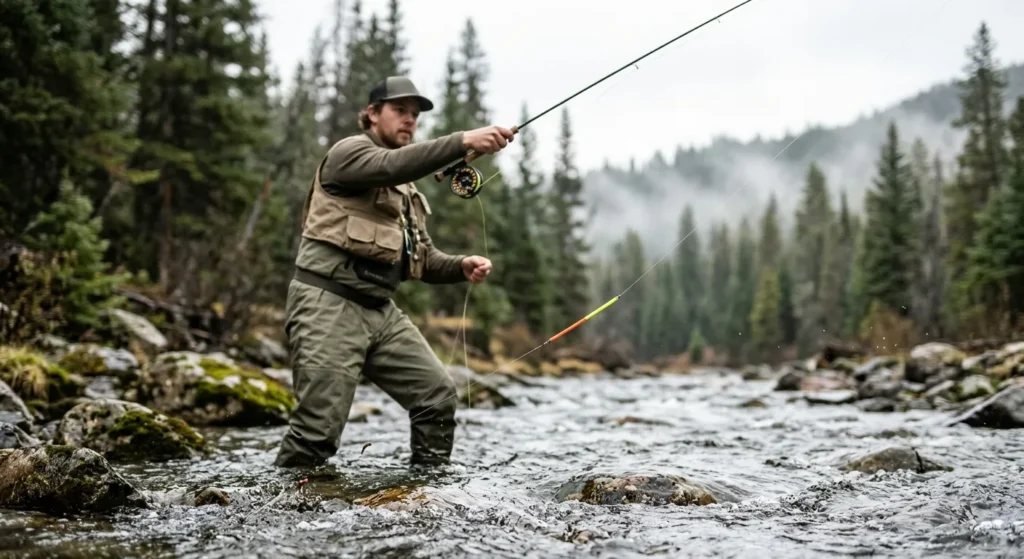
What is euro nymphing style of fishing? Euro nymphing is a style of fly fishing that uses weighted nymphs, a long leader, and a tight line to present flies naturally through trout water.
Instead of relying on a bulky strike indicator, the angler keeps direct contact with the flies and reads subtle pauses, ticks, and movements in the sighter or rod tip.
Also called European nymphing, tight-line nymphing, or contact nymphing, this method excels in riffles, pocket water, and fast runs where a traditional indicator can drag or fail to reach the bottom.
Competitive fly anglers helped popularize the approach after Polish, Czech nymph, and French anglers refined it in international competition.
What Is Euro Nymphing in Fly Fishing?
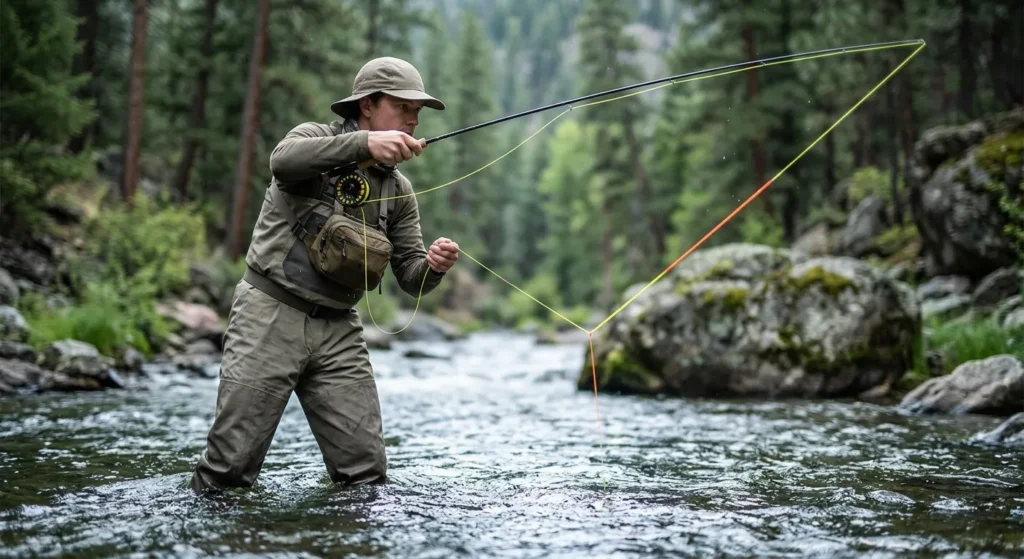
What is euro style nymphing and how do you euro nymph? Euro nymphing is a European nymphing technique built around one core idea: keep your dry fly connected to you throughout the drift. You cast weighted nymphs upstream or across current, then lead them downstream with a high rod tip while maintaining tension.
The method grew from Czech nymphing and Polish competition tactics. Wladyslaw “Vladi” Trzebunia introduced a refined version at the 1989 World Fly Fishing Championship, and fly anglers worldwide adapted the approach into the European style used today.
Tight-line nymphing does not mean dragging the fly. Your goal is a dead drift with no slack: the nymph tumbles at the speed of the current while the line, sighter, and tippet remain under light tension. That connection helps you feel bottom contact and detect strikes quickly.
How Does Euro Nymphing Work?
A Euro nymphing setup uses the weight of tungsten-bead nymphs—not split shot or a floating indicator—to get flies down. The leader usually includes a thin running line, a brightly colored sighter, a tippet ring, and fluorocarbon tippet to one or two flies.
As the flies sink, you raise the rod tip and follow the drift. The sighter helps you judge depth and angle; it is not simply a bobber. When the rig touches rocks, you feel hard ticks. When a trout eats, the take often feels softer or appears as a pause, twitch, or downstream movement in the sighter.
You control three variables:
- Depth: Add heavier flies, use a longer tippet section, or lower the rod tip to reach deeper water.
- Speed: Lead or slow the rig slightly so it does not race ahead of the current.
- Contact: Remove slack by lifting the rod and tracking the flies with the tip.
The best presentations put the nymph near the trout’s feeding lane, close to the bottom, without snagging every rock.
Euro Nymphing vs. Traditional Indicator Nymphing
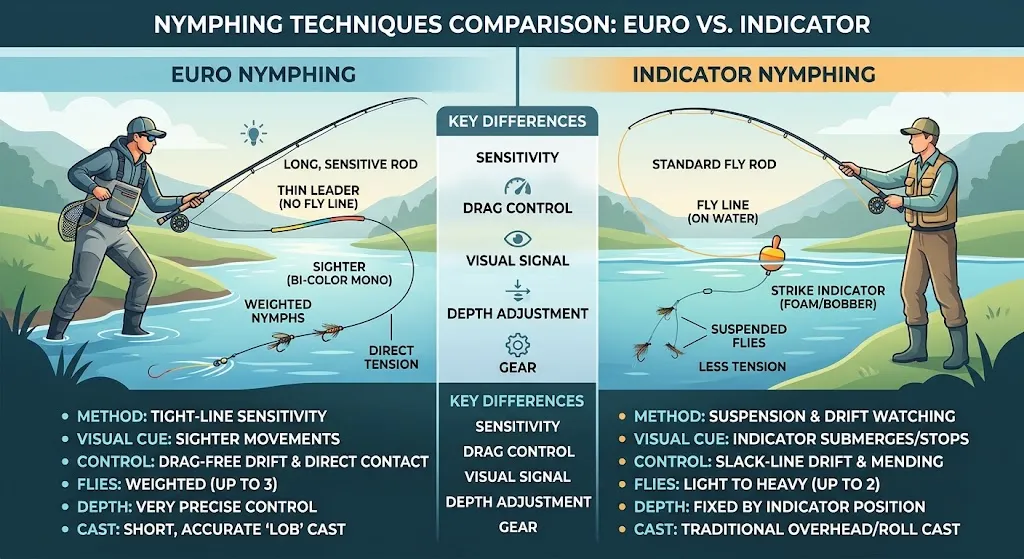
Euronymphing and indicator fishing both catch trout with subsurface flies, but they solve presentation problems differently.
| Feature | Euro nymphing | Indicator nymphing |
|---|---|---|
| Strike detection | Feel and sighter movement on a tight line | Visual movement of a strike indicator |
| Weight | Tungsten-bead flies | Split shot, weighted flies, or both |
| Best water | Shallow riffles, pockets, fast runs | Deep pools, long runs, windy conditions |
| Casting | Short upstream lob or roll cast | Longer casts are easier |
| Line control | High level of direct control | Indicator can create drag |
| Learning curve | Requires touch and constant adjustment | Easier starting point for many anglers |
An indicator rig shines when fish hold far away, deep, or in slow water where a long, visible drift matters. Euro nymphing is stronger when you need precise depth control, minimal line on the water, and quick strike detection in complicated currents.
Neither method is universally better. Many successful anglers carry both options and choose based on water depth, distance, wind, and trout behavior.
Essential Euro Nymphing Gear and Equipment
You do not need expensive gear to start, but the right Euro nymphing gear makes the technique easier to learn.
Best Euro Nymphing Rod Length and Weight
A dedicated Euro nymphing rod is usually 10 to 11 feet long and rated for a 2-, 3-, or 4-weight fly line. The extra length keeps more line off the water, improves drift control, and helps you reach across seams and pockets.
A 3-weight is a versatile starting choice: light enough to feel subtle takes, with enough backbone for trout and occasional bigger fish. Use a 2-weight for small streams and a 4-weight when wind, heavier flies, or larger rivers demand more power.
Euro Nymphing Reels and Fly Lines
Choose a lightweight reel that balances the long rod. A full-cage reel can prevent thin running line from slipping between the spool and frame.
For fly line, use a thin Euro nymphing line or a standard weight-forward line trimmed back. Some anglers use a mono rig instead of a conventional fly line, attaching a long leader directly to the reel. This reduces line mass and increases sensitivity, though it may not meet fly-fishing-only regulations in every location.
Leaders, Tippets, and Sighters
A practical beginner Euro nymphing setup looks like this:
- Thin running line or fly line
- 10 to 20 feet of leader material
- 12 to 24 inches of high-visibility sighter
- Tippet ring
- 2 to 4 feet of fluorocarbon tippet
- One or two weighted nymphs
The sighter uses brightly colored sections—often chartreuse, red, or black—so you can track its angle in changing light. Fluorocarbon tippet sinks quickly and resists abrasion around rocks. A tippet ring at the end of the sighter makes tippet replacement simple.
Best Flies for Euro Nymphing
Euro nymphing flies are usually compact, heavily weighted, and tied on jig hooks. Tungsten beads help them reach the bottom quickly, while slim profiles reduce snagging and cut through fast current.
– Pheasant Tail Nymphs
A pheasant tail nymph imitates mayfly nymphs and remains one of the most versatile patterns in fly fishing. Fish it in sizes 12 to 18, with a tungsten bead for faster water.
– Frenchie Nymphs
The Frenchie is a simplified pheasant tail with a hot spot, often orange or pink. It works well as a dropper fly because its slim body sinks efficiently while still offering a visible trigger point.
– Perdigon Nymphs
Perdigons are smooth, dense, fast-sinking nymphs designed for clear water and quick currents. Their minimal profile makes them excellent point flies when trout are feeding near the riverbed.
Hare’s Ear and Other Weighted Nymphs
A bead-head hare’s ear adds lifelike movement and suggests a wide range of aquatic insects. Caddis pupa patterns, Walt’s Worms, Zebra Midges, and Duracell-style jigs also belong in a basic Euro nymphing box.
A simple starting selection: a heavier perdigon or jig nymph on the point, plus a Frenchie, pheasant tail, or caddis pupa on the dropper.
How to Set Up a Euro Nymphing Rig
Here is a beginner-friendly Euro nymphing setup:
- Attach a thin Euro line or trimmed fly line to your reel.
- Tie on a 10- to 20-foot leader section.
- Add a two-foot sighter with high-contrast color bands.
- Attach a tippet ring below the sighter.
- Tie 2 to 4 feet of fluorocarbon tippet to the ring.
- Add your point fly—a dense tungsten nymph.
- Tie a dropper tag 12 to 20 inches above the point fly, then attach a lighter nymph.
As a rule of thumb, make the overall leader about twice the length of your rod. Adjust tippet length and fly weight until you regularly feel bottom contact without constantly hanging up.
Use the heaviest fly only as heavy as necessary. Too much weight makes the rig snag, while too little weight leaves the nymph drifting above the trout.
How to Euro Nymph Step by Step
Choose the Right Fishing Water
Start in clear, moderate-depth riffles and runs with visible seams, rocks, and current breaks. Pocket water is ideal because trout hold in predictable feeding positions behind boulders and along current edges.
Cast Upstream and Control Your Drift
Make a short upstream or quartering-upstream lob. Let the flies sink, then raise the rod and follow the drift downstream. Keep the sighter at a slight downstream angle rather than letting it belly toward you.
Maintain Contact With Your Flies
Track the flies with the rod tip and strip in excess line as needed. You should feel occasional ticks from the bottom. If you feel nothing, lower the rod tip, lengthen tippet, or switch to a heavier fly.
Detect Strikes and Set the Hook
Watch for a pause, twitch, or sudden change in the sighter. Set the hook in the opposite direction of the movement—downstream movement calls for an upstream set. A smooth, firm sweep is usually better than a violent jerk.
After each drift, take a few steps and repeat. Euronymphing rewards anglers who systematically cover every likely holding lie.
When and Where Is Euro Nymphing Most Effective?
Euro nymphing is most effective in shallow riffles, boulder gardens, seams, and medium-speed runs. These places often hold many trout, but conventional indicator rigs struggle because fast current sweeps the indicator and creates drag.
It also works well in colder months, when trout sit close to the bottom and feed on small nymphs, midges, and caddis pupa. In high, off-color water, increase fly weight and use brighter hot-spot patterns. In low, clear water, downsize tippet and choose smaller, subtler flies.
Deep, slow pools can still favor an indicator or a longer Euro leader. If the water is deeper than you can effectively reach with contact nymphing, switch methods rather than forcing the presentation.
Common Euro Nymphing Mistakes Beginners Should Avoid
- Fishing with too much slack. Slack kills strike detection. Lift the rod and track the drift.
- Using flies that are too light. If you never feel bottom, the nymph is not in the strike zone.
- Using flies that are too heavy. Constant snagging means the rig is dragging along the bottom.
- Ignoring the sighter. Small pauses and angle changes often signal a take.
- Making only one cast per lie. Change depth, weight, or fly before moving on.
- Wading too close. Trout spook easily in shallow water; approach quietly and fish the near water first.
- Setting too hard. Light tippet and small hooks break easily under an aggressive hook set.
Safety, Ethics, and Local Rules
Check local regulations before using a mono rig or multiple-fly setup. Some fly-fishing-only waters restrict leader construction, barbless hooks, or the number of flies allowed. orvis
Handle trout gently: wet your hands, keep the fish in the water when possible, and use a rubber net. Barbless jig hooks make release easier and reduce injury.
Frequently Asked Questions About Euro Nymphing
Is Euro Nymphing Good for Beginners?
Yes. Euro nymphing for beginners works best when you start with a simple two-fly rig, a visible sighter, and manageable water. The technique teaches valuable skills: reading current, controlling drift, and detecting subtle strikes.
Can You Euro Nymph With a Regular Fly Rod?
Yes. A standard 9-foot fly rod can work, especially with an 18- to 20-foot leader and weighted nymphs. A longer 10- to 11-foot rod simply makes line control and drift management easier.
Do You Need Special Fly Line for Euro Nymphing?
No, but a dedicated thin Euro nymphing line or mono rig improves sensitivity. A normal weight-forward fly line is fine for learning; simply keep most of it on the reel and fish short, controlled drifts.
How Many Flies Can You Use When Euro Nymphing?
Most anglers use one or two flies. A two-fly dropper rig lets you test depth and pattern quickly. Always follow local rules, because some fisheries limit the number of hooks or flies.
Is Euro Nymphing Better Than Indicator Fishing?
It depends on the water. Euronymphing is better for short-range, fast, shallow water where precision matters. Indicator fishing is often better for long, deep, or slow drifts and for anglers who prefer a more visual presentation.
What Weight Tippet Should I Use for Euro Nymphing?
Start with 5X fluorocarbon for average trout water. Drop to 6X in clear, pressured water, or use 4X when targeting bigger fish or fishing heavier flies around rocky structure.
Do Euro Nymphs Need Tungsten Beads?
Not always, but tungsten beads make it much easier to reach the bottom quickly. Brass beads can work in shallow or slow water, while tungsten is the better choice for fast riffles and deeper runs.
Is fly fishing in decline?
Not overall. Fly fishing dipped slightly in 2025 to 7.9 million U.S. participants, but it still has nearly 2 million more anglers than a decade ago, and total outings rose to 83 million.
Conclusion
Understanding what is Euro nymphing for trout fishing comes down to mastering contact. You cast weighted nymphs, maintain a tight line, read the sighter, and put the fly where trout actually feed. The technique rewards patience, observation, and small adjustments more than expensive equipment.
Start with a 10-foot 3-weight rod, a simple sighter leader, two tungsten nymphs, and a short stretch of riffle water. Make deliberate drifts, feel for bottom, and change one variable at a time until you find the right depth and speed. Before long, you will recognize the difference between a rock tick and a trout take.
European nymphing will not replace every nymphing method, but it gives you a precise way to fish water that many anglers skip. Learn it well, and you will become a more complete fly angler—and likely put more trout in the net.
Recommended posts
- 10 Best Fly Tying Patterns for Trout: A Step-By-Step (Guide)
- Best Fly Tying Kit for Beginners: The Ultimate Showdown!