
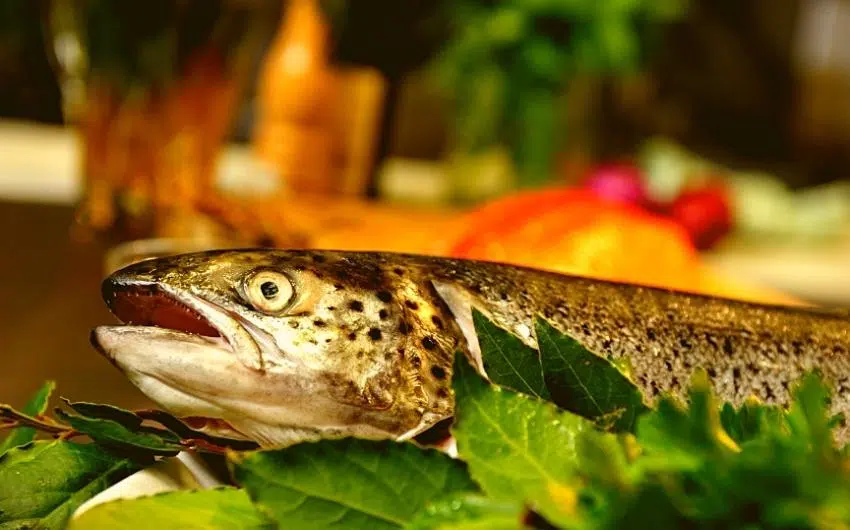
Golden rainbow trout fishing requires a specialized approach, as these vivid yellow mutations of the standard rainbow trout ($Oncorhynchus\ mykiss$) lack natural camouflage and are subject to extreme angling pressure. To consistently catch a golden rainbow trout — often referred to as a palomino trout—you must adapt your tactics to outsmart a golden rainbow trout fish that can easily spot you coming.
In this guide, you will learn the origin of these striking fish, the essential ultra-light tackle required to trick west Virginia golden rainbow trout, and precise sight-fishing techniques to trigger strikes in heavily pressured waters.
What is a Golden Rainbow Trout? (Taxonomy & Misconceptions)
The golden rainbow trout (Oncorhynchus mykiss) is one of the most visually striking fish swimming in North American freshwater streams. Characterized by its brilliant yellow-to-gold body and classic, deep-crimson lateral stripe, this fish turns heads whenever it slides into a current seam. However, despite its distinct appearance, considerable confusion exists among anglers regarding its biological classification, origins, and naming conventions.
To fish for them effectively, you must first understand what they are—and what they are not. West Virginia Gold Rush is not an exotic foreign species, nor is it a separate trout category like a brook or brown trout. Anatomically and taxonomically, it is a true rainbow trout, sharing the exact same scientific classification, habitat requirements, dietary preferences, and spawning behaviors as its dark-pigmented counterparts.
Where to Find Golden Trout Fish?
Golden trout are one of the most beautiful trout you can catch, but finding them often requires more than simply casting a lure into the nearest stream. California golden trout live primarily in cold, high-elevation waters of the Sierra Nevada, where small streams, meadow creeks, pools, and alpine lakes provide the habitat they need. The key to catching them is combining the right season, stealthy approach, lightweight tackle, and small flies or lures that match the food available in these mountain waters.
California golden trout are native to Golden Trout Creek and the South Fork Kern River drainage, although they have also been introduced into numerous high-elevation Sierra Nevada waters.
Look for:
1. High-Elevation Creeks
Small mountain creeks are among the classic golden-trout habitats.
Focus on:
- Deep pools
- Current seams
- Small riffles
- Undercut banks
- Boulder pockets
- Areas beneath overhanging vegetation
2. Mountain Meadows
Meadow streams can hold surprisingly good numbers of golden trout.
Approach carefully because fish in clear, shallow water can be extremely easy to spook.
3. Pools Below Riffles
After a riffle, look for a deeper pool.
Trout can hold where the faster water delivers insects and other food while giving the fish relatively little current to fight.
4. High-Elevation Lakes
Golden trout have been transplanted into numerous Sierra Nevada lakes and streams outside their original range.
5. Golden Trout Wilderness
The Golden Trout Wilderness provides access to many high-country waters, although reaching some locations requires substantial hiking.
CDFW identifies Golden Trout Creek as a Heritage and Wild Trout Water and the South Fork Kern River as a Wild Trout Water.

Best Rigs for Golden Trout:
Golden trout are often found in relatively small streams and high-country lakes, so lightweight tackle is usually the best approach.
1. Ultralight Spinning Rig
For anglers who prefer spinning tackle, try:
- Rod: 5–7 ft ultralight or light spinning rod
- Reel: 1000–2000-size spinning reel
- Main line: 2–4 lb monofilament or fluorocarbon
- Leader: 2–4 lb fluorocarbon when water is exceptionally clear
- Lure: Small spinner, spoon, or trout plug
- Retrieve: Slow to moderate, depending on current
The advantage of this setup is accuracy. Small mountain streams often have overhanging vegetation, rocks, narrow channels, and tiny pockets where a long cast isn’t necessary.
Pro tip: Cast upstream or slightly across the current and allow the lure to move naturally through pools and current seams.
2. Simple Fly-Fishing Rig
Fly fishing is particularly effective for California golden trout. The California Department of Fish and Wildlife notes that golden trout readily take flies, particularly dry flies and terrestrial patterns.
A practical setup:
- Rod: 3–5 weight fly rod
- Leader: 7.5–9 ft tapered leader
- Tippet: 4X–6X depending on conditions
- Fly: Small dry fly, terrestrial, or attractor pattern
Good starting patterns include:
- Parachute Adams
- Elk Hair Caddis
- Stimulator
- Royal Wulff
- Ant patterns
- Hopper patterns
Recent Eastern Sierra reports have specifically recommended bright attractor dries such as Sierra Bright Dots, Adams, Royal Wulffs, Stimulators, and Elk Hair Caddis for high-altitude golden trout.
Best Lures for Golden Trout
If you’re using spinning tackle, don’t overcomplicate your lure selection.
Small Spinners
Small spinners can be excellent for covering water.
Try:
- Inline spinners
- Size #00–#1 spinners
- Gold or silver finishes
- Small natural-color patterns
Cast beyond the target whenever possible and bring the lure through the pool or current seam.
Small Spoons
Small spoons are another good option, particularly in slightly larger pools and lakes.
Look for:
- Lightweight spoons
- Gold
- Silver
- Copper
- Natural trout patterns
Keep the retrieve relatively slow in cold water.
Small Soft Plastics
Small jigs and soft plastics can also work where regulations permit them. Keep the presentation subtle and avoid oversized presentations that look unnatural in small high-country streams.
Important: Always check the regulations for the exact water you’re fishing. Gear restrictions can vary between California waters.
Best Flies for Golden Trout


A simple golden-trout fly box doesn’t need to be huge.
| Fly | Suggested Size | Best Use |
|---|---|---|
| Parachute Adams | #14–18 | General conditions |
| Elk Hair Caddis | #14–18 | Evening/insect activity |
| Stimulator | #12–16 | Fast water & attractor fishing |
| Royal Wulff | #12–16 | High visibility |
| Ant | #14–18 | Terrestrial activity |
| Hopper | #10–14 | Late summer |
Recent Eastern Sierra fishing reports have recommended #14 Sierra Adams, #14 Stimulators, #14 Royal Wulffs and #16 Elk Hair Caddis for high-altitude golden trout.
Best Season to Catch Golden Trout – Summer Is Usually the Prime Season
For high-elevation golden trout, summer is the key season because many of the highest mountain waters become more accessible as snow and ice retreat.
A current 2026 Eastern Sierra report specifically describes summer as the time to explore high-altitude creeks for golden trout, with fish commonly found in streams above approximately 8,000 feet in that region.
Golden Trout Season Guide
Late spring:
Access can still be limited by snow and cold water at higher elevations.
June:
Lower and more accessible high-country waters may begin becoming productive as conditions improve.
July–August:
Often the prime period for high-elevation creek and meadow fishing.
September:
Excellent opportunity in accessible waters, but temperatures and weather can change quickly at elevation.
Fall:
Golden trout fishing can remain possible in some waters, but always check the regulations and local access conditions.
California regulations are water-specific. For example, the 2026 regulations list the Golden Trout Wilderness Area as open year-round, while individual waters can have different restrictions.

How to Approach Golden Trout Without Spooking Them!
This deserves its own section because it provides strong practical value.
Golden trout often live in clear, shallow mountain water, making stealth extremely important.
Before making your first cast:
- Stay low.
- Avoid walking directly along the bank when possible.
- Use rocks, bushes, and vegetation as cover.
- Approach pools from downstream.
- Avoid casting your shadow across the water.
- Make shorter, more accurate casts.
- Watch the water before disturbing it.
CDFW specifically recommends a stealthy approach in small tributaries and suggests crouching or using vegetation as cover because trout can easily be spooked in meadow habitats.
Current Golden Trout Fishing Report — Late September 2026
Region: Eastern Sierra / High Sierra
Season: Fall
Primary tactic: Dry flies transitioning toward subsurface presentations
Best water: High-elevation creeks and pools
Recommended approach: Stealthy presentations and light tackle
The latest Eastern Sierra report I found, published September 28, 2026, notes the transition into fall fishing conditions. For the broader Eastern Sierra, anglers are beginning to shift toward nymphing and streamer fishing as the season changes.
For high-altitude golden trout specifically, summer reports emphasized dry flies and attractor patterns, including Adams, Stimulators, Royal Wulffs, and Elk Hair Caddis. Golden trout were reported holding around pools, logs, and willows while looking for insects.
Fishing Report Quick Take
Best bet: High-elevation streams with accessible water and active insect life.
Fly choice: Start with an attractor dry fly when fish are visibly feeding on the surface.
If the surface bite slows: Try a small nymph or other subsurface presentation where regulations allow.
Spinning tackle: Downsize your lure and make accurate casts rather than covering water with oversized lures.
Conditions: Mountain weather can change rapidly. Check local weather, trail/access conditions, water-specific regulations, and fire restrictions before traveling.
CDFW also maintains an official fishing-report resource and encourages anglers to use its angler survey and interactive fishing resources when planning trips.
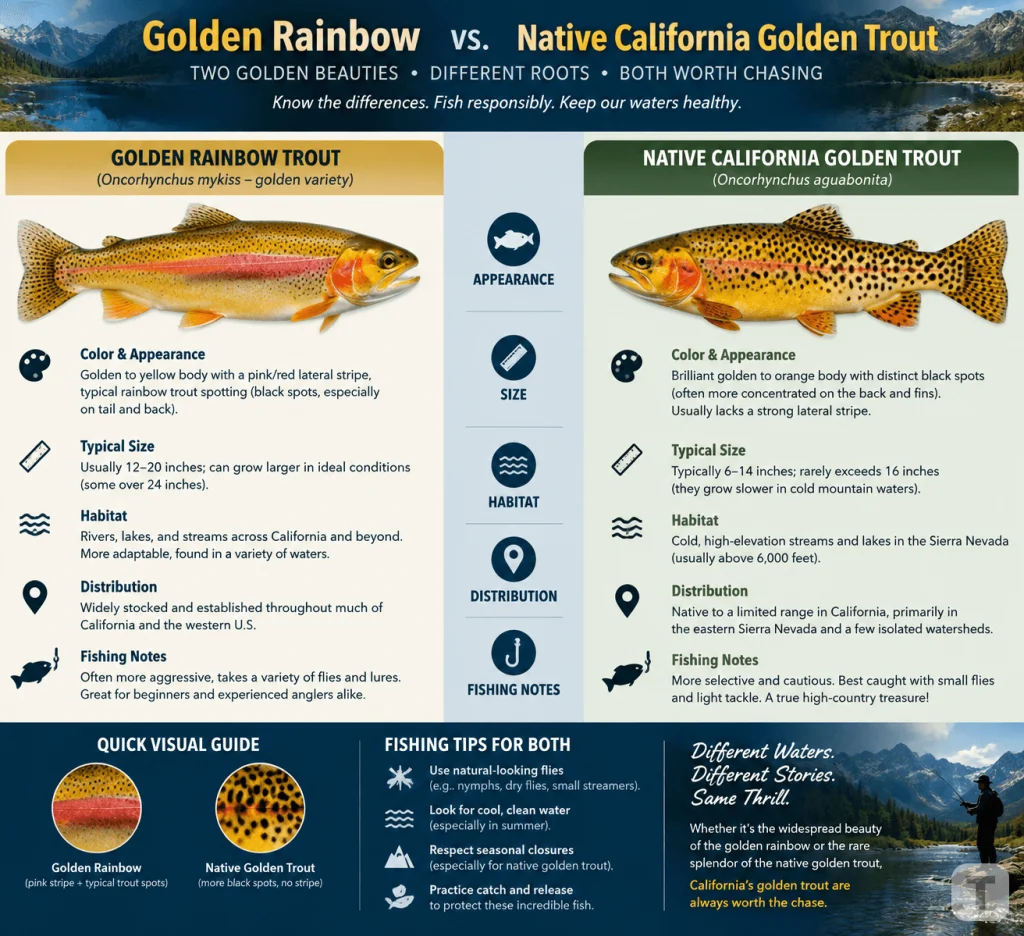
Golden Rainbow vs. Native California Golden Trout
The most common misconception in freshwater angling is confusing the regular rainbow trout with the native California golden trout (Oncorhynchus mykiss aguabonita). While both feature brilliant yellow coloration, they are fundamentally different fish:
- California Golden Trout (O. m. aguabonita): A distinct subspecies native to the high-elevation, cold-water streams of the Kern River basin in California’s Sierra Nevada range. They are small, wild, slow-growing fish with dark parr marks along their flanks and belly regions colored in deep orange and yellow.
- Golden Rainbow Trout (O. mykiss): A color-mutated strain of standard hatchery-reared rainbow trout. They do not originate from high-alpine wild stock; instead, they stem from a genetic mutation developed in state fish hatcheries. They grow to standard hatchery sizes (often reaching 2 to 10 pounds in public stocked waters) and do not retain juvenile parr marks.
Is a Palomino Trout the Same Thing?
While anglers and state wildlife agencies frequently use the terms “Golden Rainbow” and “Palomino” interchangeably, they technically refer to two distinct genetic variations:
- Pure Golden Rainbow Trout: The original strain developed in West Virginia. This golden rainbow trout fish displays a rich, deep golden-yellow body with a vivid red lateral stripe.
- Palomino Trout: A hybrid cross produced primarily by the Pennsylvania Fish and Boat Commission in the late 1960s. Biologists crossed a West Virginia pure golden rainbow male with a standard, dark-pigmented rainbow female. The resulting offspring—dubbed the “Palomino”—exhibits a lighter, straw-yellow or cream-colored coat with a muted pink lateral streak.
In modern stocking vernacular, most state agencies refer to all yellow-variant rainbow trout as “golden rainbow trout,” though many local anglers across the Mid-Atlantic still call any bright yellow stocked fish a palomino.
Golden Rainbow Fish History
The story of the golden rainbow trout stands as one of the most remarkable accidents in modern fisheries management. Rather than emerging from modern gene-editing laboratories or exotic cross-breeding programs, this iconic fish originated from a single naturally occurring genetic anomaly in a mid-century fish hatchery.
In late 1954, wildlife technicians at the Petersburg Trout Hatchery in Grant County, West Virginia, noticed a unique mutation among a standard batch of rainbow trout fry. A single female exhibited a distinct golden-yellow hue instead of the typical olive-green pigmentation. Recognizing the novelty of this biological anomaly, hatchery supervisor Chester Vance and his team isolated the fish, affectionately naming her “Little Goldy.”
Over the next several years, selective breeding experiments paired Goldy’s offspring back with standard rainbow trout stock. By 1963, West Virginia’s Department of Natural Resources officially introduced the “Golden Rainbow Trout” to public streams to commemorate the state’s centennial celebration.
Golden Rainbow Trout Timeline
========================================================================
[1954] Little Goldy Discovered (Petersburg Hatchery, WV)
   │
   ▼
[1963] Official Public Release for WV Centennial Celebration
   │
   ▼
[1960s-70s] Selective Breeding Yields Golden-to-Golden Crosses
   │
   ▼
[Present] Stocked across eastern US waters as a prized sport fish
Understanding this history is essential because it dismantles a major misconception that directly affects how you fish for them: golden rainbows are not a separate species, nor are they native high-altitude California golden trout ($Oncorhynchus\ mykiss\ aguabonita$). They share 100% of their predatory instincts, feeding habits, and anatomical structure with standard rainbow trout.
However, selective breeding data reveals a critical behavioral shift. Fisheries data from state stocking programs indicates that approximately 1 in 100 stocked trout in designated waters carries this genetic trait, meaning these fish face up to ten times the visual pressure of standard stocked trout within 48 hours of release.
Because their bright banana-yellow skin makes them instantly visible to every angler walking the bank, they quickly develop extreme hyper-awareness in clear water.
To successfully land a golden rainbow history-maker, you must adapt your tactical approach to counter this environmental vulnerability.
Why Golden Rainbows Are So Hard to Catch (The Sight-Fishing Paradox)
How to catch golden trout? Most anglers assume that because a golden rainbow trout is bright yellow and easy to locate, it should be easy to catch. In reality, the opposite is true. This phenomenon is known as the Sight-Fishing Paradox.
High Visibility in Water Column
                 │
                 ▼
  Constant Angling & Environmental Pressure
                 │
                 ▼
  Chronic Elevation of Cortisol (Stress Response)
                 │
                 ▼
Total Feeding Lockjaw & Structural Cover Seeking
The main reason these fish are hard to hook comes down to three factors:
- Extreme Angling Pressure: Because a golden trout stands out like a neon sign in clear water, every angler who walks past the pool casts at it. Within 24 hours of being stocked, a golden rainbow may see hundreds of spinners, dough baits, flies, and heavy weights dropped directly onto its nose. This relentless exposure puts the fish on permanent high alert.
- Elevated Stress and Lockjaw: Fish experience acute physiological stress responses when exposed to continuous danger. High cortisol levels shut down feeding instincts. Once a golden trout is spooked, it will stubbornly lock its jaws, ignoring all food offerings regardless of how naturally they are presented.
- Overhead Predator Awareness: Lacking dark dorsal melanin, golden rainbows cannot blend into dark riverbeds. They are hyper-aware of overhead motion from predators like blue herons, osprey, and human anglers. As a result, when light conditions are bright, they seek refuge along undercut banks, beneath submerged logs, or deep inside shaded foam lines
Best Gear & Tackle for Palomino Trout
Finesse is key when target-fishing for golden rainbows in public waters. Standard medium-action bass gear or heavy monofilament lines will spook these wary fish before your bait even hits the water.
Terminal Tackle: Rods, Reel, and Ultra-Light Fluorocarbon
- Rod: A 7’0″ to 7’6″ Ultra-Light (UL) or Light-action spinning rod with a fast tip. The extra length aids in line control during long drifts, while the soft bend cushions tiny hooks against sudden lunges.
- Reel: A 1000 to 2000 size spinning reel equipped with a smooth, micro-adjustable drag system.
- Main Line: 4 lb test high-visibility yellow or chartreuse braid. Micro-braid allows for long, accurate casts with lightweight lures, while the high-vis line makes it easier to track line drift and detect subtle bites.
- Leader: A 6-to-8-foot leader of 2 lb to 4 lb test 100% fluorocarbon. Fluorocarbon matches the refractive index of water, making it nearly invisible to keen-eyed trout. It also sinks faster than monofilament, helping unweighted micro-rigs drop quickly into the strike zone.
| Line Component | Specification | Primary Benefit |
| Main Line | 4 lb Micro-Braid | Maximum casting distance & drift control |
| Connection Knot | Back-to-Back Uni or Albright Knot | Maintains slim profile through rod guides |
| Leader | 2 lb – 4 lb Fluorocarbon (6–8 ft) | Low visibility; abrasion resistance |
| Terminal Hook | #14 – #16 Fine Wire Single Hook | Minimizes weight and line drag |
Top Baits, Flies, and Lures
To consistently hook pressured palominos, downsize your offerings and present them naturally:
- Micro-Jigs (Trout Magnets): 1/64 oz or 1/80 oz jig heads paired with split-tail soft plastic bodies in natural white, peach, or black.
- Tungsten Beadhead Nymphs: Size #14 to #18 Pheasant Tail, Hare’s Ear, or Zebra Nymphs. The tungsten bead drops the fly quickly into the current seam without the need for heavy split shot.
- Floating Dough Baits & Eggs: Floating trout dough or soft plastic micro-eggs work well in slow-moving pool tails, provided you use small #14 fine-wire hooks and minimal weight.
- Natural Live Baits: Live waxworms, mealworms, or small pink worms fished underneath a micro-strike-indicator or free-drifted with a single split shot.
How to Catch a Palomino Trout: Step-by-Step Tactical Approach
To catch a heavily pressured golden rainbow trout, follow these golden trout fishing secrets that are mentioned in pro videos on how to catch golden rainbow trout.
Step 1: Upstream Approach and Concealment:
Stay low and work from behind the fish’s field of view. Trout hold facing upstream into the current to intercept drifting food. Approach the target pool from downstream, staying low along the stream bank. Wear earthy colors (greens, tans, greys) and wear polarized sunglasses with amber or copper lenses to cut surface glare. Never let your shadow cross the pool where the target fish is holding.
Step 2: Reading the Draft and Drift Line:
Identify the exact current lane carrying natural drift. Before casting, observe the fish’s behavior. Note its precise holding depth and the specific current lane feeding its position. Identify the boundary line where fast current meets slower water (the seam). To entice a pressured golden rainbow, your bait must enter this current seam naturally, matching the exact speed of the surrounding bubbles without any line drag.
Step 3: Executing the Micro-Drop Presentation:
Cast well above the fish and let the rig drift into the strike zone. Cast your micro-rig 6 to 10 feet upstream of the golden trout’s position. Casting directly on top of the fish will instantly spook it. Allow the rig to sink naturally into the lower third of the water column as it drifts downstream. As the bait approaches the fish’s nose, avoid twitching or pulling the rod tip. Let the current deliver the bait naturally into the strike zone, and set the hook with a soft sweep the moment you see the fish’s white mouth open.
Fishing for Golden Rainbow Trout Practical Strategy: The Concealed Drift Technique
- Locate without Being Located: Position yourself at least 20 feet downstream of the pool where the golden rainbow is holding. Stay low, using streamside vegetation as a natural visual shield.
- Rig for Invisibility: Downsize your main rig to a 2-pound to 4-pound test fluorocarbon leader. Fluorocarbon shares the same light refractive index as water, making it nearly invisible to visually stressed fish.
- Present Above the Sight Line: Cast your presentation (such as a 1/64-oz micro-jig or small nymph) 6 to 8 feet upstream of the fish’s position. Allow the current to carry the bait naturally into its feeding lane at eye level.
- Trigger Reaction Strikes: If the holdover golden rainbow ignores a dead-drift presentation, impart rapid, micro-twitch movements to the line just as the lure enters its peripheral view. This forces an instinctual reaction strike before the wary fish can analyze the offering.
By treating the palomino not as a mindless hatchery product, but as an intensely pressured rainbow trout with compromised natural camouflage, you turn its historical trait into your tactical advantage.
Key Golden Rainbow Trout Fishing Questions Answered (FAQ)
Are golden rainbow trout and palomino trout the same fish?
They are functional equivalents in sport fishing, but genetically distinct. A golden rainbow trout is a pure-strain chromic mutation of Oncorhynchus mykiss originally bred in West Virginia. A palomino trout is a hybrid cross between a golden rainbow and a standard dark rainbow trout, giving it a paler, cream-colored appearance. Today, most state agencies use both terms interchangeably.
Are golden rainbow trout genetically engineered or natural mutations?
Golden rainbow trout are not genetically engineered organisms (GMOs). They stem from a naturally occurring recessive genetic mutation discovered in a West Virginia hatchery in 1954. State biologists used traditional selective breeding techniques—crossing mutants carrying the recessive gene—to stabilize the color strain over several generations.
Why do golden rainbow trout ignore bait even when dropped right in front of them?
Golden rainbows attract immediate, heavy fishing pressure due to their high visibility. Once cast at repeatedly, their stress levels spike, elevating cortisol levels and suppressing their appetite. When spooked, they will ignore food offerings entirely until they settle back down and feel safe from overhead predators.
What size line and hook should I use to avoid spooking a palomino trout?
Use a 2 lb to 4 lb test fluorocarbon leader paired with a small fine-wire hook (size #14 to #18). Fluorocarbon is virtually invisible underwater, and tiny hooks allow live bait, dough, or micro-jigs to drift naturally through current seams without drag.
Final Thoughts
Targeting golden rainbow trout is the ultimate test of an angler’s finesse, sight-fishing tactics, and rivercraft. While their brilliant yellow hue makes them easy to locate in clear water, their hyper-awareness and the heavy fishing pressure they attract mean that landing one requires far more than beginner’s luck. Success comes down to total stealth: sizing down to ultra-light fluorocarbon leaders, presenting micro-jigs or natural baits with zero line drag, and approaching every pool with calculated concealment.
Whether you refer to them as golden rainbows or palominos, hooking one of these trophy fish turns an ordinary day on the water into an unforgettable catch. Armed with an understanding of their unique genetic history, light sensitivity, and drift line behaviors, you now have the exact playbook needed to outsmart these highly wary targets. Step quietly onto the riverbank, read the current seams, and get ready to put your sight-fishing skills to the ultimate test.
You might also like: