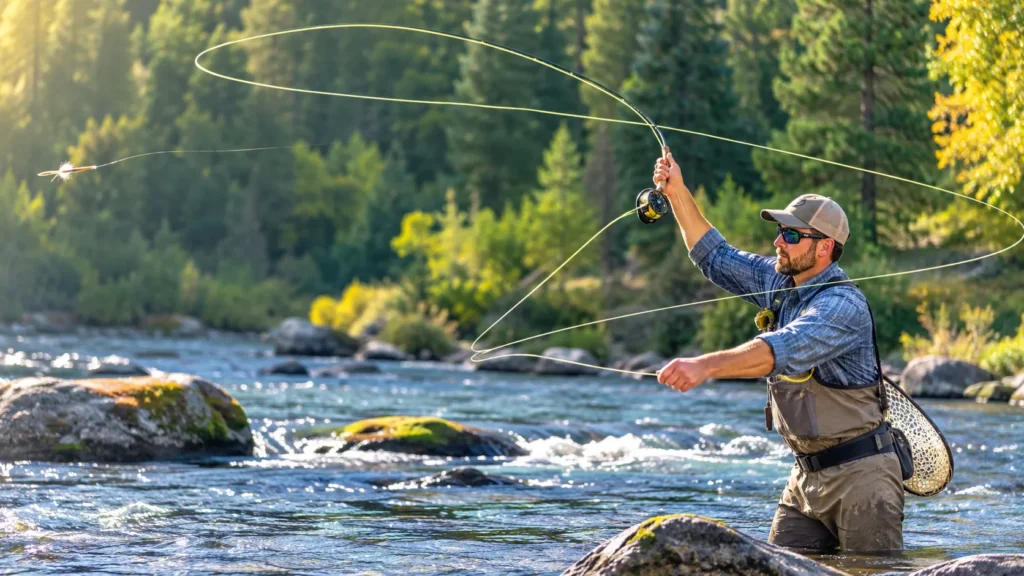
The double haul is a fly-casting skill that uses your line hand to add speed to the fly line during both the back cast and forward cast. Master it by making a clean basic cast first, then adding a short, timed tug with the line hand on each stroke—followed by a smooth return of that hand for the next haul.
In double haul fly fishing, the goal is not to pull harder. It is to move the line hand at the right moment, keep the rod tip traveling in a straight path, and let the added line speed carry the fly line farther with less effort. Once you understand the timing, the double haul casting technique becomes one of the most useful skills an angler can add to their fly casting toolkit.
Make Your Next Trout Fishing Trip More Productive. Learn How to Prospect for Fish When There’s No Hatch to Match
Quick Jump
ToggleWhat Is a Double Haul in Fly Fishing?
A double haul is a fly-casting motion in which you use your non-rod hand—the line hand—to tug the fly line during both the back cast and the forward cast. Each tug adds energy to the line, increases line speed, and helps the fly line turn over more effectively.
The name can confuse new fly fishers. You do not literally “haul” the rod. Instead, your line hand pulls downward and away from the rod hand, then returns to a ready position before the next casting stroke.
A well-executed Double Haul Cast does three things:
- Adds line speed without forcing the casting arm to work harder.
- Helps the fly line form a tighter, more efficient loop.
- Makes longer casts and windier conditions more manageable.
Joan Wulff described the value simply: the second hand adds speed to the line, loads the rod more deeply, and transfers more energy into the cast. That extra energy is especially useful for distance and casting into wind.
How Does the Double Haul Casting Technique Work?
The double haul casting technique works by combining two movements: the rod hand accelerates and stops the rod, while the line hand tugs the line at nearly the same moment. That tug increases the load on the rod and speeds up the line as it unrolls.
Think of the rod as a spring. Your basic casting stroke bends it, then the stop releases that stored energy into the line. The haul adds another source of energy: your line hand shortens the working length of line for a moment, which increases tension and speed.
The key sequence is:
- Start the casting stroke.
- Near the end of the stroke, pull down on the line with the line hand.
- Stop the rod cleanly.
- Return the line hand to its starting position.
- Repeat on the opposite cast.
Pete Kutzer from the Orvis Fly Fishing school emphasizes that the haul acts much like the wrist “flick” at the end of a normal cast. The rod hand and line hand work together, but neither should overpower the other.
Why Learn to Double Haul When Fly Fishing?
You should learn to double haul because it makes fly casting more efficient. A good double haul lets you achieve high line speed without relying only on a longer, more forceful rod stroke.
For a trout fisher working a small stream, the double haul may not be necessary on every presentation. But when you need to reach a rising fish across a river, punch a fly into a breeze, or turn over a bulky streamer, the added line speed becomes valuable.
The benefits include:
- More distance: The line carries farther after you release it.
- Better wind control: A faster line cuts through wind more effectively.
- Less arm fatigue: The line hand shares the work with the casting arm.
- Cleaner loops: A properly timed haul helps the line unroll smoothly.
- Better fly turnover: Large flies, weighted patterns, and wind-resistant flies land more reliably.
This is not only a saltwater skill. Orvis notes that the double haul can add distance while reducing strain on the casting arm and wrist, and that it is useful beyond saltwater fishing.
How to Double Haul a Fly Rod Step by Step
Before you learn how to double haul, make sure you can perform a basic pickup-and-lay-down cast with smooth, tight loops. A double haul makes a good cast better; it does not fix a poor cast.
Step 1: Set Up on Grass
Practice on a lawn, field, or open area with no obstacles. Start with about 25 to 30 feet of fly line beyond the rod tip. Keep the leader short at first so you can focus on the line, not the fly.
Hold the rod comfortably in your dominant hand. Let the line hand hold the line just above the reel, with a little slack between your hands.
Step 2: Make a Clean Back Cast
Raise the rod smoothly and accelerate into the back cast. Stop the rod around the one o’clock position. Let the line straighten behind you before starting forward.
As the rod approaches the end of the back cast, tug the line downward with the line hand. This is the back cast haul.
Step 3: Return the Line Hand
This is the part many casters miss. After the back cast haul, move the line hand back toward the rod hand to prepare for the forward haul.
Do not yank the line hand all the way back in a rushed motion. Let it drift smoothly into position while the line travels behind you. Orvis describes this as the “reposition”: haul, then drift back to set up for the next haul.
Step 4: Make the Forward Cast Haul
Start the forward cast with a smooth acceleration. As the rod approaches its forward stop, tug the line downward again. This is the forward cast haul.
Stop the rod cleanly, release the line, and let it shoot through the guides. The final haul should be slightly more assertive than the practice hauls, but it still needs to stay smooth.
Step 5: Let the Line Shoot
After the final forward haul, open the fingers of your line hand enough to let line shoot. Do not throw the line forward. Simply reduce your grip pressure and allow the stored energy in the rod and line to carry it out.
A useful practice sequence is: haul, return, haul, return, final haul, shoot.
Back cast:      Rod back → HAUL → stop → return line hand
Forward cast:   Rod forward → HAUL → stop → release line → shoot
Single Haul vs. Double Haul: What’s the Difference?
The difference between a single haul and double haul comes down to how many times you use the line hand during the casting cycle.
| Cast type | When you haul | Best use |
|---|---|---|
| Single haul | Once, usually on the forward cast | Quick distance, roll casts, simple presentations |
| Double haul | Once on the back cast and once on the forward cast | Longer casts, wind, heavier lines, big flies |
In a single haul, you add speed during one part of the cast. In a double haul, you add speed twice: once as the line moves behind you and once as it comes forward. This repeated input builds more line speed and helps the fly line maintain momentum.
A single haul is an excellent starting point. Once you can haul smoothly on the forward cast, add the back cast haul. That progression makes the double haul feel far less complicated.
Common Double Haul Casting Mistakes and How to Fix Them
Hauling Too Early
If you pull the line before the rod has accelerated, you may collapse the loop or pull the fly line off target. The haul should happen near the end of the stroke, just before the rod stop.
Fix: Count the motion as “stroke, haul, stop.” Keep the haul short at first.
Forgetting the Line-Hand Return
Many casters can haul but cannot get the line hand back in position for the next stroke. The result is a weak second haul or a cramped, awkward motion.
Fix: Practice the return separately. Haul, then consciously return the hand to the starting position. Each haul is a two-step action: haul, then return.
Pulling Too Far
A long, dramatic pull can create slack, disrupt the loop, and make timing harder. You do not need to haul several feet of line.
Fix: Start with an 18- to 24-inch haul. Orvis recommends this range as a practical starting length.
Using Only the Wrist
A caster who bends the wrist excessively often sends the rod tip off line. The result is a wide loop, poor accuracy, and a cast that collapses.
Fix: Use the forearm for the main stroke, add a controlled wrist movement at the stop, and keep the rod tip traveling in as straight a path as possible. Kutzer stresses that the rod tip should move in a straight line on both the back cast and forward cast.
Trying to Cast Too Far Too Soon
Distance is tempting, but chasing it early usually creates a jerky stroke and poor timing.
Fix: Practice short casts until the haul feels automatic. Add line only when your loops stay tight and your line hand returns smoothly.
Double Haul Tips for Casting in Windy Conditions
Wind exposes every weakness in a cast. A double haul helps because high line speed allows the line to cut through the air more effectively.
- Use a shorter haul first; a controlled tug beats a violent pull.
- Keep the rod tip on a straight path rather than sweeping it sideways.
- Make one decisive final haul instead of adding many rushed false casts.
- Aim slightly lower into a headwind, then let the line unroll before the fly lands.
- Practice with a shorter line until you can feel the rod load properly.
A water haul can also help in wind. By using surface tension and current to load the rod, you can make a quick upstream presentation without false casting, which keeps the fly in the water longer. news.orvis
How to Practice and Improve Your Double Haul
The fastest way to improve is to isolate the movements. Do not try to master the entire double haul cast in one session.
Drill 1: Haul on the Back Cast
Lay line on the grass behind you. Make a back cast, haul near the end of the stroke, then let the line settle. Repeat 10 times. Focus only on the back cast haul.
Drill 2: Haul on the Forward Cast
Lay line in front of you. Make a forward cast, haul near the end of the stroke, then let the line settle. Repeat 10 times. Focus only on the forward cast haul.
Drill 3: Haul and Return
Make one haul, then return the line hand to its starting position without casting. This builds the rhythm that makes the double haul feel natural.
Drill 4: Sidearm Practice
Cast sidearm over open ground so you can watch the line, rod tip, and hand movement. Midcurrent suggests this approach because it lets you see the rod load, haul timing, and increase in line speed. Use a stable, safe elevated position if needed. midcurrent
Drill 5: Add Line Gradually
Once you can make 30 feet look clean, add 3 to 5 feet at a time. Stop adding line when the loop begins to open or the timing breaks down.
When Should You Use the Double Haul Technique?
Use the double haul when conditions demand more line speed than a basic cast can provide.
Good situations include:
- Casting across a wide river to a rising trout.
- Fighting a steady breeze on a lake or saltwater flat.
- Turning over a large streamer, bass bug, or wind-resistant fly.
- Making a long presentation to cruising fish.
- Reducing the number of false casts when a quick delivery matters.
- Improving a roll cast when you need extra energy to turn over the fly.
You do not need to double haul every cast. For delicate trout fishing at close range, a smooth basic cast often presents the fly more effectively. The double haul is a tool, not a requirement.
Frequently Asked Questions About Double Haul Casting
Is double hauling difficult to learn?
It can feel awkward at first because you are coordinating two hands. However, the motion becomes much easier once you separate the haul from the line-hand return. Practice each part slowly before combining them.
Does double hauling help you cast farther?
Yes. By increasing line speed, a double haul helps the line carry farther after you release it. It also helps the line turn over more effectively, especially in wind or with larger flies.
Can beginners learn the double haul?
Yes. Beginners can learn it after they can make consistent basic casts and shoot line. Start with short hauls, practice one direction at a time, and add distance gradually.
Do you need a special fly rod to double haul?
No. Most standard fly rods can double haul. A rod with a comfortable grip and a line matched to its weight rating will make learning easier. Focus on technique before worrying about specialized gear.
How long should a double haul be?
Start with about 18 to 24 inches. As your timing improves, you can lengthen the haul slightly, but a smooth short haul is more effective than a long, jerky pull.
Should I double haul while fishing?
Use it when you need extra distance, wind penetration, or fly turnover. For short, delicate presentations, a basic cast may be the better choice.
What is the holy grail of fly fishing?
The “holy grail” is often considered a grand slam—catching a permit, tarpon, and bonefish on fly in one day. It is prized because each species is challenging, requires precise casting, and often demands expert guidance.
What is the longest fly cast ever recorded?
The longest verified fly-casting distance is about 437 feet, set by Maxine McCormick in the women’s division. Competitive distance casting uses specialized rods, lines, and technique, so it is not a typical fishing-cast benchmark. orvis
How to fly fish for beginners?
Start with a balanced 9-foot, 5-weight rod outfit, practice the overhead and roll casts on grass, learn two basic knots, then fish simple patterns with a natural drift. Orvis recommends keeping early gear simple and practicing casting before adding complexity.
Conclusion: How to Double Haul for Beginners
Learning how to double haul for beginners starts with patience, not power. Make sure your basic cast produces smooth, tight loops before you add the line hand. Then practice a short back cast haul, return the line hand, add a forward cast haul, and let the line shoot on the final delivery.
The double haul is not about casting harder. It is about timing, smooth hand movement, and using the line hand to create high line speed. Practice on grass, keep the haul short, and add distance only when your loops stay clean. With a few focused sessions, the double haul becomes a natural part of your fly casting technique—and a valuable skill for trout, bass, saltwater, and windy conditions alike.
Recommended posts
- How Long Should a Fly Fishing Leader Be? (2026 Guide)
- What Is Euro Nymphing in Fly Fishing? A Beginner’s Guide