
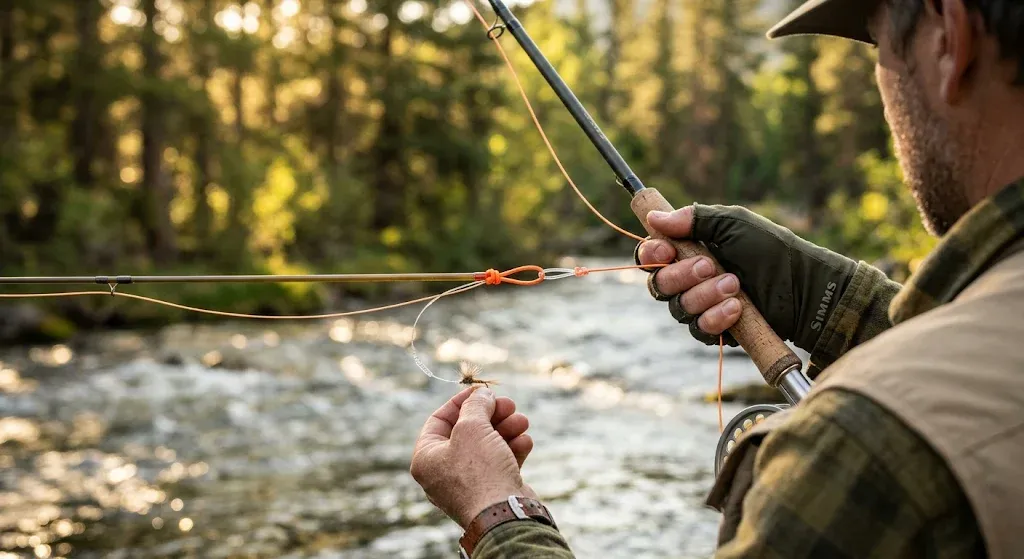
How long should a fly fishing leader be? For most freshwater fly fishing, start with a 9-foot tapered leader. It gives you enough distance between the colored fly line and the fly to avoid spooking fish, while still turning over most dry flies, nymphs, and small streamers reliably. Adjust from there based on water clarity, wind, fly size, and the type of fishing you plan to do.
A fly fishing leader is the clear, tapered section between the end of the fly line and your tippet or fly. Its job is simple but important: transfer casting energy, protect your tippet, and help the fly land naturally. The right leader is essential because a leader that is too short can put the fly line too close to wary fish, while one that is too long can collapse in the wind or fail to turn over a larger fly.
How Long Should a Fly Fishing Leader Be?
What size leader should I use for fly fishing? The best answer is: start at 9 feet, then change the length to match the fishing conditions. A 9-foot leader is the standard all-around choice for trout, panfish, and many bass situations, especially when you use a floating fly line.
Standard Fly Fishing Leader Length
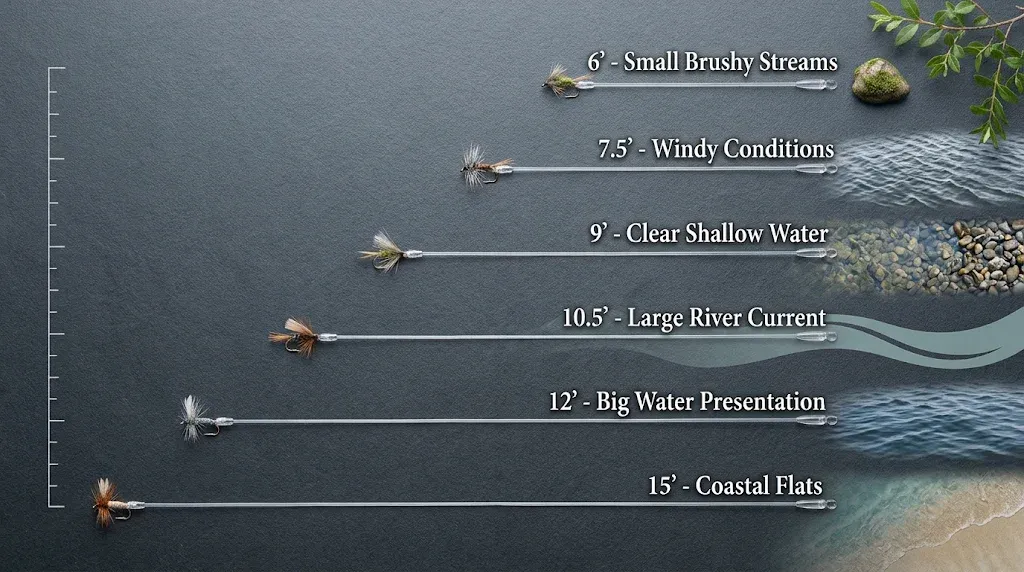
Most manufactured tapered leaders come in 7.5-foot, 9-foot, and 12-foot versions. A 9-foot tapered leader is the safest default if you are new to fly fishing or do not know the water yet.
Your leader does not need to stay exactly 9 feet. As you change flies and trim wind knots, you will add tippet to the end. Over time, the total length of your leader and tippet may become 10, 11, or even 12 feet.
Quick Guide to Choosing the Right Length
| Leader length | Best use | Why it works |
|---|---|---|
| 4–6 feet | Heavy streamers, sink-tip lines, bass in thick cover | Turns over bulky flies and keeps them near structure or the bottom. |
| 7.5 feet | Small streams, tight casting lanes, windy conditions | Easier to cast accurately and turn over in confined water. |
| 9 feet | All-around trout, panfish, light bass, dry fly fishing | The versatile starting point for most fly fishing situations. |
| 10–12 feet | Clear trout streams, lakes, selective fish, dry flies | Keeps the colored fly line farther from the fly and improves a delicate presentation. |
| 12–15 feet | Extremely clear, flat, or heavily pressured water | Gives spooky trout more distance from the fly line. |
| 15+ feet | Ultra-clear spring creeks, stillwater, specialized euro nymphing | Useful when stealth matters more than easy casting. |
What Is the Best Leader Length for Trout Fishing?
For trout fishing, begin with a 9-foot tapered leader. It works well on most trout streams, handles a wide range of fly sizes, and gives you a balanced setup for dry flies, nymphs, and small streamers.
If the stream is narrow, brushy, or windy, use a 7.5-foot leader. If the water is low, clear, and slow, move to a 10- to 12-foot leader. In exceptionally clear water where trout see anglers and flies often, a 15-foot leader can make sense.
Practical Trout Examples
- Small creek, tight trees: 7.5-foot tapered leader with 4X or 5X tippet.
- Normal trout river: 9-foot tapered leader with 4X or 5X tippet.
- Flat, clear tailwater: 12-foot tapered leader with 5X or 6X tippet.
- Dry fly fishing for selective trout: 9- to 10-foot leader plus 1 to 2 feet of tippet.
- Indicator nymphing: 9-foot leader plus 2 to 4 feet of tippet.
- Euro nymphing: A short 2- to 4-foot leader paired with 6 to 10 feet of tippet.
How Leader Length Changes in Clear vs. Murky Water
Water clarity is one of the biggest factors in leader selection. In clear water, fish can see the colored fly line more easily, so a longer leader creates more separation between the line and your fly.
In murky or fast-moving water, fish are less likely to notice the fly line. A shorter leader is often better because it turns over more easily, gives you better control, and helps you fish close to cover.
| Water condition | Suggested leader length | Best approach |
|---|---|---|
| Glassy, clear, slow water | 12–15 feet | Use a longer leader and finer tippet for a stealthy presentation. |
| Normal clear river | 9–12 feet | Start at 9 feet; lengthen if fish refuse the fly. |
| Slightly stained water | 7.5–9 feet | A shorter leader improves turnover and control. |
| Murky or fast water | 6–9 feet | Use a shorter length and stouter tippet when needed. howtoflyfish. |
Best Fly Fishing Leader Length for Bass
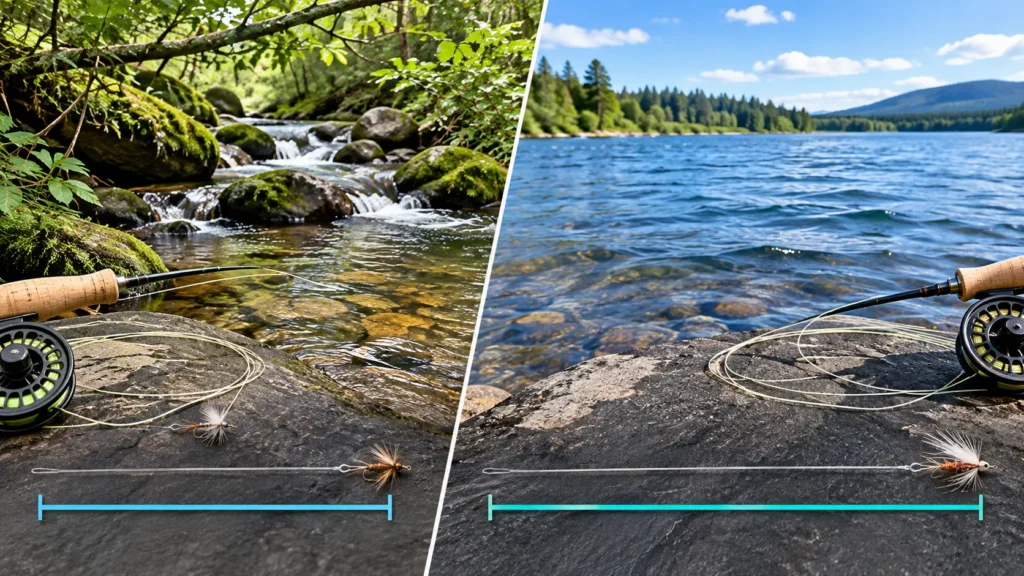
For bass, 6 to 9 feet is usually enough. Bass often hold near weeds, wood, docks, and other cover, so a shorter leader helps you put a streamer, popper, or bulky fly where it needs to be.howtoflyfish.
For small bass flies and open water, use a 9-foot tapered leader. For large streamers, heavy flies, or fishing near thick cover, shorten the leader to 4 to 6 feet and use a stronger tippet section.
A useful bass setup is a 7.5- or 9-foot tapered leader with a 2X or 3X tippet. If you are fishing heavy cover, do not worry about a delicate presentation; prioritize turnover, strength, and getting the fly out of snags.
Should You Use a Longer Leader in Clear Water?
Yes. In clear water, a longer leader is usually the better choice because it keeps the fly line farther from the fish. A 12-foot leader is a strong choice for clear trout water, and a 15-foot leader can help on flat, highly pressured streams or lakes.
But do not choose length blindly. A long leader only helps if you can still cast it well and turn over the fly. If the leader piles up, lands with a splash, or will not straighten, shorten it until your presentation improves.
How Wind and Weather Affect Leader Length
Wind makes longer leaders harder to cast. When gusts pick up, shorten the entire setup by a foot or two so the leader turns over more easily and your fly lands where you want it.
A 7.5-foot leader is a good wind-day baseline. You can also shorten the tippet rather than replacing the entire leader. On calm days, lengthen the tippet gradually in 12- to 18-inch sections until you find the presentation that produces strikes.
How to Match Leader Length to Fly Size and Type
The size and weight of the fly matter as much as water clarity. A tiny dry fly needs a delicate, longer setup; a heavy streamer needs a shorter, stronger leader that can turn it over.
Dry Flies
For dry fly fishing, start with a 9- to 10-foot tapered leader and add 1 to 2 feet of tippet. This helps the fly land softly and reduces drag on the surface.
For tiny midges or blue-winged olives on flat water, use a 12- to 15-foot leader and finish with 6X or 7X tippet. For standard size 12 to 18 dry flies, 4X to 5X tippet is often a better balance of delicacy and strength.
Nymphs
For indicator nymphing, use a 9-foot leader plus 2 to 4 feet of tippet. Fluorocarbon tippet is popular for nymphing because it sinks and is less visible underwater than nylon monofilament.
For euro nymphing, the approach changes. Use a short 2- to 4-foot leader, then add a long fluorocarbon tippet section—often 6 to 10 feet. The total length may reach 8 to 14 feet, but the design improves sensitivity and control.
Streamers
For streamer fishing, use a 7.5- to 9-foot leader for most floating-line situations. Heavy streamers need a shorter leader because it transfers energy more directly to the fly and helps it turn over.
With a sink-tip line, use a 7- or 8-foot leader so the streamer stays close to the bottom. With a floating line, an 8- to 11-foot leader can help the fly sink while keeping the fly line farther from the fish.midcurrent
Tapered vs. Straight Leaders: Does Length Matter?
Yes, length matters, but taper matters too. A tapered leader starts thick at the fly-line end and becomes thinner toward the fly, which helps casting energy travel smoothly through the leader.
A straight leader—often just level tippet material—can work for streamers, bass, or saltwater fishing, but it does not turn over small flies as smoothly. Monofilament and fluorocarbon leaders are the two common leader materials: monofilament floats more easily and is often used for dry flies, while fluorocarbon sinks and is useful for nymphs and streamers.
Furled leaders are another option. They are braided or twisted leaders that can turn over flies smoothly, but they are less common than standard tapered monofilament leaders for everyday trout fishing.
Common Fly Fishing Leader Length Mistakes to Avoid
- Using one leader for every situation. A 9-foot leader is versatile, but clear water, wind, and fly size should change your choice.
- Adding too much tippet after trimming. If your tippet becomes very short, the end of the leader becomes too thick for small flies. Replace the tippet section instead. news.orvis
- Using a long leader in strong wind. A shorter leader is easier to cast and turn over.
- Matching tippet only to fish size. The fly size, fly weight, water conditions, and target fish all matter.
- Ignoring the fly line. A colored fly line close to a spooky fish can ruin an otherwise good drift.
- Using a heavy tippet with a tiny dry fly. A fine tippet helps small flies float and land naturally, but do not go lighter than the fish and cover require.
How to Choose the Right Fly Fishing Leader Length for Your Setup
Choose the right leader by working through four questions:
- How clear is the water? Clear water favors a longer leader; stained water favors a shorter one.
- How windy is it? Wind favors a shorter leader and shorter tippet.
- What fly are you using? Small dry flies need delicate presentations; heavy streamers need shorter, stronger leaders.
- Can you cast it well? The best leader is one you can turn over consistently without piling or splashing down.
A good starting kit is a 9-foot tapered leader, spools of 3X, 4X, 5X, and 6X tippet, plus a few feet of fluorocarbon for nymphing. That covers most trout streams, rivers, lakes, and everyday fly fishing trips.
When should I use a shorter or longer fly fishing leader and tippet?
Use a shorter leader in wind, tight streams, murky water, short casts, or with large/heavy flies such as streamers and bass poppers. It turns over more easily and gives you better control.
Use a longer leader in clear, calm, flat, or heavily pressured water with your fly rod, especially for small dry flies and wary trout. It keeps the colored fly line farther from the fish for a more natural presentation.
FAQs
Is a 9-foot leader long enough?
Yes. A 9-foot leader is long enough for most trout, panfish, and light bass fishing. It is the best starting point if you are unsure what conditions you will face.
Should leader length include tippet?
Usually, no. The leader length printed on the package refers to the tapered leader before you add tippet. Your total leader and tippet length may become longer after you tie on a new tippet section.
What length leader should I use for dry flies?
Use a 9- to 10-foot tapered leader, then add 1 to 2 feet of tippet. On very calm, clear water, extend the setup to 12 feet or more for a softer presentation.
What leader length is best for nymphing?
For indicator nymphing, use a 9-foot leader with 2 to 4 feet of tippet. For euro nymphing, use a short 2- to 4-foot leader with a much longer fluorocarbon tippet.
Do bass need a long leader?
No. Bass usually do better with a 6- to 9-foot leader. Use a shorter leader for large streamers, heavy flies, or fishing close to cover.
Does a longer leader spook fewer fish?
It can. A longer leader keeps the colored fly line farther from the fly, which helps in clear, flat, or pressured water.
What tippet size should I use for fly fishing?
A simple rule is to divide the fly hook size by three. For example, a size 12 fly pairs well with 4X tippet. Adjust for wind, water clarity, fly weight, and the size of the fish.
What is the rule of 11 in fly fishing?
The rule of 11 is a quick way to convert tippet X sizes to diameter: subtract the X number from 11 to get the diameter in thousandths of an inch. For example, 4X tippet is 0.007 inch, and 6X is 0.005 inch.
Conclusion
How long should a fly fishing leader be? Start with a 9-foot tapered leader, then adjust it for the water in front of you. Use 7.5 feet for small streams and wind, 9 feet for everyday trout fishing, 10 to 12 feet for clear water and dry flies, and 12 to 15 feet when fish are especially wary. For bass and streamers, a 4- to 9-foot leader often gives you better control and turnover.
The best fly fishing leader is not the longest one—it is the one that lets your fly land naturally, drift correctly, and turn over without spooking the fish. Carry a few leader lengths and several spools of tippet, then make small changes throughout the day. When you learn to choose the right leader for each situation, you will cast more accurately, present flies better, and catch more fish.
You Might also like:
- What Is Leader Line in Fishing? Importance, Uses & Types
- Fly Fishing Tippet 101 – Sizes, Types & How to Choose