
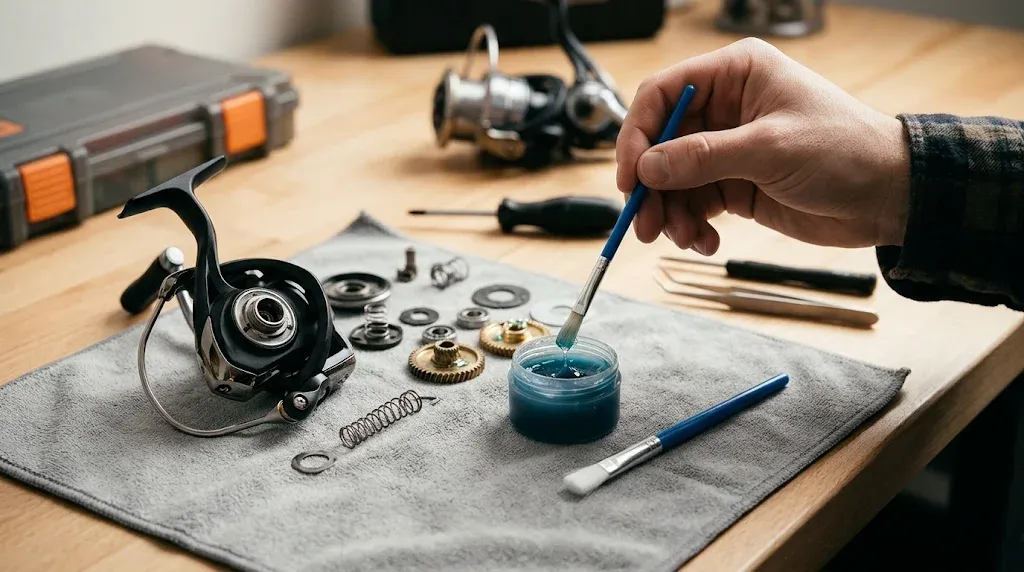
The best grease for fishing reels is a reel-specific, water-resistant grease applied in a thin film to gears, worm shafts, and other slow-moving, high-load parts. For most anglers, Penn Precision Reel Grease is the strongest all-around choice, especially for saltwater fishing reels; Shimano Star Drag Grease is an excellent alternative for smooth, quiet gear performance.
The right fishing reel grease protects metal surfaces, reduces wear, and helps prevent corrosion after wet fishing trips. It will not make a reel faster on its own—reel oil handles the fast-spinning bearings—but the correct grease extends reel life and keeps the gear train protected under load.
This guide explains the best fishing reel grease options, where each lubricant belongs, and how to grease a fishing reel without overdoing it.
Top 5 Best Saltwater Fishing Reel Grease (At a Glance)
- PENN Reel Grease, 2 oz — Best overall fly reel grease
- Cal’s Universal Fishing Reel and Star Drag Grease — Best for drag service
- ReelX Fishin’ Kit Combo — Best complete oil-and-grease kit
- Clenzoil Marine & Tackle Reel Care Kit — Best for corrosion protection
- KastKing ReelTune Reel Care Kit — Best budget-friendly maintenance kit
Quick Jump
ToggleWhat Is the Best Grease for Fishing Reels?
The best grease for fishing reels depends on the reel type, water conditions, and the part you are servicing. For a dependable all-purpose option, choose Penn Precision Reel Grease for saltwater protection or Shimano Star Drag Grease for a smooth, refined gear feel in spinning and baitcasting reels.
A quality fishing reel lubricant should cling to gears, resist water, stay stable in heat and cold, and avoid gumming up the mechanism. Reel-specific grease is better than automotive grease because it is formulated for the close tolerances and lighter loads inside fishing gear.
| Fishing need | Best choice | Why it works |
|---|---|---|
| Best overall | Penn Precision Reel Grease | Thick, tenacious, and strong against saltwater intrusion. |
| Smoothest gear feel | Shimano Star Drag Grease | Excellent for Shimano main and pinion gears. |
| Freshwater spinning reels | Ardent Reel Butter Grease | Lighter synthetic grease for smaller reels. |
| Drag service | Cal’s Universal Reel and Star Drag Grease | A long-standing choice for smoothing drag performance. |
| Heavy-duty marine protection | Yamalube Marine Grease | Water-resistant grease for larger reels and harsh conditions. |
Why Using the Right Fishing Reel Grease Matters
Fishing reel maintenance is not only about making a reel feel smooth. The correct grease creates a protective barrier between metal gears, helps prevent rust, and reduces wear on the main gear, pinion gear, worm shaft, and oscillation system.
Using the wrong product can create problems. Thick automotive grease may make the retrieve feel sluggish, while household sprays can strip existing lubrication rather than protect the moving parts. Standard WD-40, for example, is mainly a water displacer, not a long-term fishing reel oil lubricant.
Good fishing reel lubrication also matters after saltwater fishing. Salt accelerates corrosion, so a reel that gets rinsed, dried, and properly lubricated lasts much longer than one that is only wiped down after a trip.
Best Grease for Fishing Reels: Top 5 Recommendations
Penn Reel Grease
Best Super Lube grease for: Saltwater protection, conventional reels, and heavy-duty use.
Penn Precision Reel Grease—often called Penn blue grease—is a thick, sticky synthetic blend designed to stay in place under pressure. It is especially useful for anglers who fish surf, jetties, boats, or brackish water, where salt spray and moisture quickly attack unprotected metal.
Use Penn grease on the main gear, pinion gear, worm shaft, and other slow-moving metal surfaces. Apply a thin coat rather than packing the gear case; excess grease can trap grit and make the reel feel heavy.
Shimano Reel Grease
Best for: Shimano spinning reels, baitcasting reels, and smooth retrieves.
Shimano Star Drag Grease is a strong choice for anglers who want a factory-smooth feel. It works particularly well on Shimano main and pinion gears, and its water resistance makes it suitable for both freshwater and saltwater use.
Shimano also makes Permalube, a thicker grease often used in larger salt water fishing reels where durability matters most. If you own a Daiwa reel, Abu Garcia reel, or another brand, check the manufacturer’s service guide before using a competitor’s grease.
Ardent Reel Butter Grease
Best for: Smaller spinning reels and freshwater fishing.
Ardent Reel Butter is a lighter, fully synthetic grease for anglers who want less resistance in the gear train. It is a solid option for smaller spinning reels, ultralight setups, and freshwater fishing where extreme salt protection is not the main priority.
Use it sparingly on gears and threaded components. Because it is lighter than Penn or Yamalube grease, it may not be the first choice for a conventional reel that sees heavy surf or long saltwater exposure.
Cal’s Universal Reel and Star Drag Grease
Best for: Drag service and anglers who service their own reels.
Cal’s Universal Reel and Star Drag Grease has a loyal following among reel technicians and DIY anglers. It is especially known for smoothing a rough drag, and it comes in different viscosities for light and heavy drag applications.
Use it carefully. A tiny amount on the appropriate drag washers can improve consistency, but too much drag grease can cause slipping or inconsistent pressure. Always follow the reel manufacturer’s instructions, because carbon, felt, and Teflon drag washers have different needs.
Yamalube Marine Grease
Best for: Larger reels, boat use, and harsh saltwater conditions.
Yamalube Marine Grease is a high-viscosity, water-resistant option favored for larger spinning, baitcasting, and conventional reels. Its tacky formula is designed to stay on gears and resist washout when reels face spray, rain, or saltwater immersion.
It is also useful beyond reels. Anglers who maintain boat motors, downriggers, winches, pulleys, and trailers often keep marine grease on hand because those components face moisture and corrosion too.
How to Choose the Best Grease for Your Fishing Reel
Choose grease based on where it will go inside the reel—not based on which bottle looks most popular. Grease is meant for gears and slow, load-bearing parts; oil is meant for bearings and other fast-spinning components.
Look for these features:
- Water resistance: Essential for saltwater fishing reels and reels used around boats.
- Reel-specific formula: Avoid heavy automotive grease, which can create drag.
- Corrosion protection: A good reel lubricant should help prevent rust and corrosion.
- Temperature stability: The grease should not separate, harden, or run in hot or cold conditions.
- Easy application: A small applicator, brush, or precision tip helps prevent over-greasing.
- Manufacturer approval: Follow the service manual for your Penn, Shimano, Daiwa, Abu Garcia, or other reel brand.
For a basic setup, buy a reel oil and grease kit rather than trying to use one product for every job. A good reel care kit for lubricate-and-clean tasks usually includes reel cleaner, oil, grease, applicators, and a microfiber cloth.
Best Fishing Reel Grease for Saltwater vs. Freshwater Fishing
Saltwater fishing reels need stronger corrosion protection than freshwater reels. Salt water attacks metal, works into seals, and can turn a neglected reel into a corroded, gritty mess after only a few trips.
For saltwater, choose a thicker, water-resistant grease such as Penn Precision Reel Grease or Yamalube Marine Grease. For freshwater and saltwater use, Shimano grease is also a versatile option, while Ardent Reel Butter suits lighter freshwater spinning reels.
| Condition | Best grease approach |
|---|---|
| Freshwater spinning reel | Light synthetic grease on gears; reel oil on spool bearings and line roller. |
| Baitcasting reel | Thin grease on the gear train; light oil on spool bearings. |
| Saltwater spinning reel | Water-resistant grease such as Penn or Yamalube; rinse and dry after every trip. |
| Conventional or trolling reel | Thick, tenacious grease on gears; inspect drag washers during service. |
| Spincast reel | Follow the manufacturer’s guide; use very small amounts of grease and oil. |
Reel Grease vs. Reel Oil: What’s the Difference?
The key difference in the fishing reel grease vs oil debate is viscosity and location. Grease is thick and stays put; oil is thin and flows into tight spaces.
Use grease for gears: the main gear, pinion, worm gear, oscillation system, and threaded parts. These components carry load and need a lubricant that will not fling off during normal use.
Use reel oil for bearings: spool bearings, handle knobs, line rollers, and other fast-moving parts. Grease in a bearing acts like a brake, slowing rotation and reducing casting distance.
Drag washers need special care. Carbon drag washers may accept a very light coat of drag-specific grease, felt washers may need a tiny amount of oil, and some Teflon washers should remain dry. Never assume one lubricant works for every drag system.
How to Grease a Fishing Reel Step by Step
To properly clean and lubricate a fishing reel, remove dirt, salt, and debris with a soft cloth, fresh water when appropriate, and a reel-safe cleaner. Apply a small amount of manufacturer-recommended oil to bearings and moving parts, then use reel grease on gears and other designated contact points. Shimano and Penn both emphasize regular maintenance and using the correct lubricants for reliable reel performance.
Ready to stop grinding gears, sticky handles, and unexpected reel problems? This guide walks you through each cleaning step, explains where to apply oil and grease, and highlights common maintenance mistakes to avoid. Grab your cleaning supplies, and let’s get your fishing reel ready for the next trip!
Here is a simple step-by-step method for how to grease a fishing reel safely:
- Remove the spool and side plate. Take photos before disassembly so you can reinstall every part correctly.
- Clean old grease and dirt. Use a reel cleaner or mild solvent only on metal parts; keep solvents away from seals, plastic bushings, and drag washers.
- Dry every component. Use a clean microfiber cloth and let metal parts air-dry completely.
- Apply grease to gears. Put a thin film on the main gear teeth, pinion gear, worm shaft, and oscillation mechanism.
- Oil the bearings. Add one small drop of reel oil to each spool bearing, line roller, and handle knob where the manufacturer recommends it.
- Service the drag correctly. Wipe carbon washers clean, use only the recommended drag grease if applicable, and reinstall washers in the original order.
- Reassemble and test. Turn the handle, check the anti-reverse function, and make sure the spool moves freely without binding.
Do not lubricate all moving parts with the same product. The goal is to lubricate all moving parts correctly—not generously.
Where Should You Apply Grease on a Fishing Reel?
Apply grease only where metal parts mesh or slide under load. The main areas are:
- Main drive gear teeth
- Pinion gear
- Worm shaft and oscillation system
- Gear-case walls and sliding metal surfaces
- Threaded components where the manufacturer recommends grease
- Certain drag systems, but only with the correct drag grease
Keep grease away from the spool bearings, anti-reverse bearing, line roller bearing, and bail pivot points unless the reel manual specifically says otherwise. A grease-covered bearing may feel protected, but it will cast poorly and can cause long-term problems.
Common Fishing Reel Greasing Mistakes to Avoid
Avoid these mistakes during fishing reel maintenance:
- Using too much grease. A thin film protects; a thick blob traps grit and slows the mechanism.
- Greasing bearings. Bearings need light reel oil, not grease.
- Using automotive grease. It may be too heavy for precision reel components.
- Using WD-40 as a lubricant. It can displace water but does not replace proper fishing reel oil and grease.
- Greasing the wrong drag washers. Felt, carbon, and Teflon washers require different treatment.
- Skipping the rinse and dry. Salt left on a reel promotes corrosion, even if the internal gears were greased.
- Mixing incompatible lubricants. Old grease, new grease, solvent residue, and oil can create a messy mixture that does not protect properly.
How Often Should You Grease Your Fishing Reel?
For most anglers, grease the gears every six to eight fishing days or roughly every 60 to 70 hours of active fishing. Perform a complete strip-down and re-grease at least once a year; for a reel used frequently in saltwater, service it every three to four months.
Oil the spool bearings and line roller more often than you grease the gears. A dry bearing is usually the first sign that a reel needs attention, especially after long fishing trips or heavy casting sessions.
After every saltwater session, tighten the drag knob before rinsing, rinse the exterior with fresh water, dry the reel, and back the drag off for storage. This simple routine prevents salt from working into the drag stack and internal components. ukfishingpro.co
What You’ll Find in a Good Reel Care Kit for lubricate
A practical tackle reel care kit should include more than one lubricant. Look for a kit combo with a 2 oz spray cleaner or 100 ml cleaner sprayer, a 30 ml oil bottle, a 10 ml grease tube or 1 oz grease container, applicators, and a microfiber cloth.
Useful products include Clenzoil Marine for cleaning and corrosion protection, ReelX for extreme-pressure reel lubrication, and Lucas Oil products for general marine maintenance. Hoppe’s-style cleaning products can help with metal preparation, but they are not a substitute for reel-specific oil and grease.
A typical fishing reel oil kit may include a 0.9 oz reel grease, 1 ounce of oil, a 2 oz clean oil bottle, or an 8 pcs fishing maintenance set. Some kits are marketed as an oil kit that cleans rust, while others are designed to lubricate all moving parts in fresh and salt water. Read the label carefully: an oil lubricant for fish care, a reel oil lubricant, and a grease for gears are not interchangeable.
For anglers using Lucas products, using Lucas oil on exterior metal or marine equipment can be useful, but keep dedicated reel grease on the gear train. The best fishing reel setup is a small oil kit, a quality grease, a reel cleaner, and the patience to service the reel properly.
FAQs
Can I use lithium grease for fishing reels?
Lithium grease for fishing reels is not the best default choice. Some anglers use it on non-critical metal parts, but reel-specific grease is formulated to stay stable, resist water, and avoid excessive drag inside precision gear trains.
What is the best kind of grease for fishing reels?
The best kind of grease for fishing reels is a light-to-medium, water-resistant synthetic reel grease. Penn Precision Reel Grease is a strong all-around option, while Shimano Star Drag Grease is ideal for smooth gear performance.
Can I use grease for spinning reels?
Yes. Use grease for spinning reels on the main gear, pinion, and worm shaft, but use oil on the spool bearings and line roller. Grease on spool bearings will slow the reel.
What is the best grease for baitcasting reels?
The best grease for baitcasting reels is a thin, reel-specific grease on the gear train, paired with low-viscosity oil on the spool bearings. Shimano Star Drag Grease and Penn Precision Reel Grease are both dependable choices.
Should I grease drag washers?
Sometimes. Carbon drag washers may take an extremely light coat of drag grease, felt washers may need a tiny amount of oil, and some washers should remain dry. Follow your reel manufacturer’s instructions.
Can I use marine grease on fishing reels?
Yes, marine grease can work well on larger reels and heavily exposed gear. Yamalube Marine Grease is a popular example because it resists water and helps protect against corrosion.
Does grease prevent rust?
Grease helps prevent rust by coating metal and keeping moisture away from vulnerable surfaces. It is helpful, but it does not replace rinsing, drying, and proper storage after saltwater fishing.
What is the best fishing reel grease for beginners?
For a beginner, start with Penn Precision Reel Grease, a small bottle of reel oil, a reel cleaner, and a microfiber cloth. This simple fishing reel oil and grease setup covers most routine maintenance.
Is silicone grease good for fishing reels?
Silicone grease can work for seals, O-rings, and some plastic-safe applications, but it is not the best all-purpose gear grease. Use a reel-specific grease for gears and follow your reel maker’s guidance.orbispatches+2
Is Vaseline a good lubricant for fishing reels?
No. Vaseline can melt, attract dirt, gum up moving parts, and may affect some plastics or seals. Use dedicated fishing reel grease and oil instead.
Conclusion
Choosing the best grease for fishing reels comes down to matching the lubricant to the job. Use a water-resistant reel grease such as Penn Precision Reel Grease, Shimano Star Drag Grease, Ardent Reel Butter, Cal’s Universal Reel and Star Drag Grease, or Yamalube Marine Grease on gears and high-load components.
Use gear oil on bearings, line rollers, and other fast-spinning parts. The best grease for fishing reels is not the thickest option—it is the one that protects the right components without slowing the reel. With regular fishing reel maintenance, a clean reel, correct lubrication, and a small reel care kit, your fishing gear will cast smoother, resist corrosion, and last through many seasons of hard fishing.
You might also like: