

The best spinning reel combo is not the one with the highest price tag or the most bearings. It is the reel that matches your target species, lure weight, rod, and fishing conditions while delivering smooth drag, clean line lay, and dependable long-term performance.
This guide breaks down the best spinning reels for fishing by real-world use: bass fishing, trout and ultralight fishing, saltwater, travel, and budget-friendly setups. Instead of simply listing expensive baitcasting reels, it shows you how to choose the right size, gear ratio, drag rating, and fishing line setup for the way you actually fish.
Quick Picks: Best Spinning Reels on the Market
| Award | Best For | Recommended Reel Size | Why It Stands Out |
|---|---|---|---|
| Best spincast reel – overall | KastKing Centron & Centron Lite Spinning Fishing Reels, Collapsible Handle | 3000 | Smooth retrieve, strong drag, versatile freshwater and light-saltwater use |
| Best value – fishing rod combo | KastKing Centron Fishing Rod and Reel Combo, Baitcaster & Spinning Combo | 2500–3000 | Excellent balance of weight, drag, casting, and price |
| Best under $100 | Penn Wrath II Spinning Fishing Reel | 2500–3000 | Good performance without premium-reel pricing |
| Best for bass | Pflueger President Spinning Fishing Reel | 2500–3500 | Fast enough for reaction baits, smooth enough for light lures |
| Best ultralight | Daiwa Regal LT Deep Spool Spinning Reel for Lakes, Ponds and Rivers | 500–1000 | Casts tiny lures with less fatigue |
| Best saltwater | Penn Pursuit V Spinning Reel | 4000–8000 | Sealing, corrosion resistance, and stronger drag |
| Best for big fish | Big Game Surf Spinning Fishing Reel, 44Lbs Max Drag Saltwater Fishing Reels | 5000–8000 | Power, line capacity, and heat resistance |
| Best travel reel – fishing rod reel combo | Sougayilang Fishing Rod Reel Combo for Travel Saltwater Freshwater Fishing | 1000–3000 | Compact, lightweight, and easy to pair with travel rods |
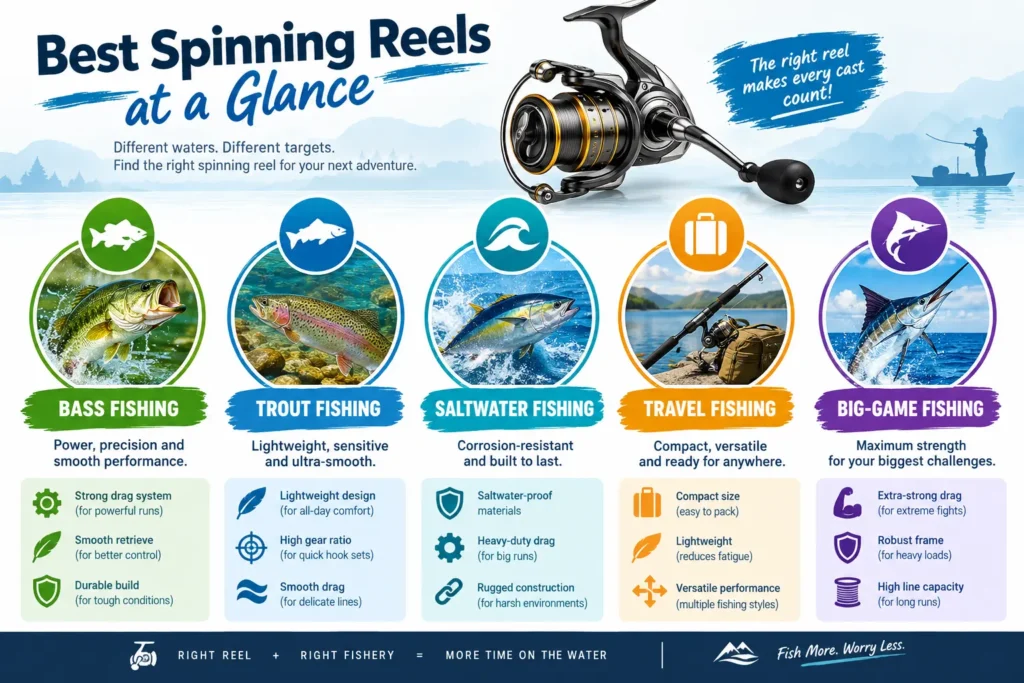
How We Chose the Best Fishing Reels (best value)
A fishing pole and reel combo can look impressive on a spec sheet and still disappoint on the water. That is why the recommendations below prioritize real fishing performance rather than marketing claims.
Each reel category was evaluated using the following criteria:
- Drag performance: Smooth startup, consistency during long runs, and resistance to sticking under pressure.
- Retrieve quality: Smoothness, sensitivity, and how well the reel transmits subtle bites.
- Casting distance: Performance with representative lure weights and braided line.
- Line lay: Ability to wind line evenly without loose loops, wind knots, or line digging.
- Weight and balance: Comfort during long sessions and compatibility with common rod sizes.
- Durability: Body construction, corrosion protection, bearing quality, and sealing.
- Value: Performance relative to price, not just the number of features.
The most important qualities in a spinning reel are a smooth retrieve, dependable drag, casting performance, line management, durability, and value. Premium reels often justify their price through better drag consistency, refined gearing, and stronger corrosion protection, especially for anglers who fish frequently or expose their gear to saltwater.
Best Overall Fishing Reel
For most anglers who want one reel that can handle freshwater fishing, occasional saltwater exposure, and a wide range of lure sizes, a premium 3000-size spinning reel is the best spincast reel that every fishing expert use.
Why a 3000-Size Reel Wins
A 3000-size reel offers the best balance for the widest range of anglers. It is large enough for bass, walleye, pike, and light inshore fishing, but still light enough for all-day casting with medium-light and medium rods.
It also provides enough line capacity for 8–12 lb braided line, which covers most freshwater applications and many inshore situations. A reel in this class should have a smooth drag, a well-supported rotor, and a body that resists flex when fighting a strong fish.
Who Should Buy It
Choose a premium 3000-size reel if you:
- Fish several times per month or more.
- Target multiple species.
- Want a reel that can move between freshwater and protected saltwater.
- Use lures from roughly 1/8 oz to 3/4 oz.
- Want better sensitivity and drag control than a budget reel provides.
Who Should Skip It
Beginners, occasional anglers, and anglers targeting only panfish or trout can usually get better value from a $70–$130 reel. You do not need a flagship reel to catch bass, trout, or panfish successfully.
Best Budget Spinning Reel
The best budget spinning reel is not necessarily the cheapest reel available. It is the least expensive reel that still offers acceptable line lay, a usable drag, and a comfortable retrieve.
What to Expect Under $100
A good reel under $100 should offer:
- A smooth drag with minimal sticking.
- A lightweight graphite or composite body.
- A bail that closes reliably.
- Decent line lay with 6–10 lb braid.
- A retrieve that does not feel gritty after normal use.
Budget reels can be excellent for panfish, trout, bass, and light inshore fishing. The key is avoiding the cheapest no-name reels, which often suffer from poor line lay, inconsistent drags, and premature corrosion.
Where Cheap Reels Fail
The biggest weaknesses in low-cost spincast reel are usually line lay and drag quality. Poor line lay creates loose loops that lead to wind knots, while an inconsistent drag can cause pulled hooks or snapped line during a fish’s first run.
If you can spend a little more, moving from a $40 reel to a $90–$130 reel often delivers a much bigger real-world improvement than moving from a $300 reel to a $500 reel.
Media suggestion: Add a comparison graphic titled “$50 vs. $100 vs. $200 Spinning Reel: What You Actually Get.”
Best Freshwater Spinning Reels for Bass
For bass fishing, the best spinning reel depends on whether you are fishing finesse baits, moving baits, or heavier presentations.
Best Reel Size for Bass
Most bass anglers should choose a 2500–3500 size spinning reel.
- 1000–2500: Finesse fishing, trout-style presentations, light jigs, and small plastics.
- 2500–3000: The best all-purpose bass size.
- 3500–4000: Heavier swimbaits, larger soft plastics, and fishing around heavier cover.
A 2500 or 3000 reel is ideal for Ned rigs, drop shots, wacky rigs, small swimbaits, and light jerkbaits. Larger spools can improve line flow and casting distance, while lighter reels reduce fatigue during long finesse sessions.
Best Gear Ratio for Bass
| Gear Ratio | Best Bass Techniques |
|---|---|
| 5.2:1–5.8:1 | Crankbaits, slow-rolled spinnerbaits, deep presentations |
| 6.0:1–6.2:1 | All-purpose bass fishing, jerkbaits, Ned rigs, small swimbaits |
| 6.2:1 and higher | Topwaters, spinnerbaits, fast retrieves, slack-line pickup |
A 5.8:1 to 6.2:1 gear ratio is the most versatile choice for bass. It gives you enough speed for most moving baits while still allowing a controlled retrieve for finesse presentations.
Best Line Setup for Bass
- Finesse: 5–8 lb braid with a 6–10 lb fluorocarbon leader.
- All-purpose: 8–10 lb braid with a 10–12 lb fluorocarbon leader.
- Heavy cover: 15–20 lb braid with a suitable fluorocarbon or monofilament leader.
Best Saltwater Spinning Reels
Saltwater fishing is harder on reels than freshwater fishing. Salt spray, sand, moisture, and repeated pressure all increase the risk of corrosion and internal wear.
What “Saltwater Ready” Really Means
A saltwater-ready spinning reel should have:
- A sealed or highly protected body.
- Corrosion-resistant ball bearings and hardware.
- A strong, heat-resistant drag system.
- A rigid aluminum or reinforced composite body.
- A line roller designed to reduce water intrusion and line twist.
Sealed bodies, corrosion-resistant materials, and quality drag washers matter most for anglers who fish saltwater regularly or expose their gear to spray.
Best Saltwater Reel Sizes
| Fishing Style | Recommended Reel Size | Typical Targets |
|---|---|---|
| Light inshore | 2500–3000 | Speckled trout, bonefish, small snook |
| All-purpose inshore | 4000–5000 | Redfish, striped bass, larger snook, pier fish |
| Surf and nearshore | 6000–8000 | Tarpon, sharks, tuna, large live baits |
The Penn Slammer IV is a strong all-around saltwater choice because of its sealed body and spool design, while the Penn Authority offers even more protection for anglers who fish in harsher saltwater conditions.
Saltwater Maintenance Is Non-Negotiable
Even a sealed reel needs care. Saltwater exposure accelerates corrosion and traps moisture in moving components, so regular cleaning is essential even for premium reels.
After every saltwater trip, wipe down the reel, avoid blasting it with high-pressure water, let it dry completely, and lightly lubricate the handle, bail, and line roller.
Media suggestion: Add a simple saltwater exposure map: “Occasional spray,” “Kayak splash,” “Surf,” and “Offshore.”
Best Ultralight Spinning Reels
Ultralight spinning reels are best for trout, panfish, creek smallmouth, and any situation where casting tiny lures accurately matters more than raw power.
Best Size for Ultralight Fishing
Choose a 500–1000 size reel for ultralight fishing.
These smaller reels pair well with 5–7 foot light or ultralight rods and are designed for lures under about 1/8 oz. They are especially effective for trout streams, ponds, small rivers, and panfish lakes.
What Matters Most
Do not choose an ultralight reel based only on bearing count. The most important features are:
- A light rotor.
- A smooth drag.
- A spool that manages light braid or monofilament.
- A comfortable handle.
- A body that balances well with a light rod.
A light, smooth rotor improves sensitivity and makes it easier to work tiny jigs, inline spinners, and small soft plastics.
Spinning Reel Buying Guide
This section answers the question most anglers actually have: “Which spinning reel should I buy for my fishing?”
Spinning Reel Sizes Explained
Spinning reel sizes can be confusing because Shimano, Daiwa, Penn, and other brands use slightly different numbering systems. However, the general size categories are consistent.
| Reel Size | Typical Use | Rod Match | Lure Range |
|---|---|---|---|
| 500–1000 | Trout, panfish, ultralight | 5–7 ft light/ultralight | Under 1/8 oz |
| 2000–2500 | Finesse bass, trout, light inshore | 6–7 ft light/medium-light | 1/16–1/4 oz |
| 3000–3500 | All-purpose bass, walleye, light saltwater | 6’6″–7’6″ medium | 1/4–3/4 oz |
| 4000–5000 | Pike, striped bass, inshore, heavier lures | 7–9 ft medium-heavy | 3/4–2 oz |
| 6000–8000 | Surf, tarpon, tuna, large live bait | 9–12 ft heavy | 2 oz and up |
A 1000-size reel is generally suited to light-line lure fishing, while 4000–5000 sizes are better for bass, pike, and heavier lure applications.
Gear Ratio Explained
Gear ratio tells you how many times the spool rotates for each full turn of the handle. A 6.2:1 reel rotates the spool 6.2 times per handle turn.
However, gear ratio alone does not tell the whole story. Spool diameter also affects how much line is retrieved per turn. A larger spool may retrieve more line per crank even at the same gear ratio.
Use this simple guide:
- Lower ratios, around 5.2:1–5.8:1: Better for crankbaits, slow presentations, and power fishing.
- Mid ratios, around 6.0:1–6.2:1: Best all-purpose range for most anglers.
- Higher ratios, above 6.2:1: Best for topwaters, spinnerbaits, and quickly taking up slack.
Drag Explained
Drag is the system that lets line leave the spool under controlled pressure. It protects your line, hook, and rod when a fish pulls hard.
For most applications, set your drag to roughly one-quarter to one-third of your line’s rated breaking strength. Then adjust based on lure size, cover, and target species.
A quality drag should start smoothly rather than jerking or sticking. Drag consistency matters more than maximum drag for most freshwater anglers.
Bearings: More Is Not Always Better
Bearing count can improve smoothness, but bearing quality, shielding, location, and maintenance matter more than the total number.
A well-sealed six-bearing reel can outperform a poorly protected ten-bearing reel, especially in saltwater. Look for shielded or sealed bearings, a smooth line roller, and a reel that still feels smooth after exposure to water and sand.
Body, Rotor, and Spool Materials
| Material | Benefits | Drawbacks |
|---|---|---|
| Graphite/composite | Lightweight, affordable, corrosion resistant | Less rigid under extreme pressure |
| Aluminum | Strong, durable, good for larger reels | Usually heavier than composite |
| Magnesium | Very lightweight | Requires excellent corrosion protection |
| Carbon fiber | Light, rigid, premium feel | Usually found in higher-priced reels |
How to Match a Spinning Reel to Your Rod
A balanced rod-and-reel setup improves casting accuracy, sensitivity, and comfort. An oversized reel on a light rod makes casting tiring and reduces sensitivity.
Use this simple matching guide:
| Rod Power | Best spincast reel Size |
|---|---|
| Ultralight | 500–1000 |
| Light | 1000–2500 |
| Medium-light | 2500–3000 |
| Medium | 3000–4000 |
| Medium-heavy | 4000–5000 |
| Heavy | 5000–8000 |
Also check the rod’s lure-rating range. If your rod is rated for 1/4–3/4 oz lures, choose a reel and line setup that lets you cast comfortably in the middle of that range.
Media suggestion: Add a “Rod + Reel Balance Chart” with rod power on one axis and reel size on the other.
Spinning Reel Maintenance Checklist
Maintenance is one of the easiest ways to extend the life of your reel and protect its performance.
After Every Saltwater Trip
- Keep the bail closed.
- Wipe the body, spool, handle, and line roller with a damp cloth.
- Avoid high-pressure water, which can force salt and debris into the reel.
- Let the reel dry fully away from direct sunlight.
- Apply a small amount of reel oil to the handle knob, bail hinge, and line roller.
- Loosen the drag slightly before storing the reel.
Saltwater reels require more frequent cleaning because salt accelerates corrosion and traps moisture inside moving components. The best approach is gentle exterior rinsing, complete drying, light lubrication, and periodic deeper servicing rather than forcing water into the reel.westmarine+1
Every Few Freshwater Trips
- Wipe down the reel.
- Check the line roller for debris.
- Inspect braid for fraying near the leader knot.
- Add one drop of reel oil to the handle and bail areas.
- Check that the bail closes firmly and the anti-reverse works properly.
Once or Twice Per Year
- Have the reel professionally serviced or carefully service it yourself.
- Inspect drag washers.
- Clean old grease from gears if you are experienced with reel maintenance.
- Replace worn line.
- Check screws, handle knobs, and the rotor for looseness.
Media suggestion: Offer a downloadable one-page “Spinning Reel Maintenance Checklist.”
Common Spinning Reel Mistakes
Avoiding these mistakes will improve casting, reduce wind knots, and help your reel last longer.
- Overfilling the spool: Too much line increases wind knots and reduces casting control. Leave a small gap below the spool lip.
- Using line that is too heavy: Heavy line hurts casting distance and finesse performance.
- Ignoring drag setup: A sticky or overly tight drag causes snapped lines and pulled hooks.
- Closing the bail by cranking: Manually closing the bail after a cast reduces line twist.
- Rinsing aggressively: High-pressure water can push salt and debris inside the reel.
- Buying too large: A heavy reel unbalances lighter rods and causes fatigue.
- Ignoring the line roller: Debris around the line roller can cause tangles and poor line lay.
Overfilling certain spincast reels can create line-management problems, so leaving a little room on the spool is often the better choice.
Spinning Reel Comparison Table
Use this table to compare reels by the specifications that matter most.
| Model | Size Tested | Weight | Gear Ratio | Max Drag | Best Use | Price Band |
|---|---|---|---|---|---|---|
| Daiwa Certate HD | 3000 | 8.5 oz | 6.2:1 | 22 lb | Premium all-purpose | $$$ |
| Shimano Stradic FM | C5000XG | 10.2 oz | 6.2:1 | 24 lb | All-purpose | $$$ |
| Lew’s Speed Spin CRX | 300 | 8 oz | 6.2:1 | 14 lb | Bass under $100 | $$ |
| Abu Garcia Beast | 3000 | 9.2 oz | 6.2:1 | 14 lb | Power fishing | $$$ |
| Okuma Inspira ISX | 3000 | 8.6 oz | 6:1 | 18 lb | Lightweight all-purpose | $$ |
| Quantum Cabo | 2500 | 9.9 oz | 6.2:1 | 25 lb | Fresh/salt crossover | $$$ |
| Penn Slammer IV | 3500 | 13.9 oz | 6.2:1 | 30 lb | Saltwater | $$$ |
| Penn Authority | 4500 | 15 oz | 5.7:1 | 30 lb | Live bait and big fish | |
| Piscifun Viper X | 3000 | 8.6 oz | 6.2:1 | 22 lb | Budget | $ |
Specifications can change by model year and regional version, so always confirm the exact size, weight, gear ratio, and drag rating on the manufacturer’s product page before buying.
How to Choose the Right Spinning Reel for You
If you want the simplest possible answer:
- Trout and panfish: 500–1000 size reel.
- All-purpose bass: 2500–3000 size reel with a 6.2:1 gear ratio.
- Pike, striped bass, and inshore: 4000–5000 size reel.
- Surf, tarpon, and offshore: 6000–8000 size reel.
- First reel: A 2500 or 3000 size reel under $100.
- Only one reel for everything: A 3000 size reel with a smooth drag and corrosion-resistant construction.
The best spinning reel is the one that matches your rod, lure weight, target species, and maintenance habits. A properly chosen mid-range reel will often outperform an expensive reel that is too large, too heavy, or poorly maintained.
FAQs About the Choosing a Spinning Reel for Saltwater and Freshwater
What is the best spinning reel for beginners?
A 2500 or 3000 size reel with a smooth drag, front-drag adjustment, and a price between $60 and $120 is ideal for most beginners. It handles most freshwater species, casts light lures well, and is easier to learn with than an oversized reel.
What size spinning reel should I buy?
Choose 500–1000 for trout and panfish, 2500–3000 for all-purpose bass fishing, 4000–5000 for pike, striped bass, and inshore saltwater, and 6000–8000 for surf, tarpon, and large gamefish. Reel size generally corresponds to line capacity and the size of fish and lures you plan to use
What gear ratio is best for a spinning reel?
A 5.8:1 to 6.2:1 gear ratio is the most versatile choice for most anglers. Choose a lower ratio around 5.2:1 for cranking power and a higher ratio above 6.2:1 for fast retrieves and reaction baits.
Are expensive spinning reels worth it?
Yes, if you fish often, need better sensitivity, or target larger fish. For occasional freshwater fishing, a quality mid-range reel usually delivers most of the real-world performance at a much lower price.
What is the best spinning reel for bass fishing?
A 2500–3500 size reel with a 6.2:1 gear ratio, smooth drag, and light rotor is best for most bass anglers. It works well for Ned rigs, drop shots, small swimbaits, jerkbaits, and light topwaters.
Can I use a freshwater spinning reel in saltwater?
You can occasionally, but it will corrode faster unless it is thoroughly cleaned after every trip. For regular saltwater fishing, choose a sealed or corrosion-resistant reel such as a Penn Slammer, Penn Authority, Quantum Cabo, or Shimano Stella SW.wired2fish+1
How much drag do I need on a spinning reel?
Most freshwater anglers need 10–20 lb of maximum drag, while inshore and nearshore anglers often benefit from 20–30 lb. More drag is not always better; smooth, consistent drag matters more than the highest number.
How often should I clean my spinning reel?
Wipe down and lightly lubricate a freshwater reel every few trips. Clean a saltwater-exposed reel after every outing, and schedule a full internal service at least annually—or more often with heavy saltwater use.westmarine+1
Final Verdict: Which Spinning Reel Should You Buy?
If you want one recommendation, buy a 3000-size spinning reel with a smooth drag, 6.2:1 gear ratio, and corrosion-resistant construction. It is the most versatile choice for bass, walleye, trout, pike, and light inshore fishing.
If you are on a budget, choose a reliable 2500–3000 size reel under $100 rather than chasing premium features you may not need. If you fish saltwater regularly, invest in sealing, corrosion resistance, and a strong drag system instead of paying for extra ball bearings or cosmetic upgrades.
The right spinning reel should feel like an extension of your rod: light enough to cast all day,