
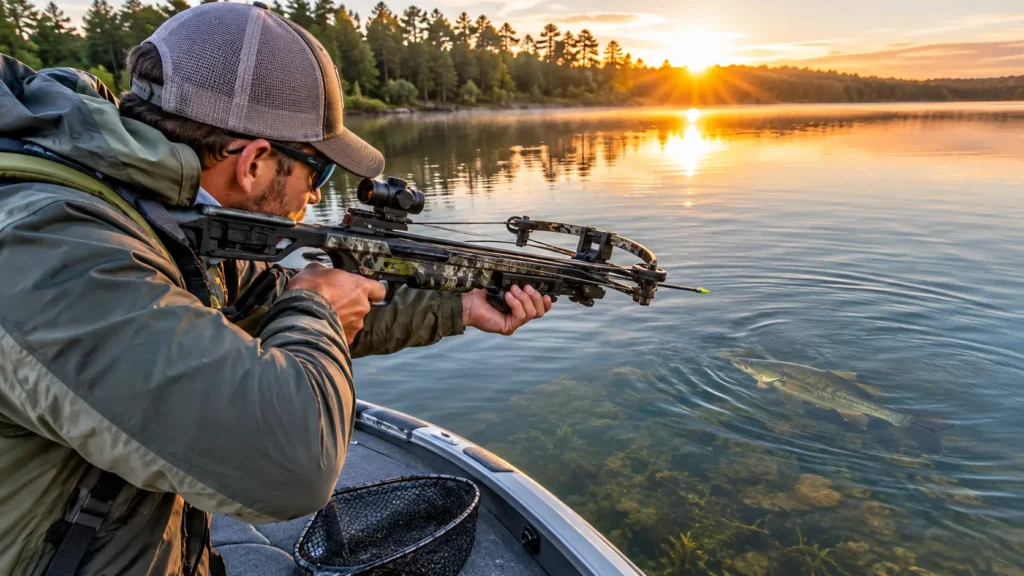
Crossbow fishing is a form of bowfishing that uses a crossbow, a barbed fishing arrow, and a line-and-reel system to shoot and retrieve fish in shallow water. It is legal in many U.S. states, but the fish you may take, the waters you may use, and the equipment rules vary by state, so always check the current regulations before you go.
This fish hunting equipment tips explains how to fish with a crossbow for beginners, from choosing a bowfishing crossbow and building a reliable cross bow fishing setup to aiming through water, retrieving your catch, and staying safe around other outdoor users.

What Is Crossbow Fishing and How Does It Work?
Crossbow fishing combines archery with fishing. Instead of casting a hook, you aim a specialized arrow at a visible fish, shoot it, and retrieve the fish with a line attached to the arrow.
Understanding Crossbow Bowfishing
Fishing with a crossbow is usually done in clear, shallow water where you can see fish cruising near the surface. Common targets include invasive or nongame species such as common carp, grass carp, gar, and buffalo. In Texas, for example, crossbows are lawful archery equipment for taking nongame fish, while game fish and protected species remain off limits.
A crossbow can be a good entry point for someone who already owns one for deer or turkey hunting, but it is not automatically the best bowfishing tool. A vertical bow often allows faster repeat shots; a crossbow catching fish offers a steadier aim and can feel easier for a new archery enthusiast.
How a Crossbow Fishing Setup Works
A basic fishing crossbow setup has four parts:
- A crossbow with enough poundage to penetrate water and fish
- A solid fishing arrow or bolt, often fiberglass or carbon
- A barbed, retrievable bowfishing tip
- A reel or spool with strong line attached to the arrow
You cock the crossbow, nock the fishing arrow, aim below the fish to correct for refraction, and fire. The barb holds the fish, while the line lets you pull it back to the boat, bank, or platform.
Suggested visual: A labeled diagram showing the crossbow, rail, mounted reel, fishing arrow, barbed tip, line, water surface, fish, and “aim low” refraction line.
Is Crossbow Fishing Legal in the United States?
Crossbow fishing is legal in many states, but there is no single national rulebook. State wildlife agencies regulate licenses, legal species, shooting hours, equipment, and restricted waters.
State-by-State Crossbow Fishing Regulations
Regulations differ significantly. Treat the examples below as a starting point, not legal advice, and confirm the current rules with your state wildlife agency before your first trip.
| State | Crossbow legality | Key rules and limits |
|---|---|---|
| Texas | Legal for bowfishing | A freshwater, saltwater, or all-water license is required; crossbows may take nongame fish only. Edible or bait-use fish such as gar, common carp, and buffalo generally cannot be released after capture. Some community lakes, state-park waters, and locally managed lakes are restricted. |
| Nebraska | Legal | Anglers age 16 and older need a fishing permit. Arrows may have only one barbed point and must be attached to the bow by a line. Nongame fish may be pursued year-round, 24 hours a day; game-fish bowfishing has a separate season and daylight-only rule. Paddlefish has special crossbow restrictions. outdoornebraska |
| Kansas | Legal | Crossbows are legal for bowfishing. Arrows need barbed heads and a line attached to the bow. Bowfishing is open statewide unless posted closed, but waters within 50 yards of occupied docks, ramps, swim areas, picnic sites, camping areas, and other occupied public-use areas are closed. |
Local governments, reservoir authorities, parks, and private landowners can add restrictions. In Texas, for instance, some city lakes and state-park waters prohibit bowfishing even where statewide rules would otherwise allow it. tpwd.texas
Fishing Licenses, Permitted Waters, and Species Restrictions
Before you fish with a crossbow, confirm four things:
- License: Most states require a valid fishing license, even when you use archery gear.
- Water access: Public lakes, rivers, ponds, and coastal waters may have separate local rules.
- Species: Many states limit crossbow fishing to nongame, invasive, or rough fish.
- Time and equipment: Some states restrict night shooting, require a line attached to the arrow, or limit arrow points. Nebraska, for example, requires a single barbed point and a line attachment.
Never assume that a crossbow legal for deer or turkey hunting is automatically legal for fishing. Hunting season rules and fishing rules are separate.
What Fish Can You Catch With a Crossbow?
Most cross bow fishing targets fish that are visible in shallow water and legal to take with archery equipment.
Common Carp and Grass Carp
Common carp are one of the most popular crossbow fish targets because they often cruise shallow flats, spawn in visible groups, and provide a strong fight. Grass carp may also be targeted in some areas, but they are sometimes stocked for vegetation control and may have special protections or permit requirements.
Do not assume every carp is legal. Check whether your state distinguishes common carp from grass carp, and follow any size, bag, or release rules.
Gar, Buffalo, and Other Nongame Fish
Other common targets include:
- Longnose, shortnose, and spotted gar
- Buffalo fish
- Mullet and sheepshead in suitable coastal waters
- Other nongame species allowed by state law
Texas specifically lists gar, buffalo, mullet, and sheepshead as examples of nongame fish that may be taken with bows and crossbows, subject to location-specific exceptions.
Avoid shooting protected species, game fish, or any fish you cannot identify. A missed identification can turn an enjoyable outing into a regulatory problem.
What Equipment Do You Need for Crossbow Fishing?
You do not need an expensive pro-level package to start, but you do need gear designed for retrieval, not ordinary target shooting.
Crossbows Designed for Bowfishing
You can use either:
- A dedicated bowfishing crossbow
- A standard hunting crossbow converted with AMS bowfishing kit
- A compact pistol crossbow fishing setup for very close-range, low-power situations
A hunting crossbow can work if your state allows it and you can safely mount a reel. Many hunters already own a Barnett Recruit, Killer Instinct, Ravin, or similar compound-style crossbow for deer, hog, or turkey hunting. Those bows can be capable fishing platforms, but their speed, power, and trigger systems may be more than a beginner needs.
A mini or pistol-style crossbow may be easier to handle from a small boat, but it usually sacrifices penetration and effective fishing crossbow range. Match the tool to the water and the fish.
Fishing Arrows, Barbed Tips, and Retrieval Lines
Use a fishing arrow, not a regular hunting arrow. Bowfishing arrows are commonly made from fiberglass or heavy carbon and use a larger diameter shaft for durability.
Your tip matters as much as the arrow:
- Barbed tips hold fish securely but may require unscrewing or reversing to remove the catch.
- Retriever or spring-style tips can make fish removal faster.
- Piranha-style or multipoint tips offer strong holding power for larger fish.
The line should be tough, low-stretch, and rated for the fish you expect to encounter. Attach it securely to the arrow and ensure it cannot snag the crossbow rail, limbs, or trigger area.
Reels, Spools, and Essential Accessories
A fishing reel or spool is essential. Common options include:
- Hand-wrap spool: Simple, affordable, and reliable for beginners.
- Closed-face reel: Helps control line and reduces tangles.
- Open-face or spinning-style reel: Offers faster retrieval but requires more practice.
Useful accessories include a boat mount or rail mount for the reel, gloves, polarized sunglasses, a fish cooler or holding container, pliers, a line cutter, spare arrows, and a first-aid kit. Stainless-steel hardware and corrosion-resistant components are worthwhile if you fish brackish or salt water.
Suggested visual: A flat-lay gear checklist photo: crossbow, fishing bolt, barbed tip, reel, line, gloves, polarized glasses, pliers, and cooler.
How to Choose the Right Crossbow for Fishing
The best crossbow for fishing is not necessarily the fastest or most expensive one. Choose a bow you can cock, hold steady, and control safely.
Draw Weight, Speed, and Accuracy
For bowfishing, moderate power is usually enough. You are shooting at close range, often less than 10 to 15 yards, and the arrow must penetrate water without wasting energy.
A light draw weight can be easier for youth shooters, smaller-framed hunters, or anyone who cannot comfortably cock a heavy hunting crossbow. However, too little power may fail to penetrate a large carp or gar. A practical starting point is a crossbow you can cocked by hand or with an approved cocking device, while still holding steady for a careful shot.
Speed matters less than shot placement. A fast bolt does not compensate for aiming at the wrong depth.
Crossbow Size, Weight, and Handling
Consider:
- Weight: Lighter bows reduce fatigue during long nights on a platform or boat.
- Width: Narrow limbs help in tight boats and around other anglers.
- Rail space: You need a secure place to attach a reel or mount.
- Optics: A simple sight can help, but many bowfishers shoot fish with crossbow instinctively at close range.
- Noise and recoil: Lower recoil helps you stay on target and recover quickly.
If you already hunt with a crossbow, test it with a fishing bolt before buying dedicated gear. If it feels bulky, heavy, or awkward at close range, a simpler bowfishing rig may serve you better.
How to Set Up a Crossbow for Bowfishing
A safe crossbow fishing setup keeps the line away from the shooter, limbs, rail, and trigger.
Attaching the Fishing Line and Reel
Follow this basic process:
- Choose a reel or spool rated for fishing line.
- Install it on a stable mount, usually beneath the crossbow or on the side of the riser.
- Attach the line to the reel or spool.
- Run the line forward, away from the rail and limbs.
- Tie the line securely to the rear of the fishing arrow or to the arrow’s designated attachment point.
- Test the full system before shooting: draw, aim, release, retrieve, and inspect for snag points.
Do not wrap line directly around your hand, wrist, or the crossbow. A large fish can pull hard, and a tangled line can create a serious safety hazard.
Choosing the Right Arrow and Bowfishing Tip
Use an arrow with:
- A durable fiberglass or carbon shaft
- A fishing nock compatible with your crossbow
- A barbed or retrievable bowfishing tip
- A line attachment point at the rear
- No standard hunting broadhead
A vane or fletching may not be necessary for short-range fishing and can create drag or compliance issues in some places. Texas, for example, prohibits possessing an arrow with fletching while fishing with archery equipment, along with unbarbed arrows and bows without a reel and line. texas.public
Check your state’s equipment language carefully. “Arrow,” “bolt,” “barbed head,” and “line attached to the bow” can have specific legal meanings.
How to Crossbow Fish: Step-by-Step Techniques
Fishing with a crossbow rewards patience, observation, and controlled shots more than raw power.
Finding Fish in Shallow Water
Start in calm, shallow water with good visibility. Look for:
- Carp tailing or rolling near the surface
- Gar basking near the top
- Shadows moving across sandy or muddy flats
- Fish holding near vegetation, drop-offs, or warm shallow water
- Early-morning and evening movement
Polarized sunglasses cut surface glare and make fish much easier to spot. Fish from a stable boat, kayak, bank, or elevated platform, and keep your movements slow.
Aiming and Adjusting for Water Refraction
Water bends light, so fish appear higher and closer than they really are. This is called refraction.
A simple beginner rule is to aim low. The deeper the fish appears and the farther away it is, the lower you should aim. At very close range, the adjustment may be small; in deeper water, it can be substantial.
Practice with a weighted target or a submerged object before shooting at live fish. Learn how your particular crossbow, arrow, and line behave at different depths.
Shooting, Retrieving, and Handling Your Catch
Use this sequence:
- Identify the fish and confirm it is legal.
- Check your background and make sure no person, boat, dock, or animal is in the line of fire.
- Cock the crossbow and nock the fishing arrow.
- Aim below the visible fish to correct for refraction.
- Fire only when you have a clean, safe shot.
- Let the reel or spool feed line smoothly.
- Retrieve steadily; do not jerk the arrow free.
- Bring the fish close, control it with pliers or gloves, and remove the barb carefully.
- Follow local rules for keeping, releasing, or disposing of the fish.
In Texas, edible or bait-use fish such as gar, common carp, and buffalo generally may not be released after being taken with lawful archery equipment.
Where Are the Best Places to Go Crossbow Fishing?
The best crossbow fishing spots combine shallow water, visible fish, legal access, and a safe shooting lane.
Lakes, Rivers, Ponds, and Shallow Flats
Good places to start include:
- shallow lake flats
- river backwaters
- pond edges with legal access
- reservoir coves
- coastal shallows where nongame species are legal
- slow-moving river bends with visible fish
Avoid crowded boat ramps, swimming beaches, picnic areas, and occupied docks. Kansas explicitly closes bowfishing within 50 yards of many occupied public-use areas.
Best Conditions for Spotting Fish
The easiest conditions for beginners are:
- Calm wind
- Sunny skies
- Clear or lightly stained water
- Early morning or late evening
- Stable water levels
- Fish moving through shallow cover
Murky water makes refraction and fish identification harder. Wind creates surface glare and makes boat control difficult.
Crossbow Fishing Safety Tips Every Beginner Should Know
A crossbow is a powerful piece of archery equipment. Treat every fishing trip with the same discipline you would use for small game or deer hunting.
Safe Shooting Practices Around Boats and Other Anglers
- Keep the muzzle or front of the crossbow pointed in a safe direction.
- Never shoot toward people, boats, docks, roads, or structures.
- Confirm what lies beyond the fish and the water.
- Keep fingers below the rail and away from the string path.
- Use a safety mechanism or anti-dry-fire device if your crossbow has one.
- Communicate clearly with anyone sharing your boat.
Never shoot unless you can positively identify the target and guarantee a safe backstop.
Handling Crossbows and Retrieving Arrows Safely
- Keep the crossbow uncocked until you are ready to shoot.
- Do not walk with a cocked, loaded crossbow.
- Keep the line clear of limbs, rail, trigger, and your body.
- Wear gloves when handling gar, catfish, stingray, or other spiny fish.
- Use pliers to remove barbs.
- Inspect arrows, line, nocks, and mounts after every shot.
A stingray, gar, or large carp can injure an unprepared angler. Carry cutting tools and know how to release a tangled line quickly.
Crossbow Fishing vs. Traditional Bowfishing: Which Is Better?
Neither style is universally better. The right choice depends on your experience, body strength, local rules, and fishing style.
Crossbow Fishing Advantages and Disadvantages
| Factor | Cross fishing | Traditional vertical bowfishing |
|---|---|---|
| Aim stability | Easier to hold steady | Requires more archery practice |
| Repeat shots | Slower to reload and cock | Faster for multiple fish |
| Beginner learning curve | Often gentler | Steeper |
| Compact handling | Can be bulky in a boat | Usually easier to maneuver |
| Equipment conversion | Requires a compatible kit and mount | Often simpler with a dedicated bowfishing bow |
| Best use | One clear shot at a visible fish | Fast action, schooling fish, quick follow-ups |
Is Crossbow Fishing a Good Choice for Beginners?
Crossbow catching fish can be a good choice for beginners who want a steady aim and already understand basic crossbow safety. It is especially useful for a hunter transitioning from deer, turkey, hog, or small game hunting.
Still, beginners should start with low-pressure practice sessions, legal nongame fish, and simple gear. Learn refraction, line control, and safe retrieval before chasing large gar or fishing at night.
FAQs
What are the fish crossbows called?
They are commonly called bowfishing crossbows, fishing crossbows, or crossbow bowfishing rigs. A standard crossbow can sometimes be converted with a fishing kit, reel, mount, and specialized arrows.
What is the best crossbow for fishing?
The best crossbow is one that is legal in your state, comfortable to cock and hold, compatible with a fishing reel, and powerful enough to penetrate your target species. A dedicated bowfishing crossbow is often simpler than converting a high-powered hunting model.
Can you use a crossbow for bowfishing?
Yes. Many states allow crossbows for bowfishing, including Texas, Nebraska, and Kansas, but species, water, licensing, and equipment rules vary.
How do you shoot a crossbow at fish?
Spot the fish, aim below it to compensate for refraction, ensure a safe background, fire, allow the line to pay out, then retrieve steadily. Practice on submerged targets before fishing.
How do you fish with a crossbow for beginners?
Start with legal nongame fish in shallow, clear water. Use a barbed fishing arrow, a reel or spool, a strong line, polarized sunglasses, and a stable platform. Aim low, retrieve smoothly, and follow all state and local rules.
Can you use a pistol crossbow for fishing?
Sometimes, but it depends on local law and the fish you target. A pistol crossbow fishing setup can work for very small, close-range targets, but it may lack the power and stability needed for larger carp or gar.
Do you need a special arrow for crossbow fishing?
Yes. Use a durable fishing arrow or bolt with a barbed or retrievable bowfishing tip and a secure line attachment. Ordinary target arrows and broadhead hunting arrows are not suitable.
Is crossbow fishing good for invasive species control?
It can help remove certain invasive or nuisance species where legal, such as common carp in some waters. Check species rules first, because some carp varieties and other fish have protections or special restrictions.
Can you use a fishing bow for hunting?
Usually no. Fishing bows use barbed, line-attached arrows for fish, while hunting requires legal broadheads and species-specific rules. Check your state’s hunting regulations before using one.
Can you use a crossbow underwater?
No. Water rapidly slows the bolt and can damage the crossbow. Bowfishing is done from above the surface, aiming into the water.mdc.mo
Are crossbows legal in New Zealand?
Yes, but no licence is required; crossbows are still offensive weapons under the Crimes Act. Hunting on public conservation land requires a DOC permit and equipment standards.
Is it better to bowfish at night or during the day?
Night is often better because fish are more active and visible under lights, with less glare and boat traffic. Day fishing is simpler for beginners; always follow local night-shooting rules.
Conclusion
Cross fishing gives beginners a steady, approachable way to try bowfishing without immediately mastering a vertical bow. With the right crossbow fishing setup—a durable fishing arrow, barbed tip, secure line, and reliable reel—you can pursue legal nongame fish in shallow lakes, rivers, ponds, and coastal flats.
The key is preparation: verify your state’s rules, identify fish correctly, aim below the target to offset refraction, and keep safety at the center of every shot. Start close, practice on submerged targets, and build skill before chasing larger gar or fishing after dark.
When done responsibly, crossbow fishing is an exciting outdoor activity that blends archery discipline with the challenge of spotting and catching fish in their own environment. Check local regulations, respect other anglers, and let your first successful retrieval be the start of a long-term crossbow catching fish hobby.
You might also like: