
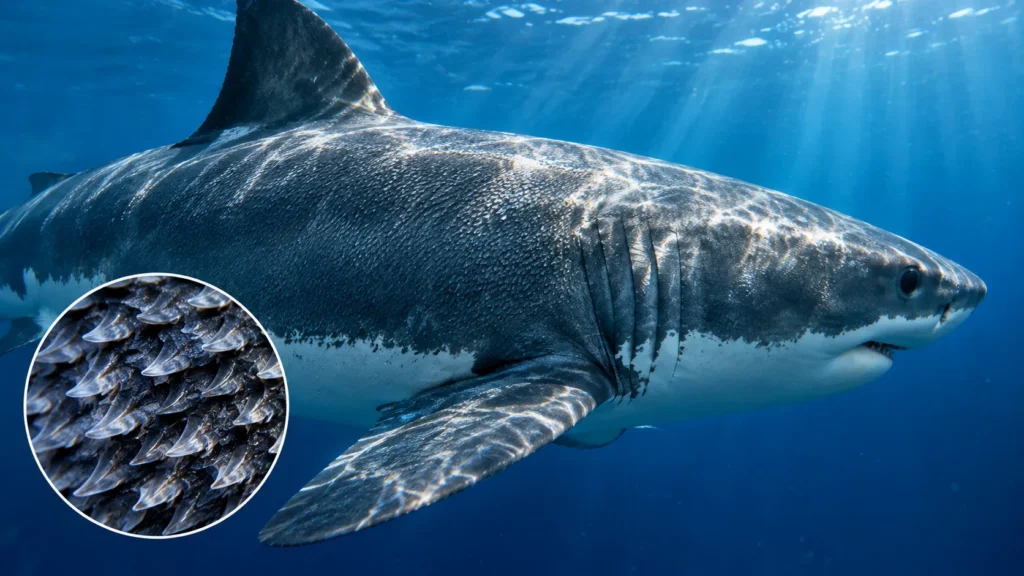
Do sharks have scales like other fish? Sharks have scales, but they are not the flat, overlapping scales most people picture on a goldfish or salmon. A shark’s body is covered with placoid scales, also called dermal denticles – tiny, tooth-like structures embedded in its skin. These scales protect the shark and help it move through water more efficiently.
Shark skin is more than just a covering. Its unusual shark skin texture helps reduce drag, supports fast swimming, and gives sharks their famous sandpaper-like feel.
Do Sharks Have Scales or Skin?
Sharks have both scales and skin. Their skin forms a tough, flexible outer layer, while millions of placoid scales sit within and project slightly from that skin.
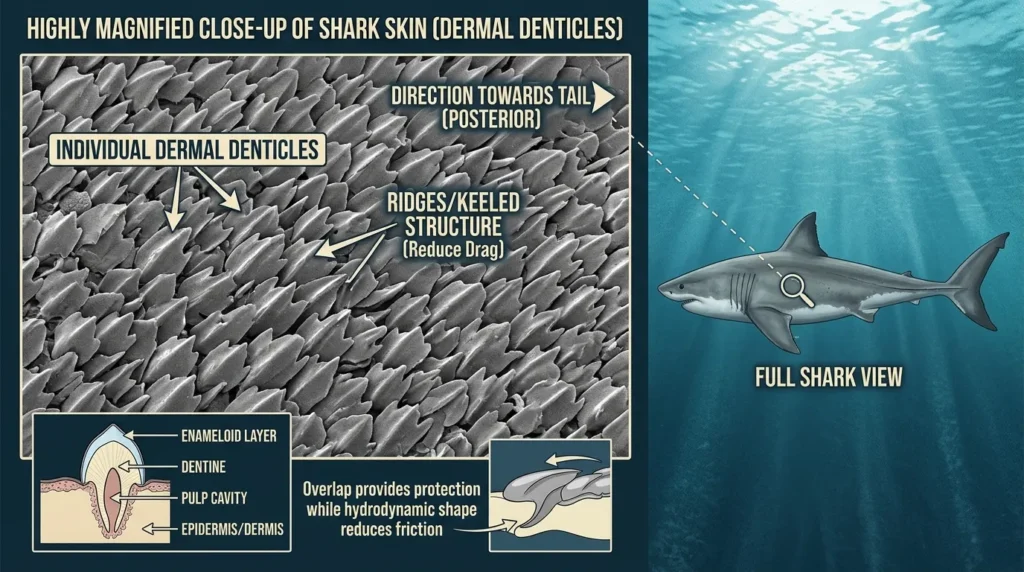
These structures are called placoid scales because of their shape and structure. They are not the same as the scales on bony fish. Instead, they resemble miniature teeth, with a hard outer surface and a structure built from materials similar to dentin and enameloid.
So, if someone asks, “Do sharks have scales like other fish?” the best answer is: yes, but not in the same way. Sharks have specialized scales adapted for protection and swimming, while many bony fish have thinner, plate-like scales that grow with their bodies.
What Are Shark Scales Called?
Shark scales have two common names:
- Placoid scales — the scientific term for this type of scale.
- Dermal denticles — a descriptive term meaning “skin teeth.”
Both names refer to the same structure. NOAA Fisheries describes shark skin as being covered in tiny, teeth-like placoid scales, also known as dermal denticles. fisheries.noaa
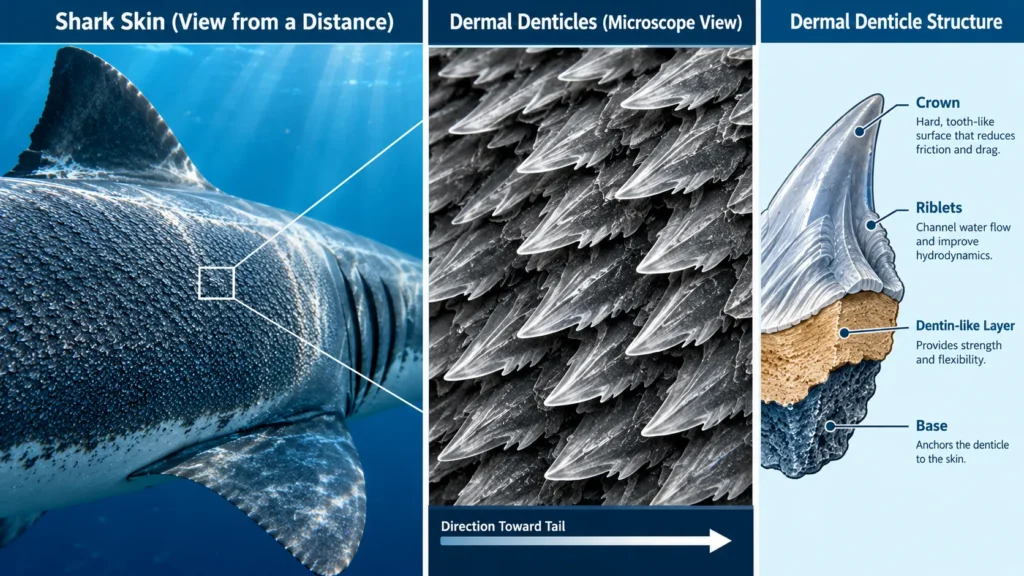
The name “denticles” makes sense when you look at their anatomy. Each denticle has a root anchored in the shark’s skin, a dentin-like inner layer, and a hard enameloid outer layer. That is similar to the basic structure of a tooth, though a denticle is much smaller and sits in the skin rather than the jaw.
During mating, male sharks often bite the female and hold on to keep themselves in position. To withstand this behavior, female sharks have evolved thicker, tougher skin that helps protect them from deep bites and serious injuries.
What Do Shark Scales Look Like Under a Microscope?
Under magnification, shark scales look like tiny, flat, V-shaped or diamond-shaped teeth packed closely across the skin. Many overlap slightly, like shingles on a roof, and most point backward toward the tail.
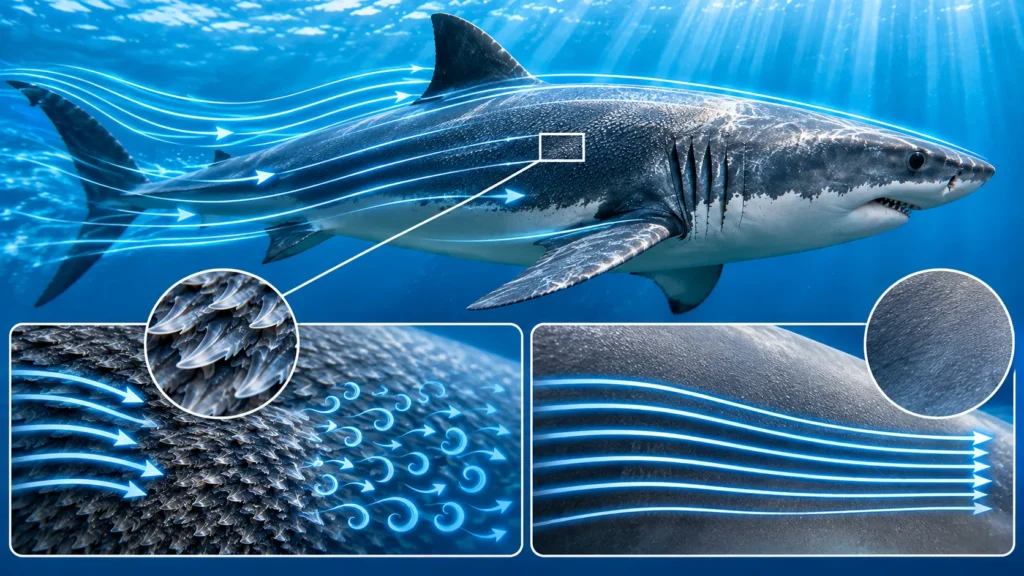
Each denticle often has raised ridges called riblets. These ridges help control how water flows over the shark’s body, reducing turbulence and friction.
What do shark scales look like? At a normal distance, they may simply make the skin look smooth or matte. Up close, they form a dense mosaic of hard, pointed, tooth-like structures.
What Does Shark Skin Feel Like?
Shark skin feels rough like sandpaper when you rub it from tail to head. That happens because the denticles point toward the tail, so stroking backward catches their raised edges.
Move your hand from head to tail, however, and the skin feels much smoother. The scales lie in the same direction as the movement, allowing your hand to glide over them more easily.
This direction-dependent shark skin texture is one of the clearest ways to understand why shark skin is different from ordinary fish skin. It is not uniformly smooth or uniformly rough; its feel depends on the direction you touch it.
What Is the Purpose of Shark Scales?
Shark scales serve two major purposes: protection and efficient movement.
Protection
Dermal denticles create a tough outer armor. Their hard, tooth-like structure helps protect the shark’s skin from scrapes, bites, parasites, and abrasion in the ocean.
Swimming efficiency
The scales also reduce drag. As water moves over the shark, the shape and spacing of the denticles help guide flow across the skin. This can reduce turbulence and friction, helping sharks swim faster and more quietly.
In some fast sharks, such as shortfin makos, the denticles can adjust position in ways that may improve water flow and help propel the animal forward.
How Are Shark Scales Different From Fish Scales?
Many bony fish have thin, flexible scales made largely of bone-like material. These scales often overlap like roof tiles and can grow as the fish grows. australian
Shark scales work differently. Placoid scales are harder, tooth-like structures embedded in the skin. They contain dentin-like tissue and surface of enamel, rather than being simple plates of bone.
| Feature | Shark scales | Many bony-fish scales |
|---|---|---|
| Common name | Placoid scales or dermal denticles | Cycloid or ctenoid scales |
| Structure | Tooth-like, with hard outer tissue and inner dentin-like layer | Thin, plate-like structures |
| Texture | Rough in one direction, smoother in the other | Usually smoother and more flexible |
| Growth | Individual scales generally do not grow much; new scales are added | Scales commonly grow with the fish |
| Main benefit | Protection and drag reduction | Protection and flexibility |
This table answers the common question, “Do sharks have scales like other fish?” They do, but shark scales are structurally closer to teeth than to the scales of a trout or tuna.
Do All Shark Species Have the Same Type of Scales?
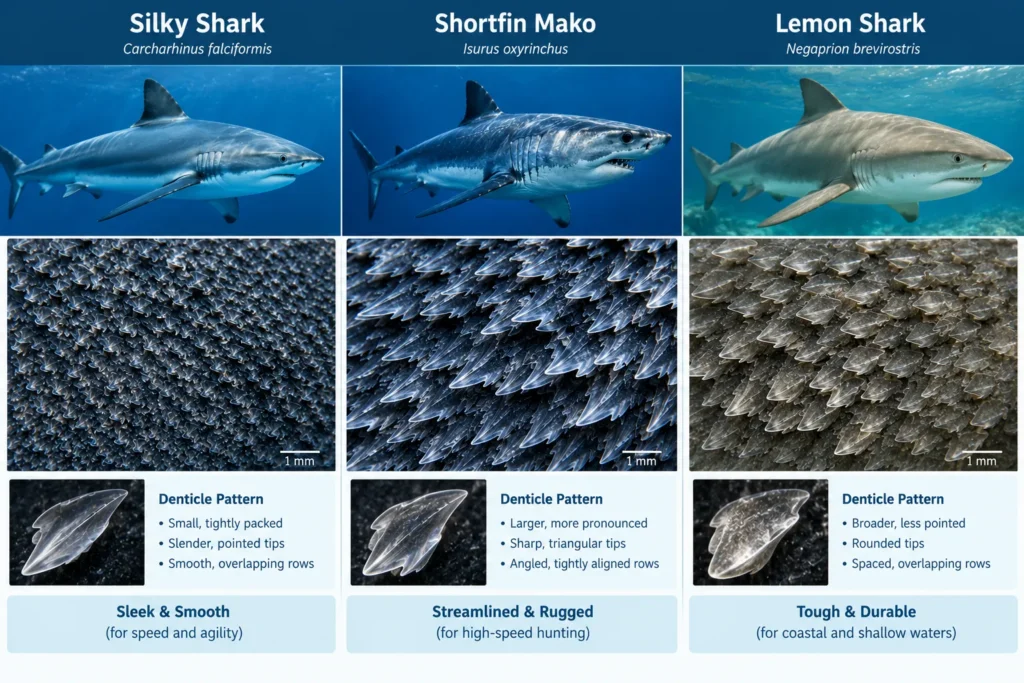
No. many sharks have placoid scales, but the size, shape, spacing, and arrangement vary by species, body area, and life stage.
For example, silky sharks have relatively small denticles, which helps give their skin a silky feel. Other species may have larger, more pronounced denticles suited to different swimming styles or environments.
Researchers can even use denticle patterns to help identify some shark species, because the shape and arrangement can be species-specific.
Do Shark Scales Grow as Sharks Get Bigger?
Individual placoid scales generally do not grow in proportion to the shark. Once a denticle reaches its size, it stays close to that size.
As the shark grows, its skin needs more coverage. New denticles develop in the spaces between existing scales, allowing the protective surface to expand with the animal.
This is a major difference from many bony fish, whose scales can enlarge as the fish grows.
Are Shark Scales Related to Their Teeth?
Yes—shark scales and shark teeth are closely related in structure. Both contain similar hard tissues, including dentin-like material and an enameloid outer layer.
That does not mean a shark’s skin scales are the same as the teeth in its mouth. Teeth are larger, arranged in the jaws, and specialized for gripping, cutting, or crushing food. Dermal denticles are much smaller, embedded across the skin, and specialized for protection and hydrodynamics.
A helpful way to remember it: shark teeth and shark scales share a design, but they do different jobs.
Are Shark Scales Useful to Humans?
Shark skin has inspired engineers for years. Its ribbed denticle pattern has influenced research into swimsuits, boat hulls, aircraft surfaces, and other materials designed to manage drag.
The real thing is difficult to copy. Shark skin combines hard denticles with a flexible skin structure, and the size and spacing of the riblets must be precise to reduce drag rather than increase it.
Researchers have also studied denticle-like surfaces for their potential to discourage microbial growth on ships and underwater structures.
Frequently Asked Questions About Shark Scales
Are shark scales sharp?
They can feel sharp when rubbed in the wrong direction. The denticles point toward the tail, so rubbing from tail to head can feel abrasive, like fine sandpaper.
Can shark scales hurt human skin?
Yes, they can scrape or irritate human skin, especially if someone brushes against a shark in the reverse direction. The injury is usually an abrasion rather than a puncture, but any wound from wildlife should be cleaned and assessed by a medical professional.
Do sharks shed their scales?
Sharks do not shed their scales the way many bony fish may lose scales. As a shark grows, it adds new denticles between older ones; individual scales may be replaced if damaged, but they do not regularly fall off in large sheets.
Can shark scales be used as sandpaper?
Historically, dried sharkskin has been used as an abrasive material in some cultures. However, modern sandpaper is manufactured with engineered abrasive particles. Shark denticles inspired the concept, but they are not the standard material used in commercial sandpaper today.
Do sharks have scales like other fish?
Sharks have scales, but not like most bony fish. Their placoid scales are tooth-like dermal denticles, while many bony fish have thinner, overlapping scales made from bone-like tissue.
What are shark scales called?
Shark scales are called placoid scales or dermal denticles. Both terms describe the same tooth-like skin structures.
What do shark scales look like?
They look like tiny, flat, V-shaped or diamond-shaped teeth arranged across the skin. Under a microscope, many have ridges called riblets and overlap slightly like shingles.
Why is shark skin rough?
Shark skin is rough because its denticles point backward toward the tail. When touched from tail to head, the raised edges catch against the skin, creating a sandpaper-like textures
Do great white sharks have scales?
Yes. Great white sharks have placoid scales, or dermal denticles, covering their skin. Like other sharks, they use these tooth-like scales for protection and to help manage water flow over their bodies while swimming.
Why do Hexanchiformes sharks have six or seven gill slits while most other sharks have only five pairs?
Hexanchiformes—including cow sharks and frilled sharks—are an early-diverging shark lineage. They retained six or seven pairs of gill slits, while most living sharks have five pairs. Scientists think this reflects their ancient evolutionary history rather than a simple need for extra breathing capacity.
Do whale sharks have scales?
Yes. Whale sharks have dermal denticles, the same type of tooth-like placoid scales found on other sharks. Their denticles have a distinctive strong central keel and may help with hydrodynamics; whale sharks also have denticles on their eyeballs, likely for protection.
What do the Chinese do with shark fins?
Shark fins are traditionally used in Chinese cuisine to make shark fin soup, often served at weddings, banquets, and other special occasions. The dorsal fins provide a chewy, gelatinous texture; the soup’s flavor comes mainly from broth and other ingredients. Conservation groups and many governments oppose unsustainable finning because it can involve removing fins and discarding the shark’s body.
Conclusion
So, do sharks have scales? Absolutely—but their scales are unlike those of most fish. Sharks are covered in placoid scales, better known as dermal denticles, which are tiny tooth-like structures embedded in the skin. They protect the shark, create its famous sandpaper-like texture, and help water flow more smoothly over its body.
These specialized scales show how well sharks are built for life in the ocean. Their skin is not just a barrier; it is a working surface that supports protection, speed, and efficient swimming. Understanding shark scales gives us a clearer picture of why sharks have remained such successful ocean predators for millions of years.
Recommended posts
- Does Cod Fish Have Scales and Fins? Myths & Facts (Revealed)
- Are Catfish Related to Sharks? Yes or No! (Catfish Vs Shark)