
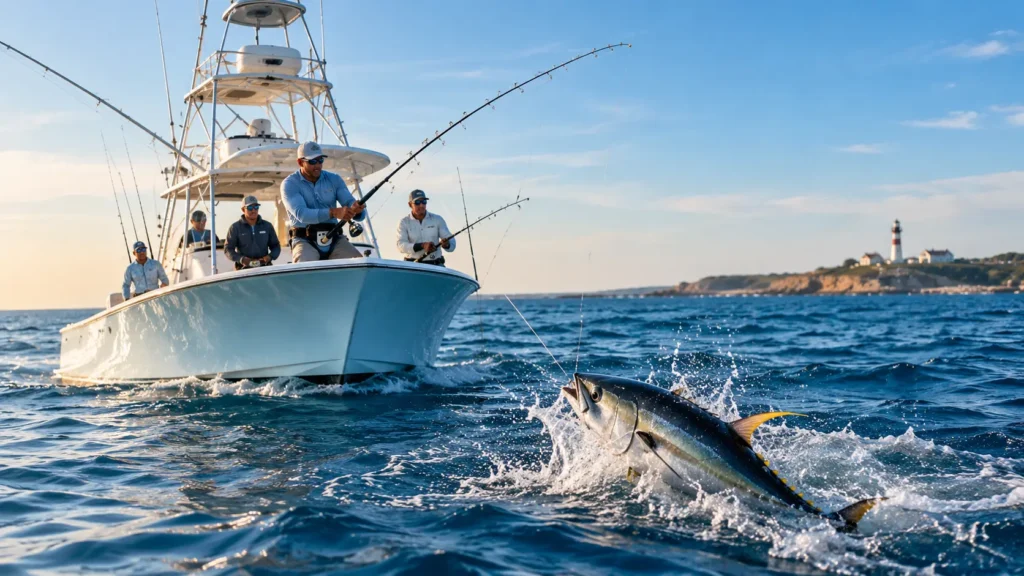
Tuna fishing Long Island puts you within reach of hard-fighting bluefin, yellowfin, bigeye, and albacore tuna. Most anglers book a private charter from Montauk, Island Park, or another Long Island port because the captain supplies the boat, federal permits, tackle, bait, ice, and local knowledge needed to fish safely and legally.
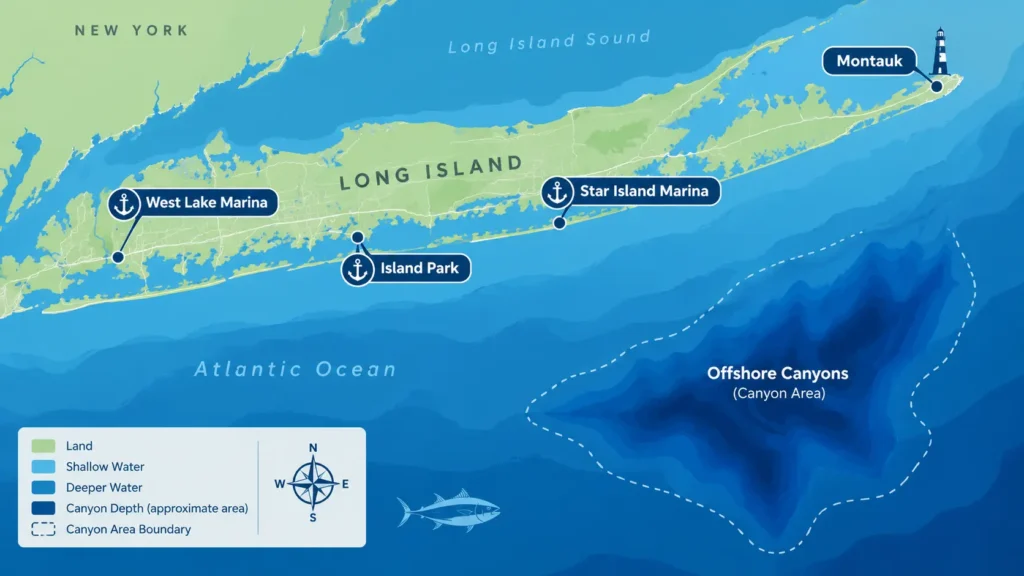
Long Island sits near productive Atlantic tuna water, but the experience changes fast depending on where you depart. Montauk offers the shortest practical route to offshore canyons, while western Long Island departures can work well for inshore bluefin when fish move close to the South Shore.
Don’t just dream about catching tuna. Start planning your trip today! [Book Your Tuna Fishing Trip Now]
Where to Find the Best Tuna Fishing Charters on Long Island?
The strongest tuna-fishing ports on Long Island are Montauk, Island Park, and other South Shore marinas. Montauk remains the main hub for deep sea tuna fishing Long Island anglers associate with offshore action, while Island Park and nearby western ports can offer shorter runs when bluefin move inshore.
Montauk’s – one of the best fishing spots
Montauk is the default choice for many tuna fishing charters Long Island NY visitors book. Its position at the East coast End gives captains quicker access to offshore grounds, and the local fleet includes both six-pack sportfishermen and larger inspected vessels.
Common departure points include:
- West Lake Fishing Lodge & Marina — A major Montauk charter base, with operators offering full-day tuna, shark, and offshore trips.
- Star Island Marina / Star Island Yacht Club — Home to several offshore-capable charter boats targeting tuna, shark, and other pelagic species.
- Montauk Harbor — A practical area to compare boats, trip lengths, passenger capacity, and expert before committing.
Book the right Long Island Tuna Fishing trip, not just any tuna trip its all hands on deck adventure.
Western Long Island and Island Park
Island Park can be a smart choice for a smaller group that wants an inshore bluefin-focused day. One advertised example is an eight-hour private bluefin fishing trip for up to four anglers aboard a 26-foot center console, equipped with GPS, radar, a fish finder, icebox, and a marine head.guidesly
This style of trip usually costs less than an overnight canyon run and puts less demand on your schedule. The tradeoff is simple: you may spend less time running, but you depend more on bluefin being close to shore.
Why Montauk Is a Top Destination for Tuna Fishing
Montauk works because deep water, bait, and shifting temperature edges are relatively accessible from the East End. Bluefin can appear closer to shore early in the season, while yellowfin, bigeye, and albacore generally relate to warmer offshore water around the canyons.
Montauk tuna fishing charters often adjust tactics through the season:
- Early summer: Troll for bluefin as the first fish arrive.
- Late summer and fall: Switch toward jigging, soft baits, and chunking as conditions and bait change.
- Overnight canyon trips: Troll during daylight, then fish jigs, soft baits, and bait around night feeding windows.
The area also produces bonus fish. Depending on the adventure and conditions, anglers may encounter mahi-mahi, wahoo, and billfish around weed lines, temperature breaks, and offshore structure.
How Much Do Long Island Tuna Fishing Charters Cost?
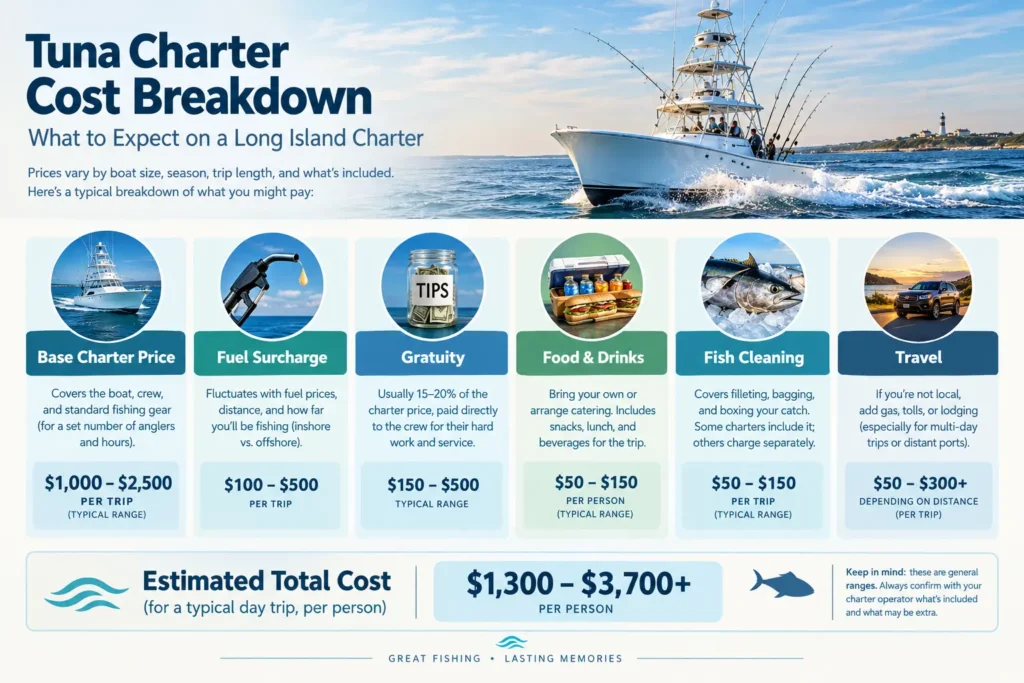
Most private tuna fishing charter Long Island trips are priced for the whole boat, not per person. A realistic planning range is roughly $1,750 for a shorter tuna trip to $2,500 for a full-day trip, with longer offshore runs costing more.
| Charter example | Departure area | Trip length | Capacity | Main target | Published price |
|---|---|---|---|---|---|
| Moondance Charters / Tuna Time | Montauk | 5 hours | Up to 5 | Seasonal tuna | $1,750 per group fishingbooker |
| Moondance Charters / Tuna Time | Montauk | 8 hours | Up to 5 | Bluefin and yellowfin tuna | $2,500 per group |
| Moondance Charters / Tuna Time | Montauk | 10 hours | Up to 5 | Tuna | $3,500 per group fishingbooker |
| FV Margarita | Island Park | 8 hours | Up to 4 | Bluefin tuna | Price set by operator; confirm directly |
| Susie E II | West Lake Marina, Montauk | Full day to overnight | Up to 28 on inspected vessel | Bluefin, yellowfin, albacore, bigeye | Confirm directly |
What the Price Usually Includes
Many Montauk operators advertise that premium tackle and bait are included in the base fare. Moondance, for example, lists its full-day eight-hour tuna trip at $2,500 with premium tackle and bait included.moondancecharters
Before you pay a deposit, ask exactly what the quote covers:
- Rods, reels, terminal tackle, lures, baitfish, and ice
- Fuel or a fuel surcharge
- Fish cleaning and bagging
- Food, drinks, and cooler space
- Overnight meals or sleeping arrangements
- Deposit amount, weather policy, and cancellation deadline
- Gratuity expectations for the mate and captain
A $2,500 eight-hour charter can be excellent value for five anglers, but it is not automatically $500 per person once you add travel, food, technique, and fish processing.
When Is the Best Time to Book a Tuna Fishing Charter?
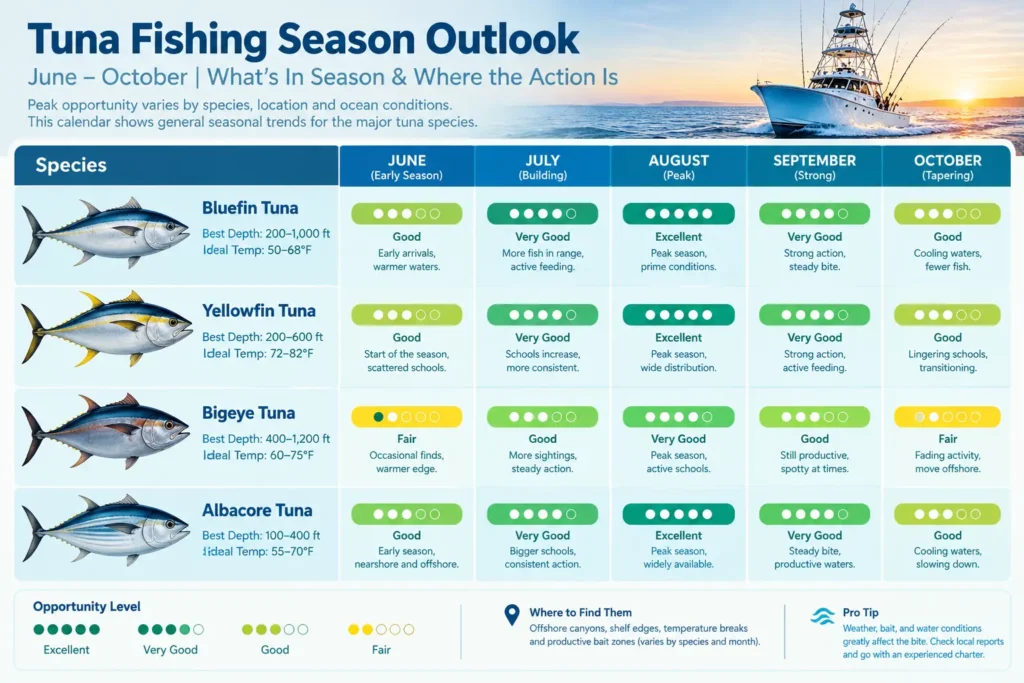
The best time for tuna fishing in Montauk generally runs from early summer through fall. Bluefin often show first around early July, while offshore yellowfin, albacore, and bigeye fishing improves as warm water moves into the canyon areas later in the season.susiee
| Period | What to expect |
|---|---|
| June to early July | Early bluefin opportunities; watch weather and confirm the captain’s recent reports. |
| July through August | More consistent bluefin action; offshore trips begin targeting warmer-water tuna. |
| September through October | Strong window for bluefin, with larger fish possible when bait remains in the area; offshore fishing can still produce yellowfin and other tuna. |
| Late fall | Conditions become more weather-dependent, but quality fish can still be available when boats can safely sail. |
Book early for weekend dates in August and September. If your schedule allows, weekday trips often give you more boat availability and more flexibility if the captain needs to move the sailing date for weather.
What Types of Tuna Can You Catch on a Long Island Charter?
Long Island tuna charters target several species, and each calls for a slightly different approach.
| Species | Typical fishery | What makes it special |
|---|---|---|
| Bluefin tuna | Inshore to offshore, with fish sometimes close to Montauk early in the season | The headline species; powerful runs and the potential for very large fish. |
| Yellowfin tuna | Warmer offshore canyon water | Fast, acrobatic, and a favorite for overnight and extended offshore fishing adventures. |
| Bigeye tuna | Deeper offshore water, often around canyons and temperature breaks | A prized offshore tuna that may appear on overnight trips. |
| Albacore | Offshore, often alongside yellowfin | Smaller than bluefin or bigeye but fast and fun on lighter tackle. |
Bluefin are the main draw for many anglers booking bluefin tuna fishing charters Long Island. They can exceed 200 pounds, and Montauk captains report giant bluefin opportunities in the fall when bait holds in the area.
Inshore vs. Offshore Tuna Charters: Which Trip Is Right for You?
Choose the trip based on your group’s experience, budget, and tolerance for a long day on the water.
| Trip type | Best for | Typical duration | What to expect |
|---|---|---|---|
| Inshore bluefin | First-timers, smaller groups, shorter days | About 8 hours | Less running time, more focus on bluefin when fish are near shore. |
| Full-day tuna | Most groups wanting a classic tuna experience | 8 to 10 hours | Time to troll, mark fish, adjust tactics, and chase a bite. |
| Overnight canyon trip | Experienced anglers and serious offshore fishermen | Overnight to extended trips | More fuel, more preparation, and shots at yellowfin, bigeye, albacore, mahi, and billfish. |
A first-time group should usually start with a full-day trip rather than an overnight canyon run. You get a real tuna experience without committing to the cost, fatigue, and weather risk of a long offshore run.
What to Expect on a Long Island Tuna Fishing Charter
Expect an early start, a safety briefing, and a fast ride toward the grounds. The captain uses electronics, water temperature, bird activity, bait, and recent reports to decide whether to troll, chunk, jig, or drift live bait.
A normal day follows this pattern:
- Arrive early, park, and load your personal gear.
- Meet the captain and mate, review safety rules, and stow your cooler.
- Run offshore while the crew prepares rods and the trolling spread.
- Watch for marks, bait, birds, temperature breaks, and surface activity.
- Rotate rods when a fish hits; the mate coaches you through the fight.
- Land, tag or retain fish according to the captain’s instructions, then reset and keep hunting.
- Return to the dock, settle up, and arrange cleaning if it is not included.
Bluefin fights can last an hour or more. Keep steady pressure, listen to the mate, and do not try to win the entire fight in the first five minutes.guidesly
What Gear, Bait, and Equipment Are Included?
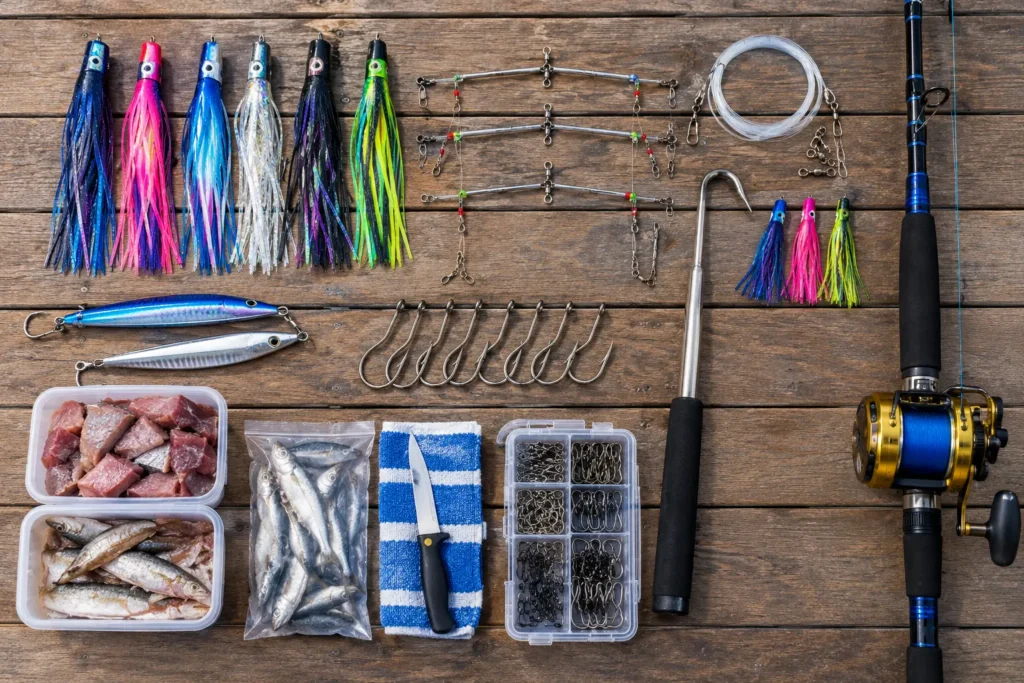
Most reputable tuna sport fishing charters in Long Island New York provide the specialized equipment. That usually includes heavy rods and reels, trolling lures, spreader bars, jigs, terminal tackle, circle hooks, bait, and ice.
Bring these items yourself:
- Non-slip shoes or boots
- Sunscreen, hat, polarized sunglasses
- Layers, rain jacket, and warm clothes for the ride home
- Seasickness medication taken before departure
- Food, water, and snacks
- Camera or phone in a waterproof case
- Small cooler for your share of cleaned fish, if the boat allows it
- Cash or card for gratuity and any fish-cleaning fee
Do not bring your own large tackle collection unless the captain asks you to. Charter tackle is matched to the boat’s drags, rods, and fishing style.
How to Choose the Right Tuna Fishing Charter and Captain
The best long island tuna charters are not always the biggest boats or the cheapest listings. Look for a captain who explains the plan clearly, communicates about weather, and sets realistic expectations.
Use this booking checklist:
- Confirm the exact departure marina and arrival time.
- Ask whether the price is per boat or per person.
- Confirm passenger capacity and whether children are welcome.
- Ask which tuna species the trip targets during your dates.
- Confirm bait, tackle, ice, fuel surcharges, and fish cleaning.
- Ask about the deposit, cancellation window, and weather reschedule policy.
- Verify the vessel has current U.S. Coast Guard licensing and required safety equipment.
- Read recent reviews, but prioritize detailed reports over star ratings alone.
- Ask how the crew handles a hooked fish: who fights it, how long the fight may last, and whether catch-and-release is encouraged.
A good captain will tell you when conditions do not favor tuna. That honesty is worth more than a promise of a full fish box.
Your Next Fishing Story Starts Beyond the Shore – Book your bluefin tuna long island fishing charter and get ready for an unforgettable adventure on the open water!
Long Island Tuna Charter Fishing Regulations and License Requirements
For a charter trip, the vessel—not each passenger—generally carries the required federal Highly Migratory Species permit. NOAA requires an HMS Charter/Headboat permit for vessels taking paying passengers recreational fishing for tuna and other HMS, and the operator must hold the applicable Coast Guard credential.fisheries.
New York anglers should also know the state rules. New York requires anglers age 16 and older to enroll in the free Recreational Marine Fishing Registry for saltwater fishing, but people fishing aboard an appropriately licensed party or charter boat do not need to register for that trip. Tuna fishing in state waters also requires a NOAA HMS permit, which is why the charter vessel’s permit matters.
Current Bluefin Rules to Confirm
NOAA Fisheries adjusted 2026 recreational bluefin retention limits effective June 1 through December 31, 2026. For charter boats fishing recreationally under an HMS Charter/Headboat permit, the limit is 3 bluefin per vessel per day/trip measuring 27 to less than 73 inches curved fork length, with only one allowed in the 47-to-less-than-73-inch range.
Other key points:
- Bluefin smaller than 27 inches cannot be retained.
- Trophy bluefin measuring 73 inches or more have a separate annual vessel limit, and area-specific trophy closures can occur during the year.fisheries.
- Recreational bluefin may not be sold. fisheries.noaa
- Charter operators must report retained or dead-discarded bluefin within 24 hours of landing or the end of the trip.
- Rules can change during the season, so confirm the current NOAA status before your trip.
long island tuna fishing charters – FAQs
How good is tuna fishing off Long Island?
Tuna fishing off Long Island can be excellent, especially from Montauk. Bluefin, yellowfin, albacore, and bigeye all occur in the region, though success depends heavily on season, bait, water temperature, weather, and the captain’s ability to adapt.
Yellowfin tuna Long Island: how far off coast?
Yellowfin are primarily an offshore species around Long Island’s canyon grounds. Canyon fisheries such as Block Canyon and Hudson Canyon are commonly described as at least 60 miles offshore, so plan on a full-day or overnight trip rather than a short inshore outing. islands
How to tuna fish in Long Island?
The easiest way is to book a licensed charter. The captain handles the vessel permit, navigation, tackle, bait, and fish-handling rules while you fish trolling spreader bars, jigs, soft baits, or chunk baits depending on the conditions.
When is tuna fishing season on Long Island NY?
Bluefin fishing often begins around early July and can continue into fall. Yellowfin, bigeye, and albacore fishing is generally better later in summer and into fall around the offshore canyons.
Conclusion
Tuna fishing Long Island delivers a rare mix of accessibility and big-game excitement. You can book a focused inshore bluefin trip from Island Park, sail a full-day charter from Montauk, or commit to an overnight canyon run in search of yellowfin, bigeye, albacore, mahi, and billfish. The right choice comes down to your group size, budget, experience, and willingness to handle a long day at sea.
Start by choosing a departure port, then compare boats on trip length, passenger capacity, included tackle, cancellation terms, and published price. Montauk remains the strongest base for offshore tuna, while western Long Island can be ideal when bluefin move within range of the South Shore.
Before you book, confirm the current NOAA bluefin limits, the vessel’s HMS Charter/Headboat permit, weather policy, and exactly what the fare includes. With a prepared crew, realistic expectations, and a flexible date, tuna fishing on Long Island can turn one day on the Atlantic into the fishing story you retell for years.
You might also like: