
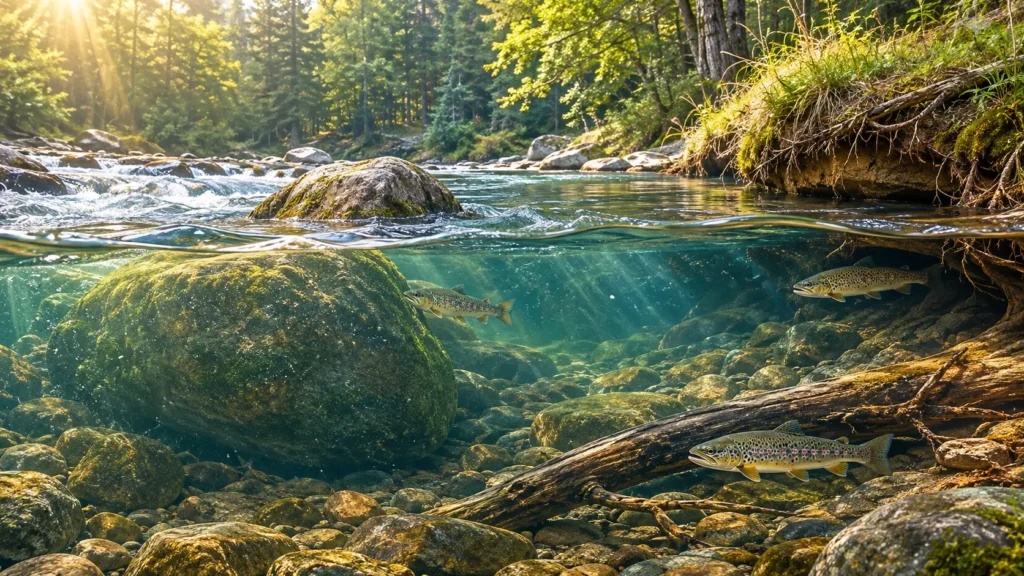
Where do trout hold in a river, and how can you spot their favorite hiding places? Trout prefer areas that offer food, oxygen, and protection from strong currents. Look for them behind rocks, along deep pools, beneath undercut banks, and near submerged logs where they can conserve energy while waiting for insects and smaller fish.
Most trout hold near current breaks, where fast-moving water meets slower currents. They also favor riffles, pool edges, deep runs, and shaded structures that provide cover and easy access to food. According to trout stream ecology principles studied by fisheries biologists such as Dr. Robert J. Behnke, habitat features and water conditions play important roles in trout distribution.
But finding these spots is only half the challenge. Water temperature, current speed, depth, and seasonal changes can all influence where trout feed and rest. Let’s explore the best places to catch trout in a river and learn how to target these locations more effectively on your next fly fishing trip.
Where Do Trout Hold in a River?
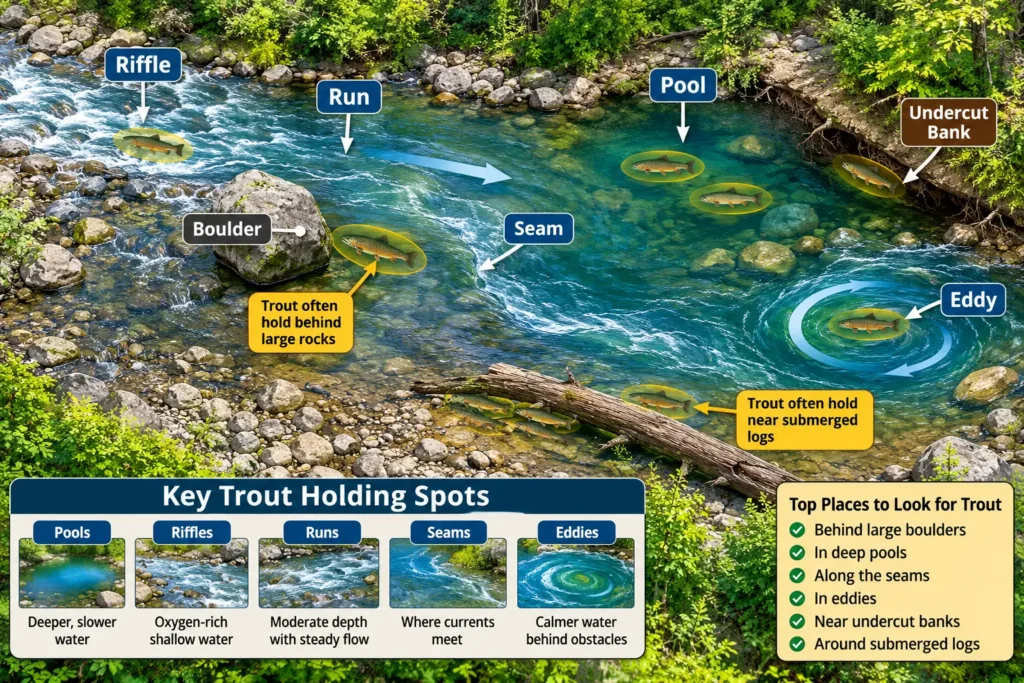
Where to fish for trout? Trout hold in rivers because they need four things at once: food, oxygen, protection, and manageable current. They rarely sit directly in the fastest water. Instead, they use nearby slower water—behind a rock, along a bank, in a pool, or in a small eddy—then move briefly into the faster flow to eat.
A useful rule is simple: find the food line, then look for the soft water beside it. Foam lines, bubble lines, and visible current boundaries often carry insects, baitfish food, and other drifting food directly to waiting rainbow or brown trout.
The trout’s energy budget
A trout cannot hold in heavy current all day and still grow. It needs a resting position with less current, but it also needs access to food moving downstream. That is why trout fishing locations often look like a compromise: sheltered water beside productive current.
Look for:
- A slower cushion in front of a boulder
- A soft eddy behind a rock or log
- A seam between fast and slow water
- A deep pocket beside shallow feeding water
- A bank with cover and a nearby current lane
Pennsylvania Fish and Boat Commission describes trout habitat as water that provides cold temperatures, cover, and food, with riffles, runs, and pools forming the basic stream sequence.pa
How to Identify the Best Trout Holding Spots
The best way to begin reading river water is to break the river into current, depth, structure, and food. Do not ask, “Does this look fishy?” Ask, “Can a trout rest here, see food, and reach it without fighting the current?”
The best trout holding spots include deep pools, current seams, undercut banks, submerged rocks, fallen trees, and the softer water behind boulders.
Experienced anglers, including renowned fly-fishing author John Gierach, emphasize the importance of understanding trout behavior and reading the water. Look for places where trout can conserve energy while staying close to passing insects and other food.
Finding these productive locations takes more than spotting deep water. You need to read current speed, water depth, stream structure, and seasonal conditions. Ready to spot the places where trout feed, rest, and wait for their next meal? Let’s explore the best trout holding spots and learn how to fish them effectively.
Current speed
Trout generally prefer holding water that is slower than the main current but close enough to intercept food. Orvis notes that trout often favor water moving around one to two feet per second, though they will adjust based on flow, temperature, and available food.
Depth and cover
Depth gives trout security. Cover—rocks, logs, undercut banks, vegetation, and broken surface water—gives them a place to hide from predators and bright light.
Food delivery
Food does not spread evenly across a river. It concentrates along seams, foam lines, current edges, and transition zones. A trout that sits beside a steady food line can feed efficiently without chasing every meal.
A practical river-reading checklist
Before making a cast, scan for:
- A visible seam or foam line
- A change in depth
- A rock, log, boulder, or bank obstruction
- A slower pocket near faster water
- Insects, rising fish, or feeding activity
- A safe approach route that will not spook fish
Deep Pools and Their Importance for River Trout
Deep pools are classic trout holding spots, especially during bright conditions, low water, cold weather, or periods of angling pressure. Pools provide depth, cover, and stable water where trout can rest between feeding periods.
Pool head
The head of a pool is where faster water enters slower, deeper water. Food gets funneled into this area, making it a reliable place to find trout. Fish often hold near the drop-off where the riffle or run ends.
Pool middle
The middle of a pool may hold trout during midday, in winter, or when fish are not actively feeding. Look for submerged structure, darker water, and subtle current breaks rather than casting blindly across open water.
Pool tailout
The tailout is the shallow, smoother section at the lower end of a pool. It can be excellent during insect activity because trout can see drifting food clearly and feed in a relatively predictable current.
Best approach: Fish the head first, then work the tailout carefully. In clear water, stay low and make your first casts to the closest holding water before wading closer.
Current Seams Where Fast and Slow Water Meet
River current seams are among the most dependable places to find feeding trout. A seam forms where faster and slower water meet, often marked by foam, bubbles, debris, or a visible line on the surface. Food collects along that boundary, while trout can hold in the slower side and dart into the faster flow to feed.
How to spot a seam
Look for:
- A foam line moving downstream
- A clear division between choppy and smooth water
- Bubbles collecting along one side of the river
- Debris drifting in a narrow line
- A change in surface texture or current direction
Where trout position themselves
Trout usually sit on the slower side of the seam, not directly in the fast water. They face upstream and watch food travel through the faster lane beside them.
A simple way to fish a seam is to cast slightly upstream, allow the fly to drift naturally through the seam, then repeat at gradually increasing distances. Start close to your position before casting across the river.
Riffles, Runs, and Pocket Water
Riffles, runs, and pocket water may look too fast or shallow, but they often hold active trout. Riffles add oxygen, produce aquatic insects, and create broken water that makes trout harder for predators to see.
Riffles
Riffles are shallow, choppy sections with gravel, rock, or small boulders on the bottom. They are especially productive in warm weather because moving water holds more dissolved oxygen and carries a steady supply of insects.
Focus on:
- Deeper pockets within the riffle
- The downstream edge where the riffle slows
- Seams beside faster current
- Areas near boulders or submerged rocks
Orvis points out that riffles are not uniformly fast; deeper depressions and turbulence create slower holding water where trout can feed comfortably. news.orvis
Runs
Runs are longer sections of fairly even current, usually deeper than a riffle. Trout often hold along the edges, near seams, or beside structure rather than in the middle of the run.
Pocket water
Pocket water contains rocks, boulders, and irregular current. Each obstruction creates a cushion of slower water in front, an eddy behind, and seams along the sides. Trout use these small shelters to rest and feed.
Best approach: Work every likely pocket methodically. Make short, accurate casts and cover the front, side, and downstream eddy of each rock.
Undercut Banks, Overhanging Trees, and Fallen Logs
Undercut banks, overhanging trees, and fallen logs provide shade, protection, and food. These areas can hold trout all day, especially when the sun is bright, water is low, or fish feel pressured.
Undercut banks
An undercut bank forms when current erodes the soil beneath the bank, creating a tunnel-like shelter. Trout can hide beneath it while remaining close to the main current and drifting food.
Overhanging trees
Trees drop terrestrial insects into the water and create shade. They also give trout overhead cover, which can make them more willing to hold in shallow water.
Fallen logs and woody debris
Logs create current breaks, eddies, and ambush points. Large woody debris can also create deeper holes and provide security for bigger trout.
Best approach: Present your fly or lure close to the cover without snagging it. A short, controlled cast upstream of the structure often works better than repeatedly casting directly into it.
Where Do Big Trout Hold in a River?
Big trout usually choose holding water that offers both safety and a dependable food supply. They often use deeper bends, large boulders, submerged timber, undercut banks, and current seams near drop-offs.
Deep bends
The inside of a bend often creates slower water and an eddy, while the outside bend may create a deeper channel. Both can hold fish, but the best spot depends on current speed, cover, and food flow.
Large boulders and submerged structure
A large rock creates several trout positions: a cushion in front, a seam along each side, and an eddy behind it. Do not fish only the obvious downstream side; trout may hold in front of or beside the rock too.
Protected feeding lanes
Larger trout often feed during low light, cloudy conditions, or periods when fewer anglers are on the water. They may move from deep security water into riffles, runs, or shallow seams to feed.
Best approach: Make your first cast count. Big trout often hold in a narrow, specific spot, and repeated poor casts can push them deeper into cover.
How Water Temperature, Season, and Weather Affect Trout Locations
Trout locations change with water temperature, flow, oxygen, light, and food availability. Cold water slows their metabolism, while warm water pushes them toward oxygen-rich riffles, shaded banks, and deeper holding water.
| Condition | Where trout often hold | Why |
|---|---|---|
| Cold water | Deep pools, slow runs, tailouts | Trout conserve energy and feed less aggressively |
| Warm summer water | Riffles, riffle edges, shaded banks | Moving water provides oxygen and cooler refuge |
| High, dirty water | Soft edges, seams, eddies, bank cover | Trout avoid the strongest current and feed along protected lines |
| Low, clear water | Deeper pools, undercuts, shaded structure | Trout seek security and avoid bright light |
| Insect hatch | Seams, riffle edges, shallow feeding lanes | Food concentrates where trout can see and intercept it |
Trout generally do best in cool, oxygen-rich water; FlyFish Circle notes an optimum feeding range of roughly 45 to 64 degrees Fahrenheit.
How to Fish Different Trout Holding Spots Effectively
Matching your presentation to the water matters more than carrying every fly pattern in your box. Pennsylvania Fish and Boat Commission separates common trout presentations into dry flies, nymphs, and streamers, each suited to different water and feeding situations.
Pools
Use a nymph, streamer, or weighted bait presentation to reach deeper water. Start near the head of the pool, then work the middle and tailout. Keep your drift natural and watch for subtle takes.
Current seams
Cast upstream or across the seam and let the fly drift through the food lane. Avoid dragging your fly across the seam. A dead-drift presentation usually works best for nymphs and dry flies.
Riffles
Use a dry fly, dry-dropper rig, nymph, or small streamer. Focus on deeper pockets, the downstream edge, and seams rather than the fastest center of the riffle.
Pocket water
Make short, precise casts into the cushion in front of rocks, the seams beside them, and the eddies behind them. Pocket water often rewards accurate placement more than long casts.
Undercut banks and logs
Keep your fly, bait, or lure tight to the cover. A streamer, small jig, weighted nymph, or bait presentation can work well because trout often hold close to structure and strike quickly.
Common Mistakes to Avoid When Reading Trout Water
Many anglers walk past fish because they fish only the obvious water. Deep pools hold trout, but they are not the only productive trout fishing locations on a river.
Avoid these mistakes:
- Fishing only the deepest, slowest water
- Ignoring shallow riffles and riffle edges
- Casting directly into the fastest current
- Overlooking small pockets behind rocks
- Wading too close and spooking fish
- Making repeated casts into the same unproductive water
- Fishing a fly or lure that does not match the current speed
- Ignoring seams, foam lines, and transition zones
Take a few minutes before entering the water. Observe insect activity, rises, current lines, and likely escape routes. FlyFish Circle recommends watching the water before stepping in, since feeding trout can be spooked easily. flyfishcircle
Trout Fishing Locations FAQs
Do trout always hold in deep water?
No. Trout use deep water for security, but they often feed in shallow riffles, seams, and runs when food is available and conditions are comfortable.
What is a current seam?
A current seam is the boundary between faster and slower water. It is one of the best places to find trout because food collects there while trout can hold in softer water nearby.
Where do trout hold during high water?
During high water, trout move out of the strongest current. Look for soft edges, eddies, seams, bank cover, and slower pockets behind rocks or logs.
Do trout hold in shallow water?
Yes. Trout hold in shallow water when it offers food, oxygen, broken surface cover, or a nearby escape route into deeper water. Riffles can be especially productive during warmer months.
Where do trout hold in a river at midday?
At midday, especially in bright conditions, native trout often hold deeper, closer to cover, or in shaded water. They may still feed along seams, but they are usually more cautious.
What is the best time to find trout feeding?
Early morning, evening, overcast days, and periods of insect activity are often best. During a hatch, wild trout may move into shallow seams and riffle edges to feed.
What is the difference between trout and salmon?
Trout and salmon are closely related salmonids, but many salmon migrate between freshwater and the ocean, while many trout live entirely in freshwater. Steelhead are ocean-going rainbow trout. ocean.si
Is lake trout good for eating?
Yes, lake trout is good to eat, but follow local advisories because larger, older fish can contain more mercury or PCBs. Smaller fish and trimmed, grilled preparations can reduce exposure.
How deep do trout swim in lakes?
Lake trout commonly hold in deep, cold water—often 65 to 230 feet—but may move shallower when temperatures and oxygen suit them. Other trout species often stay nearer shore, structure, and cooler water.
What month is trout most active?
Trout are often most active from late spring through early fall, when water stays roughly 48–65°F. In colder months, feeding windows shift to the warmest part of the day.
How deep do trout swim in lakes?
Lake trout commonly hold deeper than 50 feet and may use water beyond 200 feet. In spring and fall, they can move into 10–30 feet near shore; summer pushes them into deeper, colder water.
Why do trout hold in pools and other river features?
Trout hold in pools, seams, eddies, and behind structure because these spots offer rest from current, safety from predators, oxygen, and nearby food. They conserve energy while feeding along current edges.
Conclusion
Knowing where do trout hold in a river comes down to reading the relationship between current, food, cover, and depth. Brown and rainbow trout do not randomly scatter across a river. They choose spots where they can rest, stay safe, and intercept food with minimal effort. Start with current seams, then check riffle edges, pockets behind rocks, pool heads, tailouts, undercut banks, and deeper bends.
The next time you approach new water, do not fish the first attractive pool and stop there. Read the current, identify the food line, and target the protected water beside it. Small pockets, subtle seams, and transition zones often hold more trout than they first appear to. Once you understand why trout choose a lie, you will find productive water in nearly every stretch of river—and spend less time casting into empty water.