
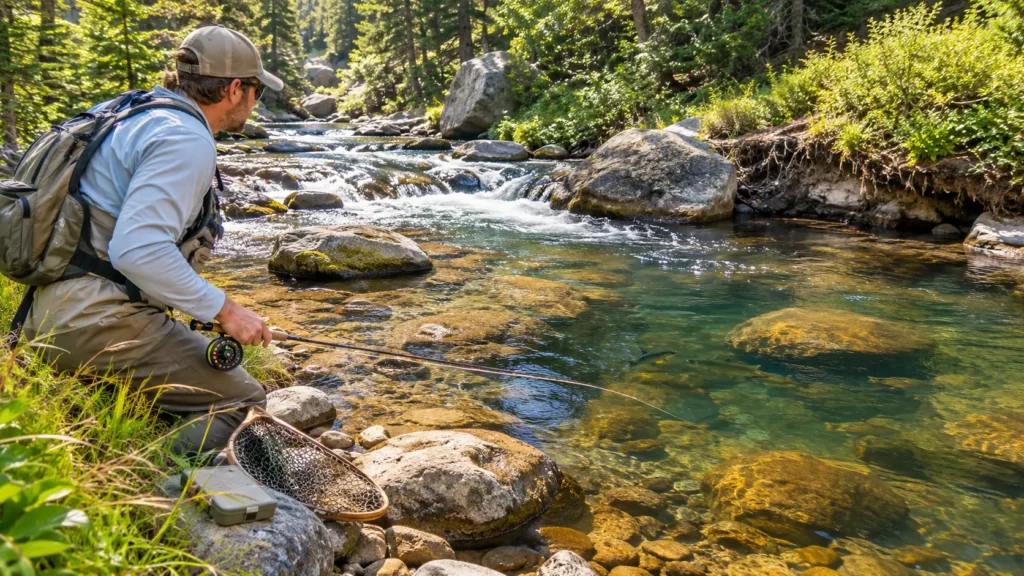
Learning how to read a trout stream like a pro and catch more fish can change your fishing results. To read a trout stream, look for riffles, pools, seams, undercut banks, and submerged rocks.
Trout often hold where slower water meets faster current because these spots deliver food while helping them conserve energy. Legendary fly-fishing author John Gierach has long emphasized observation and stream knowledge as essential parts of successful trout fishing.
The secret to reading a trout stream lies in understanding water movement, depth, structure, and trout behavior. Experienced fly-fishing angler such as Tom Rosenbauer emphasize observing trout habitats, matching presentations to feeding conditions, and approaching fish carefully. These skills help you choose better casting spots, select effective flies, and present your bait naturally.
But reading moving water takes more than spotting a promising pool. You need to recognize subtle current changes, locate hidden holding areas, and understand where trout feed throughout the day. Ready to improve your stream-reading skills?
Let’s explore helpful tips on reading a rivers that can help you fish smarter and catch more trout.
How to Read a Trout Stream?
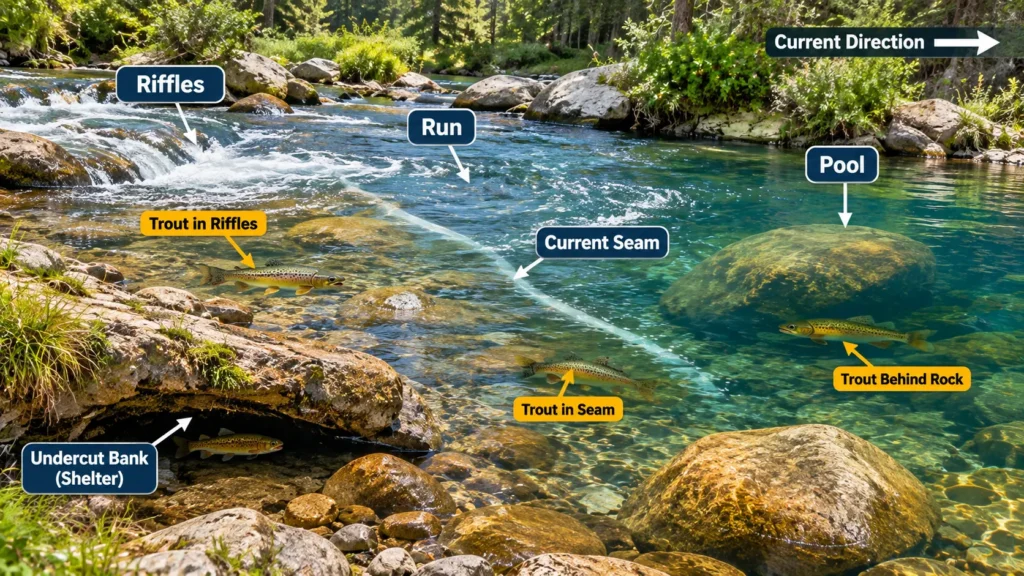
How to read a river for trout fishing? To read a trout stream, look for water where trout can rest, stay hidden, and feed without fighting strong current. The best spots usually combine a current seam, nearby cover, and a steady supply of drifting food.
Learning how to read a trout stream changes trout fishing from guesswork into a repeatable process. Instead of casting everywhere, you learn to recognize where trout hold in streams, why they choose those places, and how to present a bait, lure, or fly naturally. The core idea is simple: trout need food, protection, and a break from moving water. Find all three in one place, and you have found a high-percentage spot.
Understanding How Trout Streams Work
A trout stream is not random water. It follows a repeating pattern of riffles, runs, pools, pockets, eddies, and tailouts. Each type of trout stream structure creates different current speeds, depths, and feeding opportunities.
When you approach a new stretch of water, pause before you start fishing. Scan the stream from a distance, note the current direction, look for surface bubbles, and identify likely holding water. A few minutes of observation can save a lot of time casting to empty water.
How Water Flow Influences Trout Behavior
Trout live in moving water, but they rarely sit in the fastest current. Fighting a strong flow burns energy, so trout usually hold in slower water beside or below faster water. The faster lane delivers insects, baitfish, and other food; the slower area lets the fish hold position with less effort.
This is why a trout may sit just off the main current, behind a boulder, along a bank, or near the bottom of a deep run. The fish is not avoiding food. It is positioning itself where food comes to it without requiring constant swimming.
Why Trout Position Themselves in Certain Areas
A good trout lie meets three needs at once:
- Food: Drifting insects, nymphs, minnows, or terrestrials pass nearby.
- Shelter: Rocks, logs, depth, undercut banks, or surface chop provide protection.
- Current relief: The fish can rest in slower water while remaining close to feeding lanes.
If you remember one rule, make it this: trout like the edge between fast and slow water. Those edges—often called current seams—are among the most reliable places to find fish in rivers.
How to Identify Riffles, Runs, and Pools
Most trout streams contain a repeating sequence: riffle, run, pool, tailout, then another riffle. Once you can identify these sections, you can read water much faster.
| Water type | What it looks like | Why trout use it | Best approach |
|---|---|---|---|
| Riffle | Shallow, choppy, fast water over gravel or rock | Oxygen, cover from surface turbulence, drifting food | Fish the softer edges, deeper slots, and tail |
| Run | Steadier, deeper water below a riffle | Food delivery plus enough depth for protection | Cover seams, pockets, and current edges carefully |
| Pool | Deep, slower water at the bottom of a run | Rest, security, and larger-fish habitat | Focus on the head and tail, not the dead center |
| Tailout | Shallowing, speeding-up water below a pool | Food funnels into a narrower lane | Make precise, low-impact presentations |
Riffles, runs, pools, and eddies are the basic building blocks of trout habitat, and each can hold fish depending on flow, temperature, and available cover.
Reading Shallow Riffles for Feeding Trout
Riffles are shallow, broken sections where water tumbles over rocks or gravel. They may look too fast or too shallow, but they can be excellent feeding water—especially during a hatch or when insects become active.
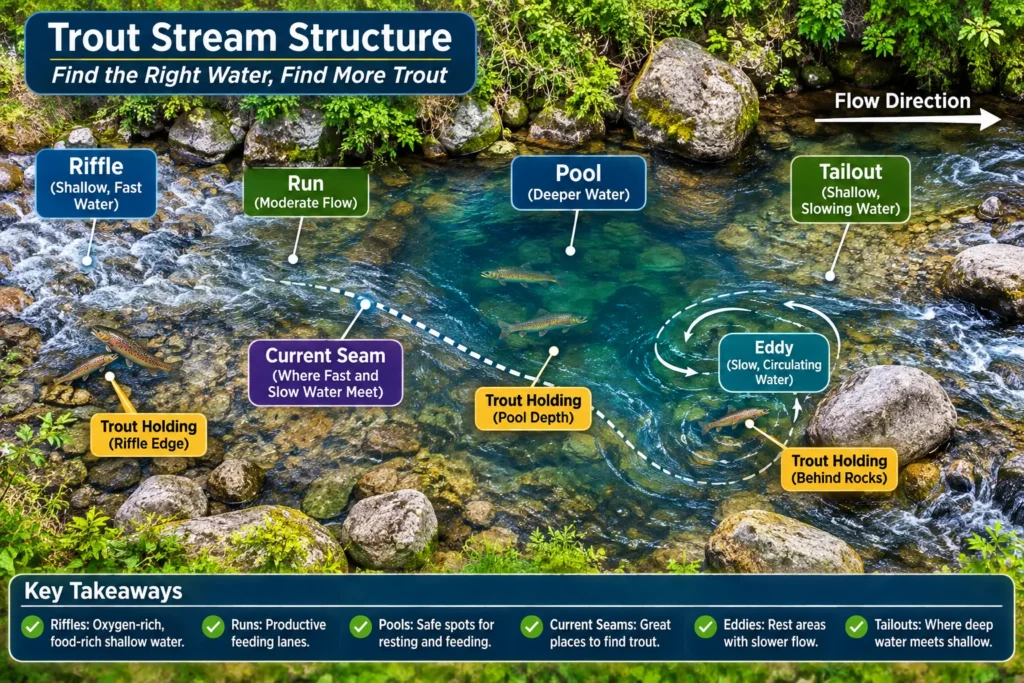
Do not fish only the middle of a riffle. Look for the softer water along its edges, deeper slots between rocks, and the transition where the riffle drops into a run. A trout can feed in surprisingly shallow water when broken surface provides cover.howtoflyfish.
Finding Trout in Deep Pools and Runs
Runs are often the most dependable holding water on a stream. They have enough depth to make trout feel secure and enough current to carry food continuously.
In pools, concentrate on the head and tail. The head receives food from the riffle above, while the tailout funnels food into a narrower current before the next riffle. The middle of a pool can hold fish, particularly in cold weather or bright sun, but it is often less productive than the moving edges.
Look for Current Seams and Feeding Lanes
How can I use current seams and deflections to locate trout and plan? A current seam is the visible or implied boundary where faster water meets slower water. Foam lines, bubbles, floating leaves, and debris often mark these transitions.
How to Spot Current Seams
Look for a line of bubbles running downstream, a change in surface texture, or a visible split where current divides around a rock, log, or bend. Where two currents meet, a pocket of calmer water often forms—even when you cannot see the bottom.
A seam can be obvious or subtle. In clear water, you may see it clearly. In stained water, watch foam, debris, and the way current bends around structure.
Where Trout Wait for Drifting Food
Trout usually sit on the slow side of a seam, facing upstream, with the faster current close by. They can dart into the faster lane to eat a nymph, emerger, dry fly, or small baitfish, then return to their holding position.
A practical way to fish a seam is to start casting on the near side, then work the seam itself, the far soft edge, and finally the tailout. Keep your fly, lure, or bait drifting naturally with the current rather than dragging it across the flow.
Find Trout Behind Rocks and Other Current Breaks
Rocks, logs, root wads, bridge pilings, and stream bends all break the current. Behind each obstruction, water slows and forms a pocket where a trout can rest while food drifts past.
Pocket water—small slots, cushions, and eddies among boulders—deserves methodical attention. Each pocket can be its own miniature holding lie. Make a short, accurate presentation to the front, sides, and rear of the rock before moving on.
An eddy forms where current curls back behind an obstruction. It may look calm, but it can hold trout, especially when drifting food collects there. Do not ignore soft water just because it does not look like classic trout water.
Understand Water Depth, Speed, and Clarity
Depth, speed, and clarity work together. Trout may feed in shallow riffles, but they often retreat to deeper water when they feel exposed, pressured, or uncomfortable.
- Depth: Deeper water offers security; shallow water can produce active feeding when cover is present.
- Speed: Trout want access to fast water, not necessarily a life in it.
- Clarity: In clear water, fish can see you more easily, so longer casts and stealthier approaches matter. Murkier water can make trout less wary but may require brighter or larger presentations.
Water temperature also changes trout behavior. Cold water slows metabolism and pushes fish toward slower, deeper lies; warm water can send them toward cooler inflows, shaded areas, riffles, or deeper oxygen-rich water. knots
Identify the Best Trout Holding Water
The best fish in a stream often hold where several favorable features overlap. Look for a seam beside cover, a pocket below a boulder, the head of a pool, or a tailout with a defined feeding lane.
A useful mental checklist:
- Is there moving water nearby to deliver food?
- Is there slower water where a trout can hold?
- Is there cover from predators or bright light?
- Is there a clear path for food to drift into the lie?
- Can you make a natural presentation without spooking the fish?
If a spot checks four or five boxes, it is worth a couple casts before you move on.
Read Undercut Banks, Overhanging Vegetation, and Structure
Undercut banks, overhanging vegetation, fallen trees, and logjams provide shade, security, and terrestrial food. These areas can hold bigger fish because they offer both cover and a nearby feeding lane.
An undercut bank creates a hidden tunnel beneath the waterline. A trout can sit under the bank, out of direct current and sight, while watching food drift past. Overhanging grass, brush, or tree limbs can drop ants, beetles, caterpillars, and other terrestrial insects into the water.
Approach these spots carefully. A careless wade, loud footsteps, or a shadow cast across the water can spook a fish before you ever make a cast.
How Weather, Water Temperature, and Light Affect Trout Location
Weather and light change where trout hold. Under bright sun, trout may move deeper or tighter to cover. During low light, overcast conditions, rain, or a hatch, they may move into shallower feeding water.
Water temps matter because trout are cold-blooded. Their activity level, feeding windows, and preferred holding water change with temperature. In summer, seek colder inflows, spring seeps, shaded banks, and oxygenated riffles. In winter, focus on slower, deeper pools and runs where fish conserve energy.
Streamflow matters too. Rising water can dislodge worms, crane-fly larvae, and other food, creating feeding opportunities. A sharp drop in flow, however, can make fish nervous and less willing to feed.
How to Approach a Trout Stream Without Spooking Fish
Stealth is part of reading water. Before you start casting, stop well back from the stream, scan for rising trout, surface disturbances, shadows, and likely holding lies.
- Wear muted clothing and polarized sunglasses.
- Stay low and avoid sudden movements.
- Wade only when necessary, slowly and quietly.
- Keep your shadow off the water.
- Make your first cast to the closest likely holding water.
- Fish upstream or across-current when possible, so fish see your presentation before they see you.
A trout that sees you may stop feeding or move to cover. A stealthy approach preserves the opportunity before you ever present a fly or lure.
How to Fish Different Stream Sections Effectively
Reading water tells you where to fish; presentation determines whether the fish eats. Match your approach to the water type, current speed, depth, and available cover.
Choosing the Right Bait, Lure, or Fly
In riffles and pocket water, short drifts with nymphs, small jigs, or bait can work well. In runs, cover the seams and deeper slots with a natural drift. In pools, try a streamer or larger presentation during low light, then switch to a more subtle offering when fish are selective.
During a midge hatch or other surface activity, dry fly fishing can be highly effective. Watch for rising trout, match the natural insect’s size and profile, and make a drag-free presentation.
Adjusting Your Presentation to the Current
Your presentation should move at the same speed as the food in that section of water. In fast currents, use enough weight or a suitable lure action to reach the holding zone quickly. In slow water, use a lighter presentation and avoid dragging your offering unnaturally across the seam.
When you catch a trout, note exactly where it was holding. Was it behind a rock, along a seam, under an overhang, or at the head of a pool? That observation teaches you more about that piece of water than a dozen random casts. executiveangler
Reading Trout Water FAQs
What is the best water to find trout in a river?
The best water usually combines a current seam, nearby cover, and a food lane. Focus on the edges of riffles, heads of pools, pockets behind rocks, undercut banks, and tailouts.
Do trout hold in fast water?
Sometimes, but not usually in the fastest part of the current. Trout prefer slower water beside fast water, where they can feed without constantly fighting the flow.
How do I find trout in murky water?
Read the stream rather than relying on sight. Target seams, current breaks, deeper runs, undercut banks, and the heads and tails of pools. Use a presentation that trout can detect easily without spooking them.
Where do big trout hold in a stream?
Bigger trout often hold near substantial cover with a clear view of a food lane: undercut banks, logjams, large boulders, deep pool edges, and current seams.
Should I fish upstream or downstream?
In moving water, start fishing the closest likely holding water and work upstream or across-current when possible. This helps your fly, bait, or lure reach fish before they see you.
What time of day is best for trout fishing?
Low-light periods—early morning, evening, overcast days, and light rain—often bring trout into shallower feeding water. Bright sun may push them deeper or closer to cover.
How do stream structure, depth, current, and underwater features aff?
They create the food, shelter, and current relief trout need. Rocks, logs, drop-offs, and undercut banks slow the flow and provide cover, while deeper water offers security; trout hold along seams where food drifts past.
How can I use current seams and deflections to locate trout and plan casts?
Find where fast water meets slow water, then cast just upstream of the seam and let your offering drift naturally through it. Target the soft edges of rocks, logs, and current breaks where trout rest while feeding.
Conclusion
Learning how to read a trout stream is the single most important skill for finding fish consistently. You do not need to memorize every rule; you need to recognize the places where food, cover, and current relief overlap. Start by identifying riffles, runs, pools, current seams, pockets, eddies, and tailouts. Then ask one question: where would a trout hold to feed while staying safe?
Read the water before you start casting, approach quietly, and fish the highest-percentage water first. A small seam behind a rock, the edge of a riffle, or the head of a pool can produce more fish than a long stretch of featureless water. Every fishing trip gives you new information. Watch where trout are rising, note where you catch fish, and use that knowledge to read the next stretch more accurately. Over time, you will find trout faster, waste less time casting, and end up catching more fish.
Recommended posts
- How to fish for trout in a Stream (A Complete Guide)