

Why do catfish croak? Catfish croak, grunt, and squeak when they feel threatened, usually by rubbing their pectoral fin spines against their shoulder bones. If you have ever reeled one in and heard a strange buzzing noise, you know exactly what this sounds like.
If you have ever picked up a channel catfish and heard a raspy croak, squeak, or grunt, you were hearing a defensive response—not the fish trying to “talk” in the way people do. The noise can happen in a river, lake, or home aquarium, and it often becomes more obvious when the animal is handled.
Why Do Catfish Croak or Grunt?
Catfish croak as a defensive reaction. When a predator, angler, or handler grabs them, the sudden movement and pressure can trigger rapid fin movements that produce a rasping sound.
The sound may warn nearby fish, startle a predator, or simply be a physical result of the catfish trying to free itself. Researchers studying thorny catfishes found that fish produced both stridulation and drumming sounds during distress, whether they were held in water or in air.
Croaking is not always a sign that a catfish is badly injured. A healthy fish can make noise after a rough bite, an unexpected net, or being lifted from the water. But frequent croaking in a tank can mean poor water condition, crowding, aggression, or another stressor.
How Do Catfish Make Croaking Sounds?
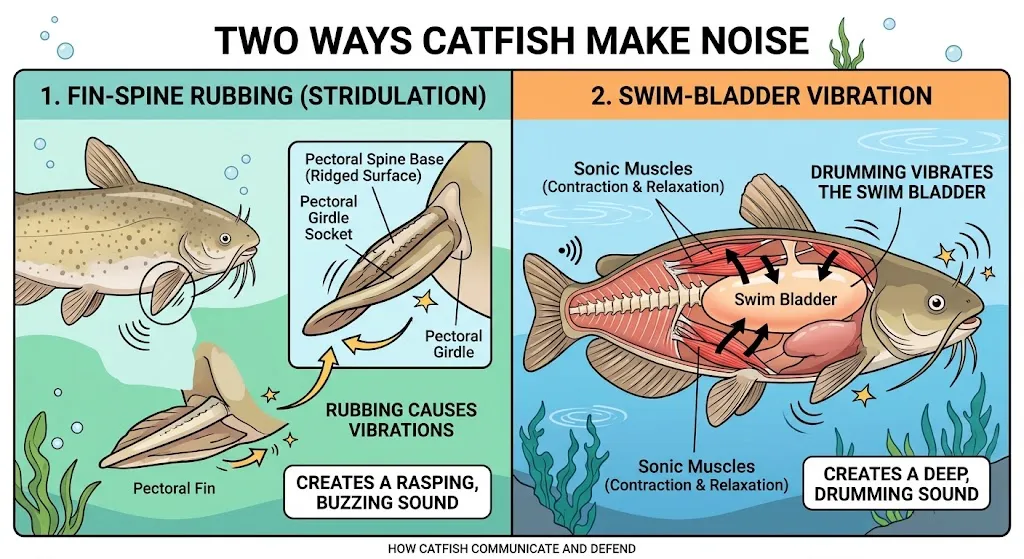
Most catfish sounds come from one of two systems: stridulation or swim-bladder vibration. “Stridulation” means the fish creates sound by rubbing hard body parts together.
Unlike mammals that use vocal cords and lungs, fish rely on completely different physical structures to create noise. They lack lungs suited for shouting into the open air, so they use ingenious mechanical tricks instead.
The Role of Pectoral Fin Spines
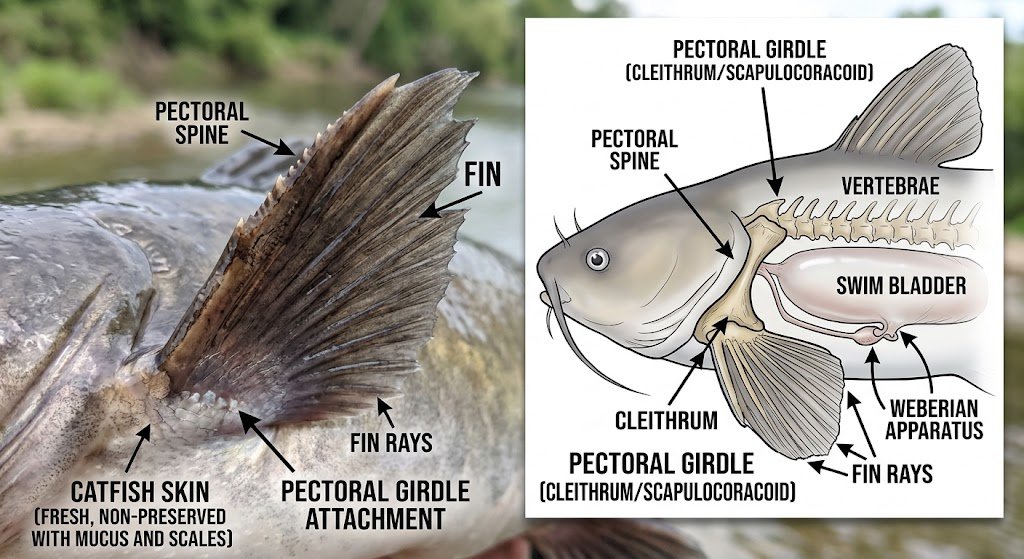
A catfish’s first pectoral fin ray is often a stiff,锁-like spine. At its base, small ridges rub against a rough area of the shoulder girdle—called the cleithrum—when the fish moves the fin quickly forward and backward.
Think of it like running a thumbnail quickly across a comb. The motion creates a series of short pulses that people describe as a croak, click, squeak, or rasping grunt. In doradid catfishes, studies found that the fish move one or both pectoral fins to create these stridulation sounds.
The pectoral spine also has a protective function. Many catfish can lock it outward, making the fish harder for a predator to swallow. That same sturdy spine becomes the “instrument” used to make loud sound.
Can Catfish Make Sounds With Their Swim Bladders?
Yes—but not every catfish does it the same way. Some species, especially certain Raphael catfishes, thorny catfishes, and pimelodids, have special muscles that rapidly move a bony plate or otherwise vibrate the swim bladder. This creates a lower-pitched drumming sound.
The swim bladder is a gas-filled organ that helps a fish control buoyancy. In many catfishes, it also helps with hearing: tiny Weberian bones connect the bladder to the inner ear, allowing vibrations and pressure changes in the water to be transmitted more effectively.
A useful way to picture the difference:
| Sound type | Body part used | Typical sound | Common situation |
|---|---|---|---|
| Stridulation | Pectoral spine and shoulder girdle | Croak, rasp, squeak, click | Handling, escape attempt, distress |
| Swim-bladder drumming | Sonic muscles and swim bladder | Low hum, thump, drumming sound | Disturbance or possible communication in water pmc. |
Why Do Catfish Croak When Caught?
A caught catfish croaks because it is suddenly restrained. The fish may flare its pectoral fins, twist its body, and try to push away; those movements rub the spine against the shoulder structure and create sound.
For catfishing, this is normal. A channel catfish, blue catfish, or other species may croak while being landed, held, or released. The sound does not necessarily mean the fish is hurt, but rough handling can still cause injury.
Use wet hands or a wet landing mat, support the fish’s weight, and avoid squeezing its body. Catfish have sensitive skin rather than scales in many species, and careful handling reduces stress after the catch.
Do Catfish Croak to Communicate With Other Fish?
Sometimes, but scientists do not treat every croak as clear communication. Distress sounds appear to serve a defensive purpose, while lower-frequency swim-bladder sounds may help catfish communicate with others of the same kind underwater.
Research on thorny catfishes suggests that stridulation may work as a distress signal in both water and air, while drumming may function more as a signal between members of the same species in water. In other words, a croak may say “back off,” while a drumming sound may carry more social meaning.
Catfish do not need to hear sound the way humans do to respond to it. Their inner ears, lateral-line system, and swim-bladder connections help them detect vibrations and pressure changes in their environment.
Do All Catfish Species Make Croaking Sounds?
No. Many catfishes can make sound, but the ability, loudness, and method depend on the species. Some rely mainly on pectoral-spine stridulation; others also use swim-bladder mechanisms.
The striped or spotted Raphael catfish is one of the better-known sound producers in aquariums. It can create both high-frequency stridulation and lower-frequency swim-bladder sounds. Channel catfish are also known for pectoral-spine locking and sound production.onlinelibrary.
Species differences matter. A small corydoras may make faint clicks, while a larger Raphael catfish may create sounds that are much easier to notice. Body size, anatomy, water temperature, and stress level can all affect what you hear.
What Does a Catfish Croak Sound Like?
If you have never heard it before, trying to imagine the sound can be difficult. It rarely resembles a frog’s ribbit. Instead, a catfish croak often sounds like:
- A dry rasp or squeak
- A short series of clicks
- A low grunt
- A rapid buzzing or crackling noise
- A muffled drumming sound underwater
Stridulation tends to be higher-pitched because it comes from hard surfaces rubbing together. Swim-bladder sounds tend to be lower and more rhythmic because fast muscles vibrate the gas-filled bladder.onlinelibrary.
People sometimes describe a Raphael catfish as a “talking catfish,” but the animal is not using words. It is producing pulses of sound through specialized body structures.
Can Catfish Make Sounds Out of Water?
Yes. Catfish can croak in air, especially when held after being caught. Research on thorny catfishes recorded stridulation sounds from fish held both underwater and in air.
The sound may seem different above the surface because air carries sound differently than water. A noise that sounds like a soft click underwater may come across as a sharper squeak or croak when the fish is in a net or on land.
That said, a catfish out of water is under significant stress. Make the encounter brief, keep its skin wet, and return it to the water promptly if you are practicing catch-and-release.
Is Catfish Croaking a Sign of Stress or Danger?
Usually, yes—it is a stress response. A catfish may croak when it is grabbed, chased, injured, crowded, or exposed to poor water conditions. But the sound alone does not prove that the fish is in immediate danger.
Watch for other signs that a catfish is stressed:
- Rapid gill movement or gasping at the surface
- Clamped fins or unusual hiding
- Loss of appetite or refusal to eat its normal food
- Rubbing its body against rocks, wood, or tank glass
- Pale coloration, red patches, or damaged fins
- Repeated croaking without obvious handling
In an aquarium, test ammonia, nitrite, nitrate, temperature, and oxygen levels. Catfish that live in a tank need clean water, enough room to swim, hiding places, and a diet suited to the species. Many aquarium catfish eat sinking pellets, insect-based foods, and occasional treats such as bloodworm; always match feeding to the fish’s natural diet rather than relying on one food type.
Catfish are often active in the dark, which explains why owners may notice croaking at night. Their whiskers, formally called barbels, are covered with taste buds and help them locate food by taste and touch in low-visibility water. A male or female catfish may also become more defensive during breeding or territorial disputes.
Frequently Asked Questions
Why do catfish croak during the day?
They croak when disturbed by handling, predators, nets, tank maintenance, or aggressive tank mates. Daytime croaking is a stress response, not a schedule-based behavior.
What sound does a catfish make?
Catfish make croaks, squeaks, clicks, grunts, rasps, and low drumming sounds. Pectoral-spine rubbing creates higher-pitched noises, while swim-bladder vibration creates lower drumming sounds.onlinelibrary.
What are the signs that a catfish is stressed?
Look for rapid breathing, hiding, clamped fins, poor appetite, color changes, unusual swimming, and repeated rubbing against surfaces. Croaking may occur alongside these signs.
Why do catfish croak at night?
Many catfish are more active in the dark, so they may croak while feeding, exploring, or defending space. Stress from water quality or aggression can also cause nighttime noise.
Why do catfish have whiskers?
Their whiskers, called barbels, help them find food by taste and touch. They are especially useful in murky water where vision is limited.
How do catfish make noise?
They make noise by rubbing a pectoral spine against the shoulder girdle or by vibrating the swim bladder with specialized muscles.
Do all catfish croak?
No. Sound production varies by species, anatomy, and situation. Some make only stridulation sounds, while others can also produce swim-bladder drumming.
Is a croaking catfish injured?
Not necessarily. Croaking often means the fish is startled or stressed. Check for visible injuries, abnormal swimming, breathing problems, and other stress signs.
Can a catfish sting you?
Yes. A catfish’s pectoral spine can puncture skin and cause a painful wound. Handle catfish carefully and avoid contact with the spines.
Should I worry if my aquarium catfish croaks?
Occasional croaking after maintenance or handling is usually normal. Frequent croaking, hiding, gasping, or loss of appetite deserves a water-quality and tank-condition check.
What Sound Does a Catfish Make?
A catfish may make a croak, squeak, click, grunt, rasp, hum, or drumming sound. The exact sound depends on whether it is rubbing its pectoral spine or vibrating its swim bladder.
Why Do Catfish Have Whiskers?
Catfish whiskers, or barbels, help them find food in dark or muddy water. They contain taste buds and touch-sensitive cells, allowing the fish to detect edible material without relying only on vision.ac
How Do Catfish Make Noise?
Catfish make noise by stridulation—rubbing the pectoral spine against the shoulder girdle—or by using muscles to vibrate the swim bladder. Some species can use both methods.
Do Catfish Croaks Mean They Are Angry?
Not exactly. A croak usually signals alarm, distress, or an attempt to escape. It may also serve as a warning to nearby fish, but it should not be interpreted as human-style anger.
Can Catfish Hear Croaks From Other Catfish?
Many catfishes have good vibration detection because their swim bladders connect to the inner ear through Weberian ossicles. They can likely detect water vibrations and pressure changes, though the exact meaning of each sound varies by species.
Are Croaking Catfish Dangerous?
The sound itself is not dangerous. However, many catfish have sharp pectoral spines that can cause a painful catfish sting if handled carelessly. Hold the fish firmly but gently behind the pectoral spines, keep your hands wet, and never grip the fins.
Do Pet Catfish Croak in a Tank?
Yes. Raphael catfishes and some other aquarium species can croak, click, or drum, especially when netted, disturbed, or stressed. A healthy tank with stable water conditions and proper hiding places usually reduces stress-related noise.
Why is the term “catfish” called catfish?
Catfish are named for the long, whisker-like barbels around their mouths, which resemble a cat’s whiskers. These barbels help the fish feel and taste for food in dark or murky water.
What other fish make sounds?
Many fish make sounds, including toadfish, black drum, red drum, Atlantic croaker, groupers, sea robins, seahorses, damselfish, and squeaker catfish. They use swim-bladder drumming, fin or bone rubbing, or fast swimming movements to create clicks, grunts, honks, and drumming sounds.
Why Do Catfish Croak During the Day?
Catfish can croak during the day when something disturbs them: a net, a hand in the tank, a predator nearby, or another fish bumping into them. Daytime croaking is especially common after handling or during tank maintenance.
Light does not prevent the behavior. Some catfish hide by day and become more active after dark, but a startled fish can make sound at any hour.
Why Do Catfish Croak at Night?
Catfish may croak at night because many species are naturally more active then. They search for food, explore, defend hiding spots, and interact with tank mates when the tank is dark.
Nighttime sounds can also occur if the fish is stressed by low oxygen, poor water quality, aggression, or an unsuitable tank setup. If the croaking is new, frequent, or paired with unusual swimming behavior, check water conditions before assuming it is normal.
What Are the Signs That a Catfish Is Stressed?
Common stress signs include rapid breathing, hiding more than usual, loss of appetite, clamped fins, erratic swimming, color changes, and repeated rubbing against objects. Croaking can accompany these behaviors, particularly after handling or conflict.
Address the likely cause quickly: improve water quality, reduce crowding, provide shelter, check for aggression, and avoid unnecessary handling.
Conclusion
Why do catfish croak? They croak because their bodies are built to create sound during moments of alarm. Many catfish rub a ridged pectoral spine against the shoulder girdle, producing a raspy croak or click, while some species also use muscles to vibrate the swim bladder and make a deeper drumming sound.
For anglers, a croaking catfish is usually a normal reaction to being caught. For aquarium keepers, it can be a useful clue that the fish feels stressed, crowded, or uncomfortable. The sound is not “talking” in the human sense, but it is a real form of animal communication and defense. Understanding why catfish croak helps you handle wild fish more safely, care for pet catfish more responsibly, and appreciate the surprising ways underwater animals use sound to survive.
You might also like:
- Top 13 Best Muddy Water Baits (Incl. AFFORDABLE Models!)
- A Complete Guide To How Often Do Catfish Lay Eggs (Explained)
- Do Catfish Have Periods? (Cat Fish Myths & Facts)
- What Do Catfish Like To Eat The Most (Killer Catfish Bait!)
- Do Catfish Burrow In Mud? Here’s The Mudfish (Full-Answer)
- Why Is Catfish Noodling Illegal? The Brutal Sport (Solved)
- Are Catfish Related To Sharks? Yes Or No! (Catfish Vs Shark)