
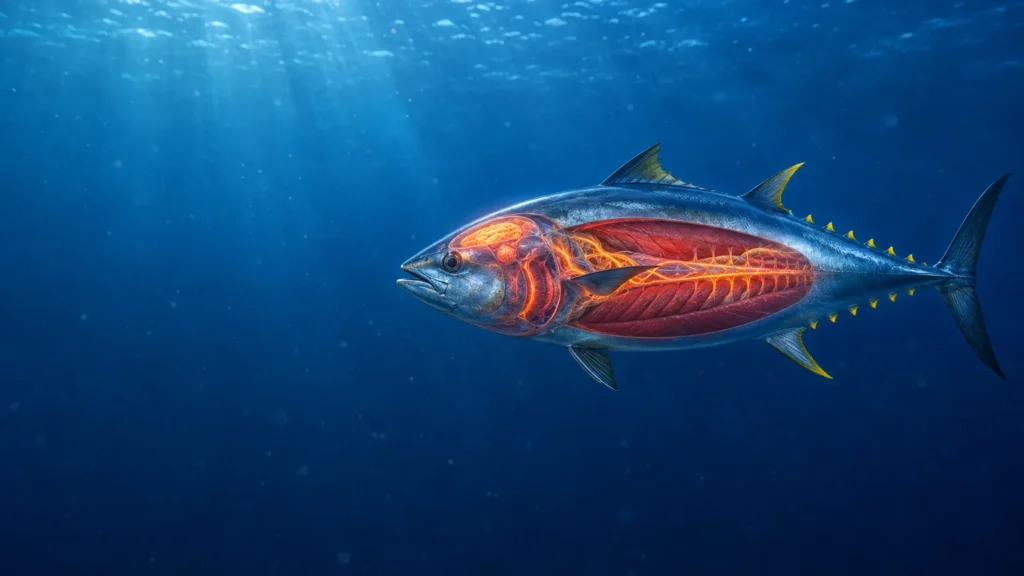
Are Tuna Warm-Blooded? Tuna fish are warm-blooded, but not in the same way humans are. Most tuna species are regionally endothermic: they keep key tissues, especially swimming muscles, eyes, brain, and some internal organs, warmer than the surrounding ocean. This adaptation helps them swim fast, hunt effectively, and tolerate a wide range of water temperatures.
Unlike a mammal or bird, a tuna does not hold its entire body at a steady, high temperature. The opah, or moonfish, is the only known fish with whole-body endothermy; tuna warm selected body regions instead.
Are Tuna Warm-Blooded or Cold-Blooded?
Tuna sit between the usual “warm-blooded” and “cold-blooded” labels. Most fish are cold-blooded, meaning their body temperature closely follows the water around them. Tuna can raise the temperature of certain tissues above that water, which scientists call regional endothermy.
So, are tuna cold-blooded? Not entirely. They are not fully warm-blooded like a mammal, but they are far more temperature-controlled than a typical cold-blooded fish. Their warm blood is concentrated in the muscles and organs that matter most for speed, vision, and hunting.
How Do Tuna Keep Their Bodies Warm?
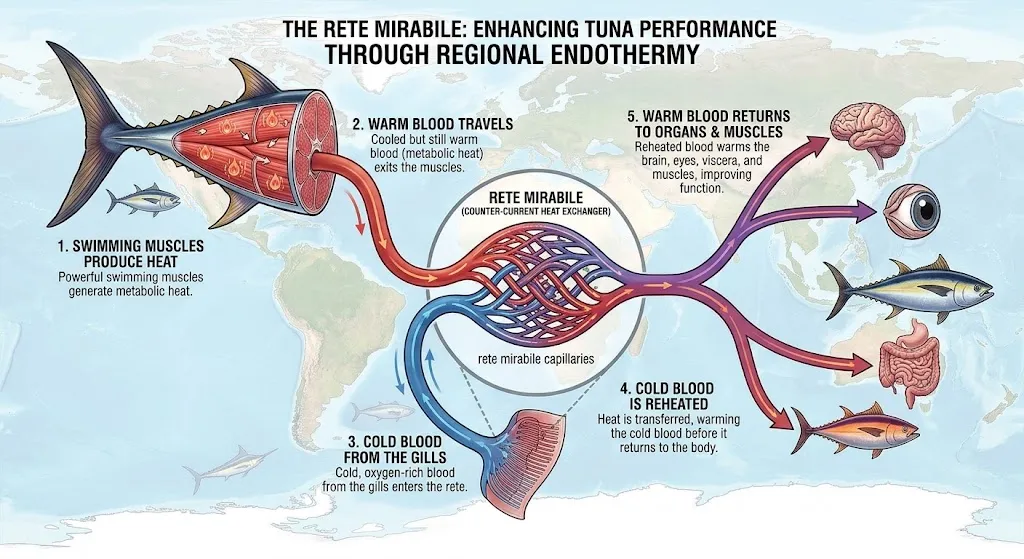
Tuna create heat when their powerful swimming muscles contract. Instead of letting that heat escape, they recycle it through a specialized circulatory system.
The key structure is a countercurrent heat exchanger, called the rete mirabile—literally, a “wonderful net.” Warm blood leaving the muscles runs beside cold blood returning from the gills. Heat moves from the warm vessels into the cold ones, so oxygen-rich blood returns to the body already warmer.
This system matters because a fish loses a great deal of heat at its gills, where blood meets cold seawater to collect oxygen. Tuna reduce that loss and keep their deep red swimming muscles, brain, eyes, and viscera warmer than the surrounding water.
Which Tuna Species Are Warm-Blooded?
Are all tuna warm-blooded? All tunas show some ability to regulate body temperature, but the strength of that ability varies by tuna species. Species with better-developed rete mirabile systems conserve more heat and handle colder water more effectively.fao
– Bluefin Tuna
Bluefin tuna are the strongest heat conservers among tunas. Atlantic bluefin tuna, Pacific bluefin tuna, and southern bluefin tuna all use regional endothermy to support long migrations and deep dives.
The Atlantic bluefin tuna can live in waters from tropical to subpolar regions. Its advanced heat-exchange system helps it tolerate colder ocean conditions than many tropical tunas.
– Yellowfin Tuna
Yellowfin tuna are warm-blooded in the regional sense, but their rete mirabile is less developed than a bluefin’s. They mostly live in tropical and warm temperate waters and generally remain closer to the surface.
– Albacore Tuna
Albacore tuna have moderate heat-conservation ability. They range across the Atlantic and Pacific oceans and often occupy cooler, more temperate waters than yellowfin or skipjack.
– Bigeye Tuna
Bigeye tuna are strong divers. Their heat-retention system helps them hunt in deeper, colder water, sometimes below 500 meters, while still returning to warmer surface waters.
– Skipjack Tuna
Skipjack tuna can elevate muscle temperature, but they have a less advanced rete than bluefin. They are mainly tropical fish and rely more on warm surface waters.
| Tuna species | Heat conservation | Typical habitat |
|---|---|---|
| Atlantic, Pacific, and southern bluefin | Strongest | Tropical to subpolar waters; deep dives and long migrations |
| Bigeye | Strong | Tropical and temperate waters; deep foraging |
| Albacore | Moderate | Temperate and subtropical waters |
| Yellowfin | Lower | Mostly tropical and warm surface waters |
| Skipjack | Lower | Tropical surface waters |
Are Tuna Fully Warm-Blooded Like Humans?
No. Humans are mammals, so we regulate temperature across the whole body and keep it within a narrow range. Tuna are regional endotherms: they warm selected tissues, while parts of the body closer to the skin can stay closer to the surrounding water temperature.
A tuna’s deep red muscle can be much warmer than the water, but its heart and other organs can cool during long dives in cold water. That is one major difference between tuna and the opah, which circulates warmed blood throughout its body, including to the heart.
Why Do Tuna Have Warmer Muscles Than Other Fish?
Warm muscles contract faster and perform better in cold water. For a tuna, that means more power, quicker acceleration, and the ability to sustain high-speed swimming.
Tuna are built for that performance. Their torpedo-shaped bodies, smooth skin, retractable dorsal and pectoral fins, and tail finlets reduce drag. Albacore tuna can swim faster than 50 miles per hour, and bluefin tuna can reach about 18 miles per hour for short bursts.
Warmer muscles also help tuna chase prey such as fish, squid, krill, and crustaceans. Their large gill surface area, oxygen-rich blood, and constant forward swimming deliver the oxygen those muscles need.
Can Tuna Swim in Cold Water?
Yes. Heat retention lets tuna enter colder ocean zones and dive through sharp temperature changes. Bluefin tuna, for example, can move between tropical spawning areas and much cooler feeding grounds.
Bigeye tuna and bluefin tuna can dive deeper than 500 meters in search of food or to avoid predators. Their countercurrent exchangers help them keep working muscles warm during those cold-water trips.
Tuna still have limits. During deep dives, some organs cool down, which can eventually force a tuna to return to warmer water to recover.
How Much Warmer Is a Tuna’s Body Than the Water?
Tuna body temperature varies by species, body region, fish size, and activity level. Deep muscles near the backbone stay warmer than muscles near the skin.pmc.ncbi.nlm.nih
Research on Atlantic bluefin tuna found that deep red muscle can be up to 21°C warmer than the surrounding water. Direct measurements in deep white muscle showed temperatures around 10°C above seawater that was 18°C.
Other studies report smaller average differences. Bigeye tuna muscle temperatures, for instance, averaged 1.5–3.9°C above ambient water in one tracking-based analysis.
Are Bluefin Tuna Warmer Than Yellowfin Tuna?
Generally, yes—bluefin tuna conserve heat more effectively than yellowfin tuna. Bluefin have a more advanced rete mirabile, while yellowfin have a less developed system and mostly stay in warmer, upper-ocean habitats. fao
That difference shapes where each species can live. Bluefin tuna tolerate colder water and undertake enormous migrations across ocean basins. Yellowfin tuna remain more tied to tropical and warm surface waters.
What Is the Difference Between Warm-Blooded Tuna and Cold-Blooded Fish?
A cold-blooded fish usually has a body temperature close to the water temperature. A tuna can keep critical tissues warmer, giving it a major advantage in speed, endurance, and habitat range.
| Feature | Warm-blooded tuna | Typical cold-blooded fish |
|---|---|---|
| Body temperature | Selected tissues stay warmer than the water | Usually matches surrounding water |
| Metabolism | Higher activity in muscles and sensory organs | Slows in colder water |
| Swimming performance | Sustained power and speed fisheries. | Often reduced in cold conditions |
| Habitat | Broader ocean range, including colder zones | Often limited by water temperature |
| Example | Atlantic bluefin tuna | Most reef and freshwater fish |
Do Warm-Blooded Tunas Have a Hunting Advantage?
Yes. Warm muscles let tuna accelerate quickly, pursue agile prey, and keep hunting when colder water slows many other fish. Warmer eyes and brain may also improve visual processing and prey detection.
That advantage is especially useful in deep water, where sunlight fades and temperatures drop. Bigeye tuna use their heat-retention ability to spend more time foraging below the thermocline, while bluefin tuna can hunt across vast migratory routes.
Tuna are predators, but they also face predators including sharks, billfish, and toothed whales. Speed, endurance, and sharp vision help them survive in the open ocean. fisheries.noaa
Why This Matters for Tuna Conservation
Tuna’s remarkable biology does not protect them from overfishing. Atlantic and southern bluefin tuna populations have experienced severe historical declines, and demand for sushi-grade seafood has placed pressure on several tuna populations.
Groups such as NOAA Fisheries and the International Commission for the Conservation of Atlantic Tunas (ICCAT) use science-based quotas, monitoring, and bycatch rules to manage fisheries. Consumers can also support sustainable choices through resources such as Monterey Bay Aquarium’s Seafood Watch.fisheries.
Protecting tuna means protecting migratory predators that connect ecosystems across the Atlantic, Pacific, and southern oceans. Their warm-blooded traits make them extraordinary—but sustainable management keeps them in the ocean.fisheries.
FAQs
Are all tuna warm-blooded?
All tunas show some regional endothermy, but bluefin tuna have the strongest heat-conservation systems. Yellowfin and skipjack retain less heat and favor warmer waters.fao
Are bluefin tuna warm-blooded?
Yes. Atlantic bluefin tuna, Pacific bluefin tuna, and southern bluefin tuna are regionally endothermic and can keep muscles, eyes, brain, and some organs warmer than the surrounding water.
Are yellowfin tuna warm-blooded?
Yes, but less effectively than bluefin. Yellowfin tuna can warm certain tissues, though their heat-exchange system is less advanced and they mostly inhabit warmer waters.
How do tuna stay warm?
Tuna generate heat through muscle activity and conserve it with countercurrent heat exchangers called rete mirabile. These vessel networks transfer heat from warm blood leaving the muscles to cold blood returning from the gills.
What fish is fully warm-blooded?
The opah, or moonfish, is the only known fish with whole-body endothermy. It keeps its entire body warmer than the surrounding water, including its heart.
Do tuna warm themselves like whales?
No. A whale is a mammal and maintains a relatively stable whole-body temperature. Tuna warm selected tissues and still depend on ocean conditions and behavior to manage temperature.
Can tuna survive in freezing water?
Tuna can tolerate much colder water than many fish, especially bluefin tuna. Their heat conservation supports movement in cold seas, but extreme cold still affects organs and can limit dive time.
Why can’t tuna stop swimming?
Tuna cannot stop swimming because they use ram ventilation: they must keep water flowing over their gills to breathe. Their large, high-performance bodies also need constant movement to stay upright and maintain oxygen-rich blood flow.
Conclusion
Are tuna warm-blooded? Yes—but with an important distinction. Tuna are regional endotherms, not fully warm-blooded animals like humans. They generate heat through powerful swimming muscles and conserve it with countercurrent heat exchangers, keeping muscles, eyes, brain, and some organs warmer than the surrounding ocean.
That ability explains why tuna can swim with such power and speed, chase prey in deep water, migrate across ocean basins, and tolerate colder conditions than many fish species. Bluefin tuna show this adaptation at its most impressive level, while yellowfin, albacore, bigeye, and skipjack use it to different degrees.
Understanding tuna body temperature is more than a fun ocean fact. It reveals how evolution shaped one of the sea’s greatest predators—and why protecting tuna populations, managing fisheries responsibly, and supporting sustainable seafood choices matter for the health of the entire ocean.Are tuna warm-blooded? Discover how this unique fish species and elite predator regulates body temperature unlike most other fish.
Recommended posts
- What Do Yellowfin Tuna Eat? A Look at Their Favorite Prey