
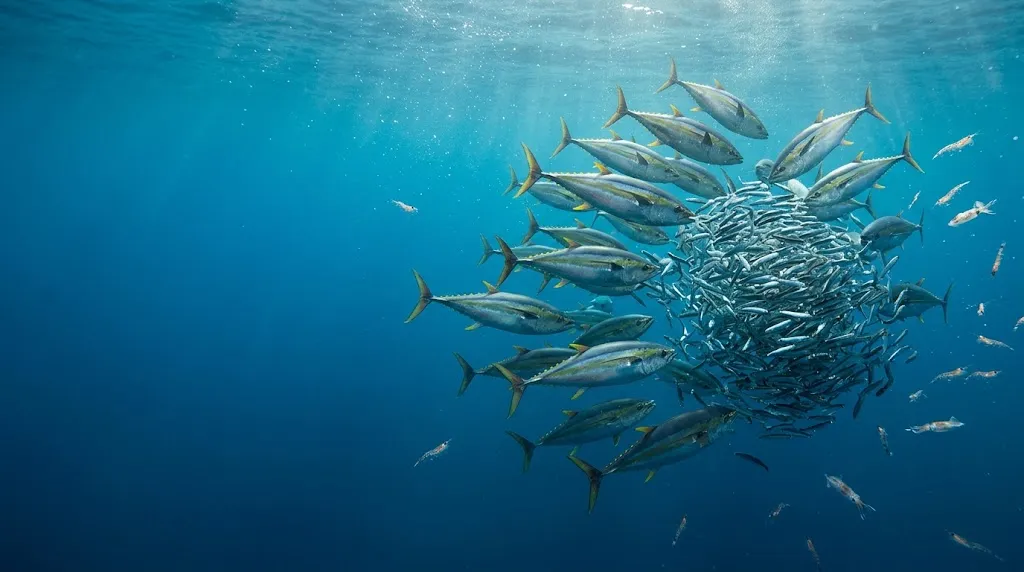
What do yellowfin tuna eat? Yellowfin tuna eat fish, squid, and crustaceans. They are opportunistic carnivores, so their exact menu depends on the prey available around them, their size, and the ocean region they hunt.
These fast, highly migratory fish patrol warm tropical and subtropical waters, often feeding near the surface but also taking prey from deeper water. Adults can reach 6 feet long and 400 pounds, so they need plenty of energy-rich food to fuel constant swimming.
What Do Yellowfin Tuna Eat in the Wild?
Yellowfin tuna (Thunnus albacares) are pelagic predators, meaning they live and hunt in open water rather than close to the seabed. Their yellowfin tuna diet centers on three prey groups: small fish, squid and other cephalopods, and crustaceans such as shrimp and crabs.
They do not rely on one “favorite” meal. Research across thousands of tuna stomachs shows that yellowfin eat whatever abundant prey they encounter, although squid and schooling fish often make up a large share of their diet.repository.
A useful way to picture their diet is a moving buffet: baitfish schools, drifting squid, floating debris, current edges, seamounts, and areas rich in plankton all create feeding opportunities. Adult yellowfin often gather where phytoplankton, zooplankton, and smaller prey concentrate.
What Are the Most Common Foods Yellowfin Tuna Eat?
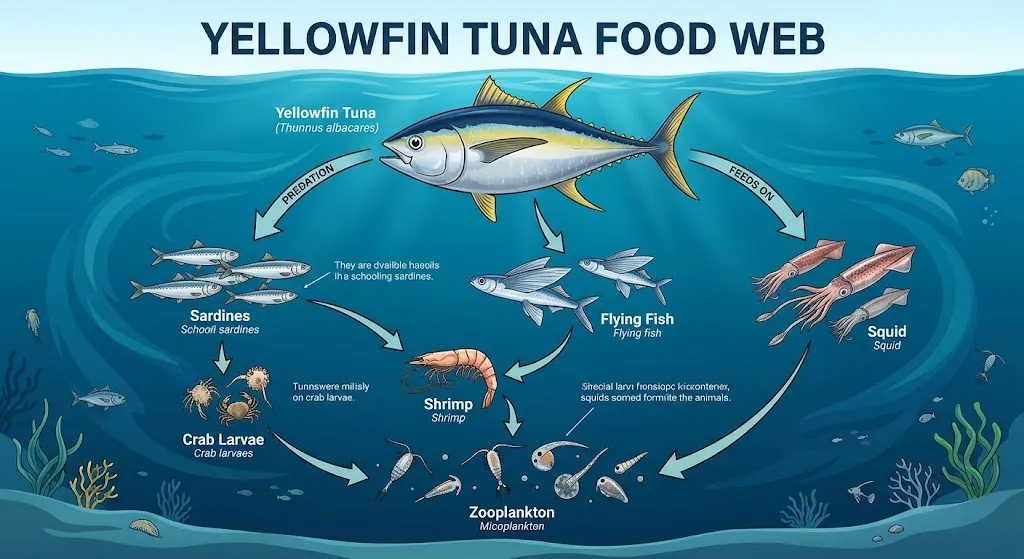
The most common yellowfin tuna prey includes schooling baitfish, squid, shrimp, and small crabs. Stomach studies repeatedly identify fish, cephalopods, and crustaceans as the main food categories.
| Natural prey | Examples | Why yellowfin eat it |
|---|---|---|
| Small fish | Sardines, anchovies, flying fish, mackerel, jacks, small tuna | High-energy, often found in dense schools |
| Squid and cephalopods | Flying squid, jumbo squid, octopus-like prey | Abundant offshore and often active at night |
| Crustaceans | Shrimp, pelagic red crabs, crab larvae, amphipods | Common in plankton-rich water and around floating structure |
| Planktonic prey | Copepods, amphipods, zooplankton | Important for larvae and smaller juveniles |
One global analysis found ommastrephid squids were among the top prey groups by weight for tuna, while epipelagic fish were especially important for yellowfin. In another study, cephalopods made up 55.4% of the diet, fish 24.2%, and crustaceans 20.1%.repository.
Small Fish: Sardines, Anchovies, and Flying Fish
Small schooling fish are a major food source for yellowfin tuna. Sardines, anchovies, flying fish, mackerel, and small jacks give tuna a concentrated meal when bait gathers in current lines, around floating objects, or beneath diving birds.
Flying fish matter especially in open-ocean areas. Research in the Gulf of Mexico found exocoetids—the family that includes flying fish—were a major spring food source for both sub-adult and adult yellowfin. pmc.ncbi.nlm.nih
Squid and Other Cephalopods
Yes—yellowfin tuna eat squid, and squid can dominate their diet in some regions. Squid are soft-bodied, protein-rich prey that tuna can swallow quickly, making them an efficient meal for a fast-moving predator.repository.
Yellowfin often hunt squid where deep and surface waters meet, especially around temperature breaks, seamounts, and areas with strong currents. Some squid rise closer to the surface at night, which can create excellent feeding windows.
Shrimp, Crabs, and Other Crustaceans
Yellowfin tuna also eat shrimp, pelagic crabs, crab larvae, amphipods, and other crustaceans. These prey may be smaller than fish or squid, but they can be extremely abundant.
Juveniles rely more heavily on crustaceans and zooplankton. As yellowfin grow, larger shrimp, crabs, squid, and fish become easier to chase and swallow.
Do Yellowfin Tuna Eat Sardines and Anchovies?
Yes. Sardines and anchovies are classic baitfish for yellowfin tuna, particularly in coastal or upwelling areas where these schools gather. In the Gulf of Guinea, for example, nearshore yellowfin fed mainly on schooling live fish such as anchovies and sardines. fao
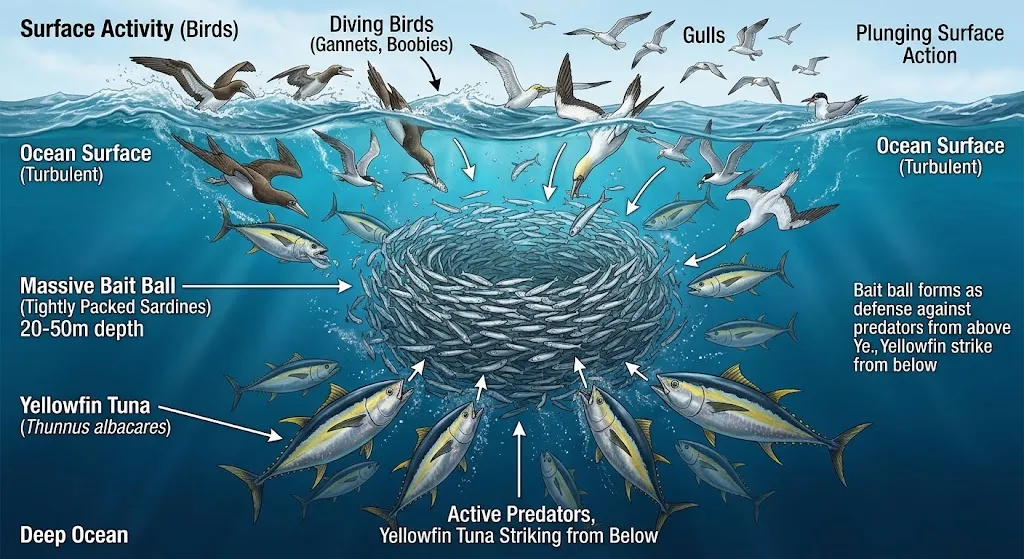
Yellowfin attack baitfish schools with speed and repetition. A school may ball up near the surface when predators press it from below; seabirds often reveal these “foamers” as tuna chase bait through the surface. Anglers frequently cast poppers, stickbaits, or metal jigs into these feeding bursts.
Do Yellowfin Tuna Eat Squid?
Yes. Squid are one of the most important foods in many yellowfin tuna populations. In a study from the Arabian Sea, the purpleback flying squid was the primary prey across all yellowfin size groups.
Tuna hunt squid both near the surface and in deeper water. In the eastern tropical Pacific, yellowfin consumed epipelagic crustaceans and mesopelagic squid, showing that they feed across more than one depth zone.
For anglers, this matters: fresh squid strips, whole squid, and squid-imitating lures can work well when tuna are feeding on cephalopods rather than baitfish.
How Do Yellowfin Tuna Hunt and Catch Their Prey?
Yellowfin tuna use speed, sharp vision, and teamwork to catch prey. Their streamlined body, powerful tail, and continuous swimming let them cover large distances and rush into bait schools before the prey can scatter.
Common hunting strategies include:
- Chasing bait balls: Tuna drive schools of sardines, anchovies, or flying fish into a tight mass, then strike repeatedly.
- Surface feeding: Birds, splashes, and white water often mark tuna pushing bait to the surface.
- Cooperative feeding: Tuna may feed in groups, sometimes near dolphins, seabirds, or other marine animals that help concentrate prey.
- Ambushing around structure: Floating debris, fish aggregating devices, buoys, seamounts, and current edges attract small prey—and tuna follow.
- Opportunistic feeding: They switch quickly from fish to squid or crustaceans when one prey type becomes more available.
Their dorsal fin and finlets help stabilize the body during high-speed movement, while the yellow dorsal fin and yellow finlets give the species its name. These features matter for identification, but the tuna’s real hunting advantage is its combination of speed, endurance, and eyesight.
Do Yellowfin Tuna Eat at Night?
Yellowfin tuna feed mostly during the day, but they can eat at night when prey is available. NOAA’s essential-fish-habitat description notes that yellowfin feeding is largely daytime and opportunistic, with fish, cephalopods, and crustaceans as the primary prey.
Night feeding becomes more likely around squid, which often move upward in the water column after dark. Offshore anglers often use squid chunks, lights, and a steady chum slick during overnight drifts to keep bait—and tuna—around the boat.
Light conditions influence the bite. Dawn and dusk can be especially productive because prey moves while visibility remains good, but a strong night squid bite can override that pattern.
Does a Yellowfin Tuna’s Diet Change as It Grows?
Yes. Young yellowfin eat smaller prey, while adults take larger fish and squid. This is called an ontogenetic diet shift: the menu changes as the tuna’s mouth, speed, and hunting range grow.
| Life stage | Typical prey |
|---|---|
| Larvae | Zooplankton, then larval fish |
| Small juveniles | Crab larvae, shrimp, amphipods, small squid, zooplankton |
| Larger juveniles | Flying fish, lanternfish, small mackerel, squid |
| Adults | Larger squid, sardines, anchovies, flying fish, mackerel, jacks, small tuna, crabs |
In one juvenile-diet study, yellowfin under about 50 cm fork length mainly ate larval squid, larval shrimp, and zooplankton. Once they passed that size, they shifted toward teleost fish, including flying fish and small tuna relatives.
Adults still eat crustaceans, but their larger size lets them pursue bigger squid and fish. NOAA notes that large squid and fish become more important diet items for adult yellowfin.
What Do Yellowfin Tuna Eat in Different Oceans?
Yellowfin tuna live across tropical and subtropical waters in the Pacific, Atlantic, and Indian Oceans, so their prey changes by region and season. NOAA describes them as highly migratory and notes that they travel long distances through warm ocean water.
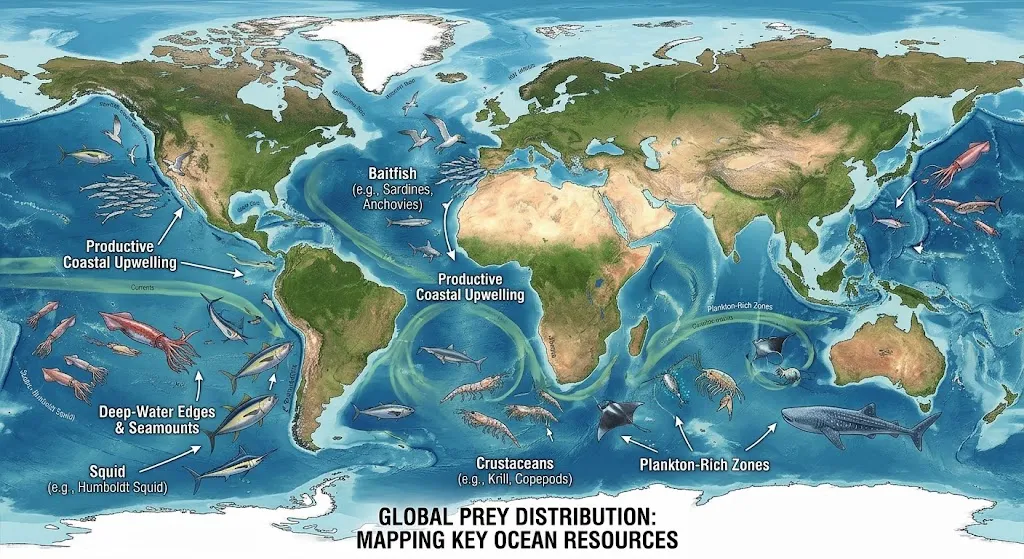
In productive coastal zones, baitfish such as sardines and anchovies can dominate. Around islands and seamounts, yellowfin may eat more reef-associated fish, crabs, squid, and pelagic invertebrates. Far offshore, squid and other open-ocean prey often become more important.
Season matters too. In the northern Gulf of Mexico, researchers found squid and flying fish dominated spring diets, juvenile carangids and scombrids increased in summer, coastal fish mattered more in fall, and planktonic prey such as amphipods rose in winter.
Natural Prey vs. Fishing Bait
The best yellowfin bait usually resembles what the fish are already eating. Match the bait’s size, color, and action to the local forage rather than assuming one bait works everywhere.
| Natural prey | Best fishing match |
|---|---|
| Sardines, anchovies, pilchards | Live sardines, pilchards, small dead baits, chum chunks |
| Flying fish | Flying-fish baits, ballyhoo, streamlined trolling lures |
| Squid | Whole squid, squid strips, squid-imitation jigs and lures |
| Small mackerel or skipjack | Live mackerel, small live skipjack, larger trolling baits |
| Shrimp and pelagic crabs | Small chunks, shrimp-style jigs, natural-colored small lures |
| Mixed baitfish schools | Trolling feathers, cedar plugs, spreader bars, skirted lures |
Best Live Baits for Yellowfin Tuna
Live sardines, pilchards, anchovies, mackerel, goggle-eyes, threadfin herring, and small skipjack are strong live-bait choices. Anglers often fly-line a live bait with little or no weight so it swims naturally into the feeding zone.
For larger yellowfin, a small live skipjack or similar baitfish can attract bigger fish. Use the local bait that is already in the water; tuna often key on a specific size and profile.
Best Dead Baits and Cut Baits
Fresh dead sardines, pilchards, butterfish, ballyhoo, and squid all produce yellowfin. Cut bait works best when it drifts naturally in a chum slick, matching the sink rate and size of the free pieces around it.
Rigged ballyhoo remains a standard trolling bait, especially when combined with a skirt or trolling lure. Squid strips can save a slow day when fish refuse live bait but continue feeding on squid.
Matching Fishing Baits to Natural Prey
An angler should “match the hatch” offshore just as a freshwater angler matches insects. If birds are working over tiny bait, use a small sardine-size bait or lure. If squid appear in the chum line or on the sonar, switch to squid strips or a squid-pattern lure.
Trolling lures, cedar plugs, feathers, spreader bars, and skirted ballyhoo imitate fleeing baitfish. Poppers and stickbaits imitate bait trapped at the surface during a feeding frenzy.
What Bait Do Anglers Use to Catch Yellowfin Tuna?
Anglers catch yellowfin tuna with live bait, dead bait, cut bait, and lures. NOAA notes that recreational anglers use troll, rod-and-reel, and handline gear, and California wildlife managers report that both trolling and live bait are common methods.fisheries.
The right choice depends on conditions:
- Live bait: Best when tuna are holding near a school, rig, buoy, or FAD.
- Chunking: Best for creating a steady scent trail during a drift.
- Trolling: Best for covering water and locating scattered fish.
- Casting lures: Best during visible surface feeds, bird activity, or “foamers.”
- Jigs: Useful when fish hold deeper or refuse surface presentations.
A good yellowfin spread may combine diving plugs, spreader bars, bird chains, and skirted ballyhoo, while keeping live bait ready for a closer opportunity.
What Do Yellowfin Tuna Eat Compared With Other Tuna?
Yellowfin share prey with other tuna species, but each species has slightly different habits. Atlantic Bluefin tuna, bigeye tuna, albacore tuna, and skipjack tuna all eat fish, squid, and crustaceans, yet their depth preferences and body size change what they target.repository.
| Tuna species | Typical prey emphasis | Useful distinction |
|---|---|---|
| Yellowfin tuna | Fish, squid, crustaceans | Opportunistic surface-to-midwater feeder |
| Bigeye tuna | Fish and squid, often deeper | Better adapted to deeper, cooler water |
| Albacore tuna | Fish, squid, crustaceans | Often takes more vertically migrating crustaceans in some regions |
| Skipjack tuna | Fish, crustaceans, squid | Smaller, fast surface feeder |
| Bluefin tuna | Fish, squid, crustaceans | Larger predator with a broad diet |
A global stomach-content analysis found important differences among other species of tuna: epipelagic scombrid fish were globally important for yellowfin, while vertically migrating euphausiid crustaceans were more important for albacore in the Atlantic and Pacific.repository.library.noaa
This comparison helps anglers too. A lure that imitates a fleeing baitfish may catch yellowfin, skipjack, and bluefin, while a deeper squid presentation may appeal more to bigeye tuna.
Do Yellowfin Tuna Eat Other Tuna?
Yes, yellowfin tuna can eat smaller tuna, including juvenile tuna and small skipjack. Australian fisheries authorities list skipjack tuna and smaller yellowfin among their prey.dpird.nsw.gov
This does not mean yellowfin hunt large tuna. They usually take smaller individuals or juveniles when the opportunity appears. Cannibalism is possible in open-ocean predators, but it is only one part of a varied diet.
Are Yellowfin Tuna Carnivores?
Yes. Yellowfin tuna are carnivores and opportunistic predators. They eat animal prey—mainly fish, squid, and crustaceans—rather than plants or algae.
Their position near the top of the food web makes them important predators in pelagic ecosystems. Their prey choices also make them sensitive to changes in baitfish abundance, squid availability, ocean temperature, and fishing pressure.
What Is a Yellowfin Tuna’s Favorite Food?
Yellowfin tuna do not have one universal favorite food. They are opportunistic feeders that eat the most available suitable prey in their area.
If forced to name the foods most often associated with yellowfin, choose squid, sardines or anchovies, flying fish, shrimp, and pelagic crabs. In one regional study, cephalopods were the leading prey group, followed by fish and crustaceans.
How Much Food Does a Yellowfin Tuna Eat per Day?
There is no single reliable daily food requirement for every yellowfin tuna. Food intake changes with body size, water temperature, activity level, prey density, and season.
What researchers do know is that yellowfin feed intermittently through the day rather than eating one huge meal. Stomach studies have found prey at different digestion stages, which suggests repeated feeding bouts.
For a practical angler takeaway: a steady chum line, fresh bait, and a realistic presentation usually outperform dumping large amounts of bait at once. The goal is to keep the tuna feeding, not to fill them up.
Frequently Asked Questions About the Yellowfin Tuna Diet
Do yellowfin tuna eat shrimp?
Yes. Yellowfin tuna eat shrimp and other crustaceans, including pelagic crabs, crab larvae, amphipods, and copepods. Shrimp are especially important for juveniles, though adults still eat larger crustaceans when available.
Do yellowfin tuna eat squid at night?
They can. Squid often move higher in the water column after dark, creating night-feeding opportunities. Anglers commonly fish squid chunks or strips during overnight drifts.
What fish do yellowfin tuna eat?
Yellowfin tuna eat sardines, anchovies, flying fish, mackerel, jacks, lanternfish, small tuna, and other pelagic fish. The exact species depends on the ocean region and season.
What bait attracts yellowfin tuna?
Live sardines, pilchards, anchovies, mackerel, small skipjack, squid, ballyhoo, and cut bait all attract yellowfin. Trolling lures such as cedar plugs, feathers, spreader bars, and skirted ballyhoo also work well.
Do yellowfin tuna eat dolphins?
No. Yellowfin tuna do not eat dolphins. They may swim near dolphin pods because both types of tuna can be attracted to the same food, but dolphins are not part of the yellowfin diet.
Are yellowfin tuna the same as ahi?
“Ahi” is a Hawaiian term commonly used for yellowfin tuna and, in some markets, bigeye tuna. Yellowfin is prized for sushi, sashimi, grilling, and many yellowfin tuna recipes.
Are yellowfin tuna overfished?
Stock status varies by ocean and management area. NOAA manages Atlantic yellowfin under a highly migratory species fishery plan, and Pacific yellowfin are managed through U.S. West Coast highly migratory species rules. Check the latest regional stock assessment before making sustainability claims.
What eats yellowfin tuna?
Larger tuna, billfish, sharks, seabirds, and marine mammals may prey on young or smaller yellowfin. Larval and juvenile yellowfin face predation from fish, seabirds, dolphins, and other animals.
What’s the healthiest tuna to eat?
Skipjack, or canned light tuna, is usually the healthiest choice because it has less mercury than albacore, yellowfin, or bigeye. Choose tuna packed in water and eat it in moderation.
Where are most yellowfin tuna caught?
Most yellowfin tuna are caught in tropical and subtropical waters of the Pacific, Atlantic, and Indian Oceans. Major fishing areas include the eastern Pacific, western Pacific, Indian Ocean, and Atlantic.
Can you provide a detailed description of tuna fish?
Tuna are large, fast, streamlined pelagic fish with dark blue backs, silver bellies, powerful tails, and finlets behind the dorsal and anal fins. They are highly migratory predators that eat fish, squid, and crustaceans.
Is there a difference between yellowfin tuna and yellowtail tuna?
Yes. Yellowfin is a true tuna, while yellowtail is an amberjack in the jack family. Yellowtail is usually smaller and fattier; yellowfin is larger, firmer, and commonly sold as ahi.
What are the health benefits and nutritional value of yellowfin tuna?
Yellowfin tuna provides about 24 grams of protein per 100 grams raw, plus omega-3s, selenium, vitamin B6, and thiamin. It is low in saturated fat and sodium, but should be eaten in moderation because of mercury.
Conclusion
So, what do yellow fin tuna eat? They eat a varied diet of small fish, squid, shrimp, crabs, and other open-ocean prey. They are not picky eaters with one fixed favorite meal; they are fast, opportunistic predators that take advantage of baitfish schools, squid movements, crustacean blooms, and feeding opportunities around floating structure.
That diet explains why yellowfin tuna fishing changes so much from one day to the next. A live sardine may be perfect when tuna are chasing bait on the surface, while squid strips or a skirted trolling lure may work better when fish are keyed on cephalopods. Learn the local forage, match your bait or lure to it, and you will understand yellowfin tuna feeding habits far better than someone who simply buys whatever bait is available.
Recommended posts
- What Bait to Use for Yellowfin Tuna? (9 Proven Options)
- Bluefin vs Yellowfin Tuna – Size, Taste, Price & More!
- Tuna Fishing Season – Best Months, Locations & Techniques
- Are Tuna Warm-Blooded? The Surprising Truth Explained