
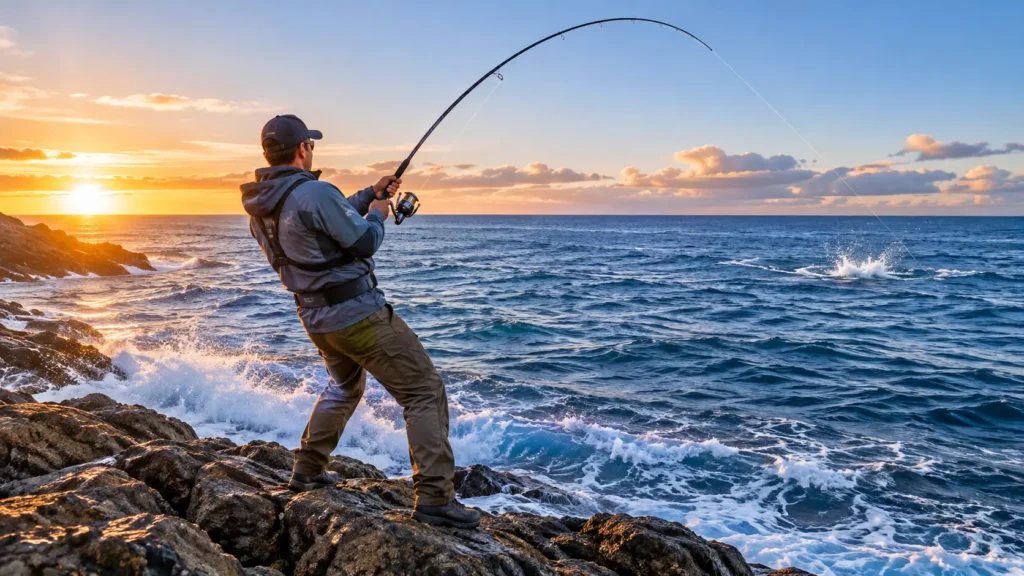
How to catch tuna from shore? You can catch tuna from shore when warm currents, baitfish, and deep-water access line up. The most reliable way to catch tuna from shore is to fish rocky headlands, points, jetties, or beaches near deep water, watch for birds and surface feeding, then cast a fast-moving metal lure, popper, or stickbait into the action.
Land-based tuna fishing rewards preparation. Tuna are powerful pelagic game fish, and a shore angler cannot chase a fish behind a boat. You need long casts, strong tackle, safe footing, and the ability to read the water’s surface before the school disappears. This guide covers the locations, gear, baits, fishing techniques, and safety steps that make shore jigging for tuna and tuna beach fishing more productive.
Quick Jump
ToggleCan You Really Catch Tuna From Shore?
Yes. Anglers catch tuna from shore every season, especially longtail tuna, skipjack tuna, blackfin tuna, and sometimes yellowfin tuna fish. The key is access to deeper, cleaner water close to land. Tuna usually follow baitfish, so they can move within casting range when bait piles up along a headland, rip line, or current edge.
Shore fishing differs from offshore fishing. From a boat, an angler can troll, drift live bait, chum, or reposition behind a feeding school. From the beach or rocks, you must intercept fish with accurate casts and use the wind, tide, and coastline to your advantage.
Which Tuna Species Come Close to Shore:
The tuna species available from shore depend on your region.
| Species | Shore-fishing likelihood | Typical shore approach |
|---|---|---|
| Longtail tuna | High in tropical and subtropical waters | Shore jigging, stickbaits, small poppers |
| Skipjack tuna | High when bait is abundant | Small metals, fast retrieves, casting into bust-ups |
| Blackfin tuna | Good in parts of the Gulf Coast and Atlantic | Live bait, small plugs, metals |
| Yellowfin tuna | Occasional near deep water or current lines | Larger poppers, stickbaits, live bait |
| Bluefin tuna | Possible in some coastal areas, especially Northeast U.S. | Heavy tackle, live bait, large plugs |
| Albacore | Less common from shore | Small metals and fast retrieves |
Longtail tuna are one of the best land-based targets. They commonly appear around rocky headlands, islands, and beaches that reach deeper water and warmer currents. They often feed in schools, respond well to metal lures and stickbaits, and provide hard runs on suitable tackle.
Best Conditions for Land-Based Tuna Fishing
Look for these conditions before you commit to a session:
- Clean, blue or green water rather than muddy runoff.
- A strong tide change, current edge, or temperature break.
- Baitfish such as herring, mullet, squid, sand eels, or threadfin herring near the surface.
- Seabirds working above the water.
- Wind that pushes bait toward a point, beach gutter, or rocky wash.
- Early morning or late afternoon low-light periods.
Tuna follow food. When you find bait, you often find tuna nearby, and they may stay in an area as long as the bait holds.
Where to Find Tuna Along the Coast?
The best shore tuna spots share one feature: they give you access to deeper water without needing a boat. A beach that drops away quickly, a rocky point with strong wash, or a long jetty beside a channel can all put a tuna within casting range.
– Rocky Headlands and Coastal Points
Rocky headlands are prime land-based tuna fishing locations. Current compresses against the point, bait gets trapped in the wash, and tuna hunt the edges of the turbulence. Fish the seam where clean water meets dirty water, and cast along current lines rather than directly into the roughest whitewater.
Fish the outgoing tide when bait gets swept away from shelter. Cast up-current, let the lure swing through the zone, and retrieve quickly once it enters likely water.
– Beaches, Jetties, and Deep-Water Access
Not every beach holds tuna. Choose a steep beach, a deep gutter, a river mouth, or a stretch of sand close to a channel. These areas let baitfish move in and out with the tide, giving tuna a reason to come close.
Jetties can be excellent because they extend into deeper water. Fish the ends, the current seams, and the shadow lines created by structure. If you can see bait flicking on the surface, work that area before moving on.
Best Time of Day and Season to Catch Tuna From Shore
The best time to catch tuna from shore is usually dawn, especially the first two hours of light. Tuna often feed near the surface at first light, when baitfish rise and birds begin searching. Late afternoon can also produce, particularly when the tide and wind push bait toward the coast.
Season matters more than time of day. In tropical and subtropical areas, longtail tuna can be caught year-round, though activity often improves in warmer months. In temperate regions, tuna may appear during summer and fall when bait schools move along the coast. In the Northeast United States, bluefin tuna have recently shown up close to shore through summer and fall, following menhaden, sand eels, and squid.
Check local reports before you go. A spot that produced last week can go quiet after a wind change, rain event, or bait movement.
Best Fishing Gear for Shore-Based Tuna Fishing
Shore tuna fishing demands gear with casting distance, line capacity, and stopping power. A light bass outfit will not control a strong tuna in current, waves, or around rocks.
Recommended Rods and Reels
A good starting setup is a 9- to 10-foot saltwater spinning rod rated for 20 to 40 pound line, paired with a 5,000 to 8,000-size spinning reel. This combination casts metal jigs, poppers, and stickbaits while leaving enough line capacity for long runs.
For bigger bluefin or yellowfin, step up to a heavier 10- to 11-foot rod, a large spinning reel, and 50 to 80 pound braid. A stout rod helps you turn a fish away from rocks and land it faster.
Choose a reel with:
- A smooth, powerful drag.
- At least 250 to 350 yards of suitable braid.
- Corrosion-resistant construction.
- A comfortable handle for long sessions.
Best Fishing Line, Leader, and Hooks
Spool your reel with 30 to 50 pound braided line for most shore tuna fishing. Braid casts far, cuts through current, and gives you better control during the fight. Use a 40 to 80 pound fluorocarbon or monofilament leader, depending on water clarity and the size of fish you expect.
Tie your leader to the braid with a strong knot such as an FG knot or improved Albright knot. Check the knot after every fish, snag, or heavy cast. Use strong split rings, solid rings, and quality hooks; tuna can straighten weak hardware.
Best Baits and Lures for Catching Tuna From Shore
Tuna eat often and move fast. Your best bait or lure is the one that matches the baitfish they are feeding on that day.
– Live Bait and Cut Bait
Live bait is deadly when tuna are feeding but refusing lures. Catch local bait first: herring, mullet, threadfin herring, squid, or small mackerel. Hook a live bait through the nose or just in front of the dorsal fin, then free-line it into the current.
Cut bait also works, especially for blackfin, skipjack, and smaller tuna. Use a fresh strip of mackerel, herring, or squid on a circle hook. Let it drift in the current rather than dragging it across the bottom.
Chumming can help from a stable jetty or rock platform. A small, regular amount of minced baitfish can attract tuna and hold them nearby. Do not dump large amounts of chum; feed sparingly so fish stay interested without becoming full.
– Metal Jigs, Poppers, and Stickbaits
Lures are usually the most practical choice for shore anglers because you can cover water quickly.
- Metal jigs: Best all-round shore tuna lure. Cast far, sink slightly, then retrieve fast.
- Poppers: Great when tuna feed on the surface. Make a loud pop, pause, then repeat.
- Stickbaits: Excellent for long casts and a wounded-baitfish action.
- Small plugs: Useful when bait is tiny and fish are selective.
- Soft plastics: Effective on a slow fall after a cast into a bust-up.
Metal lures let you cast a compact baitfish profile a long distance, which is ideal when tuna are feeding on small bait. A fast retrieve imitates a fleeing bait fish, while a pause can trigger a strike from a fish tracking the lure.
How to Catch Tuna From Shore: 5 Proven Techniques
1. Casting Metal Jigs
Shore jigging for tuna starts with distance and speed. Cast beyond the feeding area or up-current of a bait school. Let the jig sink for two to five seconds, then wind fast with the rod tip low. If nothing hits, try a burn-and-kill retrieve: wind quickly, pause, then wind again.
Vary lure weight until you can reach the fish without losing casting accuracy. A 20 to 40 gram metal often suits longtail tuna and skipjack; heavier metals work better in wind, current, or deeper water.
2. Working Topwater Poppers
Topwater techniques shine when tuna are feeding on the surface. Cast a popper past the bust-up, not into the middle of it. Work it back with sharp pops and short pauses. A tuna may strike on the pause, so keep watching the lure.
Use a popper when fish are actively crashing bait. If they are shy, switch to a smaller popper, a stickbait, or a metal jig.
3. Fishing Live Bait
Live bait is one of the most dependable ways to catch a tuna from shore. Catch bait at the venue, keep it lively, and fish it on a free line or small balloon rig. Let the current carry it into the feeding zone.
Use just enough weight to keep contact with the bait. If the bait swims unnaturally or sits under a floater without moving, change the hook position or reduce the weight.
4. Matching Lures to Baitfish
“Match the hatch” matters. If tuna are eating tiny sand eels, use a slim metal or small stickbait. If they are chasing herring or mullet, use a slightly larger profile. If squid are present, try a small squid-style lure or a natural-colored soft plastic.
Natural baitfish colors—silver, white, blue, and green—are reliable starting points. Pink can also produce when fish are pressured or feeding aggressively.
5. Targeting Surface Feeding Tuna
When tuna feed near the surface, they push bait into a tight ball. Birds dive, bait sprays across the water, and tuna crash through the school. Position yourself so the wind or current carries your cast into the path of the fish.
Do not chase every splash. Watch the direction the school moves, lead your cast, and make one accurate presentation. Repeated casts into the center of a moving school can spook fish and waste the brief window.
How to Identify Tuna Feeding Activity From Shore
Reading the water is the biggest skill in land-based tuna fishing. Tuna often reveal themselves before you see the fish.
Watch for Diving Seabirds and Bait Balls
Look for terns, gannets, gulls, or other seabirds diving repeatedly in one area. Birds follow bait, and tuna force baitfish to the water’s surface. A tight, shimmering bait ball can look like rain on the surface.
Watch bird height and movement. Birds circling high may mark bait below; birds crashing low usually mean active surface feeding.
Spotting Surface Strikes and Breaking Fish
A tuna bust-up looks like a sudden explosion, splash, or series of white water boils. Fish may appear for only seconds before moving. Look for a pattern: direction, speed, and distance from shore.
If fish are moving steadily along a current line, cast ahead of them. If they appear and vanish, wait for the next show rather than casting blindly.
How to Fight and Land a Tuna From the Shore
Fighting a tuna from shore is different from fighting one from a boat. You cannot follow the fish, so your rod, drag, and footing must do the work.
- Set the drag firmly. It should be strong enough to turn the fish but not so tight that it pulls hooks.
- Keep the rod high and use your legs. Bend from the knees, not your lower back.
- Turn the fish early. Apply pressure as soon as possible to stop it from reaching structure.
- Pump and reel. Lift with the rod, lower it, then take line on the drop.
- Move along the shore. Walk to regain line angle, but only on safe ground.
- Land carefully. Use a large net, tail rope, or gaff only where legal and safe.
A long fight exhausts the fish and increases the risk of sharks or tackle failure. Fish heavy enough to control the fight, land it promptly, and support the fish properly if you release it.
Shore Tuna Fishing Safety, Regulations, and Conservation
Tuna fishing from rocks or exposed beaches can be dangerous. No tuna is worth a wave, a slip, or a swim in heavy surf.
Fishing From Rocks and Exposed Coastlines
Follow these safety rules:
- Never turn your back on the ocean.
- Watch the swell for at least 20 to 30 minutes before choosing a position.
- Wear a life jacket, non-slip boots, and bright clothing.
- Carry a phone in a waterproof pouch and tell someone where you are fishing for tuna.
- Fish with a partner whenever possible.
- Have an escape route to higher ground.
- Do not fish a low ledge if waves are reaching it.
Longtail tuna anglers fishing from rocks and exposed coastlines are specifically advised to prioritize safety, maintain communication options, and fish with others where possible.
Tuna Size Limits, Seasons, and Fishing Licenses
Tuna regulations vary by country, state, species of tuna, and whether you fish from shore or a vessel. In U.S. Atlantic and Gulf waters, tunas such as bluefin, yellowfin, bigeye, albacore, and skipjack are managed as Highly Migratory Species. Recreational anglers generally need a federal HMS Angling Permit, and rules can include size limits, bag limits, seasons, and reporting requirements.
In U.S. Atlantic waters, yellowfin and bigeye tuna generally have a 27-inch curved fork length minimum, while Atlantic bluefin rules are stricter and can change by season and permit type. Always check the latest local regulations before you keep a tuna; catch limits and seasons can change during the year.
For conservation, release undersized fish quickly, avoid lifting large tuna by the tail alone, and use wet hands when handling a fish you plan to release.
Frequently Asked Questions About Catching Tuna From Shore
What Is the Best Bait for Catching Tuna From Shore?
The best bait is the local baitfish tuna are already eating. Live herring, mullet, threadfin herring, squid, or small mackerel are excellent choices. If live bait is unavailable, fresh cut bait or a metal jig that matches the bait size is a strong alternative.
Can You Catch Bluefin Tuna From the Beach?
Yes, but it is uncommon and demanding. Bluefin tuna sometimes come close to shore where bait such as menhaden, sand eels, or squid concentrates. You need heavy tackle, safe access to deep water, and a clear understanding of local bluefin rules.
What Is the Best Rod for Shore Tuna Fishing?
A 9- to 10-foot saltwater spinning rod rated for 20 to 40 pound line suits most shore tuna fishing. For larger tuna, use a 10- to 11-foot rod with a stronger reel and 50 to 80 pound braid.
How Far Do You Need to Cast for Tuna?
You do not always need an extreme cast. If tuna feed close to a point or jetty, 40 to 80 yards may be enough. In calm conditions or when fish stay beyond the breakers, practice casting 100 yards or more with a suitable metal jig or stickbait.
What Is the Best Time to Catch Tuna From Shore?
Dawn is usually best, followed by late afternoon. Fish the tide change, especially when current pushes bait along a point, beach gutter, or jetty.
Conclusion
Learning how to catch tuna from shore comes down to preparation, observation, and safe execution. Find coastal access to deeper water, watch for birds and bait, and cast a matching lure into the feeding zone before the school moves on. A quality rod, strong reel, suitable braid, and sharp hooks give you a fair chance once a tuna takes.
Land-based tuna fishing is not easy, but it is one of the most exciting ways to target a powerful game fish without a boat. Start with shore jigging, learn to read surface activity, and keep your bait or lure in the strike zone. Whether you chase longtail tuna, blackfin, skipjack, yellowfin, or an occasional bluefin, respect the ocean, follow local rules, and handle every tuna caught with care. With the right conditions and a well-placed cast, your next trophy may be within reach of the beach.