
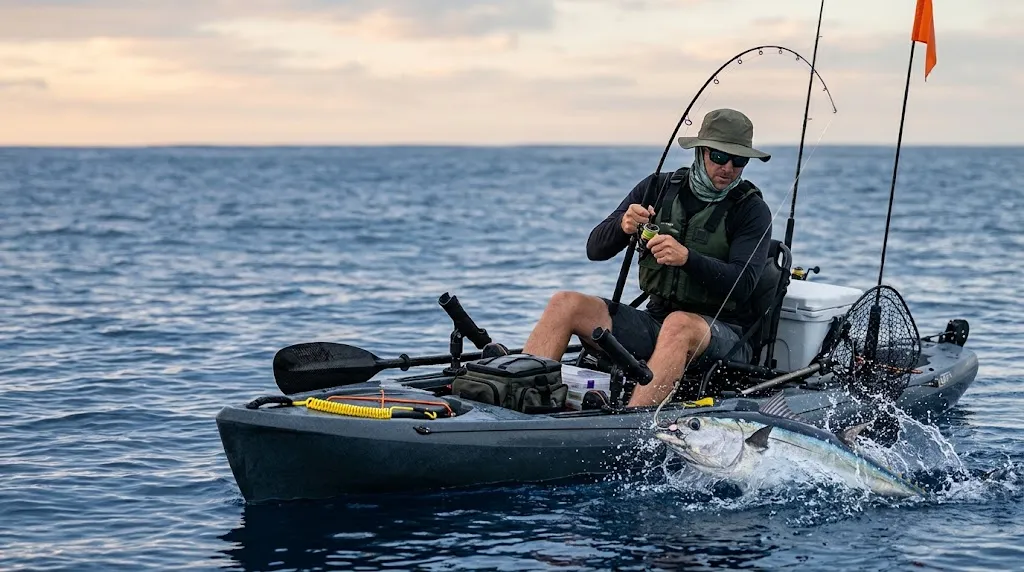
Learning how to catch tuna from a kayak starts with one simple truth: tuna are fast, powerful, and often far from shore, so success depends on preparation, balanced tackle, and a safe plan.
You can catch albacore, blackfin, yellowfin, and even bluefin tuna from a kayak, but the best results come from targeting smaller school-size fish, fishing near bait and birds, and using gear that matches the fish you expect to hook.
Kayak tuna fishing rewards anglers who troll slowly, read water conditions, and stay disciplined when a tuna makes its first screaming run.
Compare top picks for the best tuna fishing kayaks and find a model with the stability, capacity, and features your offshore fishing setup requires. Explore our recommendations and choose the right kayak for your next tuna adventure!
Quick Jump
ToggleCan You Catch Tuna From a Kayak?
Yes. Tuna fishing from a kayak is challenging, but it is absolutely possible—especially for albacore, skipjack, blackfin tuna, and smaller yellowfin.
A kayak angler cannot cover water like a powerboat, so the goal is not to chase tuna across the ocean; it is to put yourself where bait, current, birds, and feeding tuna overlap.
Most tuna kayak fishing targets fish in the 10–40 pound range. Blackfin tuna commonly run to about 40 pounds, while albacore often fall between 20 and 40 pounds, making them realistic targets for a well-rigged yak.
Bluefin tuna can exceed several hundred pounds and should only be attempted by highly experienced offshore kayak anglers with support, proper permits, and a clear emergency plan.
The real advantage of a kayak is stealth. A quiet paddle or pedal drive lets you approach feeding fish without the engine noise of a boat. That matters when tuna are crashing baitfish in a boil or feeding under diving birds.
Want a Stable Kayak for Offshore Tuna Fishing? See Which Models Stand Out!
Where to Find Tuna When Kayak Fishing
Tuna are pelagic fish, meaning they roam open water rather than holding to one reef or wreck. Look for moving water, food, and surface activity. The most productive offshore kayak fishing areas usually combine current edges, temperature breaks, bait schools, and bird activity.
Start by studying these signs:
- Birds: Terns, gannets, and petrels diving repeatedly often mark tuna pushing baitfish to the surface.
- Boils and splashes: A sudden surface explosion, followed by nervous baitfish, can mean a feeding frenzy.
- Bait schools: Glass minnows, sardines, anchovies, mackerel, and small squid are major tuna food sources.
- Current lines and rips: Where two bodies of water meet, bait collects and predators hunt.
- Temperature breaks: Tuna often gather along edges between warmer and cooler water.
Do not paddle straight through a feeding school. Back off, approach from the side or downwind, and cast to the edge of the action. A direct approach can push the fish down and end the bite.
If you fish near shore, look for steep drop-offs, shipping-channel edges, offshore reefs, and areas where bait concentrates. In some fisheries, bluefin tuna can appear surprisingly close to the beach, but that is the exception—not a reliable plan.
Don’t Guess When Choosing Your Offshore Fishing Kayak. Compare the Best Options Today!
Best Time of Year to Catch Tuna From a Kayak
The best season depends on your region and species. In general, tuna move with bait, water temperature, and seasonal currents. Early morning and late afternoon are often strongest because low light encourages baitfish and predators closer to the surface.
| Species | Typical kayak-friendly size | Common conditions |
|---|---|---|
| Albacore | 20–40 lb | Cooler offshore water, trolling bites, baitfish schools |
| Blackfin tuna | 10–40 lb | Warm coastal and offshore water, current edges, chum or troll bites |
| Yellowfin tuna | School fish to larger adults | Bait pods, birds, current breaks, offshore structure |
| Bluefin tuna | Highly variable; giants possible | Seasonal nearshore runs, strict regulations, expert-only from a yak |
Check local fishing reports, satellite sea-surface-temperature charts, wind forecasts, and recent catch reports before committing to a launch. Tuna action can change quickly from one day to the next.
Essential Gear for Kayak Tuna Fishing
Tuna demand stronger gear than most inshore kayak fishing setups. Your rod, reel, line, leader, drag, and lure must work as one balanced system. A mismatched outfit causes pulled hooks, blown drags, and lost fish.
Rod and reel
For albacore, blackfin, and school yellowfin, use a 6–7 foot saltwater rod with a medium or medium-heavy action. A shorter rod gives you better control beside a kayak and reduces the chance of high-sticking during the fight.
A quality spinning reel in the 5,000–8,000 size class works well for many kayak tuna situations. Choose a reel with:
- A smooth, strong drag
- Fast line recovery
- A large spool capacity
- Corrosion-resistant construction
- Enough line capacity for long runs
Line and leader
Spool with 30–50 pound braided line for most school tuna. Braid has low stretch, improves strike detection, and helps you feel how a lure swims. Add a 30–60 pound fluorocarbon leader for stealth and abrasion resistance. For larger yellowfin or bluefin, increase leader strength and use heavier tackle.
Safety gear
Offshore kayak fishing requires more than a rod and tackle box. Carry:
- A properly fitted PFD
- VHF radio
- GPS or phone in a waterproof case
- PLB or satellite messenger
- Signal mirror, whistle, and strobe
- Leashes for paddle and rod
- First-aid kit
- Extra water, food, sun protection, and spare clothing
- Anchor or drift chute only when conditions allow safe use fishing.
A leash is not optional when tuna fishing. A big tuna can pull an unsecured rod straight out of a rod holder, and a loose paddle can drift away during a chaotic fight.
Need More Storage for Rods, Tackle, and Safety Gear? Explore These Kayak Options!
Choosing the Best Kayak for Tuna Fishing
The best kayak for tuna fishing is stable, seaworthy, efficient, and capable of carrying safety gear, tackle, bait, and a large fish. A sit-on-top fishing kayak is usually the practical choice because it drains water, handles chop better, and gives you room to rig gear.
Look for these features:
- Length: A 12–15 foot kayak tracks better and covers water more efficiently than a short recreational yak.
- Stability: A wide, stable hull helps during casting, landing fish, and dealing with chop.
- Storage: You need room for a crate, cooler, bait bucket, PFD, radio, and safety equipment.
- Pedal or paddle propulsion: A pedal drive frees your hands for fishing, but a paddle remains essential as backup.
- Rod holders and tracks: Secure rod holders, gear tracks, and mounting points make offshore fishing safer.
- Scupper and drainage design: A self-draining sit-on-top hull is safer in rough saltwater conditions.
Pedal kayaks often offer more stability and carrying capacity, which helps offshore kayak anglers manage heavy tackle and long days. Still, test the kayak in real wind and chop before taking it far from shore.
Best Baits and Lures for Catching Tuna From a Kayak
Match the hatch. If tuna are feeding on tiny baitfish, a large offshore lure may get ignored. If they are chasing larger bait, a bigger presentation can trigger a strike.
Best trolling lures
A kayak cannot maintain the high trolling speeds many powerboats use, so choose lures that swim well at slower paddle or pedal speeds. Bibbed diving plugs, small cedar plugs, feathers, and compact skirted lures are strong choices.
Good options include:
- Small cedar plugs
- Tuna feathers
- Squid skirts
- Bibbed hard-body diving lures
- Small trolling spoons
- Daisy chains with a trailing hook lurefishing.
Best casting lures
When tuna are feeding on the surface, cast poppers, stickbaits, small jigs, or metal slices to the edge of the boil. Work the lure with a pop-and-pause cadence; many strikes come during the pause.
Best natural baits
Live bait is deadly when you can catch or buy it locally. Sardines, anchovies, herring, mackerel, pilchards, and small squid all produce tuna. Hook a live bait through the nose so it can swim naturally, then free-line it back into the chum slick.
If live bait is unavailable, chunking works. Cut baitfish into small pieces, toss a steady trickle behind the kayak, and drift a hooked chunk back with the current. Keep the bait natural—do not pull against it.
How to Catch Tuna From a Kayak: Step-by-Step Techniques
Trolling for Tuna
Trolling is the best way to search open water from a kayak. It lets you cover ground while keeping a lure in the strike zone.
- Launch early, check weather, and paddle or pedal toward known bait, current, or bird activity.
- Put one lure out first and test its action at your normal cruising speed.
- Add a second lure only if you can manage the lines safely.
- Keep the lure behind the kayak far enough that it will not foul when you turn.
- Watch the rod tip. A lure running correctly produces a steady vibration; weeds or poor action change that feel.
- When a tuna strikes, keep moving for a few seconds, then stop pedaling or paddling and begin the fight. Maintaining forward motion briefly can help hook another fish if the school is active.blackmagictackle
Troll at the speed that makes the lure track straight and swim naturally. For many kayak-friendly hard baits, that is much slower than the 6–8 knot trolling speed commonly used from larger boats.
Casting to Feeding Tuna
When you spot birds, boils, or bait being blasted, stop outside the feeding zone. Position upwind or upcurrent, then cast to the edge of the action.
Use a fast retrieve for a popper or stickbait, but include pauses. A tuna often hits as the lure stalls. If fish ignore the surface lure, drop a small jig or metal slice below the boil and work it back with sharp lifts.
Never paddle directly into the middle of a feeding frenzy. Tuna can vanish quickly when pressured, and a kayak in the middle of breaking fish creates unnecessary risk. fishing.net
Live Bait Fishing
Live bait is one of the most effective ways to catch tuna from a kayak once fish are nearby. Keep bait lively in a bucket or aerated container, changing water when needed.
- Set up a light chum slick using cut bait.
- Hook a live sardine, pilchard, mackerel, or anchovy through the nose.
- Let it swim away naturally with little or no weight.
- Keep the reel in free spool or open-bail mode until a tuna takes line.
- Close the bail, allow the fish to turn, then set the hook firmly.
Use a circle hook when regulations or release practices call for it. A non-offset circle hook typically catches in the corner of the jaw, which improves release survival.
How to Fight and Land a Tuna From a Kayak
The first run is the moment that defines kayak tuna fishing. A tuna will often peel line in a long, fast run, then begin circling beneath the kayak. Your job is to stay balanced, maintain pressure, and avoid slack line.
Follow this process:
- Set the drag at roughly 25–30 percent of line breaking strength before the fight.
- Keep the rod low and angled toward the fish.
- Pump and reel smoothly; never high-stick the rod.
- Follow circles with your kayak when safe, rather than forcing the fish to pull the kayak sideways.
- Keep the line tight, especially when the tuna shakes its head near the surface.
- Use a net, tailer, or gaff only after you have a controlled fish alongside the yak.
Never wrap the line around your hand. A strong tuna can cause serious injury when it makes a final run. If sharks appear, do not fight a exhausted fish for long; decide quickly whether to release it, land it, or cut the line safely. Sharks commonly follow tuna and can take hooked fish.
For a large tuna, consider a “mothership” arrangement: launch from or return to a support boat, or fish with another experienced kayaker nearby. This adds safety and gives you a way to handle an unexpectedly big fish.
Kayak Tuna Fishing Safety Tips and Common Mistakes to Avoid
Offshore kayak fishing is serious saltwater fishing. Tuna grounds may be miles from shore, conditions can deteriorate quickly, and a kayak offers no protection from wind, waves, or shipping traffic.
Safety rules
- Check marine weather, wind, swell, tide, and lightning forecasts.
- File a float plan with someone reliable.
- Wear your PFD; do not simply stow it.
- Carry a VHF radio and know how to call for help.
- Use leashes on paddle, rod, and pliers.
- Fish with a partner or support vessel whenever possible.
- Know your physical limits and turn back early if conditions change.
- Follow local size, bag, permit, and seasonal tuna regulations.
Common mistakes
- Using boat-sized lures that a kayak cannot troll effectively.
- Overloading the yak with bait, ice, and tackle.
- Fishing alone far offshore without communication equipment.
- Setting the drag too tight on light tackle.
- Giving a tuna slack during head shakes.
- Trying to land a fish without securing the paddle or rod.
- Ignoring sharks, weather changes, or fatigue.
- Targeting giant bluefin without the right experience, permits, and support.
Frequently Asked Questions About Kayak Tuna Fishing
What size tuna can you catch from a kayak?
Most kayak anglers target albacore, blackfin, skipjack, and school-size yellowfin in the 10–40 pound range. Larger tuna are possible, but bluefin and big yellowfin require advanced offshore skills, heavy gear, and strong safety support.
Is kayak tuna fishing dangerous?
It can be. You may be far from shore in open water, exposed to wind, waves, boat traffic, fatigue, and sharks. Wear a PFD, carry a VHF radio and PLB, check forecasts, and avoid fishing alone beyond your experience level.
How far offshore should you kayak fish for tuna?
There is no universal distance. Some albacore, blackfin, and yellowfin fisheries lie within a few miles of shore; others require long offshore runs. Let local reports, weather, your kayak’s range, and your rescue plan determine the distance—not a number you saw online.
What is the best rod and reel for kayak tuna fishing?
A 6–7 foot medium or medium-heavy saltwater rod paired with a 5,000–8,000 size spinning reel is a versatile starting point. Match it with 30–50 pound braid, a fluorocarbon leader, and a smooth drag suitable for the tuna species in your area.
Can you catch bluefin tuna from a kayak?
Yes, but it is an expert-level pursuit. Bluefin are tightly regulated in many regions and can be extremely powerful. Only target them with current local knowledge, legal authorization, heavy-duty gear, and a support plan.
Do you need a pedal kayak for tuna?
No. A paddle kayak can catch tuna, especially if it tracks well and has enough storage. A pedal drive helps you cover water and keep hands free, but it adds cost, maintenance, and potential failure points. Always carry a paddle as backup.
Are bluefin tuna found in British waters?
Yes. Atlantic bluefin tuna have returned to UK waters, especially off southwest England, Wales, and the English Channel, with peak sightings from August to October.committees.
How much does 1 lb of bluefin tuna cost?
Retail bluefin usually costs about $30–$80 per pound for lean akami; premium fatty otoro can cost $150–$275+ per pound.
How old is a 40 lb yellowfin tuna?
A 40 lb yellowfin is typically around 3–5 years old, though growth varies by region, food supply, and sex.
Conclusion
Learning how to catch tuna from a kayak is less about owning the most expensive setup and more about making smart decisions before and after launch. Find bait, birds, current, and clean water; use balanced tackle; troll lures that work at kayak speed; and stay calm when a tuna makes its first powerful run.
Kayak tuna fishing can produce unforgettable strikes from albacore, blackfin, yellowfin, and even bluefin, but offshore kayak fishing always demands respect for weather, distance, and safety. Choose the best kayak for tuna fishing that fits your body, local sea conditions, and storage needs.
Prepare your safety gear, practice your drag and landing routine, and start with realistic targets. When the rod bends, the reel screams, and a tuna takes line beside your yak, you will understand why this is a bucket-list experience for so many kayak anglers.
Recommended posts
- Tuna Fishing Season – Best Months, Locations & Techniques
- Texas Tuna Fishing 101 – Best Seasons, Spots & Charters
- How Much Is a Tuna Fishing Boat? In-Depth (Boat Cost Guide)