
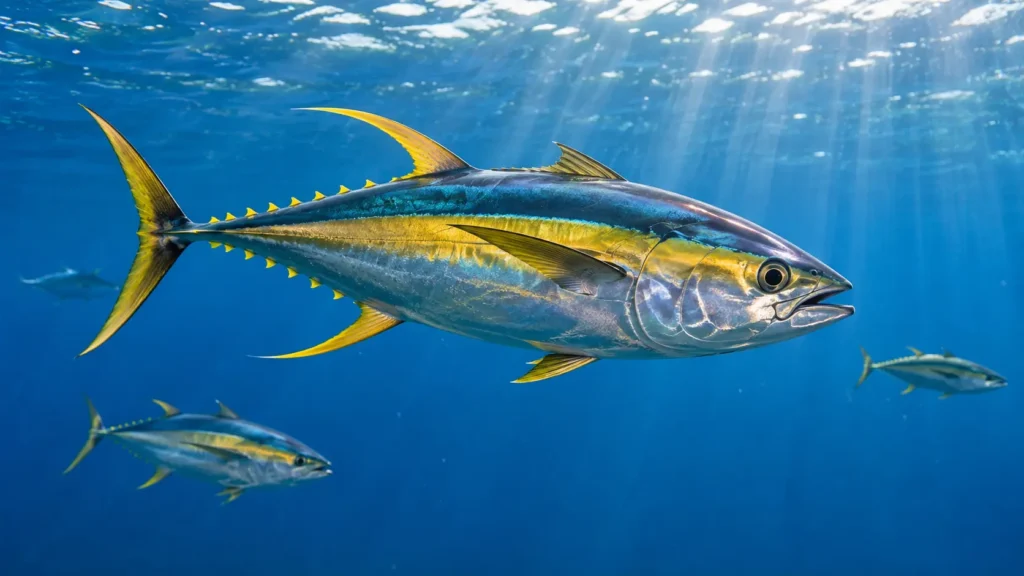
How long do yellowfin tuna live in the ocean? Yellowfin tuna typically live for about 6 to 7 years in the wild. These fast-growing ocean predators reach sexual maturity at around 2 years old and spend their relatively short lives migrating through tropical and subtropical waters.
Some individuals can live longer, with recent scientific studies documenting yellowfin tuna up to 18 years old in the Atlantic, but most fish caught today are far younger.
Yellowfin tuna (Thunnus albacares) grow quickly, reproduce early, and face constant pressure from predators and fishing. That combination creates a short average life expectancy, even though the species has impressive size and strength. NOAA Fisheries describes the usual lifespan as 6 to 7 years, while noting that yellowfin can reach about 6 feet long and 400 pounds.
How Long Do Yellowfin Tuna Live in the Wild?
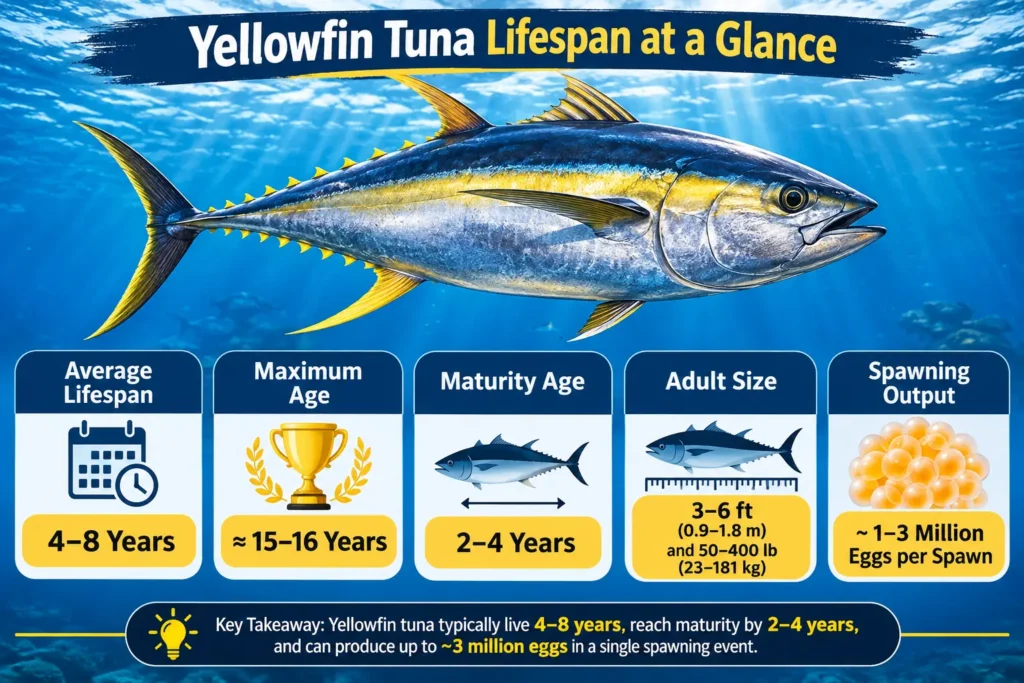
Most yellowfin tuna live about 6 to 7 years. NOAA Fisheries gives this range for Pacific yellowfin, and its Atlantic species profile similarly describes a somewhat short lifespan of about 7 years.
The maximum recorded age is more complicated. A NOAA-supported age-and-growth study in the U.S. Gulf of Mexico and western Atlantic found fish from 1 to 18 years old, with the oldest male estimated at 18 years and the oldest female at 17 years. That does not mean 18 years is the normal yellowfin tuna lifespan; it represents an exceptional maximum age found through otolith analysis.
– Average lifespan
For everyday purposes, use 6 to 7 years as the typical yellowfin tuna life expectancy. Most sampled fish in the Atlantic study were younger than 4 years old; fish under age 4 made up 78 percent of the age classes. fisheries.noaa
– Maximum recorded age
The documented maximum age can reach 15 to 18 years in certain regions. Research in the western and central Pacific Ocean reported longevity of at least 15 years, while Atlantic and Ascension Island studies found individuals up to 18 years old.
– How lifespan varies between populations
Lifespan varies by ocean region, fishing pressure, and the type of gear that catches the fish. In the U.S. Gulf of Mexico and western Atlantic study, fish caught by rod-and-reel averaged about 2.9 years old, while fish caught on pelagic longlines averaged about 4.9 years old. Longline fisheries often select larger, older fish, so gear type can shape the age range scientists observe. repository.library.noaa
What Is the Life Cycle of a Yellowfin Tuna?
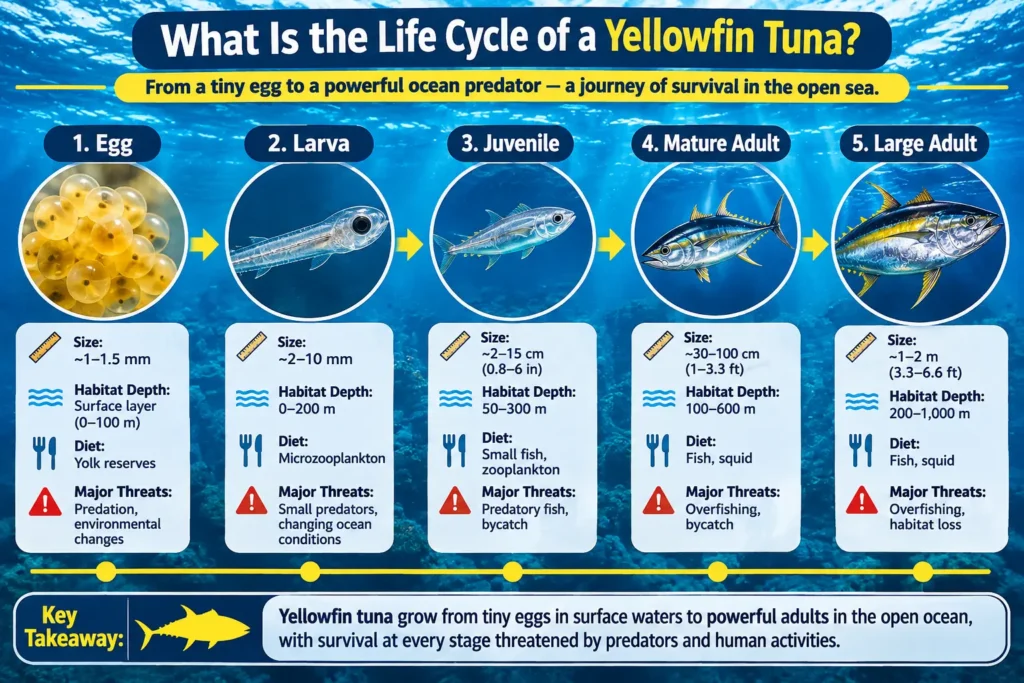
The yellowfin tuna life cycle moves from tiny surface-dwelling eggs to fast-growing juveniles and then to powerful offshore adults. The species lives in tropical and subtropical oceans worldwide, including the Pacific Ocean, Atlantic Ocean, and Indian Ocean.
Eggs and larval development
Female yellowfin tuna release millions of eggs during spawning. The eggs float in the upper water column, where larvae hatch and feed on microscopic plankton.
Larval and juvenile yellowfin stay near the surface. Fish, seabirds, dolphins, and other animals prey on them during these early stages, which is one reason so few eggs survive to adulthood.
Juvenile growth stages
Juveniles grow quickly. NOAA life-history information reports that young yellowfin can reach roughly 20 to 30 cm fork length by three months and about 50 cm by one year.
Young fish often school with skipjack and other tunas. That behavior can expose them to purse seine fishing, because juvenile yellowfin may be caught as bycatch when vessels target skipjack. worldwildlife
Adult yellowfin tuna
Adults become strong, highly migratory pelagic predators. They travel long distances through warm ocean water, often gathering around floating debris, anchored buoys, fish aggregating devices (FADs), dolphins, and other large marine animals.
Older yellowfin tend to use deeper water more often than larvae and juveniles. They still make frequent dives from the surface into cooler water, and Oceana reports dives of about 1 kilometer, with some observations reaching 1.6 kilometers. oceana
How Fast Do Yellowfin Tuna Grow?
Yellowfin tuna have one of the fastest growth rates among commercially important tunas. Their rapid growth helps explain why they can become large within a lifespan of only a few years.
Growth during the first year
A juvenile yellowfin can reach approximately 50 cm fork length by its first year. This early growth phase is especially fast compared with later life stages.
Average size by age
Size does not map perfectly to age because food supply, region, sex, and genetics all influence growth. Still, the Florida Museum reports that yellowfin can weigh about 7.5 pounds at 18 months and roughly 140 pounds at 4 years.
| Age | Typical development |
|---|---|
| 3 months | About 20–30 cm fork length |
| 1 year | About 50 cm fork length |
| 18 months | Around 7.5 pounds |
| 2 years | Many fish become mature |
| 4 years | Around 140 pounds in some populations |
| Adult maximum | Up to about 6 feet and 400 pounds |
When yellowfin tuna reach full maturity?
Yellowfin tuna reach reproductive maturity early, usually around age 2. Size matters as well as age: NOAA research notes that 50 percent maturity can occur around 112.5 cm fork length, or roughly 27.7 kg.
At What Age Do Yellowfin Tuna Reproduce?
Most yellowfin tuna can reproduce by age 2, though some regional studies place maturity closer to age 2 or 3. This early maturity supports the species’ high reproductive output.
Age of sexual maturity
NOAA Fisheries states that most yellowfin are able to reproduce by age 2. A detailed Gulf of Mexico study estimated 50 percent spawning maturity at about 2.36 years.
Spawning seasons
In tropical waters, yellowfin can spawn throughout the year. At higher latitudes, spawning becomes seasonal, with peak activity often in spring and fall.
In the western Atlantic, NOAA reports spawning from May to August in the Gulf of Mexico and from July to November in the southeastern Caribbean. In the eastern Atlantic, spawning occurs from October to March in the Gulf of Guinea and from April to June off Senegal.
How often females release eggs
Females can spawn very frequently. Atlantic yellowfin may spawn about once every three days during the season, releasing an average of 1 million to 4 million eggs each time. Pacific yellowfin can spawn almost daily and also release millions of eggs.
This high reproductive output helps yellowfin replace losses from natural mortality and harvest, but it does not make the species immune to overfishing.
What Factors Affect Yellowfin Tuna Lifespan?
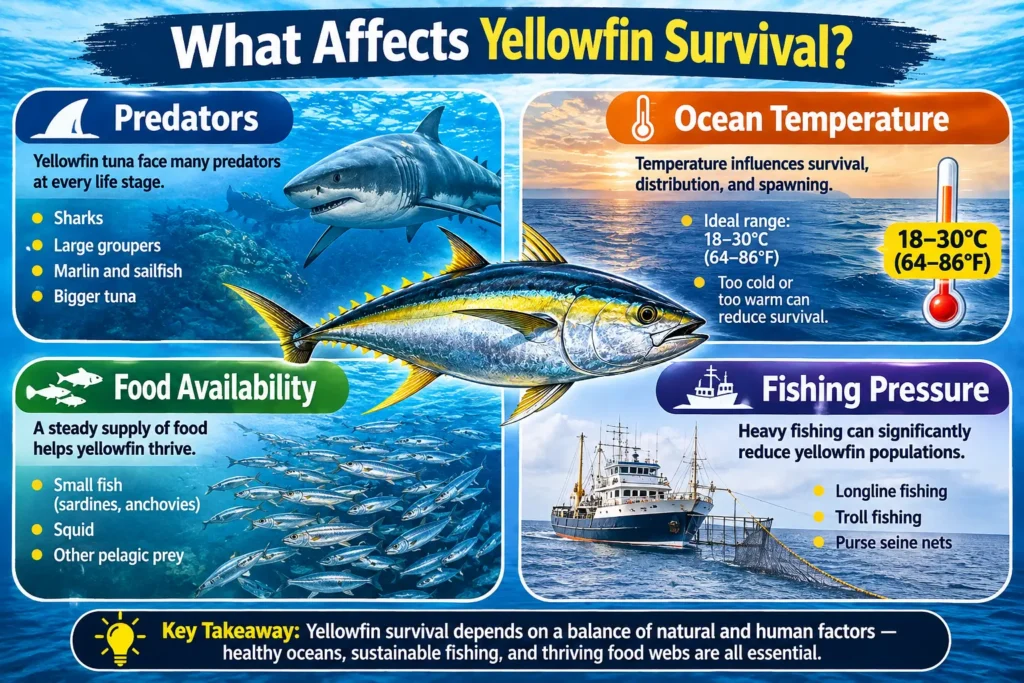
Yellowfin tuna lifespan depends on ocean conditions, food, predators, and human activity. A fish that avoids fishing gear and reaches a large size may live much longer than the average.
– Water temperature and ocean conditions
Yellowfin favor warm water, generally between 64°F and 88°F. They migrate seasonally toward higher latitudes as ocean temperatures rise.
Spawning also depends on warm conditions; research places the lower temperature limit for spawning near 24°C to 26°C.
– Food availability
Abundant bait supports faster growth and better survival. Yellowfin feed on fish, squid, and crustaceans, and they gather where phytoplankton, zooplankton, and smaller prey are plentiful.
– Predators and natural mortality
Sharks, billfish, and marine mammals prey on adult yellowfin. Eggs, larvae, and juveniles face even greater danger from fish, seabirds, dolphins, and other predators.
– Commercial and recreational fishing
Commercial fishing and recreational fishing both remove yellowfin from the ocean. Purse seine vessels, longline fisheries, troll gear, and hook-and-line operations all harvest yellowfin in different regions.
Fishing pressure can reduce the number of older fish in a stock. When juvenile yellowfin are caught before they spawn, the long-term reproductive potential of the stock can decline.
What Do Yellowfin Tuna Eat at Different Life Stages?
Yellowfin tuna change their diet as they grow. Young fish eat small prey near the surface, while adults hunt larger schooling fish offshore.
Diet of juvenile yellowfin tuna
Juveniles feed on tiny planktonic animals at first. As they grow, they begin chasing small fish, crustaceans, and squid in the upper ocean.
Adult feeding habits
Adults feed near the top of the food chain. Their prey includes mackerel, sardine, anchovy, flying fish, squid, and crustaceans.
Anglers often use live bait, trolling lures, or chunk bait to target feeding yellowfin. These fish often gather around FADs, current lines, and areas with concentrated bait.
How diet supports rapid growth
A protein-rich diet fuels the species’ fast growth rate. Constant feeding allows yellowfin to add weight quickly, reach maturity early, and sustain long migratory movements.
How Old Can Yellowfin Tuna Get Compared to Other Tuna?
Yellowfin live shorter lives than bluefin tuna but generally longer than skipjack. Their lifespan sits closer to bigeye and albacore than to the longest-lived bluefin species.
| Tuna species | Typical or estimated lifespan | Key difference |
|---|---|---|
| Yellowfin tuna | About 6–7 years; up to 15–18 years documented in some regions fisheries. | Fast growth and early maturity |
| Bigeye tuna | Often about 10–15 years fao | Slower maturity and longer potential lifespan |
| Albacore | Often about 10 years | Smaller and more temperate-water oriented |
| Atlantic bluefin tuna | Can exceed 20 years | Much slower growth and later maturity |
| Southern bluefin tuna | Often 22–40 years | One of the longest-lived tunas |
Yellowfin vs. bluefin tuna lifespan
Bluefin tuna live much longer than yellowfin. The FAO lists Atlantic bluefin maximum age at about 20 years and southern bluefin at 22 to 40 years, while yellowfin is listed at up to 10 years in that comparison table.
Bluefin also mature later. Atlantic bluefin reach maturity around 4.5 years, while yellowfin commonly mature near age 2.
Yellowfin vs. bigeye tuna lifespan
Bigeye tuna generally live longer than yellowfin. FAO lists bigeye maximum age at about 15 years, compared with yellowfin at up to 10 years in the same reference table.
Both species live offshore and support major commercial fisheries, but bigeye grow more slowly and mature later.
Yellowfin vs. albacore lifespan
Albacore tuna fish can live around 10 years, giving them a longer potential lifespan than the typical yellowfin. They also mature later, at roughly 4.5 years.
Yellowfin grow faster and mature earlier, which helps explain their shorter average life expectancy.
How Can Scientists Determine the Age of a Yellowfin Tuna?
Scientists determine yellowfin tuna age mainly by reading growth rings in otoliths, the small calcium-carbonate structures in a fish’s inner ear. These rings form in patterns that researchers can count and validate.
– Reading growth rings in otoliths
An otolith works somewhat like a tree ring record. Scientists section the structure, count annual increments, and use chemical validation methods such as radiocarbon dating to confirm the age estimates.
The Atlantic study used otolith readings to document ages from 1 to 18 years.
– Using fin spines and other structures
Researchers can also examine fin spines, scales, vertebrae, and other hard structures. Otoliths remain the most reliable method for direct age estimates, but these additional structures can support growth studies.
– Tagging and tracking studies
Tagging studies reveal migratory movements, survival rates, and regional movement patterns. Electronic tags and conventional tag returns help scientists understand where yellowfin travel, how long they remain in an area, and how fishing affects different age groups.
Do Yellowfin Tuna Die of Old Age or Predators?
Most yellowfin never die simply from old age. Predation, natural mortality, and fishing remove many fish before they reach maximum age.
– Natural predators of adult yellowfin tuna
Adult yellowfin face predation from sharks, billfish, and marine mammals. Their speed and schooling behavior reduce risk, but do not eliminate it.
– Common threats to juvenile tuna
Juveniles face threats from larger fish, seabirds, and dolphins. Because they occupy surface waters early in life, they are especially vulnerable during the first months.
– Human fishing pressure
Commercial fleets use purse seine gear, longlines, troll gear, and hook-and-line methods. Recreational anglers also target yellowfin with trolling, rod-and-reel, handline, and spearfishing methods.
Management measures, stock assessments, and regional fisheries management organizations help monitor harvest and bycatch. NOAA reports that both Pacific yellowfin stocks it assesses—the Eastern Pacific stock and the Central and Western Pacific stock—are not overfished and not subject to overfishing.
Frequently Asked Questions About Yellowfin Tuna Lifespan
Can yellowfin tuna live for 10 years?
Yes. Although 6 to 7 years is the common lifespan, scientists have documented yellowfin tuna as old as 15 to 18 years in some regions.
How old is a 100-pound yellowfin tuna?
A 100-pound yellowfin is often around 3 to 4 years old, though exact age varies by region and growth conditions. The Florida Museum reports yellowfin reaching about 140 pounds at 4 years old, so a 100-pound fish would usually be somewhat younger. floridamuseum.ufl
Do yellowfin tuna live longer than bluefin tuna?
No. Bluefin tuna generally live much longer, with Atlantic bluefin reaching about 20 years and southern bluefin potentially living 22 to 40 years.
How long does it take a yellowfin tuna to reach adulthood?
Yellowfin can become reproductively mature at about 2 years old. They continue growing after maturity, with large adults reaching up to 6 feet and 400 pounds.
What is the yellowfin tuna maximum age?
The most widely cited practical maximum age is 6 to 7 years, but peer-reviewed otolith studies have documented individuals up to 18 years old.
Why do yellowfin tuna grow so quickly?
Warm water, high food availability, early maturity, and a high-energy pelagic lifestyle support rapid growth. Juveniles can reach about 50 cm within their first year.
Why can’t we eat tuna every day?
Tuna can contain methylmercury, which builds up with frequent consumption and may harm the nervous system, especially in children and pregnant people. The FDA advises 2–3 weekly servings of lower-mercury fish instead.
How much is a 1,000 kg bluefin tuna worth?
It depends on quality and market. At recent auction prices of about £13–£15 per kg, 1,000 kg would be roughly £13,000–£15,000; premium fish can sell far higher.
Conclusion
So, how long do yellowfin tuna live in the wild? In most cases, a yellowfin tuna lives about 6 to 7 years, though exceptional fish can reach 15 to 18 years in certain ocean regions. Their short life expectancy contrasts sharply with their remarkable growth: a fish that begins as one of millions of floating eggs can become a 400-pound offshore predator within only a few years.
Understanding the yellowfin tuna lifespan matters for more than curiosity. Age and growth data guide stock assessments, help managers set sustainable harvest levels, and show why protecting juvenile fish matters. Because yellowfin migrate across international waters and support both commercial fishing and recreational anglers, responsible management depends on science, international cooperation, and careful monitoring. A healthy yellowfin stock depends on giving these fast, powerful fish enough time to spawn, grow, and continue their role in the open ocean.
Recommended posts
- How Fast Can a Tuna Swim? Top Speeds by Species Explained