
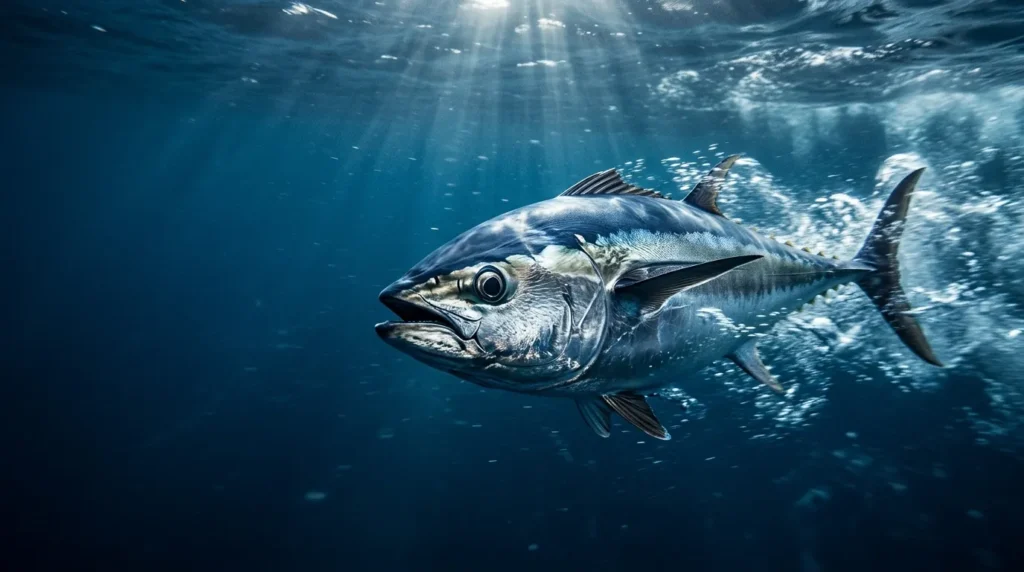
How fast can a tuna swim in mph? Tuna can swim at remarkable speeds, with some species reaching more than 50 mph in short bursts. Albacore tuna can exceed 50 miles per hour, while yellowfin tuna can reach about 45 mph; exact tuna swimming speed depends on species, size, water temperature, and whether the fish is cruising or sprinting.
Most tuna do not travel at top speed all day. They cruise at modest speeds for migration and feeding, then use explosive acceleration when chasing prey or escaping danger.
NOAA Fisheries notes that strong ocean swimmers commonly sustain roughly 5–10 mph, while tuna-like fish can hit 50 mph in short bursts.
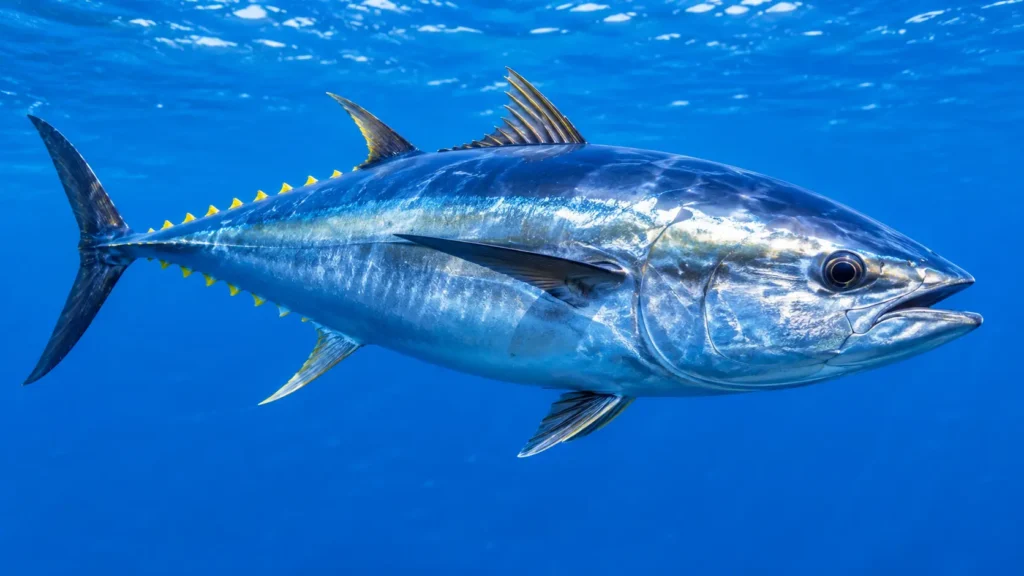
How Fast Can a Tuna Swim?
A tuna’s swimming speed has two very different numbers: cruising speed and maximum burst speed. Cruising speed is the pace a tuna can hold for hours during migration; burst speed is the short, powerful sprint used to catch fish or avoid a predator.
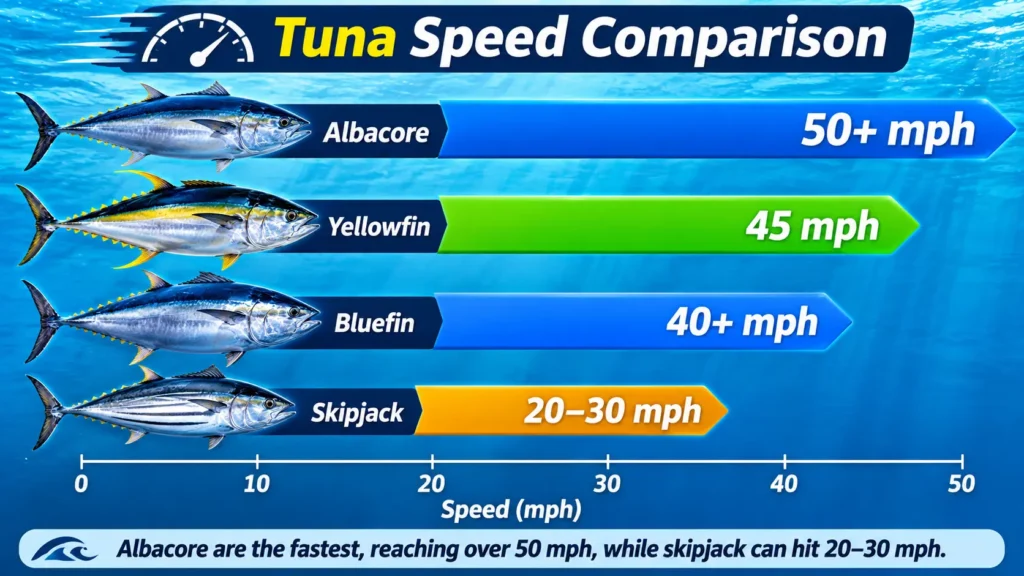
Albacore are generally considered the fastest tuna species, with NOAA Fisheries reporting speeds above 50 mph. Yellowfin tuna reach around 45 mph, while the southern bluefin tuna are powerful sprinters capable of roughly 40 mph or more in ideal conditions.
The distinction matters because a headline number such as “50 mph” does not mean a tuna swims that fast continuously. Sustained swimming demands oxygen, energy, and muscle efficiency, so tuna usually reserve their highest speeds for brief hunting or escape efforts.
How Fast Can Different Tuna Species Swim?
Different tuna species have different body shapes, muscle systems, and migration needs. The table below compares commonly cited maximum speeds, but treat them as short-burst estimates rather than everyday travel speeds.
| Tuna species | Estimated top speed | Best known for |
|---|---|---|
| Albacore tuna | More than 50 mph | Long migrations and high-speed pursuit fisheries. |
| Yellowfin tuna | About 45 mph | Fast hunting in tropical waters ocean.si |
| Bluefin tuna | About 40 mph or more | Powerful bursts and endurance |
| Skipjack tuna | Roughly 20–30 mph | Agility, schooling, and quick escapes |
| Bigeye tuna | Roughly 20–30 mph | Deep-water hunting and endurance |
These figures vary between sources because researchers measure speed in different ways: tagged fish in the open ocean, captive fish in tanks, muscle estimates, and short chase observations can all produce different results.
How Fast Can a Bluefin Tuna Swim?
Bluefin tuna speed is often reported around 40 mph, and scientific estimates suggest Atlantic bluefin tuna can reach burst speeds near 70 km/h—about 43 mph. One biomechanical study estimated that a large bluefin could theoretically reach 54 km/h, or about 34 mph, with some model-based estimates approaching 81 km/h under ideal assumptions.
Atlantic and Pacific bluefin tuna share the same basic design: a huge, muscular body, a stiff crescent tail, and adaptations that keep their swimming muscles warm. Those traits help them accelerate quickly, chase prey, and migrate across the western Atlantic, Mediterranean, and Atlantic and Pacific oceans.
In real-world tracking, Pacific bluefin tuna have shown mean speeds of about 1.20–1.57 meters per second and maximum recorded speeds of 3.05–3.55 meters per second—roughly 6.8–7.9 mph over measured intervals. That does not disprove higher burst capability; it shows that ordinary open-ocean travel is much slower than a predator-evasion sprint. link.springer
How Fast Can a Yellowfin Tuna Swim?
Yellowfin tuna can reach speeds around 45 mph, according to Smithsonian Ocean. Their slim, torpedo-shaped body and long dorsal fin help them cut through warm surface water with limited drag.
Yellowfin tuna use speed when hunting schools of small fish, squid, and other prey. They often feed near the surface in tropical waters, where quick acceleration lets them break into a bait ball and seize scattered fish before the school reforms.ocean.si
How Fast Can an Albacore Tuna Swim?
Albacore tuna can swim faster than 50 mph, making them one of the fastest tuna species and a leading candidate for the fastest tuna. NOAA Fisheries links that performance to a torpedo-shaped body, smooth skin, streamlined fins, high metabolism, and a circulatory system that improves muscle efficiency.
Albacore are also built for distance. They migrate across vast areas of the Atlantic, Pacific, and Indian oceans, often traveling through tropical and warm temperate waters. Their long pectoral fins provide lift, which helps offset their naturally negative buoyancy and supports efficient long-distance swimming.
How Fast Can a Skipjack Tuna Swim?
Skipjack tuna are smaller than bluefin or yellowfin, but they are quick, agile swimmers. They commonly reach roughly 20–30 mph, using rapid turns and bursts of acceleration to move through schools and escape larger predators.
Their speed is especially useful in open water, where skipjack travel in large schools with other tuna species. A fast directional change can be more valuable than raw straight-line speed when a shark, seabird, or larger tuna attacks.
What Makes Tuna Such Fast Swimmers?
Tuna are among the fastest fish species because nearly every part of their body reduces drag or produces power.
- Torpedo-shaped body: A narrow head, smooth body, and tapered tail help water flow around the fish instead of slowing it down.
- Crescent-shaped tail: The stiff, lunate tail works like a high-efficiency propeller, generating strong forward thrust.
- Retractable fins: Tuna can tuck their dorsal fin and pelvic fins closer to the body, reducing resistance at speed.
- Warm muscles: Specialized blood vessels conserve heat in swimming muscles, helping them work efficiently in cooler water.
- Powerful red and white muscle: Red muscle supports steady endurance swimming, while white muscle powers short, explosive sprints. fao
A tuna’s smooth skin and streamlined shape matter as much as raw muscle. Less turbulence means less energy wasted pushing water aside.
How Fast Can Tuna Swim Compared to Other Fish?
Tuna are fast, but they are not always the fastest fish in the ocean. Sailfish are often credited with the highest reported speed, though many widely repeated figures come from old estimates rather than modern tracking studies.
| Fish | Commonly reported top speed | How it compares with tuna |
|---|---|---|
| Sailfish | Often cited near 68 mph | Faster in claimed bursts, but measurements are debated |
| Wahoo | Around 45–60 mph | One of the fastest open-water game fish |
| Blue marlin | Around 50 mph or more | Large billfish with powerful sprint ability |
| Swordfish | Up to 50 mph | NOAA describes swordfish as capable of reaching 50 mph. |
| Mahi-mahi | Around 40–50 mph | Extremely fast over short distances |
| Albacore tuna | More than 50 mph | Fastest commonly cited tuna species. |
| Yellowfin tuna | About 45 mph | Among the quickest tuna. |
In a tuna vs sailfish speed comparison, sailfish usually win the claimed peak-speed contest. But tuna often have the advantage in endurance, migration range, and the ability to maintain high performance across changing ocean conditions.
How Long Can Tuna Maintain Their Top Swimming Speed?
Tuna cannot hold their maximum burst speed for long. A 50 mph sprint may last only seconds or a few minutes because anaerobic white muscle tires quickly and consumes energy rapidly.
For longer travel, tuna rely on red muscle and efficient oxygen delivery. Research on Atlantic bluefin tuna found that fish released after capture initially swam nearly twice their routine cruising speed, then settled into a steady speed after about six hours.
Several factors affect tuna swimming performance:
- Water temperature
- Fish size and age
- Oxygen availability
- Current direction
- Prey behavior
- Predator pressure
- Recent activity or exhaustion
A fisherman targeting tuna in a sport fishery may see explosive runs near the boat, but those runs are not the same as the steady pace a tuna uses during a long ocean migration.
Why Do Tuna Have to Keep Swimming?
Many tuna must keep moving to breathe. They use ram ventilation: swimming forward forces oxygen-rich water into the mouth and across the gills.
Unlike some fish that can pump water over their gills while stationary, tuna lack the structures needed to do this effectively.
NOAA Fisheries explains that albacore constantly swim with their mouths open to breathe because they cannot pump oxygen-rich water over their gills.
Continuous movement also helps some tuna maintain lift. Because they are denser than seawater, they would sink if they stopped swimming; forward motion keeps water moving over their fins and body, supporting their position in the water column.
How Fast Do Tuna Swim When Hunting or Escaping Predators?
Tuna swim fastest during two moments: attacking prey and avoiding predators. When hunting, they accelerate into schools of mackerel, anchovies, squid, or other small fish, using sudden bursts to create chaos and isolate an easy target.
When escaping sharks, billfish, marine mammals, or other large predators, speed and maneuverability both matter. A tuna may not outswim every predator in a long chase, but a rapid burst can create enough distance to break away.
Their hunting style depends on species. Yellowfin often chase fast-moving surface prey, while bluefin can pursue prey across deeper, cooler water. Albacore use their speed and stamina to cover large distances during seasonal migrations and feeding movements.
Frequently Asked Questions About Tuna Swimming Speed
What is the fastest tuna species?
Albacore tuna is generally considered the fastest tuna species. NOAA Fisheries reports that albacore can swim faster than 50 mph.
How do scientists measure a tuna’s swimming speed?
Scientists measure tuna speed using electronic tags, underwater video, acoustic tracking, captive-fish observations, and swim-tunnel studies. They distinguish between short burst speeds and slower sustained cruising speeds, since a tuna’s maximum sprint is very different from its normal travel pace.
Can tuna swim 50 mph?
Yes. Albacore tuna can exceed 50 mph in short bursts, according to NOAA Fisheries. Other tuna species may approach that speed, but 50 mph should be viewed as a peak sprint, not a normal cruising pace.
Is a tuna faster than a shark?
Some tuna can outswim some sharks in a short sprint, especially smaller or less specialized shark species. However, large fast sharks can also reach high speeds, so the answer depends on the species, size, and length of the chase.
How fast can a bluefin tuna swim in mph?
Atlantic bluefin tuna are commonly estimated to reach about 40 mph, with scientific estimates placing burst speeds near 43 mph. Their normal travel speed is far lower.
Do tuna swim faster than dolphins?
In a short sprint, some tuna can match or exceed the speed of smaller dolphins. Dolphins, however, are mammals with flexible bodies and powerful tails, and many can sustain high speeds efficiently. The winner depends on the species and distance.
What is the most expensive tuna ever sold?
The most expensive tuna ever sold at auction was a 535-pound Pacific bluefin tuna bought for about $3.2 million at Tokyo’s Toyosu Market in January 2026. The winning bidder was Kiyomura Corp., owner of the Sushi Zanmai chain.
How much is 1 lb of bluefin tuna worth?
The record-setting 2026 auction tuna worked out to about $6,060 per pound, but that was a special New Year publicity auction. Ordinary retail bluefin varies widely: lean akami often costs roughly $30–$80 per pound, while fatty otoro can exceed $150 per pound.
Conclusion
So, how fast can a tuna swim? The best answer is: much faster than most fish, but not at top speed all the time. Albacore tuna can exceed 50 miles per hour, yellowfin tuna can reach about 45 mph, and bluefin tuna can produce bursts near 40 mph or more.
A tuna’s real advantage is not just raw speed. Its streamlined body, powerful tail, warm muscles, and efficient oxygen system let it chase prey, escape danger, and migrate across enormous stretches of ocean. Whether you watch tuna from a boat, target them in a sport fishery, or simply admire them as one of the ocean’s greatest athletes, their speed is a product of both power and endurance. The next time someone asks how fast a tuna can swim, remember the full answer: around 40–50 mph in a burst, but usually far slower during everyday life at sea.
Recommended posts
- Tuna Fishing 101 – Best Tips, Techniques & Gear
- What Bait to Use for Yellowfin Tuna? (9 Proven Options)
- What Is the biggest yellowfin tuna ever caught? (443-Pound Giant)