
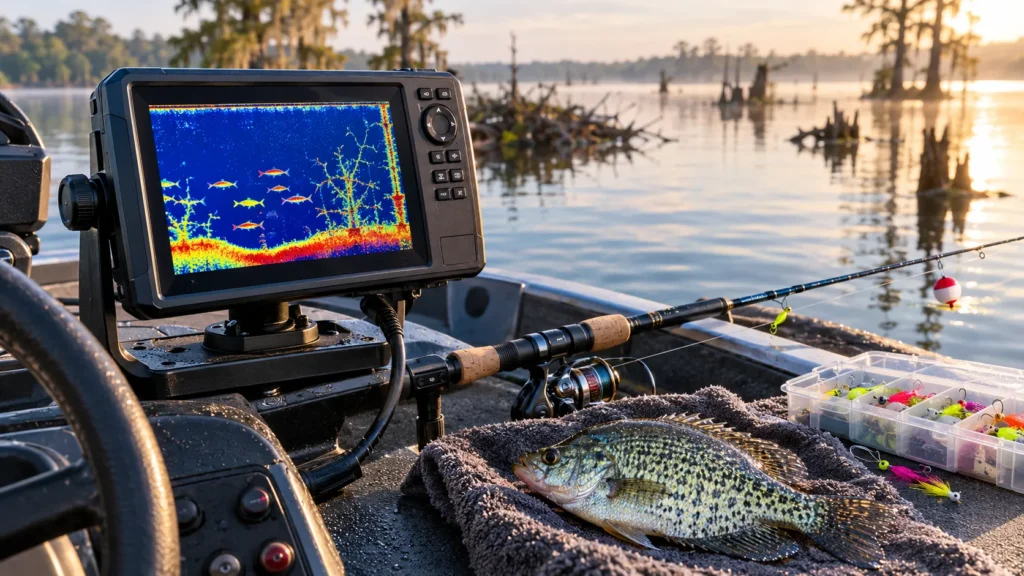
Finding suspended slabs requires gear that reads subtle structure shifts and tight fish schools. The best fish finder for crappie helps you pinpoint submerged brush piles, dock pilings, and creek channel drops where crappie love to hide.
The best crappie fish finder is one that combines clear side imaging, a readable screen, GPS mapping, and easy controls. For most crappie anglers, the Humminbird XPLORE 12 with CMSI+ GPS is the strongest overall choice because its MEGA+ Side Imaging makes brush piles, standing timber, and suspended schools much easier to identify.
Crappie often hold tight to cover or suspend in loose schools, so a good fish finder for crappie fishing needs to show both structure and fish. This guide compares the best depth finder for crappie fishing by budget, sonar type, screen size, and fishing style—not just by brand name.
Best Crappie Fish Finders – At a Glance
- Humminbird XPLORE 12 with CMSI+ GPS: Editor’s Choice for best Side Imaging sonar to find fish and structure. Features MEGA+ Imaging, a large high-definition screen, built-in LakeMaster maps, and seamless compatibility with MEGA Live 2 and MEGA 360. (If a 12-inch screen is out of your budget, the XPLORE 10 and XPLORE 9 models offer the same great performance).
- Garmin ECHOMAP Ultra 106sv fishfinder: A premier touchscreen unit equipped with a GT56UHD-TM transducer for ultra-clear SideVu, plus full compatibility with Garmin striker LiveScope.
- Lowrance Elite FS 10 Active Imaging 3-in-1: An affordable touchscreen unit providing 3-in-1 imaging and complete compatibility with Active Target live sonar.
- Garmin ECHOMAP UHD2 93sv: A feature-rich, user-friendly budget touchscreen option packed with SideVu, DownVu, built-in fish finders and GPS, maps, traditional CHIRP, and LiveScope readiness.
- Lowrance Eagle 7 TripleShot HD: The top budget side-scan choice featuring innovative “Fish Reveal” technology that superimposes fish arches directly onto your down-imaging screen.
- Humminbird HELIX 7 CHIRP DI Sonar/GPS G3N: A reliable, compact mid-tier unit featuring Dual Spectrum CHIRP, Down Imaging, internal GPS with built-in UniMap, and Ethernet networking capabilities for advanced boat setups.
What Is the Best Fish Finder for Crappie Fishing?
Choosing the ideal unit comes down to balancing display clarity, transducer frequency, and mapping tools. Crappie spend significant time suspended around deep timber, bridge pilings, and brush piles. Standard 2D sonar tells you the bottom depth, but modern imaging technologies let you count individual branches and spot crappie holding tight to cover.
TOP 7 Best Portable Fish Finder Picks to Consider
Best Budget Fish Finder for Crappie
Anglers looking for maximum value without breaking the bank should look at units like the Lowrance Eagle 7 TripleShot HD. It delivers side-scan capabilities and uses smart processing to lift fish graphics straight off heavy clutter, making it easy to identify schools hovering near sunken brush.
Best Fish Finder for Crappie with Side Imaging
When you need to cover water fast, side imaging is mandatory. The Hummingbird XPLORE 12 with CMSI+ GPS shines here. It paints a vivid picture up to 200 feet to the left and right of your boat. You can spot submerged brush piles before you even drive over them, saving valuable fishing time.
Best Live Sonar for Finding Crappie
Best sonar for crappie fishing: If your primary goal is vertical jigging or watching fish chase a presentation in real time, live sonar changes everything. The Garmin ECHOMAP Ultra 106sv paired with LiveScope tracking lets you watch individual crappie move out of a brush pile to inhale your jig.
What Features Matter Most in a Crappie Fish Finder?
Screen resolution, processor speed, and transducer quality dictate your success on the water. A crisp display ensures you can easily differentiate between a dense root ball and a school of crappie in bright sunlight. when you buy your first fish finder, look for units equipped with intuitive touchscreen controls and physical keypad backups so you can operate the device smoothly with wet or cold hands. Additionally, built-in GPS and high-definition inland lake mapping let you save productive waypoint trails over secret brush piles year after year.
CHIRP vs. Down Imaging vs. Side Imaging for Crappie
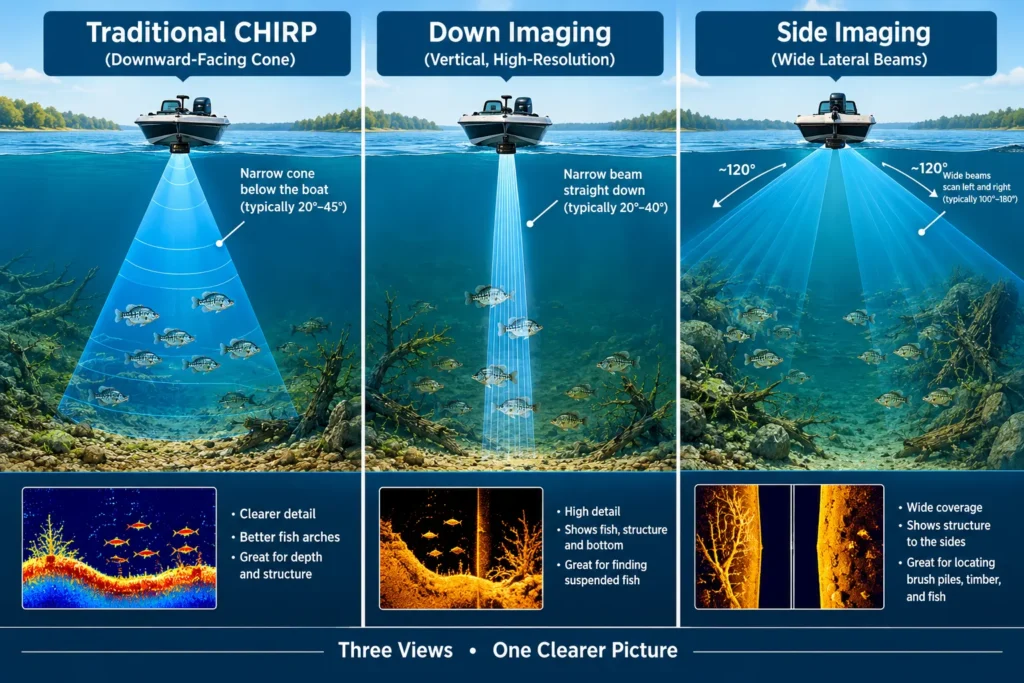
Understanding your sonar frequencies dictates how effectively you scan water. Traditional CHIRP sends a continuous sweep of frequencies to yield crisp arches of fish targets. Down imaging uses high-frequency sound waves to create a photo-like slice of the water column beneath your hull. Side imaging expands that picture laterally. For crappie anglers, side imaging finds the structure, down imaging confirms the school size, and traditional CHIRP tracks your bait depth.
Is Live Sonar Worth It for Crappie Fishing?
Live sonar offers an unmatched view of underwater behavior. While traditional sonar shows history—what you just passed over—live sonar streams real-time movement. You see your jig descending into the structure and watch how crappie react. For tournament anglers or dedicated brush-pile hunters, live sonar drastically shortens the search cycle. However, weekend anglers on a budget can still catch plenty of fish using standard down and side imaging.
Best Fish Finder Screen Size for Crappie Fishing
Best fish finder for finding crappie – Screen size impacts how much split-screen data you can view comfortably.
- 7-Inch Displays: Excellent for compact boats, kayaks, or bow setups where space is limited.
- 9 to 10-Inch Displays: The sweet spot for most crappie fishermen. They allow you to run split-screen views showing map navigation, 2D sonar, and down imaging simultaneously without feeling cramped.
- 12-Inch Displays and Up: Ideal for captains running multiple sonar feeds or utilizing complex live-imaging windows alongside mapping tools.
How to Find Crappie Using a Fish Finder
Locating crappie changes depending on the season. During the spring spawn, use side imaging to scan shallow creek arms, boat docks, and laydowns. In the summer and winter, move to deep-water channels, bridge columns, and submerged brush piles. Drive slowly over likely spots, keep your eyes locked on your side scan, and drop a waypoint the second you spot fish holding near vertical cover.
Best Fish Finder Settings for Locating Crappie Schools
Fine-tuning your fishing electronics maximizes target separation. Turn off automated noise rejection if it filters out too many faint fish returns. Adjust your sonar frequency: higher frequencies give clearer details of structure, while lower frequencies penetrate deeper water. Set your color palette to a high-contrast theme (like amber or blue) so suspended fish arches pop cleanly against the background clutter.
Choosing a Fish Finder for a Boat, Ice, or Kayak Fishing
Your vessel dictates your power needs and transducer mounting style.
- Jon Boats & Aluminum Rigs: Transom-mount or portable suction-cup transducers work seamlessly.
- Kayaks: Side-scan units require careful placement so your hull or paddle does not block the transducer beam.
- Ice Fishing: Portable shuttle setups featuring high-resolution CHIRP sonar let you monitor your jig drop directly through a hole in the ice.
Frequently Asked Questions About Crappie Fish Finders
Can a fish finder show individual crappie?
Yes. High-frequency CHIRP sonar, down imaging, and live sonar display distinct fish arches or dots, allowing you to pick out individual crappie hanging around heavy cover.
Is side imaging or down imaging better for crappie?
They serve different purposes. Side imaging is superior for searching a wide area to find hidden brush piles, while down imaging excels at showing precise depth and school density directly beneath your boat.
Do you need GPS to find crappie?
While GPS does not find fish directly, it is essential for marking and saving productive brush piles, creek channels, and waypoint trails so you can return to exact spots on future trips.
Conclusion
What is the best fishfinder for crappie fishing? Finding crappie on fish finder and catching consistent limits of fish relies heavily on understanding how to interpret underwater structure and fish behavior. Investing in the best fish finder for crappie trolling transforms guesswork into a precise science, letting you locate suspended schools hiding deep inside timber or around isolated dock pilings. By balancing your budget, screen size requirements, and preferred fishing style—whether you rely on sweeping side scans or real-time live sonar—you equip yourself to spend less time searching and more time reeling in quality fish on every trip.
You will also love:
- The Complete Guide To How Often Do Catfish Lay Eggs (Explained)
- When Do Crappie Spawn? Best Time, Water Temp & Tips