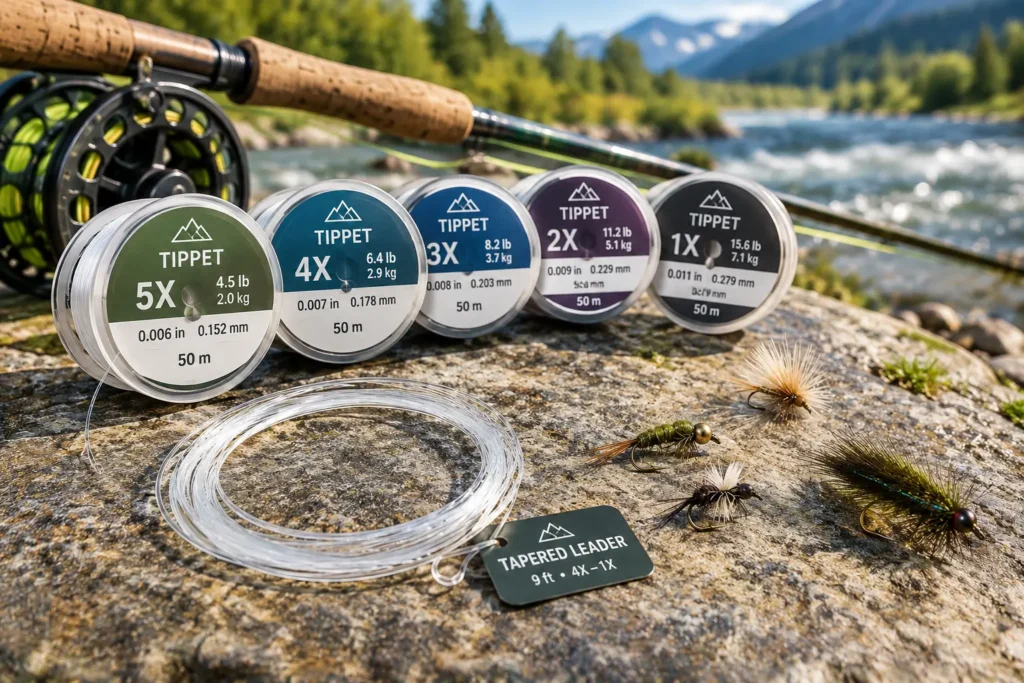
A Fly fishing tippet is the thin section of fishing line tied between your leader and your fly. It ties directly to your fly, presenting your fly naturally without scaring fish or sacrificing line strength.
If you have ever stood in a fly shop staring at spools labeled 3X, 5X, or 7X, you know how confusing line selection can feel. Choosing the wrong tippet leads to dragged flies, snapped lines, and missed strikes. This complete guide breaks down tippet various sizes, materials, and rigging techniques so you can fish with confidence every time you step into the water.
What Is a Fly Fishing Tippet and Why Do You Need One?
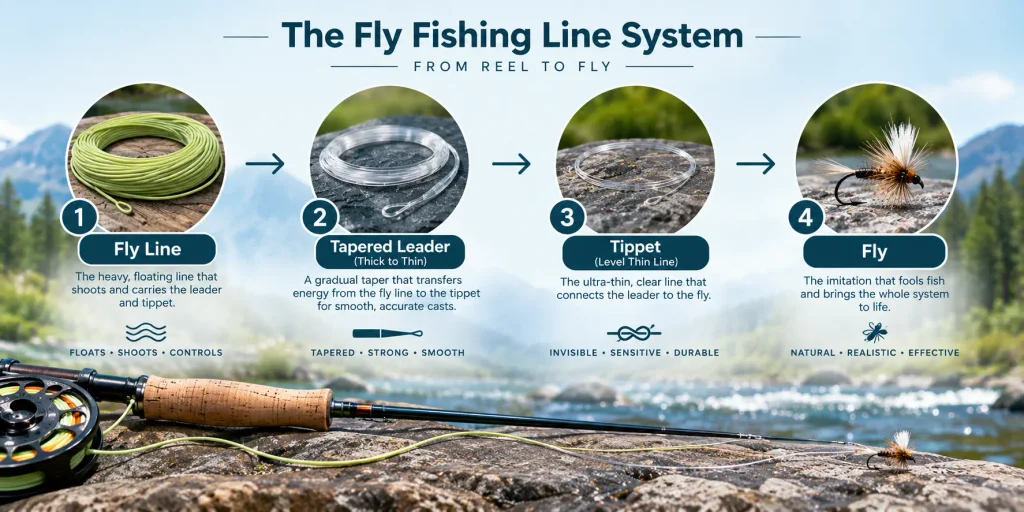
To understand a tippet, you first need to look at how a fly line rig works from your reel to your hook.
Your thick, heavy fly line delivers the energy needed to cast light flies. Attached to that fly line is a tapered fly leader, which starts thick at the fly line end and gets thinner toward the fly. The tippet is the final, level piece of light fishing line tied between the small end of the tapered leader and your fly.
Tippet vs Leader: Understanding the Difference
Many anglers confuse tippet vs leader or wonder why both are necessary. Here is a clear breakdown of tippet vs leader fly fishing dynamics:
- Fly Leader: A 7.5 to 12-foot line designed to transfer energy smoothly during a cast. Leaders taper continuously down to a thinner diameter.
- Fly Fishing Tippet: A level, non-tapered section of line (usually 1.5 to 3 feet long) tied onto the end of the leader.
| Feature | Fly leader | Tippet |
|---|---|---|
| Shape | Usually tapered | Usually level |
| Main purpose | Transfers casting energy and helps turn over the fly | Connects the fly securely and allows easy replacement |
| Typical form | Ready-made leader or hand-built sections | Line supplied on a spool |
| When to replace | When shortened, damaged, or no longer suitable | When worn, too short, or damaged |
Why You Need Tippet?
- Saves Your Leader: Every time you change a fly, you cut off a small piece of line. If you tie flies directly to a tapered leader, you quickly cut into the thick section, ruining the taper. Adding a tippet lets you cut and retie without shortening your main leader.
- Improves Presentational Stealth: The thin diameter of fishing tippets remains invisible in clear water, preventing spooked fish.
- Ensures Natural Drift: A fine tippet stays supple, allowing your fly to drift freely on current seams without stiff line pulling it unnaturally (drag).
Visual Suggestion: Infographic showing a step-by-step breakdown of a fly line setup: Fly Line → Butt Section → Tapered Leader → Tippet Ring/Knot → Tippet → Fly.
Fly Fishing Tippet Size Chart: How to Choose the Right Tippet Size
Fly fishing uses an “X” rating system to measure tippet size. The higher the X number, the thinner the tippet. For example, 0X is thick and strong, while 7X is whisper-thin and delicate.
To quickly estimate the physical diameter of any X size in thousandths of an inch, use the Rule of 11:
$$\text{Diameter (in inches)} = \frac{11 – X}{1000}$$
For example, for a 4X tippet: $11 – 4 = 7$, which equals 0.007 inches.
Fly Fishing Tippet Size Chart
| Tippet Size (X) | Line Diameter (Inches) | Approx. Breaking Strength (lbs) | Common Fly Sizes | Target Species |
| 0X | 0.011″ | 12 – 15 lbs | #2 – #1/0 | Steelhead, Bass, Large Streamers |
| 1X | 0.010″ | 10 – 12 lbs | #4 – #8 | Large Bass, Pike, Trophy Trout |
| 2X | 0.009″ | 8 – 10 lbs | #6 – #10 | Large Streamers, Bass Flies, Salmon |
| 3X | 0.008″ | 6 – 8 lbs | #8 – #12 | Heavy Nymphs, Large Dry Flies, Hopper-Droppers |
| 4X | 0.007″ | 5 – 6 lbs | #12 – #16 | Standard Nymphs, Medium Dry Flies, Streamers |
| 5X | 0.006″ | 4 – 5 lbs | #14 – #18 | Standard Trout Dry Flies, Small Nymphs |
| 6X | 0.005″ | 3 – 3.5 lbs | #18 – #22 | Micro Nymphs, Midges, Small Dry Flies |
| 7X | 0.004″ | 1.5 – 2 lbs | #22 – #28 | Tiny Midges, Ultra-Clear Spring Creeks |
Pro Tip on Breaking Strain: What pound test is 4x tippet? Standard nylon 4X tippet tests around 5 to 6 pounds, though modern premium fluorocarbons can test higher for the same diameter.
Nylon vs. Fluorocarbon Tippet: Which Is Better?
Choosing between nylon vs. fluorocarbon tippet comes down to water depth, fishing style, and budget. Both materials serve specific roles on the water.
| Feature | Nylon monofilament | Fluorocarbon |
|---|---|---|
| Flexibility | Generally more flexible | Often stiffer at comparable diameters |
| Sinking behavior | Generally floats more readily | Sinks more readily |
| Abrasion resistance | Good, depending on the product | Often strong and abrasion-resistant |
| Stretch | Generally more stretch | Generally less stretch |
| Visibility | Clear, but still reflects light | Refractive index closer to water, but not invisible |
| Cost | Usually less expensive | Usually more expensive |
| Common use | Dry flies and general fishing | Nymphs, subsurface flies, and rocky water |
       NYLON TIPPET                      FLUOROCARBON TIPPET
┌──────────────────────────┐        ┌──────────────────────────┐
│ • High Flexibility       │        │ • High Density (Sinks)   │
│ • Floats Naturally       │        │ • Nearly Invisible       │
│ • Strong Knot Strength   │        │ • High Abrasion Resistance│
│ • Budget-Friendly        │        │ • Long-Lasting (UV Resistant)│
└────────────┬─────────────┘        └────────────┬─────────────┘
             │                                   │
             ▼                                   ▼
      BEST FOR: Dry Flies                 BEST FOR: Nymphs & Streamers
Nylon Tippet
Nylon monofilament remains the traditional choice for anglers. It is lightweight, flexible, and affordable.
- Flexibility: Highly supple. Allows dry flies to drift naturally across varied currents.
- Sinking Behavior: Floats or sinks very slowly. Perfect for surface presentations.
- Abrasion Resistance: Moderate. Scratches more easily on sharp rocks or teeth.
- Best Uses: Dry fly fishing, emergency top-water rigs, and budget-friendly setups.
Fluorocarbon Tippet
Fluorocarbon tippet consists of dense fluoropolymer compounds that provide specific performance advantages underwater.
- Flexibility: Stiffer than nylon, helping turn over heavy flies or multi-fly rigs.
- Sinking Behavior: Sinks fast because its density outweighs water.
- Invisibility: Refracts light at almost the precise same index as water, making it virtually invisible to wary fish.
- Abrasion Resistance: High. Withstands dragging across rocks, timber, and gravel.
- Best Uses: Nymphing, streamer fishing, crystal-clear spring creeks, and targeting abrasive-jawed fish.
Quick Comparison: Nylon vs. Fluorocarbon
| Feature | Nylon Monofilament | Fluorocarbon |
| Water Column | Surface / Dry Flies | Subsurface / Nymphs & Streamers |
| Invisibility | Moderate | Extreme |
| Abrasion Resistance | Fair | Excellent |
| UV Degradation | Degrades over time in sun | Completely UV resistant |
| Cost | Budget-friendly ($5 – $10/spool) | Premium ($15 – $30/spool) |
How to Match Tippet Size to Your Fly and Target Fish
Matching tippet size requires balancing two goals: turning over the fly smoothly and keeping the line hidden from fish.
If your tippet is too thick, your fly won’t drift naturally. If it is too thin, the fly will helicopter during your cast, tangling your leader and snapping on the hook set.
Use the Rule of 4 to quickly match your fly size to the proper X rating:
$$\text{Tippet Size (X)} = \frac{\text{Hook Size}}{4}$$
- Example 1: Hook Size #16 $\rightarrow 16 \div 4 = \text{4X Tippet}$
- Example 2: Hook Size #20 $\rightarrow 20 \div 4 = \text{5X Tippet}$
Note: If the result lands between sizes, round up for clear water or down for heavy cover.
Key Factors Influencing Tippet Selection
- Water Clarity: In gin-clear spring creeks, drop down one X size (e.g., from 5X to 6X) or switch to fluorocarbon tippet.
- Current Speed: Fast, churned water hides thicker lines. Heavy currents allow you to use 4X instead of 5X for added strength.
- Fish Size & Fighting Power: Fighting 20-inch trout in woody debris requires 3X or 4X tippet, even if the fly size calls for 5X.
- Fly Weight: Heavy tungsten-bead nymphs and bulky streamers demand stiff 0X–3X line to roll over properly during the cast.
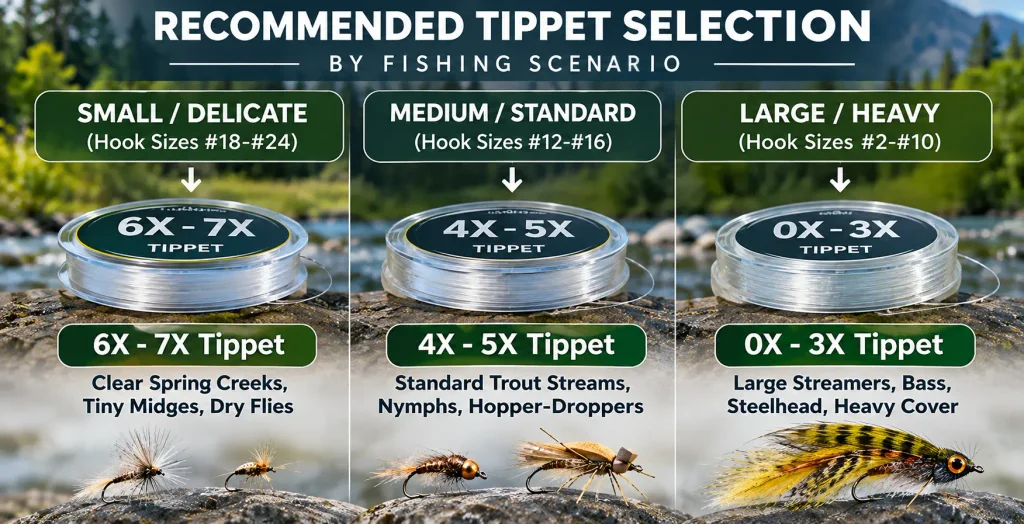
What Tippet Size Is Best for Trout Fly Fishing?
For many trout anglers, 5X tippet serves as the ultimate all-around choice, and for everyday situations.
- 4X: A practical choice for larger dry flies, bigger nymphs, moderate currents, and situations where strength matters.
- 5X: A versatile starting point for average trout fishing, including many dry flies and nymphs.
- 6X: Useful for small flies, clear water, and wary trout that may reject heavier line.
Move up to a thicker tippet when you need better control around cover or when a large fly struggles to turn over. Move finer when your fly is small and fish are refusing a presentation that otherwise looks right.
Do not select the thinnest line just because you can. Very fine tippet increases the risk of break-offs and makes knot handling more demanding.
How Long Should a Fly Fishing Tippet Be?
The average fly fishing tippet length ranges from 2 to 4 feet.
When building or repairing a leader, aim for your final setup (tapered leader + attached tippet) to match or slightly exceed the length of your fly rod. For an 8.5-foot or 9-foot rod, a 9-to-11-foot total leader system is standard.
| Fishing situation | Starting tippet length | Why |
|---|---|---|
| Small, brushy stream | 12–18 inches | Easier control in tight spaces |
| General trout fishing | 18–24 inches | A practical balance of presentation and convenience |
| Clear, slow water | 24–36 inches | Can help keep thicker leader sections farther from the fly |
| Nymph fishing | 18–30 inches | Adjust to depth, rig design, and current |
| Large streamers | Often shorter | Helps transfer energy to bulky flies |
Adjusting Tippet Length for Conditions
- Deep Nymphing Rigs (3 to 5 feet of tippet): Longer tippet lets your weighted flies drop quickly through top currents without getting pulled by the main line.
- Dry Fly Fishing (2 to 3 feet of tippet): Provides enough slack to prevent surface drag while maintaining accurate turnover.
- Windy Days or Streamer Rigs (1.5 to 2 feet of tippet): Shorter tippet punching through heavy winds prevents frustrating bird’s nests and knots.
How to Tie Tippet to a Leader and Attach a Fly
Connecting nylon or fluorocarbon lines requires secure knots that maintain high line strength. Here are three essential leader and tippet knots every fisherman needs:
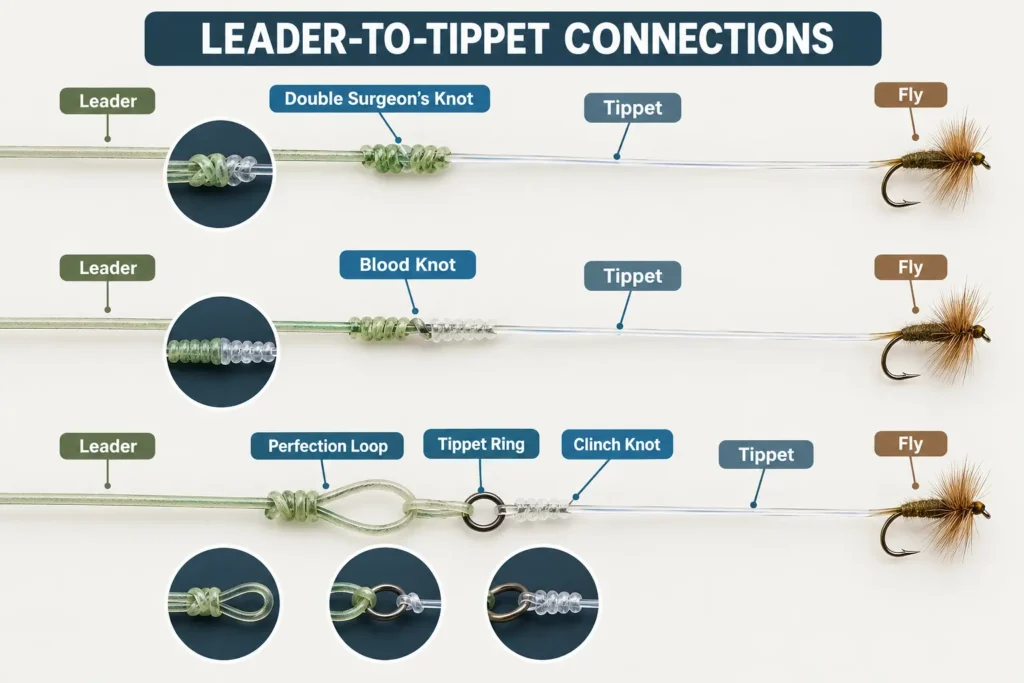
1. Connecting Tippet to Leader
- Double Surgeon’s Knot: The easiest and fastest knot for tying tippet to a leader. Works exceptionally well when joining lines of slightly different diameters.
- Blood Knot: Creates a slim, inline connection that glides effortlessly through rod guides. Best used when connecting lines of similar thickness.
- Tippet Rings: Small, seamless stainless-steel rings tied to the end of your tapered leader. Tie your leader to the ring, then tie 2 to 3 feet of tippet to the other side. Using tippet rings prevents your leader from ever shortening when changing tippet.
2. Attaching the Fly
- Improved Clinch Knot: The standard knot for securing flies to tippet. Reliable, strong, and quick to tie.
- Non-Slip Loop Knot: Creates an open loop at the hook eye, allowing streamers and wet flies to swim freely with increased action.
Crucial Tip for Knot Strength: Always moisten your knots with water or saliva before pulling them tight. Friction creates heat, which weakens line strength and causes early knot failure on big fish.
When Should You Replace or Add More Tippet?
Inspect your tippet regularly during your time on the water. Replace or rebuild your tippet whenever you notice these signs:
- Visible Abrasion or Fraying: Run the line through your fingers. If you feel rough spots, wind abrasion, or teeth scratches, replace it immediately.
- Wind Knots: Accidental overhand knots caused by casting errors cut line strength in half. Cut the line and tie a fresh piece.
- Shortened Length: Re-tying flies gradually shortens your tippet. Once your tippet drops below 1.5 feet, cut back to the leader taper and rebuild it.
- Tippet material Mismatch: When switching from top-water dry flies to deep nymphs, replace floating nylon with sinking fluorocarbon.
Common Fly Fishing Tippet Mistakes to Avoid:
- Stepping Down Too Abruptly in Line Size: Never tie 6X tippet directly to a thick 2X leader section. The sudden jump in diameter prevents the knot from seating correctly and creates severe casting hinge points. Step down gradually (e.g., 3X leader butt to 4X tippet, then 5X).
- Using Old, UV-Damaged Nylon Spools: Nylon exposed to direct sunlight and heat inside hot vehicles breaks down rapidly. Test old spools with a sharp pull before tying them to your rig.
- Tightening Knots Dry: Pulling monofilament tight without lubrication damages the line surface, cutting breaking strength by up to 30%.
- Over-Sizing Tippet for Wary Fish: Using heavy 3X tippet on calm, clear water startles educated trout. Match your tippet to water clarity and fly size.
Frequently Asked Questions About Fly Fishing Leader and Tippet
What is the difference between tapered leader vs tippet?
A tapered leader starts thick at the fly line connection and gradually tapers down to a thin end over 7.5 to 12 feet. Tippet is a uniform, level strand of thin line (1.5 to 3 feet) tied onto the end of that tapered leader to hold your fly.
Can I fly fish without tippet?
Yes, you can tie flies directly to the thin end (tippet section) of a brand-new tapered leader. However, every time you change flies, you cut away line, shortening the leader and destroying its taper. Adding a separate tippet preserves your leader investment.
What pound test is 4X tippet?
Standard 4X nylon tippet usually tests at 5 to 6 pounds of breaking strength, with a uniform diameter of 0.007 inches.
Is fluorocarbon tippet worth the extra cost?
Yes, especially for underwater nymphing, streamer fishing, and clear water setups. Fluorocarbon resists abrasion, sinks faster, and stays nearly invisible underwater. For surface dry flies, affordable nylon tippet remains the superior choice.
What is the best tippet size for beginners?
A 4X or 5X tippet paired with a 9-foot 4X tapered leader is ideal for trout beginners. This versatile setup easily handles standard dry flies, hopper-droppers, and nymph setups without tangling excessively.
How do tippet rings work?
Tippet rings are tiny, polished metal rings tied to the thin end of a tapered leader. You tie your leader directly to the ring using a Clinch Knot, then tie your fresh tippet line to the other side of the ring. This stops you from constantly cutting into your main leader.
How much tippet should I add to my leader?
Add roughly 2 to 3 feet of tippet to your tapered leader for standard fishing. For deep nymphing setups, extend that length to 4 or 5 feet to help flies sink fast.
What does the “X” mean in fly fishing tippet ratings?
The “X” rating system measures line diameter in thousandths of an inch. Subtract the X number from 11 to get the line diameter in thousandths of an inch (e.g., $11 – 5 = 6$, or 0.006 inches for 5X). Higher X numbers mean thinner, lighter line.
How often should I change my tippet?
Change your tippet when it gets shorter than 1.5 feet, shows visible abrasions, develops wind knots, or when changing to significantly different fly sizes.
Can I mix nylon tippet with a fluorocarbon leader?
Yes. Tying fluorocarbon tippet to a nylon leader works well for nymphing. Use a Double Surgeon’s Knot or a tippet ring to ensure a strong connection between the two materials.
Conclusion
Mastering fly fishing tippet selection boils down to matching your line diameter to your fly size and stream conditions. Keeping spools of 3X through 6X nylon and fluorocarbon in your vest ensures you can adapt to any hatch or water clarity level. Check your line regularly for wind knots and abrasion, lubricate your knots before pulling them tight, and consider using tippet rings to preserve your tapered leaders. By choosing the correct tippet size and material for each scenario, you will deliver natural, drift-free presentations that trigger more strikes and land more fish. Ready to hit the water? Pack your tippet spools, tie on your favorite pattern, and enjoy seamless casting on your next fly fishing adventure.
You might also love: