
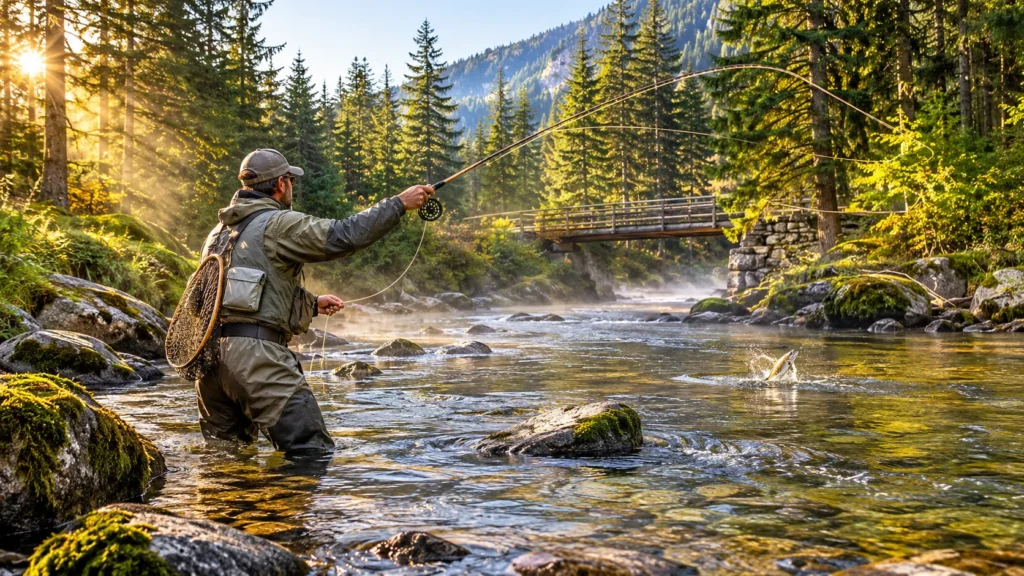
Fly fishing in Germany is a rewarding mix of clear mountain streams, wild forest creeks, productive lowland rivers, and scenic stillwaters. You can fish for brown trout and grayling in Bavaria, target trout in the Black Forest, chase pike on larger rivers, or plan a Baltic coast trip for sea trout.
Germany is not one single fishing system. Each of its 16 federal states sets its own rules, while local clubs, municipalities, and fishing-rights holders control access to most individual waters. Before you go fishing, confirm both the state-level fishing license requirement and the permit for your chosen stretch of water.
Why Go Fly Fishing in Germany?
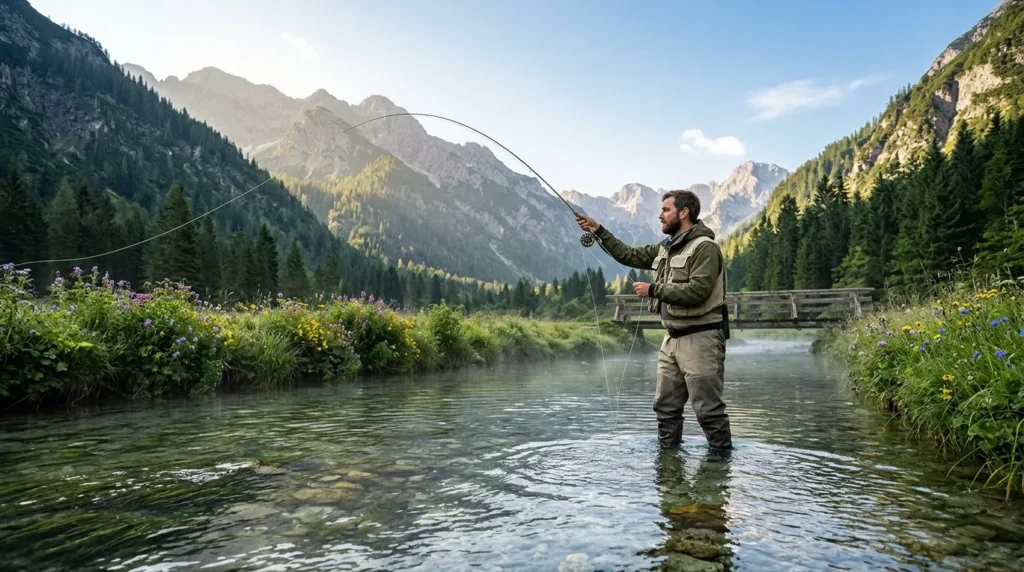
Germany is one of Europe’s most accessible fly-fishing destinations. It combines excellent infrastructure, picturesque mountain valleys, historic towns, reliable roads and rail links, and a surprising variety of fishing opportunities within a few hours’ drive.
The country is especially strong for trout fishing. Brown trout are widespread in clean rivers and streams, while grayling thrive in many larger, cooler river systems.
In parts of Bavaria and Baden-Württemberg, anglers may also encounter huchen—also called Danube salmon or Hucho—though these powerful fish are strictly protected and should only be targeted where local rules clearly allow it.
For a visiting angler, Germany offers something rare: you can spend a morning casting a dry fly to rising trout in an alpine creek, then spend the evening in Munich or a small Bavarian village. Fly fishing in Munich is particularly convenient because the Isar, surrounding lakes, and nearby Bavarian rivers place good water within reach of an international airport.
Best Places for Fly Fishing in Germany
The best fly fishing destinations in Germany depend on the experience you want. Alpine anglers should prioritize Bavaria; anglers who enjoy intimate streams should look at the Black Forest; anglers seeking bigger water, reservoirs, and varied species should consider the Harz.
The Bavarian Alps and Mountain Streams
Fly fishing in Bavaria is Germany’s best-known alpine experience. The Bavarian Alps hold beautiful trout streams fed by snowmelt, with clear water, fast currents, and dramatic mountain scenery.
Look at the Isar, Loisach, Ammer, Lech, Inn, and Traun systems. The Loisach near Garmisch-Partenkirchen is especially known for trout and grayling in clear alpine water, although access can be tightly controlled and fly-only rules may apply.risedaisy
The Traun in the Chiemgau region is another strong choice. It supports brown trout, rainbow trout, and grayling, making it a valuable destination for anglers who want a mix of species rather than a single-species trip.
Best for: German alpine fly fishing, wild brown trout, grayling, scenic valleys, and guided day trips.
The Black Forest and Its Trout Rivers
Fly fishing in the Black Forest—Schwarzwald in German—suits anglers who enjoy small water, overhanging trees, and technical presentations. Many streams are narrow, fast, and shaded, so accurate short casts matter more than long distance.
The Gutach, Nagold, Enz, Murg, and Kinzig systems are worth researching. The Nagold, for example, is a Black Forest tributary with mixed brown trout and some rainbow trout, while grayling may be available under local rules.
This is classic fishing in the Black Forest: wade carefully, keep a low profile, and fish a compact fly box built around nymphs, small dries, and terrestrials. A 5-weight rod is usually ideal because it handles both small-stream work and occasional wind.
Best for: Wild-feeling creeks, brown trout, short-range nymphing, and quiet forest fishing.
The Harz Mountains and Central Germany
The Harz Mountains, on the border of Lower Saxony, Saxony-Anhalt, and Thuringia, offer a different kind of German fishing. The region combines mountain streams, reservoirs, and historic mining landscapes.
The wild Bode is a standout for fly anglers, while the Oder Reservoir near Bad Lauterberg holds trout, pike, zander, carp, and eel. The Upper Harz ponds are also popular; a special permit covers around 40 selected ponds, generally available as one-day or three-day tickets. harzinfo
Nearby, the Ruhr in the Sauerland offers a useful example of managed fly water. Around Bestwig, the municipality provides roughly 2 km of Ruhr river sections for visiting fly anglers, with day permits, a June-to-mid-September season, and limits on trout and grayling.
The Eder is another central-German option. A section between Affoldern Lake and Edersee is designated for flyfishing only, and permits can be arranged through the Kellerwald-Edersee Nature Park.
Best for: Reservoir fishing, wild Bode water, pike, carp, and a mix of river and stillwater fishing.
Best Fish Species to Catch on the Fly in Germany
Germany has a broad range of freshwater species, but your realistic targets depend on the river, region, season, and permit.
| Species | Where to target it | Fly-fishing potential |
|---|---|---|
| Brown trout | Bavarian streams, Black Forest creeks, Harz rivers | Excellent; the classic German trout target |
| Grayling | Larger cool rivers, including Bavarian systems | Excellent; often responsive to nymphs |
| Rainbow trout | Stocked and managed rivers, some Bavarian waters | Good; check whether the water is stocked |
| Brook trout | Selected cold upland or managed waters | Possible, but water-specific |
| Char | Deep, cold alpine lakes and some managed fisheries | Seasonal and location-specific |
| Pike | Larger rivers, reservoirs, lakes | Excellent with streamers |
| Chub and barbel | Lowland and mid-sized rivers | Good on nymphs, dries, and streamers |
| Carp | Lakes, canals, and slow river sections | Possible with careful stalking |
| Huchen / Danube salmon | Danube-basin rivers, especially Bavaria and Baden-Württemberg | Highly regulated; confirm rules first |
| Sea trout | Baltic coastal rivers and coastal waters | Strong seasonal option in northern Germany |
Brown trout and grayling are the core targets for most visiting fly anglers. Brown trout and grayling often share the same rivers, but their closed seasons and minimum sizes can differ, so read the permit carefully.

Huchen, or Danube salmon, deserve special respect. They are native to the Danube basin and occur in systems including the Inn and Isar, but they are protected fish; never assume you may target, hook, or retain one without explicit local authorization.
Best Time of Year for Fly Fishing in Germany
The best fly fishing Germany seasons depend on elevation, species, and local rules. In general, late spring through early autumn offers the most reliable conditions, while winter can be productive for grayling in selected lowland rivers.
– Spring Fly Fishing
Spring is excellent for trout fishing in Germany. As water temperatures rise, trout become more active, insects hatch more consistently, and dry fly fishing becomes possible on many rivers.
Early spring can still be cold, especially in the Bavarian Alps and Black Forest. Snowmelt may turn mountain streams high and colored, so flexible plans are important. Lower-elevation rivers often fish better first.
– Summer and Early Fall Fishing
Summer is the most dependable time to go flyfishing in Germany. Long days, stable water, and active trout make it ideal for a first trip, particularly for anglers visiting from outside Europe.
Early fall is also strong. Trout feed heavily before cooler weather, terrestrial patterns can work well, and grayling fishing often improves as temperatures drop. In Bavaria, practical guided-season windows are often reported as roughly early May to mid-July and early September to mid-November, but these are not universal rules—always confirm with the water’s rights holder.
German Fly Fishing Rules, Licenses, and Permits
Can Americans fish in Germany? U.S. citizens can fly fish in Germany, and the country offers excellent opportunities to catch trout, grayling, and other freshwater species. Rivers, mountain streams, and alpine lakes provide beautiful settings for fly fishing. However, American anglers must follow German fishing laws, which differ from state to state (Bundesland).
The most important requirement is obtaining the appropriate German fishing license (Fischereischein) or an accepted tourist fishing permit. You also need permission to fish the specific river, lake, or stream, usually through a local fishing permit called an Angelkarte. Some states offer special arrangements for foreign visitors.
This is the most important section for international anglers. Germany does not have one simple national fishing license that works everywhere. Instead, fishing is regulated by 16 federal states, and each water may have additional rules.
Understand the two documents
Most anglers need:
- A fishing license (Fischereischein): the state-level certificate or tourist authorization.
- A fishing permit (Erlaubnisschein or Angelkarte): permission for the specific river, lake, pond, or reservoir.
- Proof of the fishing fee where required: some states require a separate annual fee or levy.
In Bavaria, for example, anglers must carry a valid fishing license and, as a rule, a valid water permit. Bavaria generally requires an examination for a standard license, although eligible non-resident tourists may apply for a tourist license without taking the Bavarian exam.
German fishing license for tourists
Americans can fly fish in Germany, and the country offers excellent opportunities to catch trout, grayling, and other freshwater species.
A German fishing license for tourists is available in several states, but the rules differ. In Bavaria, the annual tourist license is for adults who do not live in Germany and is valid for no more than three months per year.verwaltung.
Baden-Württemberg offers a tourist fishing license for foreign visitors staying no longer than four weeks. Other states, including Hesse, Mecklenburg-Vorpommern, North Rhine-Westphalia, Schleswig-Holstein, Thuringia, Saxony, and Rhineland-Palatinate, have their own tourist or guest-license arrangements.
Do not assume a tourist license purchased in one state works in another. Temporary tourist licenses are generally not recognized across state borders.
Practical licensing checklist
Before leaving home:
- Choose your exact fishing region and target water.
- Check the federal state’s license rules.
- Apply for the appropriate tourist or guest license early; guided-trip operators report that applications can take up to two weeks.flyrus
- Buy the water-specific permit from the club, municipality, fishery, or booking platform.
- Save digital copies and carry printed copies.
- Check closed seasons, minimum sizes, bait rules, fly-only sections, and daily catch limits.
- Ask whether barbless hooks, single hooks, or catch-and-release rules apply.
The German Anglers’ Federation, DAFV, maintains a useful overview of nationwide angling regulations and explains that most waters also require a separate permit issued by the owner or leaseholder. dafv
Best Rivers and Lakes for Flyfishing in Germany
Germany has many productive rivers, but these waters are a strong starting point for planning a first trip.
| Water | Region | Why fish it |
|---|---|---|
| Isar | Bavaria, including near Munich | Alpine-influenced river with trout, grayling, and potential huchen; access and rules vary by section |
| Loisach | Bavarian Alps | Clear water, brown trout, grayling, and controlled access |
| Traun | Chiemgau, Bavaria | Strong trout and grayling water with natural reproduction in parts of the system |
| Inn | Bavaria | Larger river with grayling, brown trout, and huchen in the wider system |
| Wiesent | Franconian Switzerland, Bavaria | Classic limestone-influenced trout water |
| Danube | Bavaria and Baden-Württemberg | Major river with varied species and access to Danube-basin fisheries |
| Ruhr | Sauerland, North Rhine-Westphalia | Managed fly-fishing sections with visitor permits |
| Eder | Hesse | Fly-only section near Edersee and productive surrounding water |
| Bode | Harz | Wild-feeling river and one of the region’s best fly-fishing options |
| Oder | Harz | Reservoir and river fishing, with trout, pike, zander, carp, and eel |
| Elbe | Eastern Germany and Saxony | Large-river fishing and access to eastern German fisheries |
| Baltic coastal rivers | Northern Germany | Potential sea trout fishing, subject to coastal and river rules |
The Danube River is especially interesting for anglers who want more than small-stream trout fishing. It is the heart of the huchen’s German range, although anglers should treat the species as a protected highlight rather than a guaranteed target.
For eastern Germany, the Elbe and its tributaries can offer a less crowded alternative to the Alps. Conditions, access, and species vary greatly, so local knowledge matters.
Essential Fly Fishing Gear for German Waters
You do not need an excessive amount of equipment, but German waters reward preparation. A versatile setup will cover alpine streams, forest creeks, and medium-sized rivers.
Recommended rod setup
- 5-weight, 9-foot fly rod: The best all-round choice for trout, grayling, small streamers, and windy conditions.
- 3- or 4-weight rod: Useful for tight Black Forest creeks and small Bavarian tributaries.
- 6- or 7-weight rod: Better for pike, larger rivers, reservoirs, and windier conditions.
- Floating line: Essential for dry fly fishing and light nymphing.
- Sink-tip or intermediate line: Helpful for streamers, deeper pools, and reservoirs.
What to pack
Bring waders, felt-free boots, a landing net, polarized sunglasses, forceps, nippers, tippet, indicators, and a compact fly box. A small selection of nymphs, dry flies, streamers, and terrestrials will cover most situations.
For a typical trout stream, carry:
- Pheasant Tail nymphs
- Hare’s Ear nymphs
- Caddis larvae and pupae
- Blue-winged olive dries
- Elk-hair caddis patterns
- Attractor dries
- Small streamers
- Ants, beetles, and hoppers in late summer
Local fly patterns can outperform generic patterns, especially on heavily guided or club-managed water. Ask your guide or local fly shop which patterns are producing before you tie on.
Popular Fly Fishing Techniques and Patterns in Germany
German fly fishing rewards adaptable tactics. The right method depends on water clarity, flow, depth, and whether fish are feeding on the surface.
Nymphing for trout and grayling
Nymphing is often the most productive approach on German rivers. A small nymph fished beneath an indicator or along a tight line can produce trout and grayling when no visible rise is present.
Use a natural approach in clear alpine water. Longer, finer leaders, subtle indicators, and accurate drifts matter more than aggressive stripping.
Dry fly fishing
Dry fly fishing is excellent during insect hatches, especially in late spring and summer. Look for rising fish in slower seams, eddies, and foam lines.
On smaller creeks, a stealthy approach matters. Stay low, avoid repeated false casts, and make your first cast count.
Streamer fishing for pike and trout
Pike are a great change of pace from trout fishing. Larger rivers, reservoirs, and slower backwaters can hold aggressive fish that respond well to streamers.
Use a 7- or 8-weight setup, wire or heavy fluorocarbon where rules allow, and durable baitfish patterns. Always check whether wire leaders are permitted on the specific water.
Guided Fly Fishing Trips and Local Fishing Clubs in Germany
Fly fishing guides in Germany can save you days of research. A good guide handles permits, access, tactics, equipment, transport, and local rules—particularly valuable when you have only one or two fishing days.
Guided fly fishing trips are especially useful in Bavaria, the Black Forest, and the Harz. Operators such as Flyrus advertise guided trips, beginner instruction, rental equipment, and help with fishing licenses and permits.
Local fishing clubs also matter. In many German regions, the club or leaseholder controls the water, sets visitor rules, and sells the permit. The Eder Fishing Club, for example, controls fishing rights on parts of the Eder, while some stretches are available through the nature park. naturpark-kellerwald-edersee
When choosing a guide, ask:
- Which exact river or lake will we fish?
- Is the permit included?
- Which species are legally targetable that day?
- Is the water fly-only?
- What is the cancellation and weather policy?
- Can you help arrange the tourist license?
- Do you provide rental gear and transport?
Practical Tips for Planning a Fly Fishing Trip to Germany
A successful Germany fly fishing trip depends less on finding a famous river and more on matching the water, season, rules, and travel logistics.
Build a realistic itinerary
If you fly into Munich, focus on Bavaria. The Isar, Loisach, Ammer, Lech, Inn, and Traun systems give you several options within a manageable driving distance.
If you arrive in Frankfurt, consider the Eder, Ruhr, and Black Forest. If you land in Berlin, look toward eastern Germany, the Elbe, Brandenburg lakes, and the Baltic coast for sea trout.
Plan around access
Do not assume a river is public just because it looks accessible. Many German fishing waters are privately controlled or managed by clubs. The permit tells you where you may stand, wade, park, and fish.
Respect local etiquette
Greet other anglers, keep noise low, avoid wading through spawning gravel, and pack out every piece of litter. Many German fisheries have strict rules because pressure on limited water is high.
Where is the best fly fishing around Berlin, Germany?
For anglers based in Berlin, the best nearby options are usually stillwaters, lowland rivers, and day trips toward Brandenburg, Mecklenburg-Vorpommern, or Saxony. Berlin itself has urban fishing opportunities, but fly anglers seeking trout and grayling generally need to travel farther south or east.
For a dedicated trout-focused trip, consider the Harz, Saxony, or Bavaria. For pike, perch, zander, carp, and stillwater fishing, Brandenburg and Mecklenburg-Vorpommern can be more practical. The Baltic Sea also creates opportunities to fish for sea trout, though coastal rules and permits apply.
FAQs
Is there any good fly fishing in Germany?
Yes—Germany has very good fly fishing destinations, especially in Bavaria, the Black Forest, and the Harz. The Traun, Isar, Wiesent, Enz, Bode, and Ruhr offer strong trout and grayling fishing, with clear water, scenic settings, and managed fly-only sections.
Where is the best fly fishing around Berlin, Germany?
The best fly fishing around Berlin is usually outside the city. For trout and grayling, plan a trip to the Harz, Saxony, or Bavaria. For pike, carp, zander, and stillwater fishing, Brandenburg and Mecklenburg-Vorpommern offer more convenient options. The Baltic coast is the best direction for sea trout.
Do I need a license to fly fish in Germany?
Usually, yes. Most German states require a fishing license, and nearly all specific waters also require a separate permit. Bavaria, for example, requires both a fishing license and, as a rule, a permit.
Can tourists get a German fishing license?
Yes, in many states. Tourist licenses are available in places including Bavaria, Baden-Württemberg, Hesse, North Rhine-Westphalia, Schleswig-Holstein, Thuringia, Saxony, and Rhineland-Palatinate, but eligibility, duration, and recognition rules differ.
Is fly fishing in Bavaria good for beginners?
Yes. Bavaria is a strong destination for beginners, especially with a guide. The region has clear water, good infrastructure, and many rivers within reach of Munich, though access rules can be strict.
What fish can I catch fly fishing in Germany?
The most common targets are brown trout, grayling, rainbow trout, pike, chub, barbel, carp, perch, and zander. In the Danube basin, huchen—also called Danube salmon—may be present, but strict protections apply.
When is trout season in Germany?
There is no single nationwide trout season. Closed seasons and minimum sizes are set by each federal state and can differ by species and water. Always check the current rules for your exact river or lake.
Is the Black Forest good for fly fishing?
Yes. The Black Forest is excellent for anglers who enjoy small streams, wild-feeling creeks, and technical brown-trout fishing. The Gutach, Nagold, Enz, Murg, and Kinzig systems are worth researching.
Can I fish for huchen in Germany?
Only where local rules explicitly allow it. Huchen are protected in German waters, and anglers should confirm the legal status, season, gear restrictions, and handling rules before targeting them.
Do I need a guide to fly fish in Germany?
No, but a guide is valuable for a short trip. Guides help with permits, access, fly selection, local rules, and finding productive water. This matters most in Bavaria, the Black Forest, and the Harz.
Is Germany good for sea trout fishing?
Yes, particularly along the Baltic coast and in suitable coastal rivers. Sea trout fishing is seasonal and regulated, so check both the coastal rules and the rules for the river you plan to fish.
What European country has the best fly fishing?
Iceland is often considered Europe’s best fly-fishing country for Atlantic salmon, Arctic char, and sea-run brown trout. Slovenia is a close rival for wild trout and grayling, while Norway, Scotland, and Bosnia also offer exceptional, highly varied fly-fishing opportunities.
Conclusion
Fly fishing in Germany rewards anglers who plan carefully. From Bavarian alpine streams and Black Forest creeks to the Harz, Eder, Ruhr, Danube, and Baltic coast, the country offers a remarkable variety of water within a compact travel area. Brown trout and grayling remain the most dependable targets, while pike, carp, chub, barbel, and sea trout add variety for anglers who want more than a standard trout trip.
The biggest difference between a frustrating trip and a memorable one is paperwork. Secure the correct German fishing license for tourists, buy the permit for your exact water, and confirm the season, fly-only rules, and species restrictions before you travel. With a 5-weight rod, a practical fly box, and a local guide or club contact, fly fishing in Germany can become one of Europe’s most enjoyable and accessible fly-fishing experiences.
You might also like:
- Is Fly Fishing Hard To Learn? (Not With This Quick Guide!)
- Do You Need A Tapered Leader For Fly Fishing? (Explained)
- How Much Do Fly Fishing Guides Make? (The Real Numbers)
- Can You Fly Fish In A Pond? Must-Read (Tips & Hacks)
- Best Time To Fly Fish In Colorado – 13 Things (Should-Know)
- What Size Swivel For Trout Fishing? Incl. Affordable Models!
- Are Cicadas Good Fishing Bait? Does It (Really Work!)
- What Size Line For Trout Fishing? (Incl. AFFORDABLE Models!)
- Top 10 Best Fly Reel Under 200$ (Incl. Affordable Models!)
- How Does Flying Fishing Work: The Only Guide You’ll Ever Need
- What Weight of Fly Rod for Trout Is Best: (No More Guesswork!)