
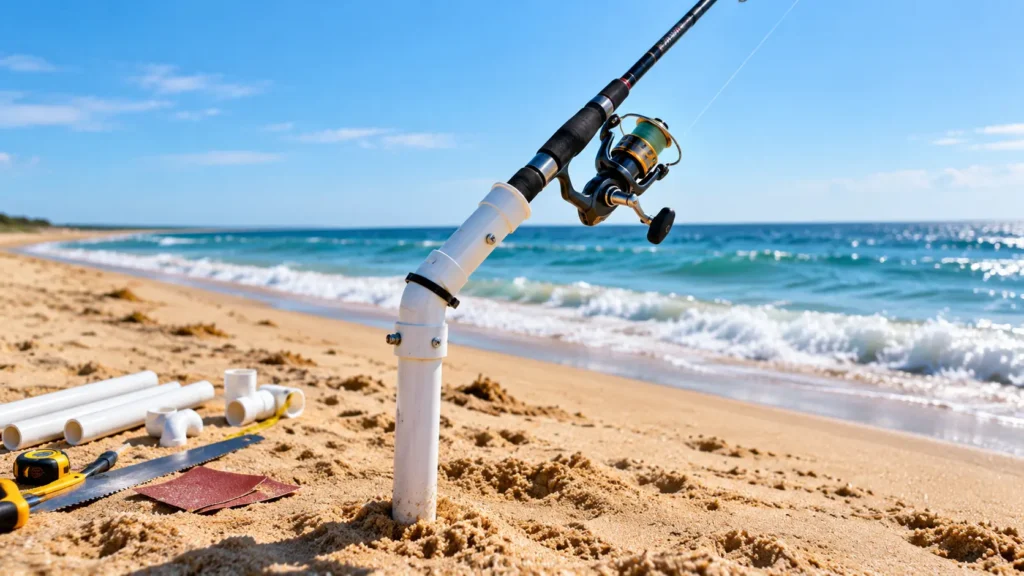
A surf fishing rod holder—often called a sand spike—is a simple tube or post you push into the beach to support your rod while you wait for a bite. The easiest way to make one is to cut a 30–36 inch length of 1.5- or 2-inch PVC pipe, angle one end into a point, smooth the edges, and add a bolt near the top so your rod butt rests securely.surfcastingrepublic+2
This guide shows you how to make surf fishing rod holder designs that cost little, survive salt air, and work in loose beach sand.
Why Make Your Own Surf Fishing Rod Holder?
Making your own DIY sand spike rod holder saves money and lets you match the holder to your rod, beach conditions, and fishing style. A basic homemade beach rod holder needs only PVC pipe, a saw, sandpaper, and a bolt—materials most hardware stores stock.
A DIY PVC surf rod holder also gives you control over the details that matter: pipe diameter, total length, spike angle, and whether you want one rod rest or a multi-rod setup. Store-bought sand spikes work well, but a custom holder can be lighter, longer, or better suited to soft sand.
You can build several cheap surf rod holders from one 10-foot PVC pipe, which makes them ideal backups if a wave pulls one into the surf.
Materials and Tools Needed for a DIY Surf Fishing Rod Holder
For one standard PVC sand spike, gather – DIY surf rod holder
- PVC pipe: 1.5-inch or 2-inch diameter, Schedule 40; buy a 6- or 10-foot length if you want several holders.surfcastingrepublic+2
- PVC saw, hacksaw, or miter saw: For a clean cut.
- Measuring tape and marker: To mark your cut line.
- Sandpaper or a file: To remove burrs and protect your rod blank.
- Stainless-steel bolt, washer, and lock nut: About 2–3 inches long; this creates a stop for the rod butt.fishingzenith+2
- Drill with a bit slightly larger than the bolt: For the rod-stop hole.
- Rubber mallet or small hammer: Helpful for firm sand.
- Optional: PVC end cap, reflective tape, paracord lanyard, or hose clamp.
Use stainless hardware where possible. Salt spray corrodes ordinary bolts quickly, and a rusted bolt can jam or fail after a few beach trips.
How to Choose the Right PVC Pipe for Surf Fishing
The best PVC size depends on your rod’s butt diameter and how much wind or current you expect.
| PVC diameter | Best use | Notes |
|---|---|---|
| 1 inch | Light freshwater-style rods | Too tight for many surf rods |
| 1.5 inches | Most spinning and conventional surf rods | Strong balance of light weight and fit anglerwithin+1 |
| 2 inches | Large surf rods, thick butt sections, loose sand | Heavier but very stable lakemichiganangler+1 |
Choose Schedule 40 PVC rather than thin-wall pipe. It resists cracking better when you drive it into packed sand or gravel. A 1.5-inch pipe fits many rods, while 2-inch pipe gives extra clearance for cork tape, reel seats, and thicker rod butts.reddit+1
Before cutting, test the rod butt in the pipe. You want a snug fit—not so tight that sand jams it, and not so loose that the rod rattles in wind.
How to Make a Surf Fishing Rod Holder Step by Step
This is the simplest No-Weld Aluminum Surf Fishing sand Rod Holder design: one PVC tube, one angled bottom, and one bolt stop.
Step 1: Measure and Cut the PVC Pipe
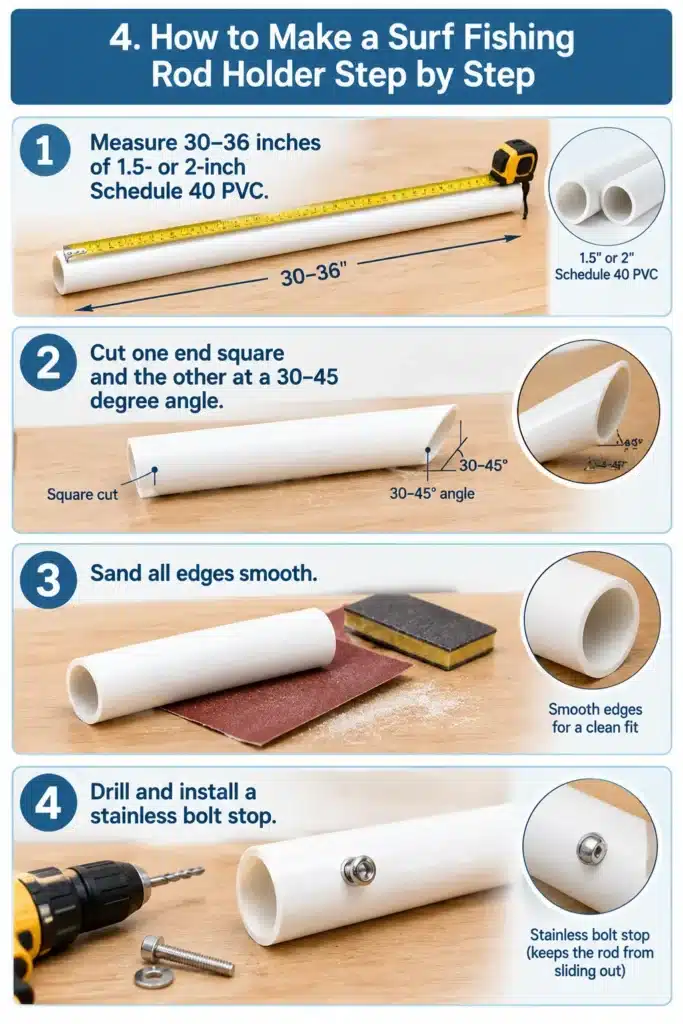
Measure and mark 30–36 inches from one end of the pipe. For soft sand, strong surf, or a long surf rod, start at 36 inches; you can trim it later if it feels too tall.reddit+1
Cut the marked end square with a PVC saw or miter saw. Then cut the opposite end at a 30–45 degree angle. That angled end becomes the spike that penetrates the sand.surfcastingrepublic+2
Photo suggestion: Show a tape measure against the pipe, followed by a close-up of the 45-degree cut.
Step 2: Shape the Bottom for Easy Sand Insertion
The angled cut already creates a point, but you can improve it by lightly sanding the lower edge into a cleaner taper. Avoid making it razor sharp; a slightly blunt edge pushes through sand without splitting the PVC.
If your beach has shell fragments or compacted sand, keep the spike longer rather than narrower. A narrow point can bend or crack under pressure.
Step 3: Smooth the Edges and Finish the Holder
Sand every cut edge until it feels smooth. Pay special attention to the top opening, because your rod slides in and out of it repeatedly.
Drill a hole through the pipe about 16–20 inches below the open top. Insert the stainless bolt through the hole, add a washer and lock nut, and tighten it. The bolt acts as a stop so the rod cannot slide all the way through.fishingzenith+2
Finally, rinse the holder with fresh water after each trip and let it dry before storing it.
How Long Should a Surf Fishing Rod Holder Be?
For most anglers, 30–36 inches is the practical length. This leaves enough pipe above the sand to hold the rod at a useful angle while keeping the holder portable.
Use a longer holder—up to 48 inches—when you fish soft sand, heavy surf, or want to keep your reel and line higher above shore break. A 5-foot spike can work, but it becomes awkward to carry and may put unnecessary leverage on the rod.wonews+1
A good rule: bury at least 12–18 inches, then judge whether the remaining height suits your rod and surf conditions.surfcastingrepublic+1
How to Secure Your Rod Holder in Soft or Loose Sand
Loose, dry sand is the main reason a DIY sand spike fails. Push the angled end straight down with steady pressure, then work it side to side slightly to compact the sand around it.
For very soft sand:
- Push the holder deeper, ideally 18 inches or more.
- Use a 2-inch pipe for a wider footprint.
- Add a PVC end cap to the bottom before inserting it; the cap increases surface area and reduces sinking.
- Set the holder just above the wet sand line, where the substrate is usually firmer.
- Carry a rubber mallet, but tap gently—hard strikes can crack PVC.
A metal garden-post base with a short PVC sleeve and hose clamps is another useful option for loose sand or gravel. lakemichiganangler
How to Position Your Fishing Rod for Better Bite Detection
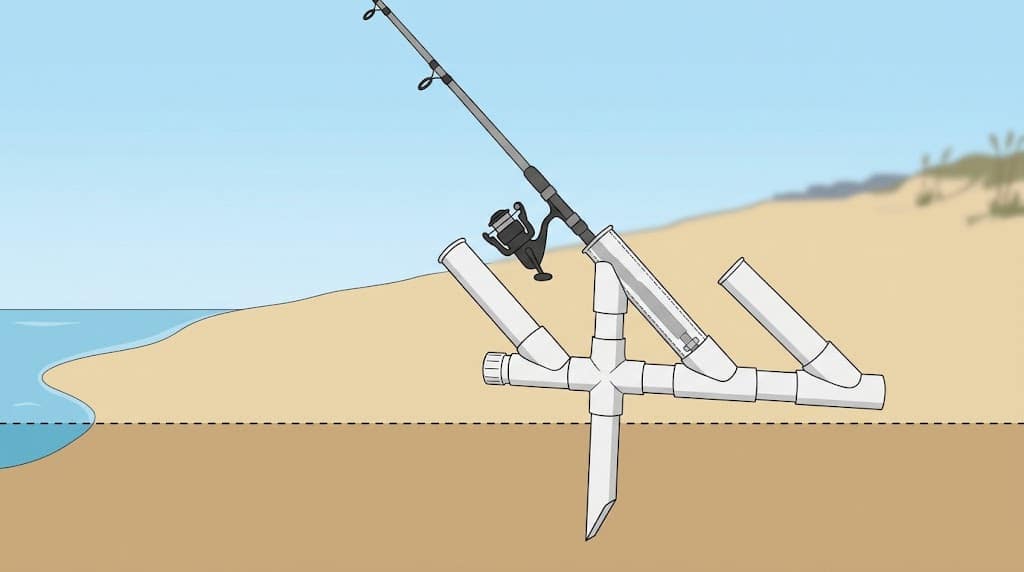
Place the rod in the holder at roughly a 45–55 degree angle, with the tip pointing toward the water. This keeps line tension more consistent and makes taps, pulls, and rod-tip movement easier to see.surfcastingrepublic
Avoid laying the rod almost flat. A low angle lets waves and sand reach the reel, and it reduces the visible action of the tip. Also avoid pointing the rod directly into a strong crosswind; a slight angle away from the wind reduces false movement.
Set the rod butt on the bolt stop, then check that the reel handle clears the sand and the line runs freely through the guides.
DIY Surf Fishing Rod Holder Variations for Multiple Rods
Once you make one PVC surf rod holder, it is easy to build versions for several rods.
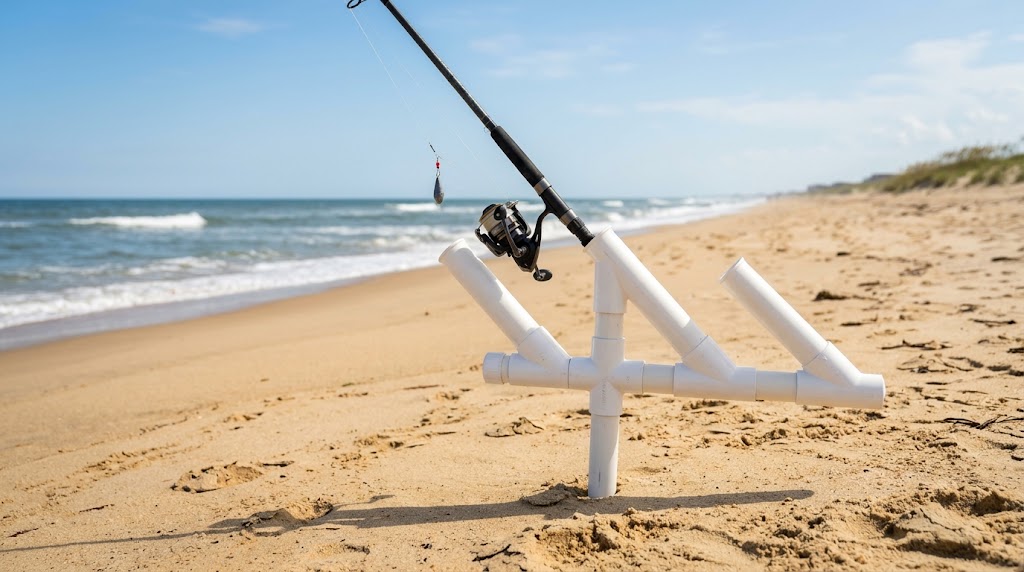
- Two-rod PVC rack: Join two vertical pipes to a horizontal PVC crossbar with tees and elbows. Drive the base into sand or weigh it with a sand-filled container.
- PVC pipe cluster: Cut three or four short holders and bind them with hose clamps around a central stake.
- Rod-holder bucket: Drill holes in a 5-gallon bucket lid, insert short PVC sleeves, and fill the bucket with sand for portable stability.
- Aluminum-and-PVC hybrid: Attach a 1.5- or 2-foot PVC sleeve to aluminum angle stock with stainless hose clamps. This works better where sand mixes with rocks.thebeachangler+2
- Bolt-stop upgrade: Add two bolts at different heights so you can adjust rod angle for different surf conditions.reddit+1
For a family beach trip, build two or three matching holders from one length of pipe and mark each with colored tape.
Common Mistakes to Avoid When Making a Surf Fishing Rod Holder
- Using pipe that is too narrow. Sand and salt can make a tight fit worse; test your rod before final assembly.
- Cutting the spike too blunt. A square bottom is hard to insert, especially in packed wet sand.
- Leaving rough edges. Burrs can scratch the rod finish or cut your hands.
- Making it too short. A holder that is buried too deeply leaves too little rod angle and exposes the reel to spray.
- Using non-stainless hardware. Salt water corrodes cheap bolts and nuts.
- Ignoring wind direction. Position the holder so waves, wind, and line direction work with you rather than against you.
- Forgetting drainage. Drill a small weep hole near the bottom if you use an end cap, so water can drain out.
Frequently Asked Questions About DIY Surf Fishing Rod Holders
What Size PVC Pipe Is Best for a Surf Fishing Rod Holder?
Homemade surf fishing rod holders DIY: For most surf rods, use 1.5-inch Schedule 40 PVC. Choose 2-inch PVC if your rod butt is thick or you fish loose sand and want extra stability.surfcastingrepublic+2
How Deep Should You Push a Rod Holder Into the Sand?
Push it into the ground with your foot in 12–18 inches minimum. In soft, dry sand, go deeper or use a wider 2-inch pipe so wind and rod pressure do not pull it over.surfcastingrepublic+1
Can You Make a Surf Fishing Rod Holder Without Special Tools?
Yes. A hacksaw, sandpaper, hand drill, marker, and tape measure are enough. If you do not have a drill, use a PVC end cap and shape the top so the rod rests securely without a bolt stop.
How to Make a Beach Rod Holder?
Cut a 30–36 inch piece of 1.5- or 2-inch PVC, angle one end, smooth all edges, and add a stainless bolt stop near the top. Push the angled end into the sand and set your rod at an aluminum angle iron toward the water.
How to Make a Sand Spike for Surf Fishing?
A sand spike is simply a sturdy tube with a pointed bottom. Cut PVC at a 30–45 degree angle, sand it smooth, drill a bolt stop, and drive it into firm wet sand.anglerwithin+1
How to Make a Surf Fishing Pole Holder?
Use the same PVC method. The key is matching the pipe diameter to the pole butt, smoothing the top edge, and positioning the pole high enough to keep the reel clear of spray.
How to Make a Surf Rod Holder?
Measure, cut, angle, sand, drill, and install a bolt stop. Start with a 36-inch length of Schedule 40 PVC for a reliable all-around homemade surf rod holder.
How to Make Beach Rod Holders?
Build several at once from a 10-foot PVC pipe. Cut it into 30–36 inch sections, angle one end of each, and add bolt stops. This is the cheapest best way to make surf rod holders, and equip a group or keep spare holders in your truck.
How to Make PVC Surf Rod Holders?
Use Schedule 40 PVC, cut a diagonal spike, deburr every edge, and add stainless hardware. PVC is best for sandy beaches; combine it with metal angle stock for rocky or mixed terrain.thebeachangler+1
How To Make A Surf Fishing Rod Holder?
Cut a 1.5- or 2-inch PVC pipe to 30–36 inches, bevel the bottom, smooth the edges, and fit a stainless bolt stop. Push it 12–18 inches into the sand and angle the rod toward the water.
How to Make a Swimsuit Holder Out of a Surfboard?
This is a different project. Mount PVC pipe clips, towel bars, or padded hooks to a surfboard wall rack or a freestanding surfboard-shaped frame, then hang swimsuits by their straps. Keep hardware smooth and covered so it does not snag fabric.
Conclusion
Learning how to make surf fishing rod holder equipment is one of the easiest DIY rod projects for beach anglers. With a short piece of Schedule 40 PVC, a saw, sandpaper, and one stainless bolt, you can build a dependable sand spike that holds your rod steady, improves bite detection, and keeps your reel above wet sand.
Start with a 36-inch, 1.5-inch PVC holder if you are unsure. Test it on your local beach, adjust the depth and angle for the conditions, and build a second one once you know what works. A homemade surf fishing rod holder costs very little, takes minutes to make, and gives you a practical upgrade that lasts season after season.
Related Articles:
- How to Get the Best Fishing Rod for Your Next Angling Trip?
- Best Ultralight Fishing Rod Buyer’s Guide (Top picks & reviews)
- How to replace fishing rod guide insert (Repair your pole Like A pro)