
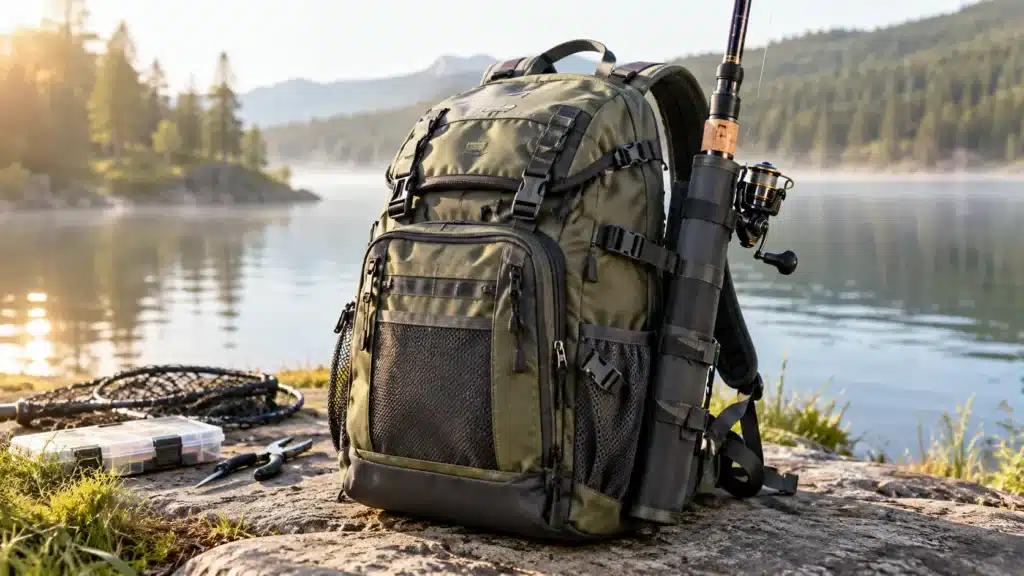
A good fly fishing backpack with rod holder lets you carry your rods, tackle, tools, and rain gear without using your hands. It is a good pick if you walk to your spot, fish from the bank, or hate setting your rod down in the dirt.
The right one should hold your rod firmly, fit the tackle trays you already own, and feel comfortable after a few miles. It should not be so large that you end up carrying gear you never use.nauticamalibutri+1
I like these packs for one simple reason: they free up your hands. You can climb down a muddy bank, push through brush, carry a net, or tie a new lure without balancing a rod against a tree.
Best Choice: KastKing KarryAll Fishing Backpack with Rod Holder
Carry your rods, tackle, and essentials hands-free with this 40/26L backpack—complete with 4 tackle boxes. [Check Price on Amazon]
Quick Jump
ToggleWhat Is a Fishing Backpack With Rod Holder?
It is a backpack made for fishing gear. The main part holds tackle boxes, line, tools, snacks, and clothing. On the outside, you get rod holders, straps, or tubes that keep one or more rods secure while you move.fitlyfast+1
Think of it as a tackle bag and a daypack in one. Some anglers use them for short pond trips. Others use them for long hikes to remote creeks, rivers, or lakes.fitlyfast+1
Why Use a Fishing Tackle Backpack with Rod Holder?
Backpack rod holder prepared for convenience and durability. A fishing tackle backpack with rod holder solves a basic problem: rods are awkward to carry. Hold one in your hand and you cannot easily use a net, open a gate, or climb over rocks.
A backpack spreads the load across both shoulders. That feels much better than a single-strap tackle bag when you are carrying trays, water, spare line, and a rain jacket.kastking+1
It also keeps your rod off the ground. Wet grass, sand, gravel, and mud are hard on cork handles, reel seats, and rod tips.
It makes sense if you:
- Walk more than a few minutes to fish.
- Carry several trays or lots of lures.
- Fish alone and need both hands free.
- Move from spot to spot during the day.
- Want your rod secure while you hike in.fitlyfast+1
Key Features to Look for in a Fishing Backpack
Do not buy based on pocket count alone. A pack can have 20 pockets and still fail if the rod holder lets your rod slide around.
– Rod holder security
Look for two points of contact. One should hold the rod butt. The other should secure the rod higher up, near the blank or reel seat.fitlyfast+1
A deep pocket with an adjustable strap is usually better than a shallow mesh sleeve. Shallow holders let the tip flop around, especially when you walk fast or duck under branches.
Check the fit with your actual rod. A holder that works for a light spinning rod may be too loose for a heavy baitcasting setup.
– Tackle storage
Make sure it fits the trays you use. Many packs are built around 3600 or 3700 boxes, but not all of them.nauticamalibutri+1
You also want a place for the small stuff. Pliers, hooks, spare line, phone, keys, and sunscreen all need a home. Otherwise, they end up buried at the bottom of the main compartment.nauticamalibutri+1
– Comfort and durability
Padded shoulder straps matter. So does a back panel that lets air move. If you plan to hike, look for a chest strap and waist strap too.kastking+1
A loaded fishing pack gets heavy fast. Water, tackle, rain gear, and a spare reel can add up before you notice.
– Weather protection
Most packs are water-resistant, not waterproof. That is fine for rain and spray. It is not enough if your bag might end up in the water.nauticamalibutri+1
A rain cover helps. So does a waterproof pouch for your phone, wallet, and fishing license.
– Tough materials
Look for strong nylon or Oxford fabric, solid zippers, and reinforced stitching. A firm base is useful too. It helps the pack stand upright on wet ground instead of falling over.nauticamalibutri+1
Best Fishing Bag with Rod Holder – Features Compared
Here is a quick look at three popular options. Each one suits a slightly different type of angler.
| Model | Best for | Rod carrying | Storage highlights | Weather protection |
|---|---|---|---|---|
| KastKing Bait Boss | Anglers who carry lots of lures and trays | Built-in rod holders | Holds four 3600 boxes; six clear PVC pockets for soft plastics; many zippered pockets | PVC-coated fabric and rain cover nauticamalibutri+1 |
| 43L Ghosthorn Fishing Backpack | Hikers and anglers who move around | Two external rod holders | 43L capacity; 15 pockets; adjustable divider; detachable waist bag | Water-resistant nylon and rain cover |
| Blisswill Fishing Bag | Bank anglers who bring bait or drinks | Holds two rods | 14 pockets; three main compartments; insulated pocket for bait, drinks, or short-term fish storage | 1000D nylon with PVC-coated back panel |
KastKing Bait Boss Fishing Tackle Backpack
This is the one I would pick if tackle organization is your main concern. It comes with four 3600 tackle boxes, and the front PVC pockets are handy for worms, craws, and other soft plastics.nauticamalibutri+1
The pack also has a rain cover, a non-slip base, and plenty of pockets for tools and small gear. Some reviewers note that the rod holders are not the strongest part of the design, so test the fit with your own rod before a long hike. nauticamalibutri
Best for: Bass anglers, lure collectors, and anyone who wants tackle boxes included.
43L Ghosthorn Fishing Backpack with Rod Holder
The Ghosthorn is a better match if you walk a lot. It has two rod holders, a large 43L main section, and a detachable waist bag for items you want close at hand.
The adjustable divider is useful. You can make room for tackle trays one day and clothing or food the next. MOLLE webbing also gives you a way to attach extra pouches or tools.
Best for: Hikers, mobile bank anglers, and anyone who wants one pack for fishing and general outdoor use.
Blisswill Fishing Bag – Large Water-Resistant Fishing Backpack
The Blisswill stands out because of its insulated section. You can use it for bait, drinks, or a few fish you plan to keep.
It has two rod holders, 14 pockets, and a tough 1000D nylon build. It does not include tackle boxes, so factor that into the total cost if you need trays.
Best for: Shore anglers who bring live bait, food, or drinks along with their tackle.
How to Choose the Right Backpack Size and Capacity
Bigger is not always better. A huge pack encourages you to bring everything, and then you pay for it on the walk in.
For a quick morning at a local pond, 20 to 30 liters is plenty. For a full day on a river or lake, 30 to 45 liters gives you more room without becoming a burden.
If you hike far, camp overnight, or carry extra clothing, look at 40 liters or more. Just make sure the pack has proper straps and back support.
| Trip type | Good capacity | What matters most |
|---|---|---|
| Quick pond or creek trip | 20–30L | Light weight and easy access |
| Full-day bank fishing | 30–45L | Tray storage, rain cover, tool pockets |
| Long hike to remote water | 40L+ | Chest strap, waist strap, padded back |
| Kayak or boat fishing | 30–45L | Water resistance and secure rod storage |
Types of Fishing Rod Holders and How They Work
There are a few common designs. Each has trade-offs.
– Strap-style holders
These use loops, bungees, or Velcro straps to hold the rod against the pack. They are light and simple. They can loosen, though, especially if you walk through thick brush.nauticamalibutri+1
– Tube-style holders
A tube holds the rod butt in place. This usually feels more secure than a basic strap. The downside is bulk, and some tubes are too narrow for large reel handles or thick cork grips.fitlyfast+1
– MOLLE and modular attachments
Some packs have webbing or attachment points for extra pouches and rod holders. This is useful if your setup changes from trip to trip.getfishing
– Separate rod tubes
For expensive rods or rough trails, a hard rod tube may be worth carrying. It adds bulk, but it protects the tip better than most backpack holders.fitlyfast+1
Best Fishing Backpack Features for Shore and Bank Fishing
Bank fishing is all about quick access. When a fish hits, you do not want to unzip three compartments to find your pliers.
Look for a pack that stands on its own. A non-slip base helps on wet grass, gravel, and boat decks.nauticamalibutri+1
Also look for:
- A tool holder for pliers or line cutters.
- A waterproof pocket for your phone and keys.
- Room for a rain jacket and water bottle.
- Two rod holders if you switch techniques.
- Reflective details if you fish early or late.nauticamalibutri+2
Waterproof Tackle Box vs. Water-Resistant Fishing Backpacks
This is where product listings can get confusing. Many packs labeled waterproof are really water-resistant. They shed rain and splash, but water can still get in through zippers or seams.nauticamalibutri+1
A truly waterproof pack uses sealed seams, roll-top closures, or drybag-style materials. That matters most for kayak fishing, wading, or heavy rain.
For most bank anglers, a water-resistant pack with a rain cover is enough. Keep electronics in a separate dry pouch anyway. It is cheap insurance.
Fishing Backpack vs. Traditional Tackle Bag: Which Is Better?
Neither is better all the time. It depends on how you fish.
A tackle bag is easy to open when you are sitting in a boat or on a pier. You can set it down, flip it open, and grab what you need.
A backpack is better when you are moving. It keeps your hands free and spreads the weight more evenly.
| Factor | Tackle Box Backpack with Rod Holder | Traditional fishing tackle bag |
|---|---|---|
| Walking and hiking | Better | Can get tiring |
| Hands-free use | Excellent | Limited |
| Rod carrying | Built-in options | Usually needs a separate carrier |
| Access while seated | Good | Often better |
| Best use | Shore, bank, hiking, mobile fishing | Boats, piers, fixed fishing spots |
If you mostly fish from one place, a tackle bag may be simpler. If you move around, get the backpack.
How to Pack and Organize Your Fishing Backpack
Pack for the day, not for every possible situation. Heavy items belong close to your back. Gear you use often belongs near the top or in an outside pocket.
Here is a simple setup that works well:
- Put tackle trays in the main compartment.
- Keep rain gear in the middle section.
- Store pliers, line cutters, and hooks in a quick-access pocket.
- Put your phone, keys, and license in a waterproof pouch.
- Use mesh pockets for wet lures or a damp towel.
- Secure the rod at both the bottom and top attachment points.
- Keep bait, drinks, or snacks in the insulated pocket if your pack has one.
Before you leave, do a quick check. Can you reach your pliers without taking the pack off? If not, move them.
Frequently Asked Questions About Fishing Backpacks With Rod Holders
Can a fishing backpack with rod holder carry two rods?
Many can. Some have two separate holders, while others use straps that secure one rod on each side. Check the holder depth and strap design before buying.fitlyfast
Are fishing backpacks waterproof?
Most are water-resistant. They handle rain and splash, but they are not made to sit underwater.
What size fishing backpack do I need?
For short fishing trips, start with 20 to 30 liters. For full-day trips, 30 to 45 liters is a safer range. Go larger only if you carry extra clothing, food, or several rod setups.
Do fishing backpacks include tackle boxes?
Some do. The KastKing Bait Boss and Ghosthorn models include four boxes. The Blisswill generally does not.
Is a backpack rod holder safe for expensive rods?
It can be, if it holds the rod at two points and fits well. For costly rods or rough trails, add a rod tip cover or use a hard tube.fitlyfast+1
Can I use a fishing backpack for hiking or camping?
Yes. Many anglers use the same pack for fishing, hiking, and day trips. Just make sure the straps and back panel are comfortable with a full load. kastking
Conclusion
A good backpack tackle box with rod holder makes a day on the water simpler. Your rods stay secure. Your tackle stays organized. Your hands stay free for the parts of fishing that actually matter.
Do not get caught up in pocket counts or big capacity numbers. Start with rod security, comfort, tray fit, and weather protection. Then choose a size that matches the fishing trips you really take.
The KastKing Bait Boss is a solid pick if you carry lots of tackle. The Ghosthorn 43L suits anglers who hike or move between spots. The Blisswill works well if you need space for bait, drinks, or extra gear.
Pick the fishing backpack with rod holder that fits your style, load it with only what you will use, and you will spend less time digging through gear—and more time with a line in the water.
You might also love: