

Finding the best tuna fishing reels means tracking down a heavy-duty powerhouse that stops blistering runs from fast offshore giants without failing under intense pressure. Tuna explode onto surface baits and dive deep with relentless force, testing every gear tooth and bearing inside your setup.
The best reel for tuna fishing combine a smooth, powerful drag, enough braid capacity for long runs, and corrosion-resistant construction that survives repeated offshore trips. For most anglers, a sealed 8000–20000-size spinning reel handles yellowfin, albacore, and mid-size bluefin; a 30- to 80-class conventional reel is the better choice for trolling, live bait, and giant bluefin.
This guide compares spinning and conventional reels for tuna fishing by species, technique, drag, gear ratio, and budget.
Quick Picks: Best Reels for Tuna Fishing
Check current prices of the best tuna reels that are perfect for big game fishing:
- Shimano TLD 2-Speed conventional reels for tuna fishing
- Penn Fathom Lever Drag Saltwater Casting Reel
- Shimano Talica tuna fishing reel
- Daiwa Saltiga Lever Drag Fishing reel
- Shimano Reel 19 Stella SW 14000PG Japan Domestic
- Daiwa Saltiga Spinning Reel for Deep-sea fishing
- Penn Slammer IV Saltwater Spinning Reel
- Shimano Saragosa SW A Off-shore Spinning Reel
- Daiwa BG MQ Tuna Spinning Fishing Reels
| Reel | Best for | Why it stands out |
|---|---|---|
| Shimano Stella SW 14000/20000 | Premium spinning for bluefin and yellowfin | Extremely smooth retrieve, build, excellent drag control. |
| Daiwa Saltiga 8000–20000 | Popping, jigging, and serious offshore spinning | ideal for saltwater punishment. |
| Penn Slammer IV 8500/10500 | Value-focused offshore spinning | Strong drag for tuna-style runs. |
| Shimano Saragosa SW A 10000–20000 | Best mid-price tuna spinning reel | Proven offshore reliability at a lower price |
| Daiwa BG MQ 8000–20000 | Best spinning reel for tuna for your Budget | Aluminum body, and strong drag |
| Shimano TLD 2-Speed 30/50 | Value conventional trolling reel | Large line capacity, and strong offshore value. |
| Penn Fathom II Lever Drag 30–80 | Live bait, trolling, and heavy jigging | Two-speed gearing, lighter conventional Reel. |
| Shimano Talica / Tiagra | Bluefin tuna fishing and big-game trolling | Premium lever-drag for hard fights. |
| Daiwa Saltiga 2-Speed Lever Drag 80 | Giant bluefin and heavy offshore trolling | Built for extreme drag, capacity, and pressure. |
- Shop Top-Rated Tuna Spinning Reels on Amazon
- Explore Heavy-Duty Offshore Conventional Reels on Amazon
What Are the Best Tuna Fishing Reels for Different Fishing Styles?
The best tuna reels depend less on brand loyalty and more on how you fish. A reel that excels at casting poppers may feel wrong for trolling spreads, while a trolling reel may be too heavy for all-day vertical jigging.
| Fishing style | Best reel type | Recommended size/class | Typical line |
|---|---|---|---|
| Casting poppers and stickbaits | Spinning | 8000–20000 | 50–80 lb braid |
| Vertical jigging | Spinning or conventional | 5000–10000 spinning; 20–30 conventional | 50–80 lb braid |
| Live bait | Conventional or spinning | 30–50 conventional; 10000–20000 spinning | 50–100 lb braid |
| Trolling | Conventional | 30–80 class | 50–130 lb braid or mono |
| Giant bluefin | Heavy conventional | 50–80 class | 100–130 lb braid |
For tuna spinning reels, prioritize a sealed body, a drag that stays smooth under heat, and a handle that remains comfortable after hours of casting. For conventional reels for tuna fishing, prioritize drag consistency, cranking power, line capacity, and a reliable two-speed system.
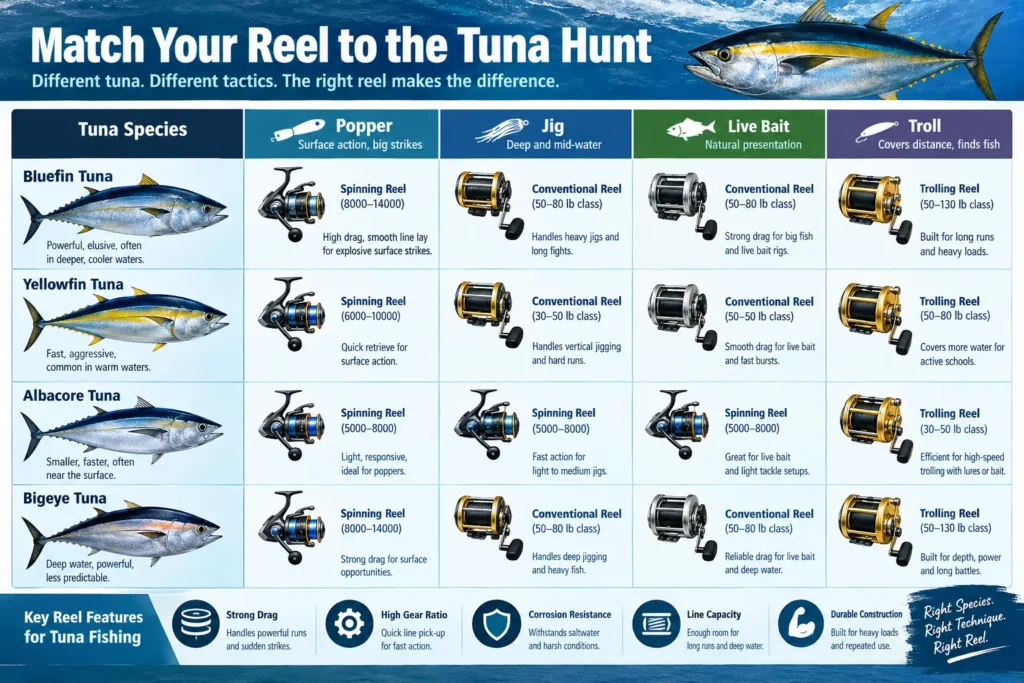
Spinning vs. Conventional Reels for Tuna Fishing
A spinning reel is easier to cast and better when tuna are feeding on the surface. You can cast a popper, stickbait, or lure accurately to breaking fish, then work it back with a controlled retrieve. Offshore spinning reels in the 10000–30000 range are designed for tuna, billfish, and other heavy pelagic species.
A conventional reel gives you more direct cranking power and better line control. That matters when a tuna pulls hard, dives deep, or when you troll multiple baits. Conventional tuna fishing reels also suit anglers who want a lever-drag system with repeatable settings.
Choose spinning when:
- You cast lures to surface-feeding tuna.
- You fish poppers, stickbaits, or jigs.
- You want faster learning curve and easier casting.
- You target yellowfin, albacore, or school-size bluefin.
Choose conventional when:
- You troll ballyhoo, diving plugs, or spreader bars.
- You fish live bait around structure or current.
- You target large bluefin or fish beyond 150 pounds.
- You want maximum cranking power and drag control.
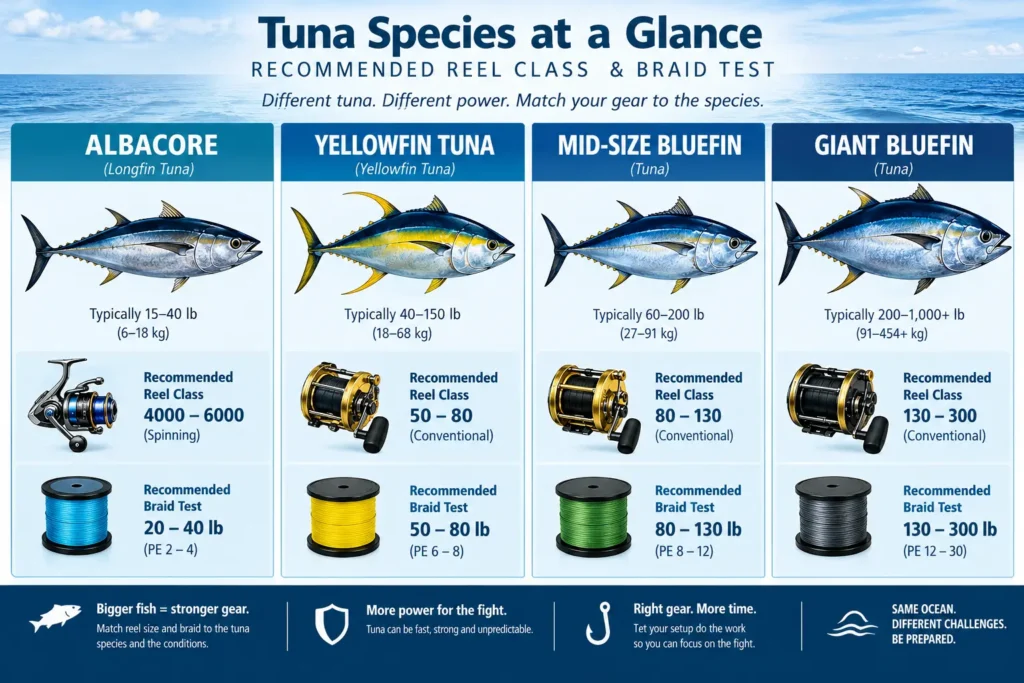
Best Reel Size for Bluefin, Yellowfin, and Albacore Tuna
Reel size should match the fish, bait, water depth, and technique—not just the brand name on the spool.
Albacore tuna
Albacore usually call for a lighter setup. A 5000–8000 spinning reel with 30–50 lb braid works well for casting and fast jig retrieves. A 6.0:1 or higher gear ratio helps you work a jig efficiently and keep pace with a fast-moving fish.
Yellowfin tuna
Yellowfin tuna fishing gear should be stronger without becoming exhausting to use. A 8000–14000 spinning reel or a 30-class conventional reel is a practical starting point. Aim for at least 300–500 yards of suitable braid and a drag that can hold a controlled fight without overheating.alibaba+1
Bluefin tuna fishing REELS
The best reel for bluefin tuna depends heavily on fish size. For bluefin from roughly 50–150 pounds, a 14000–20000 spinning reel or 30–50 conventional can work. For fish beyond 200 pounds, experienced offshore anglers generally move to a 50- or 80-class conventional reel with a two-speed gear train, high line capacity, and a serious drag system.fishing+1
How Much Drag Do You Need for Tuna Fishing?
You do not need to fish at maximum drag. A useful starting point is to set strike drag at roughly 20–30 percent of your line’s breaking strength, then adjust based on conditions, rod power, and how the fish fights.westmarine+1
| Target tuna | Practical strike drag | Suggested maximum drag |
|---|---|---|
| Albacore | 8–12 lb | 20–25 lb |
| Yellowfin | 12–18 lb | 25–40 lb |
| Mid-size bluefin | 18–25 lb | 35–50 lb |
| Giant bluefin | 25–35+ lb | 50–80+ lb |
A powerful drag rating is useful, but smoothness matters more. A drag that starts smoothly and stays consistent prevents sudden break-offs when a tuna makes its first run. Test the setting with a spring scale before the trip rather than guessing by feel.
Best Gear Ratio for Tuna Fishing Reels:
Gear ratio controls how quickly the spool picks up line. Higher ratios retrieve faster; lower ratios provide more cranking power per handle turn. The better comparison is often inches of line recovered per crank, because spool diameter also affects retrieve speed.
| Technique | Recommended ratio | Why |
|---|---|---|
| Popper and stickbait casting | 5.7:1–6.2:1 | Enough speed to work the lure and pick up slack |
| Vertical jigging | 6.0:1+ | Faster jig action and better hooksets |
| Live bait | 4.8:1–5.7:1 | More power during the fight |
| Trolling | 4.0:1–5.0:1 | Strong, steady retrieve under load |
For tuna jigging, a fast spin-style retrieve can help you keep contact with the lure, but do not sacrifice too much power. A reel that combines speed with a strong gearset is the ideal choice for repeated vertical work.
Line Capacity and Braided Line for Catching Tuna
Tuna make long runs, so line capacity is not optional. A reel that holds enough braid gives you room to fight the fish without spooling down to the knot.
As a practical baseline:
- Albacore: 250–350 yards of 30–50 lb braid
- Yellowfin: 400–600 yards of 50–80 lb braid
- Mid-size bluefin: 500–800 yards of 65–100 lb braid
- Giant bluefin: 800–1,000+ yards of 100–130 lb braidalibaba+1
Braid is popular because it is thinner than mono at the same test, so it takes up less spool space and cuts through water more efficiently. Use a suitable fluorocarbon or mono topshot when the situation calls for abrasion resistance or a more forgiving stretch.
Best Tuna Fishing Reels for Trolling, Jigging, and Live Bait
Best trolling reels
For trolling, choose a conventional lever-drag reel with a wide spool, strong frame, and enough capacity for long runs. The Shimano TLD 2-Speed remains a strong value option, while Shimano Talica, Tiagra, Penn International, and Daiwa Saltiga lever-drag reels sit in the premium offshore category.fishmasters+1
Best pick: Shimano TLD 2-Speed on Amazon
Best tuna jigging reel
For jigging, choose a lightweight reel that still has a sealed drag and durable gears. A 8000–10000 spinning reel works well for many anglers, while a compact conventional reel suits those who prefer direct line control. Look for a high-retrieve model that can work a jig without wearing out your wrist.
Best pick: Daiwa Saltiga Spinning Reel on Amazon
Best live-bait reels
Live bait fishing rewards smooth drag and controlled line release. A 30- or 50-class conventional reel is a classic choice, though a large spinning reel works well when fish are selective and you need precise casts.
Best pick: Penn Fathom Lever Drag on Amazon
Saltwater Reel Features That Matter for Offshore Tuna Fishing
Offshore fishing reels face salt spray, pressure, heat, and long fights. Focus on these features before you compare price alone:
- Sealed or corrosion-resistant body: Aluminum bodies, stainless hardware, and sealing systems help keep saltwater out.
- Smooth carbon-fiber drag: Consistent pressure matters more than a headline drag number.
- Strong handle and knobs: You need grip when hands are wet and the fish is pulling.
- Quality bail and line roller: These parts take abuse during casts and retrieves.
- Two-speed gearing: Helpful for trolling, live bait, and big bluefin.
- Serviceable design: A reel you can rinse, lubricate, and service will last longer.
Shimano, Penn, and Daiwa have strong reputations in this category because their offshore reels balance durability, drag quality, and parts support.fishing+1
How to Match a Tuna Fishing Reel With the Right Rod
A powerful reel cannot make up for the wrong rod. Match the rod’s line rating, lure weight range, and action to the reel and technique.
| Reel setup | Rod guide |
|---|---|
| 8000–10000 spinning | 7’–8’6″ rod, 50–80 lb braid, 2–6 oz lure rating |
| 14000–20000 spinning | 7’6″–8’6″ rod, 65–100 lb braid, 3–8 oz lure rating |
| 30-class conventional | 5’6″–6’6″ rod, 50–80 lb line |
| 50–80-class conventional | 5’6″–6’6″ rod, 80–130 lb line |
For popping, use a rod with enough backbone to drive hooks but enough tip to cast a heavy lure. For jigging, a shorter rod gives you better leverage and control. For trolling, prioritize a strong butt section and guides rated for the line class.
How to Maintain Your Tuna Fishing Reel for Long-Term Performance
Saltwater destroys neglected tackle. Rinse the reel with fresh water after every trip, but avoid high-pressure water because it can force salt into seals and stainless steel ball bearings.
- Loosen the drag after each trip.
- Rinse gently with fresh water.
- Wipe the body, handle, and spool dry.
- Check braid for cuts or abrasion.
- Service drag washers and bearings according to the manufacturer’s schedule.
- Store the reel in a dry place, not in a sealed wet tackle bag.
A well-maintained Penn, Shimano, or Daiwa reel can serve you for many seasons. Neglect is usually what turns a good offshore reel into an expensive problem.
How to Use Electric Reels for Tuna Trolling
Electric reels are not necessary for every tuna trip, but they help when you troll deep, retrieve heavy spreader bars, or fish long days with heavy tackle. They reduce fatigue and make it easier to reset baits quickly.
To use one effectively:
- Set the drag manually before deploying the bait.
- Use the electric motor for bait retrieval, not to winch a fish in without control.
- Keep the battery charged and protected from saltwater.
- Match the reel to a rod with enough backbone for the trolling spread.
- Practice switching between manual and electric retrieve before you need it in a fast bite.
Electric reels work best as a tool for efficiency. The angler still needs to manage the drag, rod angle, and boat position during the fight.
Big Game Fishing Reels AND tackle for Tuna Fish FAQs
What size spinning reel is best for tuna?
For most tuna fishing, choose an 8000–14000 spinning reel for yellowfin and albacore. For larger bluefin, step up to a 14000–20000 model with at least 500 yards of quality braid.outdoorbenchmark+1
Are spinning reels good for bluefin tuna?
Yes. Sealed offshore spinning reels can handle bluefin, especially when casting poppers, stickbaits, and jigs. For very large bluefin, many anglers still prefer a 50- or 80-class conventional reel.fishing+1
What is the best reel for yellowfin tuna?
A 10000-size sealed spinning reel or a 30-class conventional reel is a strong all-around choice. Prioritize smooth drag, 400–600 yards of braid, and a rod that matches the line class.alibaba+1
How much should I spend on a tuna reel?
A dependable mid-price spinning reel can start around a few hundred dollars, while premium offshore reels can cost much more. Spend more on drag quality, sealing, and line capacity if you fish offshore often.fishing
Can I use a jigging reel for tuna?
Yes. A tuna jigging reel should have a strong drag, smooth bearings, and a fast enough retrieve to work the jig. Spinning reels are popular for lighter jigging; conventional tuna reels offer more direct power for heavier applications.
What braid test should I use for tuna?
Use 50–80 lb braid for albacore and many yellowfin situations. For larger yellowfin and bluefin, 80–130 lb braid is more appropriate, depending on regulations, rod rating, and drag settings.alibaba+1
Conclusion
Choosing the best tuna fishing reels comes down to matching the reel to the fish, technique, and conditions you actually face. A sealed 8000–20000 spinning reel is an excellent choice for casting poppers, working jigs, and chasing yellowfin or school-size bluefin. A 30- to 80-class conventional reel remains the stronger option for trolling, live bait, and giant bluefin that demand maximum capacity and cranking power.
Focus on a smooth drag, enough braid for long runs, corrosion-resistant construction, and a rod that balances the reel properly. Shimano, Daiwa, and Penn offer dependable options at several price points, from value-focused offshore reels to premium big-game models. The right tuna reel should feel powerful without exhausting you, hold up to saltwater, and give you confidence when a fish makes its first long run. Choose for the technique you fish most, maintain it after every trip, and your setup will be ready when the next tuna shows up.
You will also Love:
- Tuna Fishing Season – Best Months, Locations & Techniques
- Bluefin vs Yellowfin Tuna – Size, Taste, Price & More!
- Top 5 Electric Fishing Reels For Disabled Anglers (Tested & Reviewed)
- How To Pick The Best Spinning Reel In 2026 (Buying Guide And Reviews)
- What Bait to Use for Yellowfin Tuna? (9 Proven Options)