
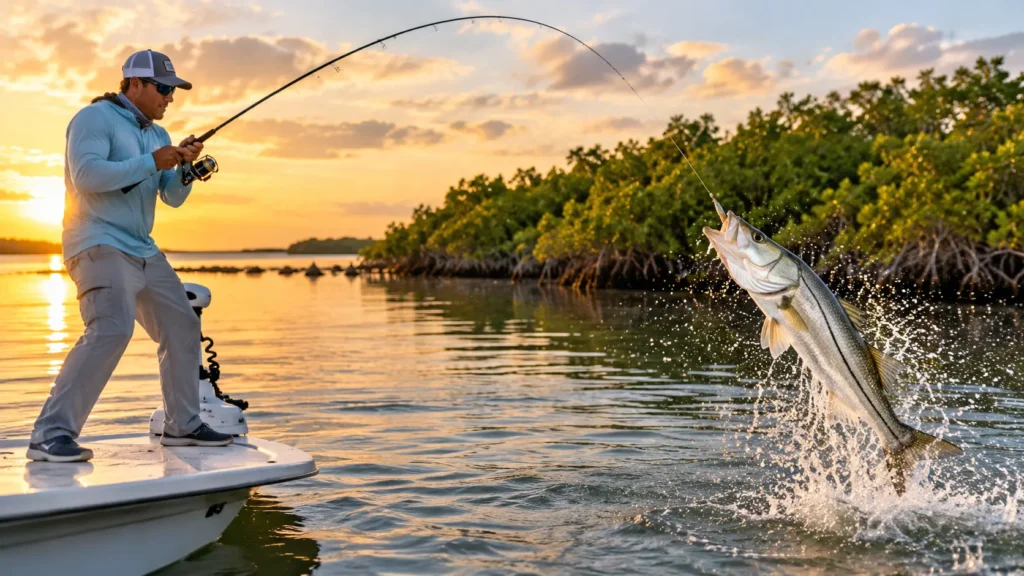
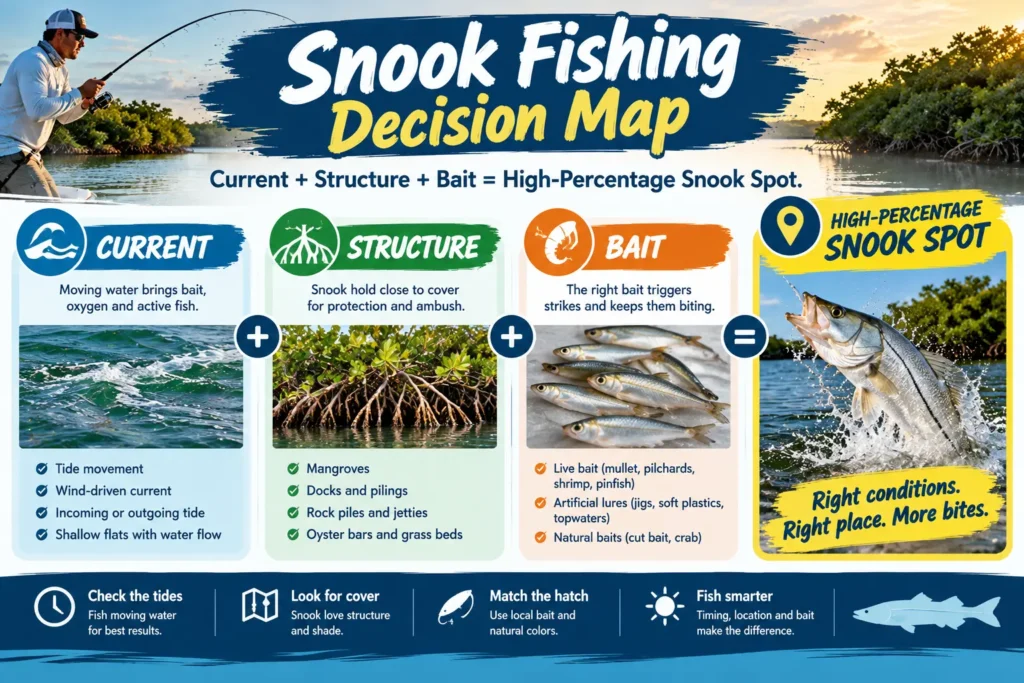
Snook fishing means targeting a powerful, structure-loving inshore predator around mangroves, docks, bridges, passes, and beaches. The best approach is to fish moving water near cover with live pilchards, mullet, pinfish, or shrimp—or with paddle tails, jigs, topwaters, and shrimp-imitation lures. Tides matter because current moves bait and puts snook in feeding positions.
Snook are most often found in warm coastal waters from Florida through the Gulf Coast, with Florida being the center of the fishery. They tolerate brackish and even freshwater, so check tidal creeks, river mouths, canals, and protected backwaters as well as obvious saltwater spots.
🌎 Ready to find your next fishing adventure? Discover top snook fishing charters near you and around the world with FishingBooker!
Important Note: Snook seasons, size limits, bag limits, and permit requirements vary by state and even by management region. In Florida, for example, east-coast and west-coast rules differ, so confirm the current rules with the Florida Fish and Wildlife Conservation Commission before keeping a fish.
What Is Snook Fishing? A Beginner’s Fishing Guide
Snook fishing is the practice of targeting snook, also called linesiders, from boats, kayaks, shorelines, piers, and wading spots. These fish are known for hard strikes, fast runs, jumps, and a strong instinct to dive back into cover.
A snook has a long body, a pronounced lateral line, a large mouth, and a lower jaw that extends slightly past the upper jaw. That mouth shape helps it feed upward, pick food off the bottom, and ambush baitfish moving through current. fishingbooker
For snook fishing for beginners, start with three priorities:
- Find moving water.
- Fish close to structure.
- Match your bait or lure to what snook are eating.
You do not need an expensive boat. Many anglers go for snook fishing around bridges, beaches, public docks, bridges, seawalls, and kayaks. The key is positioning yourself where bait gets pushed past cover.
Quick beginner setup: A 7-foot medium-heavy spinning rod, a 3000–4000 size reel, 20–30 pound braided line, and a 30–40 pound fluorocarbon leader will handle most everyday snook situations.
Where to Find Snook in Saltwater and Inshore Waters
Where to fish for snook? If you want to know where to catch snook, look for the combination of current, cover, and bait. Snook are ambush predators, so they rarely sit in open water without a reason.saltstrong
Best snook habitats
- Mangrove shorelines: Fish the roots, cuts, potholes, and shaded pockets.
- Docks: Target pilings, shadow lines, and areas where lights attract shrimp and baitfish.
- Bridges: Fish current seams, eddies, pilings, and the dark edge of bridge lights.
- Inlets and passes: Focus on current breaks, rock piles, jetties, and channels during strong tidal flow.
- Beaches: Walk the trough near shore, especially around sandbars, rip currents, and bait schools.
- Creeks and rivers: Fish bends, deep holes, mouth areas, and places where freshwater meets saltwater.
Snook can move between saltwater, brackish water, and freshwater environments, which makes tidal rivers and coastal canals worth checking.
How to read a new spot?
Ask four questions before casting:
- Is water moving?
- Is there cover or a current break?
- Can I see baitfish, shrimp, or surface disturbances?
- Is there a shadow line or depth change nearby?
If you find at least three of those features, fish it carefully. If the area has no bait and no current, move sooner rather than later.saltstrong
Best Time of Day and Season for Snook Fishing
The best time to catch snook is usually low light: dawn, dusk, night, cloudy conditions, and periods of moving tide. Snook feed during the day, but they become more aggressive when shadows, current, and bait line up.
Best time of day:
| Condition | Why it works | Best approach |
|---|---|---|
| Dawn | Bait moves, water is cooler, and snook feed before boat traffic | Topwater plugs, paddle tails, live bait |
| Dusk | Snook move shallow and hunt along structure | Walk-the-dog lures, jigs, live mullet |
| Night | Lighted docks and bridges concentrate bait | Shrimp imitations, jigs, live shrimp |
| Overcast or windy days | Reduced visibility makes snook less cautious | Faster retrieves and louder lures |
| Moving tide | Current delivers food and creates ambush zones | Cast upcurrent and work the seam |
Best seasons:
- Spring: Fish move out of winter holes and feed aggressively as water warms.
- Summer: Beaches, inlets, and passes can produce excellent action, especially early and late.
- Fall: Bait migrations, including mullet runs in some areas, create outstanding fishing.
- Winter: Slow down and look for deeper holes, warm-water outflows, protected canals, and sunny mud flats.
Snook are sensitive to cold. When water temperatures fall sharply, their metabolism slows and they often gather in deeper or warmer areas.
Do snook bite in the rain?
Yes. Snook can bite after rain, especially when rain creates current, stirs up bait, or reduces light. Light rain often improves fishing. Heavy rain can hurt the bite if it drops salinity, muddies the water, or pushes bait out of the area. Fish the edges of dirty and clean water, slow your presentation, and use lures with vibration or strong silhouette.
Best Bait for Snook Fishing: Live Bait vs. Artificial Lures
The best bait for snook fishing is usually the natural forage already in the water. If you see pilchards, use pilchards. If mullet are everywhere, throw mullet-colored baits. If shrimp are flushing from the grass, fish shrimp.
Live bait options
| Bait | Best situation | Simple rigging |
|---|---|---|
| Live shrimp | Docks, bridges, creeks, night fishing | Hook through the horn or tail |
| Pilchards / scaled sardines | Beaches, passes, open water | Nose-hook and free-line |
| Finger mullet | Mangroves, seawalls, beach troughs | Nose-hook for current; tail-hook to steer it |
| Pinfish | Docks, grass edges, structure | Hook behind the dorsal fin or through the nose |
| Croakers | Beaches and deeper current areas | Nose-hook and let it work near bottom |
Live croakers, pilchards, pinfish, mullet, and shrimp are all proven snook baits. Free-line them when possible so they swim naturally with the tide.fishyourassoff+3
Best size hook for snook shrimp
For a medium or large live shrimp, a 1/0 to 3/0 circle hook is a reliable choice. Use a smaller 1/0 hook for smaller shrimp and a 2/0 or 3/0 hook for jumbo shrimp. Match the hook to the bait—not to the size of the fish you hope to catch.
Live bait vs. lures
Live bait often produces more bites, especially around pressured docks and during tough conditions. Artificial lures win on convenience, cost, and the ability to cover water quickly. You do not need live bait to catch snook consistently.saltstrong
Best Snook Fishing Lures for Different Conditions
The best lures for snook fishing depend on depth, water clarity, current, and bait size. Carry a small selection that covers the surface, mid-column, and bottom.
Lures by situation
- Clear, calm water: White or natural paddle tails, small twitchbaits, and walk-the-dog topwaters.
- Murky water: Chartreuse, gold, root beer, or dark-colored lures with vibration.
- Mangroves and docks: Weedless soft plastics, paddle tails, Shad Tail and jerk baits you can skip into shade.
- Bridges and passes: Heavier jigs, bucktails, swimbaits, and subsurface plugs.
- Night fishing: Dark paddle tails, glow shrimp imitations, bucktail jigs, and topwaters around bait.
- Beach fishing: White paddle tails on 1/8- to 1/4-ounce jig heads, plus small spoons for distance.
A white paddle tail on a red or natural jig head is one of the most versatile snook lures. Work it slowly along the bottom, then speed up if fish follow without committing.fishyourassoff+3
Do snook hit spoon lures hard?
Yes. Snook can hit spoon lures hard, particularly when baitfish are small, water is slightly off-color, or fish are holding farther from shore. Silver spoons cast well, flash like wounded bait, and work well around sandbars, passes, and beach troughs. Use a steady to slightly erratic retrieve and add a fluorocarbon leader to reduce cutoffs.
How to Catch Snook Around Mangroves, Docks, and Bridges
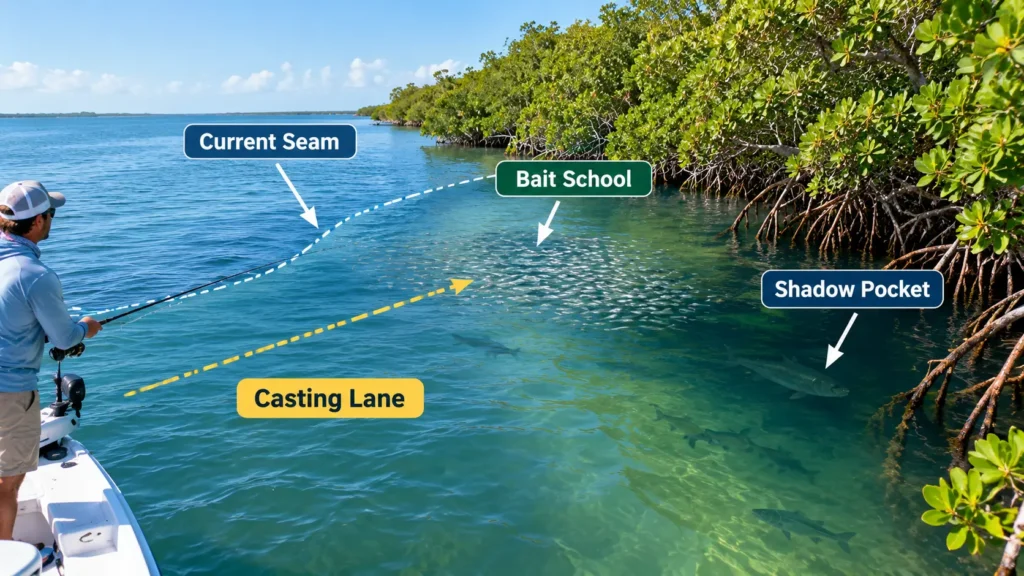
Learning how to catch snook around structure comes down to casting accuracy and retrieving your bait through the strike zone. Snook often face into current and wait for food to come to them. saltstrong
– Mangrove technique
- Position upcurrent or upwind of the shoreline.
- Make a quiet cast parallel to the mangroves.
- Let the bait fall beside the roots or into a shaded pocket.
- Use short twitches, then pause.
- Move on after several accurate casts if nothing happens.
Do not make long casts across open water. A precise cast two feet from the mangroves usually beats a long cast into empty water.
– Dock technique
Fish the shady side first. Cast beyond the dock or piling, then bring your lure back through the shadow line. At night, work the edge where light meets darkness; bait collects there and snook wait just outside the light.
– Bridge technique
Bridges create current seams, eddies, and ambush zones. Cast upcurrent, let your bait or jig sweep naturally through the strike zone, and keep contact with your line. Use heavier tackle near barnacle-covered pilings because a hooked snook will run straight for cover.
Best Rod, Reel, Line, and Leader for Snook Fishing
The right snook fishing techniques only work if your gear matches the structure. Light tackle is fun, but heavy cover demands stopping power.
Recommended setups:
| Fishing situation | Rod | Reel | Main line | Leader |
|---|---|---|---|---|
| Open flats and beaches | 7 ft medium-fast | 2500–3000 | 10–15 lb braid | 20–30 lb fluorocarbon |
| General inshore fishing | 7–7 ft 6 in medium-heavy | 3000–4000 | 15–20 lb braid | 30–40 lb fluorocarbon |
| Docks and mangroves | 7–7 ft 6 in medium-heavy | 3000–4000 | 20 lb braid | 40–50 lb fluorocarbon |
| Bridges, jetties, inlets | 7 ft 6 in heavy | 4000–5000 | 30 lb braid | 50–60 lb fluorocarbon |
Fluorocarbon leader is important because snook have rough gill plates and sharp edges that can fray weaker line. Around heavy structure, abrasion resistance matters more than a nearly invisible leader.
7 Snook Fishing Techniques for Beginners and Experienced Anglers
These seven techniques cover most snook situations. Use them as a checklist rather than treating every spot the same.
– Fish the current seam
Cast upcurrent and bring your bait through the line where fast and slow water meet. Snook hold there because food drifts directly to them.saltstrong
– Skip baits into shade
Around docks and mangroves, accuracy matters more than distance. Skip a soft plastic or small lure under overhanging cover and retrieve it slowly through the shadow.
– Work the shadow line at night
At lighted docks and bridges, cast into the dark side and retrieve through the edge of the light. That transition zone is a major feeding lane.
– Bounce a jig along bottom
Use a jig or bucktail when snook feed near the bottom, especially around bridges, passes, and deeper docks. Keep your rod tip low and maintain contact so you can detect subtle bites.
– Walk a topwater at dawn or dusk
A walk-the-dog plug can trigger explosive strikes when snook are keyed on mullet or other surface bait. Use it in calm water column and around visible surface activity.
– Match the bait size
During a mullet run or small-bait bite, downsizing often produces more strikes. A large lure can look out of place when snook are eating two-inch glass minnows.
– Move with purpose
Give a good-looking spot several accurate casts, then move. Covering productive water beats soaking one bait in an area with no current, bait, or visible activity.
Common Snook Fishing Mistakes and How to Avoid Them
Many anglers struggle with catching snook because they fish good-looking water without reading the conditions. Avoid these common errors:
- Fishing slack tide too long: Current moves bait. If the water stops moving, relocate or slow your presentation dramatically.
- Using leader that is too light: Snook can cut line on gill plates and structure. Match leader strength to cover.
- Making long, random casts: A short cast tight to cover is usually better.
- Retrieving too fast in cold water: Slow down after cold fronts and work deeper holes.
- Ignoring bait: If mullet, pilchards, shrimp, or glass minnows are present, match them.
- Landing Inshore Snook incorrectly: Never lift a big fish vertically by the jaw. Support it horizontally with one hand under the belly.
- Not checking rules: Seasons and slot limits change by area and time of year.myfwc+3
Snook Fishing Regulations, Size Limits, and Catch-and-Release Tips
Snook are tightly managed because they are sensitive to cold weather, habitat changes, and fishing pressure. Regulations differ by location, so always check the rules for the exact water you plan to fish.myfwc+3
Florida size and season examples
Florida’s rules vary by management region. As current examples:
- Northeast, Indian River Lagoon, and Southeast regions: Open season Feb. 1–May 31 and Sept. 1–Dec. 14; closed June 1–Aug. 31 and Dec. 15–Jan. 31; slot limit 28–32 inches total length; one fish per person per day.
- Panhandle, Big Bend, Tampa Bay, and Sarasota Bay regions: Open season March 1–April 30 and Sept. 1–Nov. 30; closed Dec. 1–end of February and May 1–Aug. 31; slot limit 28–33 inches total length; one fish per person per day.
- Charlotte Harbor and Southwest regions: Open season March 1–April 30 and Oct. 1–Nov. 30; closed Dec. 1–end of February and May 1–Sept. 30; slot limit 28–33 inches total length.
What size snook can you keep?
In Florida, the general answer is 28 inches or longer, but the upper limit depends on region: 32 inches in some east-coast regions and 33 inches in several west-coast regions. Measure total length correctly and verify the current rule before harvest.myfwc+3
Can seniors keep a legal-size snook without a license?
Rules vary by state, age, residency, and license type. In Florida, many anglers need both a recreational saltwater fishing license and a snook permit, though certain exemptions may apply. A senior exemption for a fishing license does not automatically mean every species permit requirement disappears. Check the official state wildlife agency before keeping a snook. wftv
How to handle a snook
- Decide before the fight whether you plan to keep the fish.
- Use circle hooks or crimped barbs when appropriate.
- Land the fish quickly to reduce exhaustion.
- Keep it in the water while removing the hook.
- Use wet hands or wet gloves.
- Support the fish horizontally; never hang a large snook vertically by the jaw.
- Revive it gently in clean, moving water and release it as soon as it can swim away.
Snook eating quality
Snook are widely regarded as excellent table fare, with firm, mild white meat. That said, many anglers release most snook because the fishery is highly regulated and catch-and-release fishing helps protect future opportunities.
Snook Fishing Guide – FAQs
Is it hard to catch a snook?
Snook can be challenging because they relate closely to structure, tide, bait, and light conditions. They become much easier to catch once you fish moving water near cover and match your bait to the local forage.saltstrong
How to get a snook fast?
If you want to know how to get a snook fast, fish a moving tide at first or last light. Start with a white paddle tail or a live pilchard, cast upcurrent beside the best structure you can find, and make repeated accurate casts through the same strike zone. If you get follows but no bites, slow down, downsize, or switch to a natural bait.
Does snook have sharp teeth?
Snook have teeth, but their gill plates and rough mouth edges are more likely to cut your line than their teeth. Use fluorocarbon leader and avoid putting fingers near the gills.
Do snook teeth hurt?
A snook bite can scrape or puncture skin, but most anglers are more concerned with sharp gill plates and hooks. Use a lip-gripping tool carefully or support the fish with wet hands.
Do snook bite after a rain?
They can. Light rain and fresh current often improve the bite. Heavy runoff can reduce salinity and muddy the water, so slow down and fish darker, high-vibration lures.
Do snook fish hit spoon lures hard?
Yes. Spoons can draw aggressive strikes, especially around beaches, sandbars, and passes. Retrieve them with a steady or slightly erratic action.
What hooks size to use for snooks?
Use hook size based on bait size. A good starting range is 1/0 to 3/0 for shrimp, pilchards, and small mullet. Use larger hooks for big mullet, ladyfish, or large live baits.
Where are there snook in South Carolina?
Snook are primarily a warm-water species, and South Carolina is generally at or beyond the northern edge of dependable common-snook habitat. Occasional tropical or subtropical fish may appear during warm periods, but South Carolina is not a reliable year-round snook fishery. Focus on Florida, Texas, and tropical locations for consistent action.
How to catch more snook from land?
Fish public beaches, bridges, seawalls, piers, and accessible mangrove shorelines. Arrive at dawn or dusk, fish moving tide, cast parallel to structure, and use a white paddle tail, live shrimp, or a small pilchard. Keep moving until you find bait and current.
What is the best way to handle a snook?
Support it horizontally, keep it wet, avoid touching the gills, remove the hook quickly, and release it headfirst into the water. Never hold a large snook vertically by the lower jaw.
Can a 12 lb drag handle a snook fish?
Yes, for many snook in open water. Around bridges, jetties, and heavy structure, prioritize a smooth drag, strong rod, abrasion-resistant leader, and enough line capacity to stop the first run.
Why do snook put their tails up?
When you see a snook’s tail or back breaking the surface, it is often “tailing” in shallow water while feeding with its head down. The fish may be rooting for shrimp, crabs, or small baitfish. Cast ahead of the direction it is moving, not directly on top of it.
Is snook chasing something under the water?
Often, yes. Surface wakes, nervous baitfish, and rolling bait can mean a snook is pushing bait from below. Cast beyond the disturbance and retrieve through it rather than placing your lure directly on the splash.
Is there a snook with no line?
Snook have a visible lateral line, which is a sensory line running along each side of the body. If you mean a snook with no visible lateral line, that is unusual; the lateral line is one of the species’ identifying features.
What size reel do you need to catch a snook?
For most snook fishermen, a 3000 to 4000 size spinning reel is ideal. Use a 2500–3000 reel for open water and lighter lures. Step up to a 4000–5000 reel when wading near docks, fishing bridges, or targeting bigger snook around strong current.
Can a 12-pound drag handle a snook fish?
Yes, a reel with 12 pounds of max drag can handle many snook, especially average-sized fish in open water. The bigger issue is not drag number alone—it is drag smoothness, line capacity, rod strength, and your ability to turn the fish before it reaches structure. For bridges, inlets, and big snook, use a stronger setup and do not rely on maximum drag for every fight.
When wading for snook by docks, what reel size is best?
A 3000 or 4000 size reel is a strong choice for wading near docks. It gives enough line capacity and power to turn a snook away from pilings while remaining comfortable to cast all day.
is there snook in Costa Rica?
Yes, Costa Rica has snook, especially along its Pacific and Caribbean coasts. Common snook and other snook species inhabit coastal lagoons, river mouths, mangrove-lined estuaries, and brackish rivers. Anglers can target them year-round, although seasonal patterns and local conditions affect fishing success.
Conclusion
Strong snook fishing tips come down to simple decisions made before you cast. Find moving water, locate cover, identify the bait, and put your offering where a snook can ambush it. A live pilchard, shrimp, mullet, or pinfish will catch fish, but a white paddle tail, bucktail jig, topwater plug, or spoon can be just as effective when you match it to the conditions.
Start with a 7-foot medium-heavy spinning rod, 3000–4000 reel, braided main line, and fluorocarbon leader. Fish dawn, dusk, night, cloudy weather, and moving tide. Around mangroves and docks, make short, accurate casts into shade. Around bridges and beaches, work current seams and bait schools. Handle every fish carefully, release undersized or out-of-season snook quickly, and check local regulations before keeping one. Do those things consistently, and your trout, redfish, andsnook fishing will improve trip after trip.
You might also like: